Emulsion Polymers Market

ID: MRFR/CnM/1638-HCR
135 Pages
Priya Nagrale
Last Updated: June 22, 2026
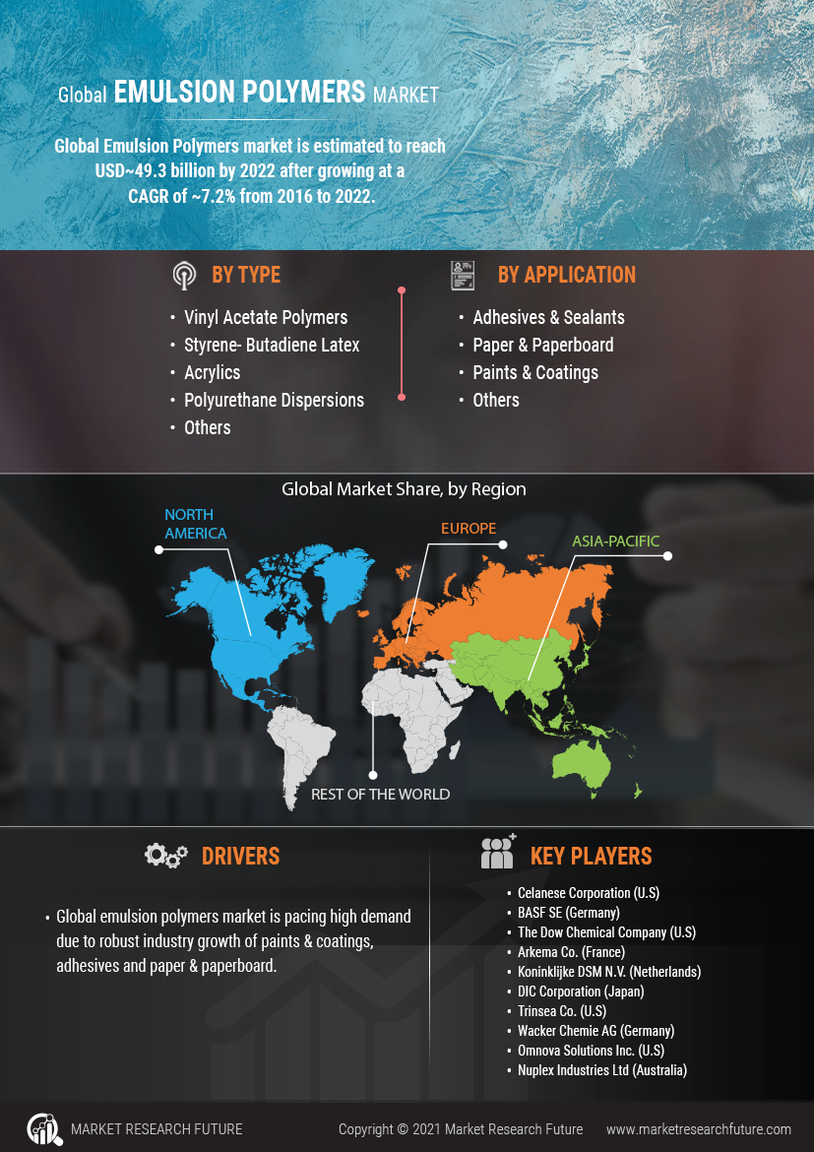
Emulsion Polymers Market Size, Share & Industry Analysis Research Report Information By Types (Vinyl acetate polymers, Styrene- butadiene latex, Acrylics, Polyurethane dispersions, Others), By Application (Adhesives & Sealants, Paper & Paperboard, Paints & Coatings, Others), and By Region (North America, Europe, Asia-Pacific, And Rest Of The World) – Market Forecast Till 2035
Download PDF ×

We do not share your information with anyone. However, we may send you emails based on your report interest from time to time. You may contact us at any time to opt-out.

  1. 1 Market Overview |
    1. 1.1 Study Assumptions & Market Definition |
    2. 1.2 Scope of the Study |
    3. 1.3 Research Methodology
  2. 2 Market Summary & Key Takeaways
  3. 3 Market Dynamics |
    1. 3.1 Market Drivers Analysis | |
      1. 3.1.1 Tightening VOC Regulations | |
      2. 3.1.2 Construction and Infrastructure Spending | |
      3. 3.1.3 EV and Automotive Lightweighting | |
      4. 3.1.4 Bio-Based Monomer Commercialization | |
      5. 3.1.5 E-Commerce Packaging Expansion | |
      6. 3.1.6 Digital Formulation Platforms | |
      7. 3.1.7 Surfactant-Free Polymerization Advances |
    2. 3.2 Market Restraints Analysis | |
      1. 3.2.1 Raw-Material Price Volatility | |
      2. 3.2.2 Performance Gaps in Extreme Environments | |
      3. 3.2.3 Slow Regulatory Harmonization | |
      4. 3.2.4 Higher Formulation Complexity | |
      5. 3.2.5 Energy-Intensive Drying Requirements |
    3. 3.3 Market Opportunity Analysis | |
      1. 3.3.1 Smart-City Infrastructure in Emerging Economies | |
      2. 3.3.2 Digital Formulation-as-a-Service | |
      3. 3.3.3 Bio-Based and Circular Polymer Chemistries | |
      4. 3.3.4 EV Battery-Enclosure Coatings | |
      5. 3.3.5 Sustainable-Packaging Mandates in MEA and South America |
    4. 3.4 Industry Value Chain Analysis |
    5. 3.5 Porter's Five Forces Analysis
  4. 4 Global Emulsion Polymers Market Size & Forecast (2021–2035) |
    1. 4.1 Historical Market Size (2021–2025) |
    2. 4.2 Current & Forecast Market Size (2026–2035) |
    3. 4.3 Market Size by Revenue (USD Billion) |
    4. 4.4 Year-over-Year Growth Analysis
  5. 5 Segmentation Analysis |
    1. 5.1 By Product Type | |
      1. 5.1.1 Acrylics | |
      2. 5.1.2 Styrene Butadiene (SB) Latex | |
      3. 5.1.3 Polyurethane Dispersions | |
      4. 5.1.4 Vinyl Acetate Polymers | |
      5. 5.1.5 Others |
    2. 5.2 By Application | |
      1. 5.2.1 Paints and Coatings | |
      2. 5.2.2 Adhesives and Carpet Backing | |
      3. 5.2.3 Paper and Paperboard Coatings | |
      4. 5.2.4 Others |
    3. 5.3 By End-User Industry | |
      1. 5.3.1 Building and Construction | |
      2. 5.3.2 Packaging | |
      3. 5.3.3 Automotive and Transportation | |
      4. 5.3.4 Textiles | |
      5. 5.3.5 Others |
    4. 5.4 By Solid Content | |
      1. 5.4.1 Low Solids | |
      2. 5.4.2 Medium Solids | |
      3. 5.4.3 High Solids
  6. 6 Regional Analysis |
    1. 6.1 North America | |
      1. 6.1.1 United States | |
      2. 6.1.2 Canada | |
      3. 6.1.3 Mexico |
    2. 6.2 Europe | |
      1. 6.2.1 Germany | |
      2. 6.2.2 United Kingdom | |
      3. 6.2.3 France | |
      4. 6.2.4 Italy | |
      5. 6.2.5 Spain | |
      6. 6.2.6 Nordic Countries | |
      7. 6.2.7 Russia | |
      8. 6.2.8 Rest of Europe |
    3. 6.3 Asia-Pacific | |
      1. 6.3.1 China | |
      2. 6.3.2 India | |
      3. 6.3.3 Japan | |
      4. 6.3.4 South Korea | |
      5. 6.3.5 ASEAN | |
      6. 6.3.6 Rest of Asia-Pacific |
    4. 6.4 South America | |
      1. 6.4.1 Brazil | |
      2. 6.4.2 Argentina | |
      3. 6.4.3 Rest of South America |
    5. 6.5 Middle East & Africa | |
      1. 6.5.1 Saudi Arabia | |
      2. 6.5.2 UAE | |
      3. 6.5.3 South Africa | |
      4. 6.5.4 Egypt | |
      5. 6.5.5 Rest of MEA
  7. 7 Competitive Landscape |
    1. 7.1 Market Share Analysis (2025) |
    2. 7.2 Competitive Benchmarking Matrix |
    3. 7.3 Company Profiles | |
      1. 7.3.1 BASF SE | |
      2. 7.3.2 Dow Inc. | |
      3. 7.3.3 Arkema SA | |
      4. 7.3.4 Celanese Corporation | |
      5. 7.3.5 Wacker Chemie AG | |
      6. 7.3.6 Synthomer plc | |
      7. 7.3.7 Trinseo S.A. | |
      8. 7.3.8 DIC Corporation | |
      9. 7.3.9 Nouryon | |
      10. 7.3.10 Dairen Chemical Corporation
  8. 8 Future Outlook & Strategic Recommendations (2026–2035) |
    1. 8.1 AI-Driven Formulation and Process Optimization |
    2. 8.2 Circular-Economy Integration |
    3. 8.3 Electrification and E-Mobility Coatings |
    4. 8.4 ESG Reporting and Scope-3 Transparency
  9. 9 Recent Developments & News
  10. 10 Frequently Asked Questions (FAQs)
  11. 11 Report Scope & Methodology |
    1. 11.1 Study Period & Base Year |
    2. 11.2 Data Sources & Citations |
    3. 11.3 Abbreviations
  12. 12 LIST OF TABLES |
  13. TABLE 1 Global Emulsion Polymers Market Size & Forecast, by Revenue (USD Billion), 2021–2035 |
  14. TABLE 2 Global Emulsion Polymers Market — Year-over-Year Growth Analysis, 2021–2035 |
  15. TABLE 3 Driver Impact Analysis — Emulsion Polymers Market, 2026–2035 |
  16. TABLE 4 Restraints Impact Analysis — Emulsion Polymers Market, 2026–2035 |
  17. TABLE 5 Global Emulsion Polymers Market Size, by Product Type, 2021–2035 (USD Billion) |
  18. TABLE 6 Global Emulsion Polymers Market Size, by Application, 2021–2035 (USD Billion) |
  19. TABLE 7 Global Emulsion Polymers Market Size, by End-User Industry, 2021–2035 (USD Billion) |
  20. TABLE 8 Global Emulsion Polymers Market Size, by Solid Content, 2021–2035 (USD Billion) |
  21. TABLE 9 Global Emulsion Polymers Market Size, by Region, 2021–2035 (USD Billion) |
  22. TABLE 10 North America Emulsion Polymers Market Size, by Country, 2021–2035 (USD Billion) |
  23. TABLE 11 Europe Emulsion Polymers Market Size, by Country, 2021–2035 (USD Billion) |
  24. TABLE 12 Asia-Pacific Emulsion Polymers Market Size, by Country, 2021–2035 (USD Billion) |
  25. TABLE 13 South America Emulsion Polymers Market Size, by Country, 2021–2035 (USD Billion) |
  26. TABLE 14 Middle East & Africa Emulsion Polymers Market Size, by Country, 2021–2035 (USD Billion) |
  27. TABLE 15 Competitive Benchmarking Matrix — Global Emulsion Polymers Market, 2025 |
  28. TABLE 16 Company Profiles — Key Players, Global Emulsion Polymers Market |
  29. TABLE 17 Recent Developments & Strategic Announcements, 2023–2025 |
  30. TABLE 18 North America Emulsion Polymers Market Size, by Product Type, 2021–2035 (USD Billion) |
  31. TABLE 19 North America Emulsion Polymers Market Size, by Application, 2021–2035 (USD Billion) |
  32. TABLE 20 North America Emulsion Polymers Market Size, by End-User Industry, 2021–2035 (USD Billion) |
  33. TABLE 21 North America Emulsion Polymers Market Size, by Solid Content, 2021–2035 (USD Billion) |
  34. TABLE 22 Europe Emulsion Polymers Market Size, by Product Type, 2021–2035 (USD Billion) |
  35. TABLE 23 Europe Emulsion Polymers Market Size, by Application, 2021–2035 (USD Billion) |
  36. TABLE 24 Europe Emulsion Polymers Market Size, by End-User Industry, 2021–2035 (USD Billion) |
  37. TABLE 25 Europe Emulsion Polymers Market Size, by Solid Content, 2021–2035 (USD Billion) |
  38. TABLE 26 Asia-Pacific Emulsion Polymers Market Size, by Product Type, 2021–2035 (USD Billion) |
  39. TABLE 27 Asia-Pacific Emulsion Polymers Market Size, by Application, 2021–2035 (USD Billion) |
  40. TABLE 28 Asia-Pacific Emulsion Polymers Market Size, by End-User Industry, 2021–2035 (USD Billion) |
  41. TABLE 29 Asia-Pacific Emulsion Polymers Market Size, by Solid Content, 2021–2035 (USD Billion) |
  42. TABLE 30 South America Emulsion Polymers Market Size, by Product Type, 2021–2035 (USD Billion) |
  43. TABLE 31 South America Emulsion Polymers Market Size, by Application, 2021–2035 (USD Billion) |
  44. TABLE 32 South America Emulsion Polymers Market Size, by End-User Industry, 2021–2035 (USD Billion) |
  45. TABLE 33 South America Emulsion Polymers Market Size, by Solid Content, 2021–2035 (USD Billion) |
  46. TABLE 34 Middle East & Africa Emulsion Polymers Market Size, by Product Type, 2021–2035 (USD Billion) |
  47. TABLE 35 Middle East & Africa Emulsion Polymers Market Size, by Application, 2021–2035 (USD Billion) |
  48. TABLE 36 Middle East & Africa Emulsion Polymers Market Size, by End-User Industry, 2021–2035 (USD Billion) |
  49. TABLE 37 Middle East & Africa Emulsion Polymers Market Size, by Solid Content, 2021–2035 (USD Billion) |
  50. TABLE 38 Report Scope & Methodology Summary |
  51. TABLE 39 Detailed Sources and Citations
  52. 13 LIST OF FIGURES |
  53. FIGURE 1 Emulsion Polymers Market Dynamics — Drivers, Restraints, and Opportunities |
  54. FIGURE 2 Industry Value Chain — Monomer Sourcing to End-Use Application |
  55. FIGURE 3 Porter's Five Forces Analysis — Emulsion Polymers Market |
  56. FIGURE 4 Global Emulsion Polymers Market Size Trend (USD Billion), 2021–2035 |
  57. FIGURE 5 Emulsion Polymers Market Share, by Product Type, 2025 (%) |
  58. FIGURE 6 Emulsion Polymers Market Share, by Application, 2025 (%) |
  59. FIGURE 7 Emulsion Polymers Market Share, by End-User Industry, 2025 (%) |
  60. FIGURE 8 Emulsion Polymers Market Share, by Solid Content, 2025 (%) |
  61. FIGURE 9 Emulsion Polymers Market Share, by Region, 2025 (%) |
  62. FIGURE 10 North America Emulsion Polymers Market — Country Share, 2025 (%) |
  63. FIGURE 11 Europe Emulsion Polymers Market — Country Share, 2025 (%) |
  64. FIGURE 12 Asia-Pacific Emulsion Polymers Market — Country Share, 2025 (%) |
  65. FIGURE 13 South America Emulsion Polymers Market — Country Share, 2025 (%) |
  66. FIGURE 14 Middle East & Africa Emulsion Polymers Market — Country Share, 2025 (%) |
  67. FIGURE 15 Competitive Landscape — Market Share Heat Map, 2025 |
  68. FIGURE 16 Competitive Positioning Matrix — Key Players, 2025

Segmentation Quick Reference

DimensionSub-SegmentsDominant SegmentFastest Growing Segment
Product TypeAcrylics, Styrene Butadiene (SB) Latex, Polyurethane Dispersions, Vinyl Acetate Polymers, OthersAcrylicsPolyurethane Dispersions
ApplicationPaints and Coatings, Adhesives and Carpet Backing, Paper and Paperboard Coatings, OthersPaints and CoatingsAdhesives and Carpet Backing
End-User IndustryBuilding and Construction, Packaging, Automotive and Transportation, Textiles, OthersBuilding and ConstructionAutomotive and Transportation
Solid ContentLow Solids, Medium Solids, High SolidsLow SolidsMedium Solids
GeographyAsia-Pacific, North America, Europe, South America, Middle East & AfricaAsia-PacificAsia-Pacific


Market Segmentation Overview

By Product Type

Sub-SegmentKey Trend
AcrylicsDominates architectural and industrial coatings; bio-acrylic pilots gaining traction
Styrene Butadiene (SB) LatexCore binder in paper coatings and carpet backing; stable, mature segment
Polyurethane DispersionsRapid uptake in automotive clear-coats and synthetic-leather finishes
Vinyl Acetate PolymersCost-effective solution for interior paints and wood-bonding adhesives
OthersIncludes epoxy dispersions and specialty hybrid chemistries for niche uses


Acrylic emulsion polymers command the largest product-type share due to their balance of performance, cost, and regulatory compliance across both decorative and industrial applications. Polyurethane dispersions are gaining share fastest, supported by automotive OEM specification shifts toward flexible, abrasion-resistant waterborne finishes.

By Application

Sub-SegmentKey Trend
Paints and CoatingsLargest application; driven by construction activity and repaint cycles
Adhesives and Carpet BackingFastest growing; propelled by VOC mandates on packaging and flooring adhesives
Paper and Paperboard CoatingsSteady demand from flexible-packaging barrier requirements
OthersIncludes textile coatings, nonwoven binders, and construction sealants


Paints and coatings absorb the majority of water based polymers produced globally, with demand closely tracking residential and commercial construction output. Adhesive applications are accelerating as brand owners and converters adopt low-VOC synthetic emulsion resins to meet tightening packaging regulations.

By End-User Industry

Sub-SegmentKey Trend
Building and ConstructionDominant end-user; high emulsion intensity per square meter of built area
PackagingGrowing share driven by e-commerce and sustainable-packaging laws
Automotive and TransportationFastest growing; EV production creating new coating-specification requirements
TextilesNiche but expanding use in performance and technical-fabric finishes
OthersElectronics conformal coatings, medical-device adhesives


Building and construction remains the backbone of the Emulsion Polymers Market, consuming paint binder materials and tile-adhesive resins across every phase of a structure's lifecycle. Automotive and transportation is emerging as the highest-growth vertical, as electric-vehicle platforms demand specialized industrial polymer emulsions for battery-pack enclosures and lightweight composites.

By Solid Content

Sub-SegmentKey Trend
Low SolidsLargest share; standard grade for decorative paints and general adhesives
Medium SolidsFastest growing; preferred for high-build industrial and protective coatings
High SolidsPremium segment for thick-film flooring and heavy-duty protective systems


Low-solids polymer dispersion chemicals lead volume by serving the high-turnover decorative-paint segment, where ease of application and quick drying are paramount. Medium-solids grades are gaining ground as manufacturers seek fewer coating passes and reduced drying-energy expenditure in factory-line operations.