Energy Storage Battery Pack MRO Services Market

Energy Storage Battery Pack MRO Services Market Research Report Information By End Use (Residential, Commercial, Industrial, Utility, Transportation), By Technology (Advanced Energy Storage, Smart Grid Technology, Battery Management Systems, Energy Management Systems, Renewable Energy Technologies), By Application (Grid Energy Storage, Renewable Energy Integration, Uninterruptible Power Supply, Electric Vehicle Charging, Telecommunications Backup), By Battery Type (Lithium-Ion, Lead-Acid, Nickel-Metal Hydride, Flow Battery, Sodium-Sulfur), By Service Type (Maintenance, Repair, Overhaul, Testing, Consultation) And By Region (North America, Europe, Asia-Pacific, And Rest Of The World) – Market Forecast Till 2035.

Forecast Period
2025 - 2035
CAGR
4.18%
2024 Market Size
$ 6.5 Billion
2035 Market Size
$ 10.2 Billion
MRO ● Updated May 12, 2026 Report ID: MRFR/MRO/64841-HCR | Pages: 200 | Author: Shubham Munde, Garvit Vyas

Energy Storage Battery Pack MRO Services Market Summary

As per MRFR analysis, the Energy Storage Battery Pack MRO Services Market was estimated at 6.5 USD Billion in 2024. The Energy Storage Battery Pack MRO Services industry is projected to grow from 6.77 USD Billion in 2025 to 10.2 USD Billion by 2035, exhibiting a compound annual growth rate (CAGR) of 4.18% during the forecast period 2025 - 2035.

Key Market Trends & Highlights

The Energy Storage Battery Pack MRO Services Market is poised for substantial growth driven by technological advancements and sustainability initiatives.

  • Technological advancements in battery systems are enhancing performance and reliability across various applications.
  • North America remains the largest market, while Asia-Pacific is emerging as the fastest-growing region in energy storage solutions.
  • The grid energy storage segment holds the largest share, whereas the renewable energy integration segment is witnessing rapid growth.
  • Growing demand for renewable energy solutions and regulatory support are key drivers propelling market expansion.

Market Size & Forecast

2024 Market Size 6.5 (USD Billion)
2035 Market Size 10.2 (USD Billion)
CAGR (2025 - 2035) 4.18%

Major Players

Tesla (US), LG Energy Solution (KR), Samsung SDI (KR), Panasonic (JP), CATL (CN), BYD (CN), A123 Systems (US), Saft (FR), EnerSys (US)

Our Impact

Enabled $4.3B Revenue Impact for Fortune 500 and Leading Multinationals

Partnering with 2000+ Global Organizations Each Year

30K+ Citations by Top-Tier Firms in the Industry

Energy Storage Battery Pack MRO Services Market Drivers

Regulatory Support and Incentives

Regulatory frameworks and government incentives play a pivotal role in shaping the Energy Storage Battery Pack MRO Services Market. Various governments are implementing policies that promote the adoption of energy storage technologies, often accompanied by financial incentives. For instance, tax credits and grants for energy storage installations have been introduced in several regions, encouraging businesses and consumers to invest in battery systems. This regulatory support not only stimulates market growth but also enhances the demand for MRO services, as more energy storage systems are deployed. In 2025, it is anticipated that the number of energy storage installations will increase significantly, leading to a corresponding rise in the need for maintenance and repair services. Therefore, the favorable regulatory environment is likely to be a key driver for the MRO services market.

Advancements in Battery Technology

Technological advancements in battery technology are significantly influencing the Energy Storage Battery Pack MRO Services Market. Innovations such as solid-state batteries and enhanced lithium-ion technologies are improving energy density, lifespan, and safety. These advancements not only enhance the performance of energy storage systems but also create new opportunities for MRO services. As battery technologies evolve, the complexity of maintenance and repair processes may increase, necessitating specialized MRO services. In 2025, the market for advanced battery technologies is expected to grow, with projections indicating a compound annual growth rate of over 15%. This growth will likely drive demand for MRO services, as operators seek to maintain the efficiency and reliability of their energy storage systems.

Rising Awareness of Energy Efficiency

Rising awareness of energy efficiency among consumers and businesses is driving the Energy Storage Battery Pack MRO Services Market. As energy costs continue to rise, stakeholders are increasingly seeking solutions that enhance energy efficiency and reduce operational expenses. Energy storage systems are recognized as vital components in achieving these goals, leading to a heightened demand for MRO services. In 2025, it is estimated that energy storage systems will account for a significant portion of energy management strategies across various sectors. This trend suggests that organizations will prioritize the maintenance and optimization of their energy storage systems, thereby increasing the demand for specialized MRO services. Consequently, the focus on energy efficiency is likely to be a key factor in the growth of the MRO services market.

Increased Electrification of Transportation

The electrification of transportation is emerging as a significant driver for the Energy Storage Battery Pack MRO Services Market. As electric vehicles (EVs) gain traction, the demand for efficient energy storage solutions is surging. In 2025, the number of electric vehicles on the road is projected to exceed 30 million, creating a substantial market for energy storage systems. This trend necessitates robust MRO services to ensure the reliability and performance of battery packs used in EVs. Furthermore, as the infrastructure for charging stations expands, the need for maintenance and repair services for energy storage systems at these stations will also increase. Thus, the electrification of transportation is likely to propel the growth of the MRO services market.

Growing Demand for Renewable Energy Solutions

The increasing demand for renewable energy solutions is a primary driver for the Energy Storage Battery Pack MRO Services Market. As nations strive to meet their energy needs sustainably, the integration of energy storage systems becomes crucial. In 2025, The Energy Storage Battery Pack MRO Services is projected to reach a valuation of approximately 200 billion USD, indicating a robust growth trajectory. This surge is largely attributed to the rising adoption of solar and wind energy, which necessitates efficient energy storage solutions. Consequently, the need for maintenance, repair, and operations (MRO) services for battery packs is expected to escalate, as these systems require regular upkeep to ensure optimal performance and longevity. Thus, the energy storage battery pack MRO services market is likely to benefit significantly from this trend.

Market Segment Insights

By Application: Grid Energy Storage (Largest) vs. Renewable Energy Integration (Fastest-Growing)

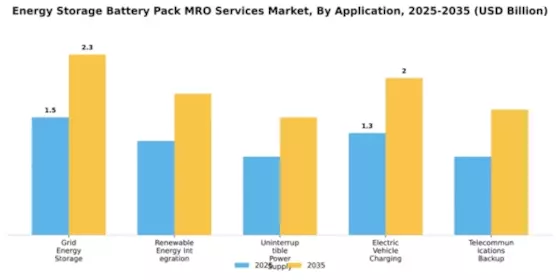
The application segment of the Energy Storage Battery Pack MRO Services Market showcases varied demand across its core areas, with grid energy storage leading in market share. This segment is supported by a hefty investment in infrastructure, enabling utilities to manage energy fluctuations effectively. Meanwhile, renewable energy integration garners increasing attention as nations strive towards sustainable energy sources, leading to competitive growth centered around this segment.
Energy Storage Battery Pack MRO Services Market Segment Image 0

Uninterruptible Power Supply (Dominant) vs. Electric Vehicle Charging (Emerging)

Uninterruptible Power Supply (UPS) systems dominate the Energy Storage Battery Pack MRO Services Market due to their crucial role in ensuring continuous power supply for businesses and sensitive equipment. UPS systems are extensively utilized across sectors, including data centers and telecommunications, guaranteeing reliability and safety. In contrast, Electric Vehicle Charging, while still emerging, reflects significant growth potential as electric vehicle adoption increases worldwide. Driven by environmental concerns and government incentives, this segment is rapidly evolving, with investments aimed at expanding charging infrastructure and enhancing battery technologies.
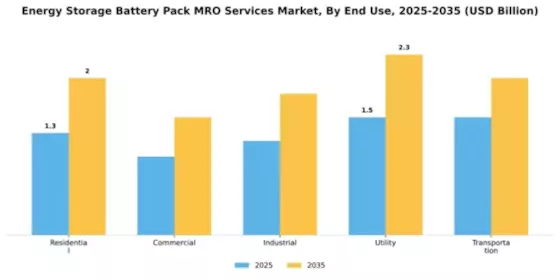
By End Use: Residential (Largest) vs. Utility (Fastest-Growing)

Energy Storage Battery Pack MRO Services Market Segment Image 1

The Energy Storage Battery Pack MRO Services Market is primarily segmented into residential, commercial, industrial, utility, and transportation end uses. Among these, the residential segment dominates the market, largely due to increased adoption of renewable energy sources and self-consumption strategies. Consumers are increasingly investing in home battery systems, driven by the demand for energy independence and cost savings. On the other hand, the utility segment is experiencing rapid growth, fueled by substantial investments in grid-scale battery systems, which enhance energy reliability and facilitate the integration of renewable energy. In terms of growth trends, the residential segment is projected to continue its stronghold, benefiting from government incentives and falling battery prices. Innovations in battery technology and the rise of smart home solutions are contributing to market expansion as consumers seek efficient energy management systems. Conversely, the utility segment is gaining momentum due to governmental regulations mandating renewable energy use and modernizing grid infrastructures. This trend towards larger battery systems for load management and energy storage challenges positions the utility segment as the fastest-growing area in the MRO services market.

Residential (Dominant) vs. Utility (Emerging)

The residential segment in the Energy Storage Battery Pack MRO Services Market is characterized by a significant number of installations, primarily driven by homeowners' desire for energy independence and sustainability. This segment thrives on the back of technological advancements in home energy storage solutions, allowing for effective integration with solar power systems. Homeowners are increasingly favoring battery systems capable of peak-shaving and load-shifting, which optimize electricity use and reduce costs. Conversely, the utility segment, while emerging, is rapidly evolving due to massive investments in grid-scale energy storage projects. With utilities focusing on enhancing grid resilience, integrating renewable sources, and meeting regulatory requirements, utility-scale batteries are being deployed for various applications, including load balancing and frequency regulation. Thus, the utility segment is positioned to grow substantially as the energy landscape shifts towards sustainability and efficiency.

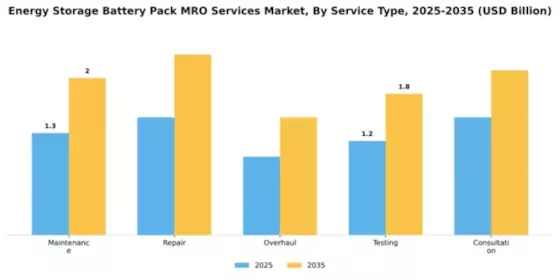
By Service Type: Maintenance (Largest) vs. Repair (Fastest-Growing)

In the Energy Storage Battery Pack MRO Services Market, Maintenance emerges as the largest segment due to its critical role in ensuring the longevity and efficiency of battery packs. This segment is essential for regular upkeep and performance optimization, contributing significantly to overall market dynamics. Following closely is the Repair segment, which is experiencing rapid growth, driven by an increasing need for cost-effective solutions to extend battery life and performance. As battery technology advances, the demand for specialized repair services is also elevating the segment's contribution to the overall market.
Energy Storage Battery Pack MRO Services Market Segment Image 2

Maintenance (Dominant) vs. Repair (Emerging)

The Maintenance service in the Energy Storage Battery Pack MRO Services Market is characterized by routine inspections and servicing that mitigate performance degradation. This segment not only enhances battery lifespan but also elevates operational efficiency, making it a staple service for energy storage systems. Conversely, the Repair segment is rapidly emerging, propelled by technological advancements in battery design and a growing trend towards sustainability. With batteries becoming more complex, repair services are evolving to address specific issues like cell balancing and fault detection, positioning them as a viable alternative to outright replacement, thus appealing to budget-conscious consumers looking for sustainable options.
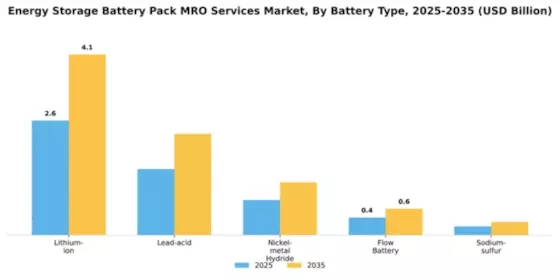
By Battery Type: Lithium-ion (Largest) vs. Flow Battery (Fastest-Growing)

Energy Storage Battery Pack MRO Services Market Segment Image 3

In the Energy Storage Battery Pack MRO Services Market, the primary battery types exhibit distinct market shares. Lithium-ion batteries dominate the segment due to their widespread applications in electric vehicles and renewable energy solutions. They hold a significant share as manufacturers and consumers gravitate toward their high efficiency, longevity, and decreasing costs. In contrast, although Flow Batteries currently hold a smaller market position, they are gaining traction, particularly in large-scale energy storage applications, as their benefits in cycle life and scalability are recognized.

Lithium-ion (Dominant) vs. Flow Battery (Emerging)

Lithium-ion batteries are characterized by their high energy density, rechargeable capabilities, and extensive use in consumer electronics and electric vehicles. They dominate the energy storage landscape, driven by advancements in battery technology and decreasing manufacturing costs. In contrast, Flow Batteries, while emerging, offer unique advantages such as long cycle life and the ability to store energy for extended periods, making them attractive for grid-scale applications. The distinct operational mechanism of flow batteries allows for easy scalability and maintenance, positioning them as a key alternative for future renewable energy integration.

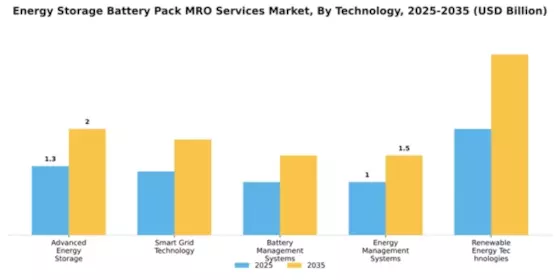
By Technology: Advanced Energy Storage (Largest) vs. Smart Grid Technology (Fastest-Growing)

The Energy Storage Battery Pack MRO Services Market features a diverse range of technologies, with Advanced Energy Storage leading in market share due to its critical role in stabilizing energy supply and demand. Smart Grid Technology has emerged as a significant force, capitalizing on the need for enhanced grid management and efficiency in energy distribution. Battery Management Systems, Energy Management Systems, and Renewable Energy Technologies also contribute to the segment, though they hold comparatively smaller shares.
Energy Storage Battery Pack MRO Services Market Segment Image 4

Technology: Advanced Energy Storage (Dominant) vs. Smart Grid Technology (Emerging)

Advanced Energy Storage technology remains the dominant force within the Energy Storage Battery Pack MRO Services Market, primarily due to its proven capability in managing variable energy supplies and its integration into renewable energy systems. This technology encompasses a variety of storage solutions, including lithium-ion and flow batteries, enabling long-duration storage and grid resilience. In contrast, Smart Grid Technology is fast emerging, focusing on automated control and communication systems that enhance energy efficiency and reliability. The adaptability of Smart Grid technology to consumer needs and its potential for supporting a decentralized energy generation framework position it as a key driver of innovation in this sector, making it essential for future advancements in energy management.

Get more detailed insights about Energy Storage Battery Pack MRO Services Market Request Free Sample

Regional Insights

North America : Market Leader in MRO Services

North America is poised to maintain its leadership in the Energy Storage Battery Pack MRO Services Market, holding a market size of $3.25B in 2025. Key growth drivers include increasing investments in renewable energy, stringent regulations promoting energy efficiency, and a growing demand for electric vehicles (EVs). The region's robust infrastructure and technological advancements further catalyze market expansion, making it a hub for innovation and service delivery. The competitive landscape is characterized by major players such as Tesla, A123 Systems, and EnerSys, which are driving advancements in battery technology and service offerings. The U.S. leads the market, supported by favorable government policies and incentives for clean energy. As the demand for energy storage solutions rises, North America is expected to continue attracting investments, solidifying its position as a market leader.

Europe : Emerging Market with Regulations

Europe is rapidly evolving in the Energy Storage Battery Pack MRO Services Market, with a market size of $1.8B projected for 2025. The region benefits from strong regulatory frameworks aimed at reducing carbon emissions and promoting sustainable energy solutions. Initiatives such as the European Green Deal and various national policies are driving demand for energy storage systems, enhancing market growth and innovation in MRO services. Leading countries like Germany, France, and the UK are at the forefront of this transformation, with significant investments in battery technology and infrastructure. Key players such as LG Energy Solution and Saft are expanding their operations to meet the growing demand. The competitive landscape is intensifying as companies innovate to provide efficient and sustainable solutions, positioning Europe as a key player in the global market.

Asia-Pacific : Rapid Growth and Adoption

Asia-Pacific is witnessing rapid growth in the Energy Storage Battery Pack MRO Services Market, with a projected market size of $1.7B by 2025. The region's growth is driven by increasing energy demands, government initiatives promoting renewable energy, and a surge in electric vehicle adoption. Countries like China and Japan are leading the charge, supported by favorable policies and investments in energy storage technologies. China, in particular, is a dominant player, with companies like CATL and BYD leading the market. The competitive landscape is characterized by a mix of established players and emerging startups, all vying for market share. As the region continues to innovate and expand its energy storage capabilities, Asia-Pacific is set to become a significant contributor to The Energy Storage Battery Pack MRO Services.

Middle East and Africa : Untapped Potential in MRO Services

The Middle East and Africa region is gradually emerging in the Energy Storage Battery Pack MRO Services Market, with a market size of $0.75B anticipated by 2025. The growth is primarily driven by increasing energy demands, particularly in countries like South Africa and the UAE, where renewable energy initiatives are gaining momentum. Government policies aimed at diversifying energy sources are also catalyzing market development in this region. Despite its smaller market size, the competitive landscape is evolving, with local and international players exploring opportunities. Companies are beginning to invest in energy storage solutions to meet the growing demand for reliable power supply. As the region continues to develop its energy infrastructure, the MRO services market is expected to expand significantly, presenting numerous opportunities for growth.

Key Players and Competitive Insights

The Energy Storage Battery Pack MRO Services Market is currently characterized by a dynamic competitive landscape, driven by the increasing demand for energy storage solutions across various sectors. Key players are actively engaging in strategies that emphasize innovation, regional expansion, and partnerships to enhance their market positioning. For instance, Tesla (US) continues to focus on vertical integration and technological advancements in battery technology, which positions it as a leader in the market. Similarly, LG Energy Solution (KR) is enhancing its operational capabilities through strategic partnerships aimed at expanding its service offerings and improving customer engagement.The market structure appears moderately fragmented, with several players vying for market share. Companies are increasingly localizing manufacturing and optimizing supply chains to reduce costs and improve service delivery. This competitive structure allows for a diverse range of services and innovations, as companies leverage their unique strengths to capture different segments of the market. The collective influence of these key players is shaping a landscape where agility and responsiveness to market demands are paramount.In November CATL (CN) announced a strategic partnership with a leading renewable energy firm to develop integrated energy storage solutions. This collaboration is expected to enhance CATL's capabilities in providing comprehensive MRO services, thereby solidifying its position in the market. The strategic importance of this partnership lies in its potential to combine renewable energy generation with efficient storage solutions, addressing the growing need for sustainable energy practices.In October Panasonic (JP) unveiled a new service model aimed at optimizing battery lifecycle management for commercial clients. This initiative focuses on predictive maintenance and real-time monitoring, which could significantly reduce operational downtime and enhance customer satisfaction. The strategic move underscores Panasonic's commitment to innovation in service delivery, positioning it as a forward-thinking player in the MRO services sector.In September BYD (CN) expanded its service network in Europe, aiming to enhance its customer support and service capabilities. This expansion is indicative of BYD's strategy to strengthen its foothold in the European market, which is increasingly prioritizing energy storage solutions. The strategic importance of this move lies in its potential to improve service accessibility and responsiveness, thereby enhancing customer loyalty and market share.As of December current trends in the Energy Storage Battery Pack MRO Services Market are heavily influenced by digitalization, sustainability, and the integration of AI technologies. Strategic alliances are becoming increasingly vital, as companies seek to leverage complementary strengths to drive innovation and efficiency. The competitive differentiation is likely to evolve from traditional price-based competition towards a focus on technological advancements, reliability in supply chains, and the ability to offer comprehensive, sustainable solutions.


Key Companies in the Energy Storage Battery Pack MRO Services Market include

Future Outlook

Energy Storage Battery Pack MRO Services Market Future Outlook

The Energy Storage Battery Pack MRO Services Market is projected to grow at a 4.18% CAGR from 2025 to 2035, driven by increasing demand for renewable energy and technological advancements.

New opportunities lie in:

  • Development of predictive maintenance software for battery performance optimization. Expansion of mobile service units for on-site battery repairs. Partnerships with renewable energy providers for integrated service offerings.

By 2035, the market is expected to be robust, reflecting substantial growth and innovation.

Market Segmentation

energy-storage-battery-pack-mro-services-market End Use Outlook

  • Residential
  • Commercial
  • Industrial
  • Utility
  • Transportation

energy-storage-battery-pack-mro-services-market Technology Outlook

  • Advanced Energy Storage
  • Smart Grid Technology
  • Battery Management Systems
  • Energy Management Systems
  • Renewable Energy Technologies

energy-storage-battery-pack-mro-services-market Application Outlook

  • Grid Energy Storage
  • Renewable Energy Integration
  • Uninterruptible Power Supply
  • Electric Vehicle Charging
  • Telecommunications Backup

energy-storage-battery-pack-mro-services-market Battery Type Outlook

  • Lithium-ion
  • Lead-acid
  • Nickel-metal Hydride
  • Flow Battery
  • Sodium-sulfur

energy-storage-battery-pack-mro-services-market Service Type Outlook

  • Maintenance
  • Repair
  • Overhaul
  • Testing
  • Consultation

Report Scope

MARKET SIZE 2024 6.5(USD Billion)
MARKET SIZE 2025 6.77(USD Billion)
MARKET SIZE 2035 10.2(USD Billion)
COMPOUND ANNUAL GROWTH RATE (CAGR) 4.18% (2025 - 2035)
REPORT COVERAGE Revenue Forecast, Competitive Landscape, Growth Factors, and Trends
BASE YEAR 2024
Market Forecast Period 2025 - 2035
Historical Data 2019 - 2024
Market Forecast Units USD Billion
Key Companies Profiled Tesla (US), LG Energy Solution (KR), Samsung SDI (KR), Panasonic (JP), CATL (CN), BYD (CN), A123 Systems (US), Saft (FR), EnerSys (US)
Segments Covered Application, End Use, Service Type, Battery Type, Technology
Key Market Opportunities Integration of advanced diagnostics and predictive maintenance in Energy Storage Battery Pack MRO Services Market.
Key Market Dynamics Rising demand for energy storage solutions drives competition and innovation in battery pack maintenance, repair, and overhaul services.
Countries Covered North America, Europe, APAC, South America, MEA

Table of Contents

  1. SECTION I: EXECUTIVE SUMMARY AND KEY HIGHLIGHTS |
    1. 1.1 EXECUTIVE SUMMARY | |
      1. 1.1.1 Market Overview | |
      2. 1.1.2 Key Findings | |
      3. 1.1.3 Market Segmentation | |
      4. 1.1.4 Competitive Landscape | |
      5. 1.1.5 Challenges and Opportunities | |
      6. 1.1.6 Future Outlook 2
  2. SECTION II: SCOPING, METHODOLOGY AND MARKET STRUCTURE |
    1. 2.1 MARKET INTRODUCTION | |
      1. 2.1.1 Definition | |
      2. 2.1.2 Scope of the study | | |
        1. 2.1.2.1 Research Objective | | |
        2. 2.1.2.2 Assumption | | |
        3. 2.1.2.3 Limitations |
    2. 2.2 RESEARCH METHODOLOGY | |
      1. 2.2.1 Overview | |
      2. 2.2.2 Data Mining | |
      3. 2.2.3 Secondary Research | |
      4. 2.2.4 Primary Research | | |
        1. 2.2.4.1 Primary Interviews and Information Gathering Process | | |
        2. 2.2.4.2 Breakdown of Primary Respondents | |
      5. 2.2.5 Forecasting Model | |
      6. 2.2.6 Market Size Estimation | | |
        1. 2.2.6.1 Bottom-Up Approach | | |
        2. 2.2.6.2 Top-Down Approach | |
      7. 2.2.7 Data Triangulation | |
      8. 2.2.8 Validation 3
  3. SECTION III: QUALITATIVE ANALYSIS |
    1. 3.1 MARKET DYNAMICS | |
      1. 3.1.1 Overview | |
      2. 3.1.2 Drivers | |
      3. 3.1.3 Restraints | |
      4. 3.1.4 Opportunities |
    2. 3.2 MARKET FACTOR ANALYSIS | |
      1. 3.2.1 Value chain Analysis | |
      2. 3.2.2 Porter's Five Forces Analysis | | |
        1. 3.2.2.1 Bargaining Power of Suppliers | | |
        2. 3.2.2.2 Bargaining Power of Buyers | | |
        3. 3.2.2.3 Threat of New Entrants | | |
        4. 3.2.2.4 Threat of Substitutes | | |
        5. 3.2.2.5 Intensity of Rivalry | |
      3. 3.2.3 COVID-19 Impact Analysis | | |
        1. 3.2.3.1 Market Impact Analysis | | |
        2. 3.2.3.2 Regional Impact | | |
        3. 3.2.3.3 Opportunity and Threat Analysis 4
  4. SECTION IV: QUANTITATIVE ANALYSIS |
    1. 4.1 Industrial Automation & Equipment, BY Application (USD Billion) | |
      1. 4.1.1 Grid Energy Storage | |
      2. 4.1.2 Renewable Energy Integration | |
      3. 4.1.3 Uninterruptible Power Supply | |
      4. 4.1.4 Electric Vehicle Charging | |
      5. 4.1.5 Telecommunications Backup |
    2. 4.2 Industrial Automation & Equipment, BY End Use (USD Billion) | |
      1. 4.2.1 Residential | |
      2. 4.2.2 Commercial | |
      3. 4.2.3 Industrial | |
      4. 4.2.4 Utility | |
      5. 4.2.5 Transportation |
    3. 4.3 Industrial Automation & Equipment, BY Service Type (USD Billion) | |
      1. 4.3.1 Maintenance | |
      2. 4.3.2 Repair | |
      3. 4.3.3 Overhaul | |
      4. 4.3.4 Testing | |
      5. 4.3.5 Consultation |
    4. 4.4 Industrial Automation & Equipment, BY Battery Type (USD Billion) | |
      1. 4.4.1 Lithium-ion | |
      2. 4.4.2 Lead-acid | |
      3. 4.4.3 Nickel-metal Hydride | |
      4. 4.4.4 Flow Battery | |
      5. 4.4.5 Sodium-sulfur |
    5. 4.5 Industrial Automation & Equipment, BY Technology (USD Billion) | |
      1. 4.5.1 Advanced Energy Storage | |
      2. 4.5.2 Smart Grid Technology | |
      3. 4.5.3 Battery Management Systems | |
      4. 4.5.4 Energy Management Systems | |
      5. 4.5.5 Renewable Energy Technologies |
    6. 4.6 Industrial Automation & Equipment, BY Region (USD Billion) | |
      1. 4.6.1 North America | | |
        1. 4.6.1.1 US | | |
        2. 4.6.1.2 Canada | |
      2. 4.6.2 Europe | | |
        1. 4.6.2.1 Germany | | |
        2. 4.6.2.2 UK | | |
        3. 4.6.2.3 France | | |
        4. 4.6.2.4 Russia | | |
        5. 4.6.2.5 Italy | | |
        6. 4.6.2.6 Spain | | |
        7. 4.6.2.7 Rest of Europe | |
      3. 4.6.3 APAC | | |
        1. 4.6.3.1 China | | |
        2. 4.6.3.2 India | | |
        3. 4.6.3.3 Japan | | |
        4. 4.6.3.4 South Korea | | |
        5. 4.6.3.5 Malaysia | | |
        6. 4.6.3.6 Thailand | | |
        7. 4.6.3.7 Indonesia | | |
        8. 4.6.3.8 Rest of APAC | |
      4. 4.6.4 South America | | |
        1. 4.6.4.1 Brazil | | |
        2. 4.6.4.2 Mexico | | |
        3. 4.6.4.3 Argentina | | |
        4. 4.6.4.4 Rest of South America | |
      5. 4.6.5 MEA | | |
        1. 4.6.5.1 GCC Countries | | |
        2. 4.6.5.2 South Africa | | |
        3. 4.6.5.3 Rest of MEA 5
  5. SECTION V: COMPETITIVE ANALYSIS |
    1. 5.1 Competitive Landscape | |
      1. 5.1.1 Overview | |
      2. 5.1.2 Competitive Analysis | |
      3. 5.1.3 Market share Analysis | |
      4. 5.1.4 Major Growth Strategy in the Industrial Automation & Equipment | |
      5. 5.1.5 Competitive Benchmarking | |
      6. 5.1.6 Leading Players in Terms of Number of Developments in the Industrial Automation & Equipment | |
      7. 5.1.7 Key developments and growth strategies | | |
        1. 5.1.7.1 New Product Launch/Service Deployment | | |
        2. 5.1.7.2 Merger & Acquisitions | | |
        3. 5.1.7.3 Joint Ventures | |
      8. 5.1.8 Major Players Financial Matrix | | |
        1. 5.1.8.1 Sales and Operating Income | | |
        2. 5.1.8.2 Major Players R&D Expenditure. 2023 |
    2. 5.2 Company Profiles | |
      1. 5.2.1 Tesla (US) | | |
        1. 5.2.1.1 Financial Overview | | |
        2. 5.2.1.2 Products Offered | | |
        3. 5.2.1.3 Key Developments | | |
        4. 5.2.1.4 SWOT Analysis | | |
        5. 5.2.1.5 Key Strategies | |
      2. 5.2.2 LG Energy Solution (KR) | | |
        1. 5.2.2.1 Financial Overview | | |
        2. 5.2.2.2 Products Offered | | |
        3. 5.2.2.3 Key Developments | | |
        4. 5.2.2.4 SWOT Analysis | | |
        5. 5.2.2.5 Key Strategies | |
      3. 5.2.3 Samsung SDI (KR) | | |
        1. 5.2.3.1 Financial Overview | | |
        2. 5.2.3.2 Products Offered | | |
        3. 5.2.3.3 Key Developments | | |
        4. 5.2.3.4 SWOT Analysis | | |
        5. 5.2.3.5 Key Strategies | |
      4. 5.2.4 Panasonic (JP) | | |
        1. 5.2.4.1 Financial Overview | | |
        2. 5.2.4.2 Products Offered | | |
        3. 5.2.4.3 Key Developments | | |
        4. 5.2.4.4 SWOT Analysis | | |
        5. 5.2.4.5 Key Strategies | |
      5. 5.2.5 CATL (CN) | | |
        1. 5.2.5.1 Financial Overview | | |
        2. 5.2.5.2 Products Offered | | |
        3. 5.2.5.3 Key Developments | | |
        4. 5.2.5.4 SWOT Analysis | | |
        5. 5.2.5.5 Key Strategies | |
      6. 5.2.6 BYD (CN) | | |
        1. 5.2.6.1 Financial Overview | | |
        2. 5.2.6.2 Products Offered | | |
        3. 5.2.6.3 Key Developments | | |
        4. 5.2.6.4 SWOT Analysis | | |
        5. 5.2.6.5 Key Strategies | |
      7. 5.2.7 A123 Systems (US) | | |
        1. 5.2.7.1 Financial Overview | | |
        2. 5.2.7.2 Products Offered | | |
        3. 5.2.7.3 Key Developments | | |
        4. 5.2.7.4 SWOT Analysis | | |
        5. 5.2.7.5 Key Strategies | |
      8. 5.2.8 Saft (FR) | | |
        1. 5.2.8.1 Financial Overview | | |
        2. 5.2.8.2 Products Offered | | |
        3. 5.2.8.3 Key Developments | | |
        4. 5.2.8.4 SWOT Analysis | | |
        5. 5.2.8.5 Key Strategies | |
      9. 5.2.9 EnerSys (US) | | |
        1. 5.2.9.1 Financial Overview | | |
        2. 5.2.9.2 Products Offered | | |
        3. 5.2.9.3 Key Developments | | |
        4. 5.2.9.4 SWOT Analysis | | |
        5. 5.2.9.5 Key Strategies |
    3. 5.3 Appendix | |
      1. 5.3.1 References | |
      2. 5.3.2 Related Reports 6 LIST OF FIGURES |
    4. 6.1 MARKET SYNOPSIS |
    5. 6.2 NORTH AMERICA MARKET ANALYSIS |
    6. 6.3 US MARKET ANALYSIS BY APPLICATION |
    7. 6.4 US MARKET ANALYSIS BY END USE |
    8. 6.5 US MARKET ANALYSIS BY SERVICE TYPE |
    9. 6.6 US MARKET ANALYSIS BY BATTERY TYPE |
    10. 6.7 US MARKET ANALYSIS BY TECHNOLOGY |
    11. 6.8 CANADA MARKET ANALYSIS BY APPLICATION |
    12. 6.9 CANADA MARKET ANALYSIS BY END USE |
    13. 6.10 CANADA MARKET ANALYSIS BY SERVICE TYPE |
    14. 6.11 CANADA MARKET ANALYSIS BY BATTERY TYPE |
    15. 6.12 CANADA MARKET ANALYSIS BY TECHNOLOGY |
    16. 6.13 EUROPE MARKET ANALYSIS |
    17. 6.14 GERMANY MARKET ANALYSIS BY APPLICATION |
    18. 6.15 GERMANY MARKET ANALYSIS BY END USE |
    19. 6.16 GERMANY MARKET ANALYSIS BY SERVICE TYPE |
    20. 6.17 GERMANY MARKET ANALYSIS BY BATTERY TYPE |
    21. 6.18 GERMANY MARKET ANALYSIS BY TECHNOLOGY |
    22. 6.19 UK MARKET ANALYSIS BY APPLICATION |
    23. 6.20 UK MARKET ANALYSIS BY END USE |
    24. 6.21 UK MARKET ANALYSIS BY SERVICE TYPE |
    25. 6.22 UK MARKET ANALYSIS BY BATTERY TYPE |
    26. 6.23 UK MARKET ANALYSIS BY TECHNOLOGY |
    27. 6.24 FRANCE MARKET ANALYSIS BY APPLICATION |
    28. 6.25 FRANCE MARKET ANALYSIS BY END USE |
    29. 6.26 FRANCE MARKET ANALYSIS BY SERVICE TYPE |
    30. 6.27 FRANCE MARKET ANALYSIS BY BATTERY TYPE |
    31. 6.28 FRANCE MARKET ANALYSIS BY TECHNOLOGY |
    32. 6.29 RUSSIA MARKET ANALYSIS BY APPLICATION |
    33. 6.30 RUSSIA MARKET ANALYSIS BY END USE |
    34. 6.31 RUSSIA MARKET ANALYSIS BY SERVICE TYPE |
    35. 6.32 RUSSIA MARKET ANALYSIS BY BATTERY TYPE |
    36. 6.33 RUSSIA MARKET ANALYSIS BY TECHNOLOGY |
    37. 6.34 ITALY MARKET ANALYSIS BY APPLICATION |
    38. 6.35 ITALY MARKET ANALYSIS BY END USE |
    39. 6.36 ITALY MARKET ANALYSIS BY SERVICE TYPE |
    40. 6.37 ITALY MARKET ANALYSIS BY BATTERY TYPE |
    41. 6.38 ITALY MARKET ANALYSIS BY TECHNOLOGY |
    42. 6.39 SPAIN MARKET ANALYSIS BY APPLICATION |
    43. 6.40 SPAIN MARKET ANALYSIS BY END USE |
    44. 6.41 SPAIN MARKET ANALYSIS BY SERVICE TYPE |
    45. 6.42 SPAIN MARKET ANALYSIS BY BATTERY TYPE |
    46. 6.43 SPAIN MARKET ANALYSIS BY TECHNOLOGY |
    47. 6.44 REST OF EUROPE MARKET ANALYSIS BY APPLICATION |
    48. 6.45 REST OF EUROPE MARKET ANALYSIS BY END USE |
    49. 6.46 REST OF EUROPE MARKET ANALYSIS BY SERVICE TYPE |
    50. 6.47 REST OF EUROPE MARKET ANALYSIS BY BATTERY TYPE |
    51. 6.48 REST OF EUROPE MARKET ANALYSIS BY TECHNOLOGY |
    52. 6.49 APAC MARKET ANALYSIS |
    53. 6.50 CHINA MARKET ANALYSIS BY APPLICATION |
    54. 6.51 CHINA MARKET ANALYSIS BY END USE |
    55. 6.52 CHINA MARKET ANALYSIS BY SERVICE TYPE |
    56. 6.53 CHINA MARKET ANALYSIS BY BATTERY TYPE |
    57. 6.54 CHINA MARKET ANALYSIS BY TECHNOLOGY |
    58. 6.55 INDIA MARKET ANALYSIS BY APPLICATION |
    59. 6.56 INDIA MARKET ANALYSIS BY END USE |
    60. 6.57 INDIA MARKET ANALYSIS BY SERVICE TYPE |
    61. 6.58 INDIA MARKET ANALYSIS BY BATTERY TYPE |
    62. 6.59 INDIA MARKET ANALYSIS BY TECHNOLOGY |
    63. 6.60 JAPAN MARKET ANALYSIS BY APPLICATION |
    64. 6.61 JAPAN MARKET ANALYSIS BY END USE |
    65. 6.62 JAPAN MARKET ANALYSIS BY SERVICE TYPE |
    66. 6.63 JAPAN MARKET ANALYSIS BY BATTERY TYPE |
    67. 6.64 JAPAN MARKET ANALYSIS BY TECHNOLOGY |
    68. 6.65 SOUTH KOREA MARKET ANALYSIS BY APPLICATION |
    69. 6.66 SOUTH KOREA MARKET ANALYSIS BY END USE |
    70. 6.67 SOUTH KOREA MARKET ANALYSIS BY SERVICE TYPE |
    71. 6.68 SOUTH KOREA MARKET ANALYSIS BY BATTERY TYPE |
    72. 6.69 SOUTH KOREA MARKET ANALYSIS BY TECHNOLOGY |
    73. 6.70 MALAYSIA MARKET ANALYSIS BY APPLICATION |
    74. 6.71 MALAYSIA MARKET ANALYSIS BY END USE |
    75. 6.72 MALAYSIA MARKET ANALYSIS BY SERVICE TYPE |
    76. 6.73 MALAYSIA MARKET ANALYSIS BY BATTERY TYPE |
    77. 6.74 MALAYSIA MARKET ANALYSIS BY TECHNOLOGY |
    78. 6.75 THAILAND MARKET ANALYSIS BY APPLICATION |
    79. 6.76 THAILAND MARKET ANALYSIS BY END USE |
    80. 6.77 THAILAND MARKET ANALYSIS BY SERVICE TYPE |
    81. 6.78 THAILAND MARKET ANALYSIS BY BATTERY TYPE |
    82. 6.79 THAILAND MARKET ANALYSIS BY TECHNOLOGY |
    83. 6.80 INDONESIA MARKET ANALYSIS BY APPLICATION |
    84. 6.81 INDONESIA MARKET ANALYSIS BY END USE |
    85. 6.82 INDONESIA MARKET ANALYSIS BY SERVICE TYPE |
    86. 6.83 INDONESIA MARKET ANALYSIS BY BATTERY TYPE |
    87. 6.84 INDONESIA MARKET ANALYSIS BY TECHNOLOGY |
    88. 6.85 REST OF APAC MARKET ANALYSIS BY APPLICATION |
    89. 6.86 REST OF APAC MARKET ANALYSIS BY END USE |
    90. 6.87 REST OF APAC MARKET ANALYSIS BY SERVICE TYPE |
    91. 6.88 REST OF APAC MARKET ANALYSIS BY BATTERY TYPE |
    92. 6.89 REST OF APAC MARKET ANALYSIS BY TECHNOLOGY |
    93. 6.90 SOUTH AMERICA MARKET ANALYSIS |
    94. 6.91 BRAZIL MARKET ANALYSIS BY APPLICATION |
    95. 6.92 BRAZIL MARKET ANALYSIS BY END USE |
    96. 6.93 BRAZIL MARKET ANALYSIS BY SERVICE TYPE |
    97. 6.94 BRAZIL MARKET ANALYSIS BY BATTERY TYPE |
    98. 6.95 BRAZIL MARKET ANALYSIS BY TECHNOLOGY |
    99. 6.96 MEXICO MARKET ANALYSIS BY APPLICATION |
    100. 6.97 MEXICO MARKET ANALYSIS BY END USE |
    101. 6.98 MEXICO MARKET ANALYSIS BY SERVICE TYPE |
    102. 6.99 MEXICO MARKET ANALYSIS BY BATTERY TYPE |
    103. 6.100 MEXICO MARKET ANALYSIS BY TECHNOLOGY |
    104. 6.101 ARGENTINA MARKET ANALYSIS BY APPLICATION |
    105. 6.102 ARGENTINA MARKET ANALYSIS BY END USE |
    106. 6.103 ARGENTINA MARKET ANALYSIS BY SERVICE TYPE |
    107. 6.104 ARGENTINA MARKET ANALYSIS BY BATTERY TYPE |
    108. 6.105 ARGENTINA MARKET ANALYSIS BY TECHNOLOGY |
    109. 6.106 REST OF SOUTH AMERICA MARKET ANALYSIS BY APPLICATION |
    110. 6.107 REST OF SOUTH AMERICA MARKET ANALYSIS BY END USE |
    111. 6.108 REST OF SOUTH AMERICA MARKET ANALYSIS BY SERVICE TYPE |
    112. 6.109 REST OF SOUTH AMERICA MARKET ANALYSIS BY BATTERY TYPE |
    113. 6.110 REST OF SOUTH AMERICA MARKET ANALYSIS BY TECHNOLOGY |
    114. 6.111 MEA MARKET ANALYSIS |
    115. 6.112 GCC COUNTRIES MARKET ANALYSIS BY APPLICATION |
    116. 6.113 GCC COUNTRIES MARKET ANALYSIS BY END USE |
    117. 6.114 GCC COUNTRIES MARKET ANALYSIS BY SERVICE TYPE |
    118. 6.115 GCC COUNTRIES MARKET ANALYSIS BY BATTERY TYPE |
    119. 6.116 GCC COUNTRIES MARKET ANALYSIS BY TECHNOLOGY |
    120. 6.117 SOUTH AFRICA MARKET ANALYSIS BY APPLICATION |
    121. 6.118 SOUTH AFRICA MARKET ANALYSIS BY END USE |
    122. 6.119 SOUTH AFRICA MARKET ANALYSIS BY SERVICE TYPE |
    123. 6.120 SOUTH AFRICA MARKET ANALYSIS BY BATTERY TYPE |
    124. 6.121 SOUTH AFRICA MARKET ANALYSIS BY TECHNOLOGY |
    125. 6.122 REST OF MEA MARKET ANALYSIS BY APPLICATION |
    126. 6.123 REST OF MEA MARKET ANALYSIS BY END USE |
    127. 6.124 REST OF MEA MARKET ANALYSIS BY SERVICE TYPE |
    128. 6.125 REST OF MEA MARKET ANALYSIS BY BATTERY TYPE |
    129. 6.126 REST OF MEA MARKET ANALYSIS BY TECHNOLOGY |
    130. 6.127 KEY BUYING CRITERIA OF INDUSTRIAL AUTOMATION & EQUIPMENT |
    131. 6.128 RESEARCH PROCESS OF MRFR |
    132. 6.129 DRO ANALYSIS OF INDUSTRIAL AUTOMATION & EQUIPMENT |
    133. 6.130 DRIVERS IMPACT ANALYSIS: INDUSTRIAL AUTOMATION & EQUIPMENT |
    134. 6.131 RESTRAINTS IMPACT ANALYSIS: INDUSTRIAL AUTOMATION & EQUIPMENT |
    135. 6.132 SUPPLY / VALUE CHAIN: INDUSTRIAL AUTOMATION & EQUIPMENT |
    136. 6.133 INDUSTRIAL AUTOMATION & EQUIPMENT, BY APPLICATION, 2024 (% SHARE) |
    137. 6.134 INDUSTRIAL AUTOMATION & EQUIPMENT, BY APPLICATION, 2024 TO 2035 (USD Billion) |
    138. 6.135 INDUSTRIAL AUTOMATION & EQUIPMENT, BY END USE, 2024 (% SHARE) |
    139. 6.136 INDUSTRIAL AUTOMATION & EQUIPMENT, BY END USE, 2024 TO 2035 (USD Billion) |
    140. 6.137 INDUSTRIAL AUTOMATION & EQUIPMENT, BY SERVICE TYPE, 2024 (% SHARE) |
    141. 6.138 INDUSTRIAL AUTOMATION & EQUIPMENT, BY SERVICE TYPE, 2024 TO 2035 (USD Billion) |
    142. 6.139 INDUSTRIAL AUTOMATION & EQUIPMENT, BY BATTERY TYPE, 2024 (% SHARE) |
    143. 6.140 INDUSTRIAL AUTOMATION & EQUIPMENT, BY BATTERY TYPE, 2024 TO 2035 (USD Billion) |
    144. 6.141 INDUSTRIAL AUTOMATION & EQUIPMENT, BY TECHNOLOGY, 2024 (% SHARE) |
    145. 6.142 INDUSTRIAL AUTOMATION & EQUIPMENT, BY TECHNOLOGY, 2024 TO 2035 (USD Billion) |
    146. 6.143 BENCHMARKING OF MAJOR COMPETITORS 7 LIST OF TABLES |
    147. 7.1 LIST OF ASSUMPTIONS | |
      1. 7.1.1 |
    148. 7.2 North America MARKET SIZE ESTIMATES; FORECAST | |
      1. 7.2.1 BY APPLICATION, 2025-2035 (USD Billion) | |
      2. 7.2.2 BY END USE, 2025-2035 (USD Billion) | |
      3. 7.2.3 BY SERVICE TYPE, 2025-2035 (USD Billion) | |
      4. 7.2.4 BY BATTERY TYPE, 2025-2035 (USD Billion) | |
      5. 7.2.5 BY TECHNOLOGY, 2025-2035 (USD Billion) |
    149. 7.3 US MARKET SIZE ESTIMATES; FORECAST | |
      1. 7.3.1 BY APPLICATION, 2025-2035 (USD Billion) | |
      2. 7.3.2 BY END USE, 2025-2035 (USD Billion) | |
      3. 7.3.3 BY SERVICE TYPE, 2025-2035 (USD Billion) | |
      4. 7.3.4 BY BATTERY TYPE, 2025-2035 (USD Billion) | |
      5. 7.3.5 BY TECHNOLOGY, 2025-2035 (USD Billion) |
    150. 7.4 Canada MARKET SIZE ESTIMATES; FORECAST | |
      1. 7.4.1 BY APPLICATION, 2025-2035 (USD Billion) | |
      2. 7.4.2 BY END USE, 2025-2035 (USD Billion) | |
      3. 7.4.3 BY SERVICE TYPE, 2025-2035 (USD Billion) | |
      4. 7.4.4 BY BATTERY TYPE, 2025-2035 (USD Billion) | |
      5. 7.4.5 BY TECHNOLOGY, 2025-2035 (USD Billion) |
    151. 7.5 Europe MARKET SIZE ESTIMATES; FORECAST | |
      1. 7.5.1 BY APPLICATION, 2025-2035 (USD Billion) | |
      2. 7.5.2 BY END USE, 2025-2035 (USD Billion) | |
      3. 7.5.3 BY SERVICE TYPE, 2025-2035 (USD Billion) | |
      4. 7.5.4 BY BATTERY TYPE, 2025-2035 (USD Billion) | |
      5. 7.5.5 BY TECHNOLOGY, 2025-2035 (USD Billion) |
    152. 7.6 Germany MARKET SIZE ESTIMATES; FORECAST | |
      1. 7.6.1 BY APPLICATION, 2025-2035 (USD Billion) | |
      2. 7.6.2 BY END USE, 2025-2035 (USD Billion) | |
      3. 7.6.3 BY SERVICE TYPE, 2025-2035 (USD Billion) | |
      4. 7.6.4 BY BATTERY TYPE, 2025-2035 (USD Billion) | |
      5. 7.6.5 BY TECHNOLOGY, 2025-2035 (USD Billion) |
    153. 7.7 UK MARKET SIZE ESTIMATES; FORECAST | |
      1. 7.7.1 BY APPLICATION, 2025-2035 (USD Billion) | |
      2. 7.7.2 BY END USE, 2025-2035 (USD Billion) | |
      3. 7.7.3 BY SERVICE TYPE, 2025-2035 (USD Billion) | |
      4. 7.7.4 BY BATTERY TYPE, 2025-2035 (USD Billion) | |
      5. 7.7.5 BY TECHNOLOGY, 2025-2035 (USD Billion) |
    154. 7.8 France MARKET SIZE ESTIMATES; FORECAST | |
      1. 7.8.1 BY APPLICATION, 2025-2035 (USD Billion) | |
      2. 7.8.2 BY END USE, 2025-2035 (USD Billion) | |
      3. 7.8.3 BY SERVICE TYPE, 2025-2035 (USD Billion) | |
      4. 7.8.4 BY BATTERY TYPE, 2025-2035 (USD Billion) | |
      5. 7.8.5 BY TECHNOLOGY, 2025-2035 (USD Billion) |
    155. 7.9 Russia MARKET SIZE ESTIMATES; FORECAST | |
      1. 7.9.1 BY APPLICATION, 2025-2035 (USD Billion) | |
      2. 7.9.2 BY END USE, 2025-2035 (USD Billion) | |
      3. 7.9.3 BY SERVICE TYPE, 2025-2035 (USD Billion) | |
      4. 7.9.4 BY BATTERY TYPE, 2025-2035 (USD Billion) | |
      5. 7.9.5 BY TECHNOLOGY, 2025-2035 (USD Billion) |
    156. 7.10 Italy MARKET SIZE ESTIMATES; FORECAST | |
      1. 7.10.1 BY APPLICATION, 2025-2035 (USD Billion) | |
      2. 7.10.2 BY END USE, 2025-2035 (USD Billion) | |
      3. 7.10.3 BY SERVICE TYPE, 2025-2035 (USD Billion) | |
      4. 7.10.4 BY BATTERY TYPE, 2025-2035 (USD Billion) | |
      5. 7.10.5 BY TECHNOLOGY, 2025-2035 (USD Billion) |
    157. 7.11 Spain MARKET SIZE ESTIMATES; FORECAST | |
      1. 7.11.1 BY APPLICATION, 2025-2035 (USD Billion) | |
      2. 7.11.2 BY END USE, 2025-2035 (USD Billion) | |
      3. 7.11.3 BY SERVICE TYPE, 2025-2035 (USD Billion) | |
      4. 7.11.4 BY BATTERY TYPE, 2025-2035 (USD Billion) | |
      5. 7.11.5 BY TECHNOLOGY, 2025-2035 (USD Billion) |
    158. 7.12 Rest of Europe MARKET SIZE ESTIMATES; FORECAST | |
      1. 7.12.1 BY APPLICATION, 2025-2035 (USD Billion) | |
      2. 7.12.2 BY END USE, 2025-2035 (USD Billion) | |
      3. 7.12.3 BY SERVICE TYPE, 2025-2035 (USD Billion) | |
      4. 7.12.4 BY BATTERY TYPE, 2025-2035 (USD Billion) | |
      5. 7.12.5 BY TECHNOLOGY, 2025-2035 (USD Billion) |
    159. 7.13 APAC MARKET SIZE ESTIMATES; FORECAST | |
      1. 7.13.1 BY APPLICATION, 2025-2035 (USD Billion) | |
      2. 7.13.2 BY END USE, 2025-2035 (USD Billion) | |
      3. 7.13.3 BY SERVICE TYPE, 2025-2035 (USD Billion) | |
      4. 7.13.4 BY BATTERY TYPE, 2025-2035 (USD Billion) | |
      5. 7.13.5 BY TECHNOLOGY, 2025-2035 (USD Billion) |
    160. 7.14 China MARKET SIZE ESTIMATES; FORECAST | |
      1. 7.14.1 BY APPLICATION, 2025-2035 (USD Billion) | |
      2. 7.14.2 BY END USE, 2025-2035 (USD Billion) | |
      3. 7.14.3 BY SERVICE TYPE, 2025-2035 (USD Billion) | |
      4. 7.14.4 BY BATTERY TYPE, 2025-2035 (USD Billion) | |
      5. 7.14.5 BY TECHNOLOGY, 2025-2035 (USD Billion) |
    161. 7.15 India MARKET SIZE ESTIMATES; FORECAST | |
      1. 7.15.1 BY APPLICATION, 2025-2035 (USD Billion) | |
      2. 7.15.2 BY END USE, 2025-2035 (USD Billion) | |
      3. 7.15.3 BY SERVICE TYPE, 2025-2035 (USD Billion) | |
      4. 7.15.4 BY BATTERY TYPE, 2025-2035 (USD Billion) | |
      5. 7.15.5 BY TECHNOLOGY, 2025-2035 (USD Billion) |
    162. 7.16 Japan MARKET SIZE ESTIMATES; FORECAST | |
      1. 7.16.1 BY APPLICATION, 2025-2035 (USD Billion) | |
      2. 7.16.2 BY END USE, 2025-2035 (USD Billion) | |
      3. 7.16.3 BY SERVICE TYPE, 2025-2035 (USD Billion) | |
      4. 7.16.4 BY BATTERY TYPE, 2025-2035 (USD Billion) | |
      5. 7.16.5 BY TECHNOLOGY, 2025-2035 (USD Billion) |
    163. 7.17 South Korea MARKET SIZE ESTIMATES; FORECAST | |
      1. 7.17.1 BY APPLICATION, 2025-2035 (USD Billion) | |
      2. 7.17.2 BY END USE, 2025-2035 (USD Billion) | |
      3. 7.17.3 BY SERVICE TYPE, 2025-2035 (USD Billion) | |
      4. 7.17.4 BY BATTERY TYPE, 2025-2035 (USD Billion) | |
      5. 7.17.5 BY TECHNOLOGY, 2025-2035 (USD Billion) |
    164. 7.18 Malaysia MARKET SIZE ESTIMATES; FORECAST | |
      1. 7.18.1 BY APPLICATION, 2025-2035 (USD Billion) | |
      2. 7.18.2 BY END USE, 2025-2035 (USD Billion) | |
      3. 7.18.3 BY SERVICE TYPE, 2025-2035 (USD Billion) | |
      4. 7.18.4 BY BATTERY TYPE, 2025-2035 (USD Billion) | |
      5. 7.18.5 BY TECHNOLOGY, 2025-2035 (USD Billion) |
    165. 7.19 Thailand MARKET SIZE ESTIMATES; FORECAST | |
      1. 7.19.1 BY APPLICATION, 2025-2035 (USD Billion) | |
      2. 7.19.2 BY END USE, 2025-2035 (USD Billion) | |
      3. 7.19.3 BY SERVICE TYPE, 2025-2035 (USD Billion) | |
      4. 7.19.4 BY BATTERY TYPE, 2025-2035 (USD Billion) | |
      5. 7.19.5 BY TECHNOLOGY, 2025-2035 (USD Billion) |
    166. 7.20 Indonesia MARKET SIZE ESTIMATES; FORECAST | |
      1. 7.20.1 BY APPLICATION, 2025-2035 (USD Billion) | |
      2. 7.20.2 BY END USE, 2025-2035 (USD Billion) | |
      3. 7.20.3 BY SERVICE TYPE, 2025-2035 (USD Billion) | |
      4. 7.20.4 BY BATTERY TYPE, 2025-2035 (USD Billion) | |
      5. 7.20.5 BY TECHNOLOGY, 2025-2035 (USD Billion) |
    167. 7.21 Rest of APAC MARKET SIZE ESTIMATES; FORECAST | |
      1. 7.21.1 BY APPLICATION, 2025-2035 (USD Billion) | |
      2. 7.21.2 BY END USE, 2025-2035 (USD Billion) | |
      3. 7.21.3 BY SERVICE TYPE, 2025-2035 (USD Billion) | |
      4. 7.21.4 BY BATTERY TYPE, 2025-2035 (USD Billion) | |
      5. 7.21.5 BY TECHNOLOGY, 2025-2035 (USD Billion) |
    168. 7.22 South America MARKET SIZE ESTIMATES; FORECAST | |
      1. 7.22.1 BY APPLICATION, 2025-2035 (USD Billion) | |
      2. 7.22.2 BY END USE, 2025-2035 (USD Billion) | |
      3. 7.22.3 BY SERVICE TYPE, 2025-2035 (USD Billion) | |
      4. 7.22.4 BY BATTERY TYPE, 2025-2035 (USD Billion) | |
      5. 7.22.5 BY TECHNOLOGY, 2025-2035 (USD Billion) |
    169. 7.23 Brazil MARKET SIZE ESTIMATES; FORECAST | |
      1. 7.23.1 BY APPLICATION, 2025-2035 (USD Billion) | |
      2. 7.23.2 BY END USE, 2025-2035 (USD Billion) | |
      3. 7.23.3 BY SERVICE TYPE, 2025-2035 (USD Billion) | |
      4. 7.23.4 BY BATTERY TYPE, 2025-2035 (USD Billion) | |
      5. 7.23.5 BY TECHNOLOGY, 2025-2035 (USD Billion) |
    170. 7.24 Mexico MARKET SIZE ESTIMATES; FORECAST | |
      1. 7.24.1 BY APPLICATION, 2025-2035 (USD Billion) | |
      2. 7.24.2 BY END USE, 2025-2035 (USD Billion) | |
      3. 7.24.3 BY SERVICE TYPE, 2025-2035 (USD Billion) | |
      4. 7.24.4 BY BATTERY TYPE, 2025-2035 (USD Billion) | |
      5. 7.24.5 BY TECHNOLOGY, 2025-2035 (USD Billion) |
    171. 7.25 Argentina MARKET SIZE ESTIMATES; FORECAST | |
      1. 7.25.1 BY APPLICATION, 2025-2035 (USD Billion) | |
      2. 7.25.2 BY END USE, 2025-2035 (USD Billion) | |
      3. 7.25.3 BY SERVICE TYPE, 2025-2035 (USD Billion) | |
      4. 7.25.4 BY BATTERY TYPE, 2025-2035 (USD Billion) | |
      5. 7.25.5 BY TECHNOLOGY, 2025-2035 (USD Billion) |
    172. 7.26 Rest of South America MARKET SIZE ESTIMATES; FORECAST | |
      1. 7.26.1 BY APPLICATION, 2025-2035 (USD Billion) | |
      2. 7.26.2 BY END USE, 2025-2035 (USD Billion) | |
      3. 7.26.3 BY SERVICE TYPE, 2025-2035 (USD Billion) | |
      4. 7.26.4 BY BATTERY TYPE, 2025-2035 (USD Billion) | |
      5. 7.26.5 BY TECHNOLOGY, 2025-2035 (USD Billion) |
    173. 7.27 MEA MARKET SIZE ESTIMATES; FORECAST | |
      1. 7.27.1 BY APPLICATION, 2025-2035 (USD Billion) | |
      2. 7.27.2 BY END USE, 2025-2035 (USD Billion) | |
      3. 7.27.3 BY SERVICE TYPE, 2025-2035 (USD Billion) | |
      4. 7.27.4 BY BATTERY TYPE, 2025-2035 (USD Billion) | |
      5. 7.27.5 BY TECHNOLOGY, 2025-2035 (USD Billion) |
    174. 7.28 GCC Countries MARKET SIZE ESTIMATES; FORECAST | |
      1. 7.28.1 BY APPLICATION, 2025-2035 (USD Billion) | |
      2. 7.28.2 BY END USE, 2025-2035 (USD Billion) | |
      3. 7.28.3 BY SERVICE TYPE, 2025-2035 (USD Billion) | |
      4. 7.28.4 BY BATTERY TYPE, 2025-2035 (USD Billion) | |
      5. 7.28.5 BY TECHNOLOGY, 2025-2035 (USD Billion) |
    175. 7.29 South Africa MARKET SIZE ESTIMATES; FORECAST | |
      1. 7.29.1 BY APPLICATION, 2025-2035 (USD Billion) | |
      2. 7.29.2 BY END USE, 2025-2035 (USD Billion) | |
      3. 7.29.3 BY SERVICE TYPE, 2025-2035 (USD Billion) | |
      4. 7.29.4 BY BATTERY TYPE, 2025-2035 (USD Billion) | |
      5. 7.29.5 BY TECHNOLOGY, 2025-2035 (USD Billion) |
    176. 7.30 Rest of MEA MARKET SIZE ESTIMATES; FORECAST | |
      1. 7.30.1 BY APPLICATION, 2025-2035 (USD Billion) | |
      2. 7.30.2 BY END USE, 2025-2035 (USD Billion) | |
      3. 7.30.3 BY SERVICE TYPE, 2025-2035 (USD Billion) | |
      4. 7.30.4 BY BATTERY TYPE, 2025-2035 (USD Billion) | |
      5. 7.30.5 BY TECHNOLOGY, 2025-2035 (USD Billion) |
    177. 7.31 PRODUCT LAUNCH/PRODUCT DEVELOPMENT/APPROVAL | |
      1. 7.31.1 |
    178. 7.32 ACQUISITION/PARTNERSHIP | |

FAQs

What is the projected market valuation for the Energy Storage Battery Pack MRO Services Market in 2035?

The projected market valuation for the Energy Storage Battery Pack MRO Services Market in 2035 is 10.2 USD Billion.

What was the overall market valuation for the Energy Storage Battery Pack MRO Services Market in 2024?

The overall market valuation for the Energy Storage Battery Pack MRO Services Market in 2024 was 6.5 USD Billion.

What is the expected CAGR for the Energy Storage Battery Pack MRO Services Market during the forecast period 2025 - 2035?

The expected CAGR for the Energy Storage Battery Pack MRO Services Market during the forecast period 2025 - 2035 is 4.18%.

Which companies are considered key players in the Energy Storage Battery Pack MRO Services Market?

Key players in the Energy Storage Battery Pack MRO Services Market include Tesla, LG Energy Solution, Samsung SDI, Panasonic, CATL, BYD, A123 Systems, Saft, and EnerSys.

What are the projected valuations for the Grid Energy Storage segment by 2035?

The projected valuation for the Grid Energy Storage segment by 2035 is 2.3 USD Billion.

How does the Electric Vehicle Charging segment perform in terms of projected valuation by 2035?

The Electric Vehicle Charging segment is projected to reach a valuation of 2.0 USD Billion by 2035.

What is the expected valuation for the Maintenance service type in 2035?

The expected valuation for the Maintenance service type in 2035 is 2.0 USD Billion.

What is the projected valuation for Lithium-ion batteries in 2035?

The projected valuation for Lithium-ion batteries in 2035 is 4.1 USD Billion.

How does the Renewable Energy Technologies segment perform in terms of projected valuation by 2035?

The Renewable Energy Technologies segment is projected to reach a valuation of 3.4 USD Billion by 2035.

What is the expected valuation for the Industrial end-use segment by 2035?

The expected valuation for the Industrial end-use segment by 2035 is 1.8 USD Billion.

Author
Author
Author Profile
Shubham Munde LinkedIn
Team Lead - Research
Shubham brings over 7 years of expertise in Market Intelligence and Strategic Consulting, with a strong focus on the Automotive, Aerospace, and Defense sectors. Backed by a solid foundation in semiconductors, electronics, and software, he has successfully delivered high-impact syndicated and custom research on a global scale. His core strengths include market sizing, forecasting, competitive intelligence, consumer insights, and supply chain mapping. Widely recognized for developing scalable growth strategies, Shubham empowers clients to navigate complex markets and achieve a lasting competitive edge. Trusted by start-ups and Fortune 500 companies alike, he consistently converts challenges into strategic opportunities that drive sustainable growth.
Co-Author
Co-Author Profile
Garvit Vyas LinkedIn
Vice President - Operations
Garvit Vyas is a Research Analyst with experience in working across multiple industry domains in the market research sector. Over the past four years, he has been actively involved in analyzing diverse markets, gathering industry insights, and contributing to the development of comprehensive research reports. His work includes studying market trends, evaluating competitive landscapes, and supporting data-driven business insights. In the early phase of his career, Garvit worked on cross-domain research projects, which helped him build a strong foundation in market analysis, data interpretation, and industry intelligence across various sectors. Later, he transitioned into the Quality Control (QC) function, where he focuses on reviewing and refining research reports and marketing collaterals to ensure accuracy, consistency, and high editorial standards. His responsibilities include validating research data, improving report structure, and maintaining the overall quality of published content. Garvit is committed to maintaining strong research integrity and delivering reliable insights that support informed business decision-making.
Share::
Request Free Sample
Download Free Sample

Kindly complete the form below to receive a free sample of this Report

Share::
Request Free Sample
Download PDF ×

We do not share your information with anyone. However, we may send you emails based on your report interest from time to time. You may contact us at any time to opt-out.