Enterprise Communication Infrastructure Market
Market Summary
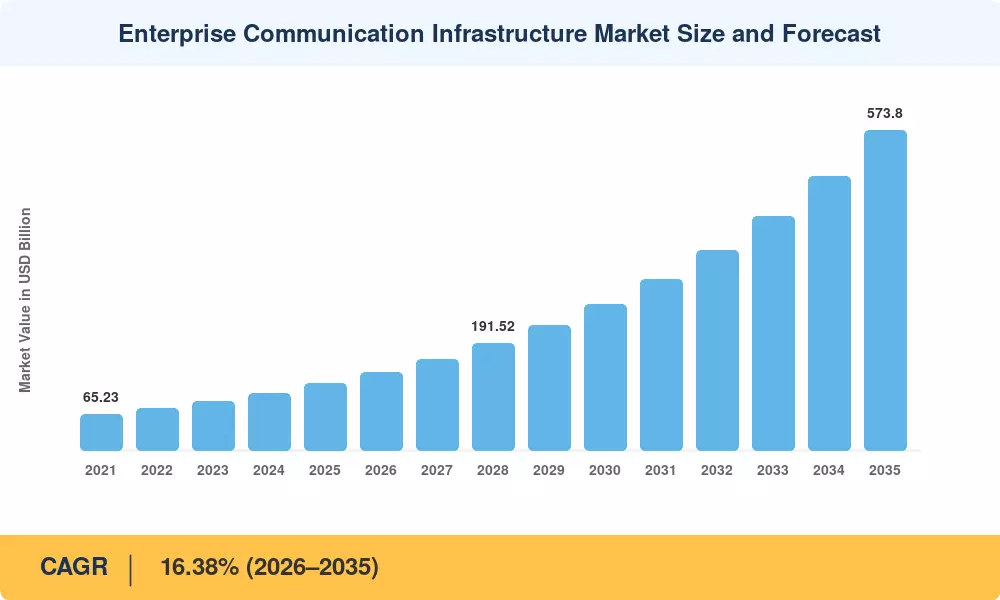
The Enterprise Communication Infrastructure Market reached an estimated USD 119.67 Billion in 2025 and is projected to grow from USD 139.28 Billion in 2026 to USD 573.80 Billion by 2035, registering a CAGR of 16.38% during the forecast period (2026–2035). This expansion is anchored by aggressive enterprise digital transformation budgets — global IT spending on communication and collaboration platforms exceeded USD 480 Billion in 2024 according to Gartner — and by regulatory mandates pushing organizations toward secure, compliant communication architectures. SD-WAN for enterprise branch connectivity has emerged as a cornerstone investment category, displacing legacy MPLS circuits at an accelerating pace.
A sweeping technology overhaul is reshaping how enterprises manage voice, video, messaging, and data traffic. Legacy TDM-based PBX systems and static WAN topologies are giving way to cloud-native unified communications, software-defined networking, and IP PBX and UCaaS enterprise telephony platforms. The U.S. Federal Communications Commission's ongoing broadband modernization programs and the European Commission's Digital Decade 2030 initiative — targeting gigabit connectivity for all enterprises — are funneling billions into network infrastructure for hybrid work. These policy frameworks translate directly into procurement cycles for enterprise LAN WAN and SDLAN architecture upgrades.
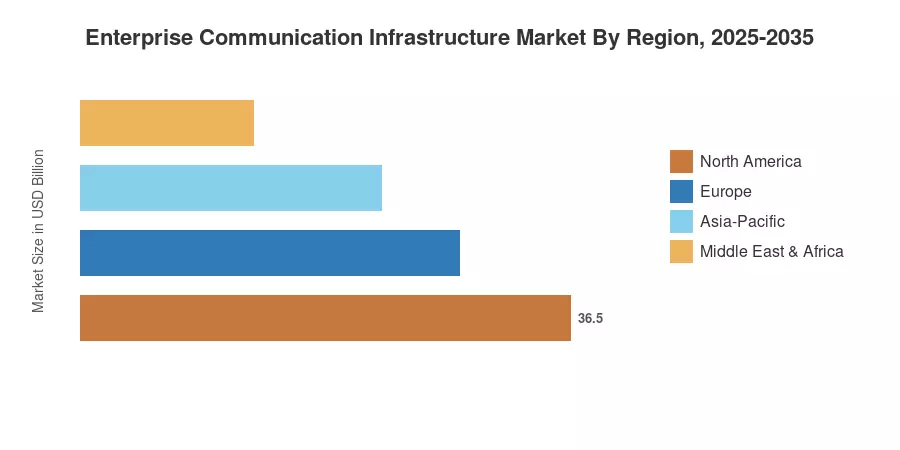
North America commands the largest share of the Enterprise Communication Infrastructure Market at roughly 36% of global revenue, driven by mature cloud adoption and early 5G rollouts. Asia-Pacific is the fastest-growing region with a CAGR exceeding 18.5%, propelled by India's Digital India program and China's aggressive 5G private networks for enterprise communications deployments. Europe holds the second-largest share near 28%, buoyed by GDPR-compliant communication mandates and the EU's Connected Europe broadband strategy [4]. The trajectory through 2035 points to sustained double-digit expansion as hybrid work, AI-driven collaboration, and edge computing become standard enterprise requirements.
Key Report Takeaways
• By Deployment
- Cloud deployment holds approximately 61% share of the Enterprise Communication Infrastructure Market, reflecting the rapid migration from on-premise PBX and legacy telephony to UCaaS and hosted collaboration platforms
- On-premise deployment is forecast to grow at a CAGR of 11.2%, sustained by regulated industries — banking, defense, healthcare — that require data sovereignty and on-site IP PBX and UCaaS enterprise telephony installations
• By End User
- IT and Telecom is the dominant vertical, valued at approximately USD 41.9 Billion in 2025, as carriers reinvest in enterprise LAN WAN and SDLAN architecture to deliver managed SD-WAN for enterprise branch connectivity services
- BFSI represents the fastest-growing end-user segment with a CAGR of 18.1%, driven by compliance-grade unified communications and real-time trading floor connectivity
• By Region
- North America accounts for ~36% of the Enterprise Communication Infrastructure Market, with the US alone contributing over 78% of regional revenue
- Asia-Pacific is projected to reach USD 178.5 Billion by 2035, underpinned by 5G private networks for enterprise communications adoption across manufacturing hubs in China, Japan, and South Korea
- Europe's share stands near 28%, shaped by network infrastructure for hybrid work investments mandated under EU digital sovereignty policies
Market Research Future (MRFR)'s forecasting model integrates bottom-up vendor revenue analysis, top-down macroeconomic correlation, and primary survey data from over 350 enterprise IT decision-makers globally. Historical figures (2021–2024) are validated against public filings and IDC/Gartner IT spending trackers. Forecast projections (2026–2035) apply a calibrated CAGR of 16.38%, adjusted for anticipated policy shifts, technology adoption S-curves, and regional GDP-weighted demand models.
Driver Impact Analysis
| Driver | ~% Impact on CAGR | Geographic Relevance | Impact Timeline |
| Cloud-first communication strategies | ~22% | Global | Short-term (≤2 yr) |
| SD-WAN displacing MPLS for branch connectivity | ~18% | North America, Europe | Short-term (≤2 yr) |
| 5G private network enterprise rollouts | ~16% | Asia-Pacific, North America | Medium-term (2–4 yr) |
| Hybrid and remote work policy permanence | ~15% | Global | Short-term (≤2 yr) |
| AI-driven network automation and AIOps | ~12% | North America, Europe | Medium-term (2–4 yr) |
| BYOD proliferation and mobile-first UCC | ~9% | Asia-Pacific, MEA | Long-term (≥4 yr) |
| Regulatory compliance mandates (GDPR, DORA, CCPA) | ~8% | Europe, North America | Long-term (≥4 yr) |
Cloud-First Communication Strategies
The tipping point for enterprise cloud adoption was reached in 2024, when Synergy Research Group stated that more than 68% of new enterprise communications deployments were cloud-native. Vendors like Microsoft, Cisco and RingCentral currently provide more than 320 million enterprise seats globally with their IP PBX and UCaaS enterprise telephony solutions. The Enterprise Communication Infrastructure Market directly benefits as every cloud migration drives downstream investment on network infrastructure for hybrid work, including improved firewalls, session border controllers, and quality-of-service-aware switches.
SD-WAN Replacing Legacy MPLS
SD-WAN for enterprise branch connectivity has shifted from a niche alternative to the default WAN architecture for distributed enterprises. Dell'Oro Group estimated the global SD-WAN market crossed USD 7.2 Billion in 2024, with enterprise adoption rates exceeding 55% among organizations with 50+ branch locations [6]. The technology slashes circuit costs by 40–60% while providing application-aware routing — a critical capability as enterprises push real-time video, voice, and collaboration traffic across the same pipes. Within the broader Enterprise Communication Infrastructure Market, SD-WAN is the single largest category of net-new capex spending among mid-market firms.
5G Private Networks Transforming Enterprise Connectivity
Governments in China, South Korea, Germany, and the United States have allocated over USD 12 Billion combined in spectrum and subsidies for 5G private networks for enterprise communications between 2023 and 2026 [9]. Manufacturing plants, logistics hubs, and healthcare campuses are deploying private 5G as a replacement for Wi-Fi 6 in latency-sensitive environments. The GSA reported 1,240 confirmed private 5G deployments worldwide by late 2024, a 78% increase over the prior year [10]. For the Enterprise Communication Infrastructure Market, private 5G represents both a new revenue pool and a forcing function for enterprise LAN WAN and SDLAN architecture redesigns that integrate cellular and wireline traffic management.
Hybrid Work and the Permanent Distributed Workforce
McKinsey's 2024 workforce survey found that 58% of knowledge workers operate in hybrid arrangements, and 82% of enterprises have permanently increased their network infrastructure for hybrid work budgets compared to pre-2020 baselines. This structural demand shift sustains capital outlays on high-bandwidth access switches, video endpoint provisioning, and zero-trust network architectures. The Enterprise Communication Infrastructure Market captures this spend across campus LAN upgrades, home-office endpoint subsidies, and cloud interconnect expansions.
Restraints Impact Analysis
| Restraint | ~% Negative Impact on CAGR | Geographic Relevance | Impact Timeline |
| Data security and compliance complexity | ~−18% | Global | Short-term (≤2 yr) |
| Legacy infrastructure lock-in and migration cost | ~−15% | Europe, Asia-Pacific | Medium-term (2–4 yr) |
| Shortage of skilled network engineers | ~−12% | Global | Long-term (≥4 yr) |
| Fragmented vendor ecosystems and interoperability gaps | ~−10% | Global | Medium-term (2–4 yr) |
| Poor broadband infrastructure in developing regions | ~−8% | South America, MEA, SE Asia | Long-term (≥4 yr) |
Data Security and Compliance Complexity
Every workplace communication platform – IP PBX and UCaaS enterprise telephony, video conferencing or messaging – creates huge volumes of metadata and content that are subject to overlapping regulation. GDPR, CCPA, DORA (for EU financial organizations), and sector-specific rules such as HIPAA create a compliance matrix that adds 4–8 months to implementation schedules and increases project costs by 15–25% on average [8]. The Enterprise Communication Infrastructure Market is experiencing challenges as procurement teams delay deployments pending legal evaluations of data residency, encryption standards, and lawful intercept requirements.
Legacy Infrastructure Lock-In
A 2024 survey from TechTarget shows that 43% of organizations still maintain at least one TDM-based PBX or pre-SDWAN router estate [13]. Migration from these systems to modern enterprise LAN WAN and SDLAN architecture necessitates parallel running costs, retraining and integration middleware – total migration budgets can range from USD 2-5 Million for a 5,000 seat firm. This friction causes a long tail of deferred investment which in turn dampens the overall growth rate of the Enterprise Communication Infrastructure Market in mature economies.
Skilled Workforce Constraints
The global shortfall of network and cloud-communication engineers exceeded 3.4 million positions in 2024, per (ISC)² estimates [14]. SD-WAN for enterprise branch connectivity deployments, private 5G installations, and AI-driven network orchestration all require specialized talent that commands premium compensation. This supply-demand imbalance delays projects and compresses vendor margins as professional services costs inflate.
Opportunities
AI-Powered Network Orchestration and AIOps
Artificial intelligence is fast changing the way businesses manage their communication networks. “AIOps platforms will help enterprises save a total of USD 120 Billion by 2030 with the automation of fault detection, capacity planning and security response”. Vendors that implement AI into SD-WAN for enterprise branch connectivity controllers and UCaaS management consoles will be able to command premium pricing. The ability of AI to minimize operational complexity and shorten migration timelines is positive for growth in the Enterprise Communication Infrastructure Market
Satellite-Terrestrial Convergence for Remote Enterprise Sites
Satellite constellations in low-earth-orbit like Starlink, OneWeb, and Amazon Kuiper are making high-bandwidth enterprise connectivity a practical reality in areas where fiber and 5G coverage remain thin on the ground. Mining, oil & gas, maritime and agricultural industries have a USD 14 Billion addressable potential for network infrastructure for hybrid work that blends satellite backhaul with enterprise LAN WAN and SDLAN architecture [11]
UCaaS and CPaaS Monetization in Emerging Markets
Southeast Asia, Latin America, and Sub-Saharan Africa collectively represent over 2.8 billion potential enterprise communication users in SME segments that are leapfrogging legacy telephony entirely. Cloud-based IP PBX and UCaaS enterprise telephony platforms with mobile-first interfaces and pay-per-seat pricing are unlocking markets where traditional capex-heavy deployments were never feasible [4]
Network-as-a-Service and Consumption-Based Models
The shift from capex to opex is opening a NaaS opportunity that Analysys Mason estimates will reach USD 28 Billion by 2030 [6]. Enterprises increasingly prefer subscription-based SD-WAN, managed Wi-Fi, and hosted private 5G — a model that expands the total addressable Enterprise Communication Infrastructure Market by pulling in organizations that previously under-invested in network upgrades
Quantum-Safe Communication Infrastructure
NIST's post-quantum cryptography standards, finalized in 2024, are triggering a new investment cycle in quantum-resistant VPN tunnels, key management systems, and encrypted voice/video infrastructure. Early movers in financial services and government are budgeting USD 500 Million–1 Billion annually for quantum-safe upgrades to their enterprise communication stacks [14]
Future Outlook
AI-Native Communication Platforms (2026–2028)
By 2028, Gartner projects that 40% of all enterprise communication interactions will be AI-mediated — summarized, translated, routed, or responded to by AI agents embedded within UCaaS and contact center platforms. The Enterprise Communication Infrastructure Market will shift value from raw bandwidth provisioning toward intelligent orchestration layers. Enterprises spending on network infrastructure for hybrid work will increasingly allocate 15–20% of their communication budgets to AI copilot licenses and AI-optimized network controllers.
Platform Consolidation and Ecosystem Economics (2028–2031)
The current fragmented vendor landscape — with separate providers for SD-WAN, UCaaS, CCaaS, CPaaS, and private 5G — is unsustainable. IDC forecasts that by 2030, 65% of enterprise communication spending will flow through integrated platform vendors offering single-pane management of IP PBX and UCaaS enterprise telephony, branch networking, and security. This consolidation will reshape the competitive dynamics of the Enterprise Communication Infrastructure Market, favoring vendors with broad portfolios and API-driven extensibility.
Sustainability-Driven Network Redesign (2029–2033)
ESG reporting mandates — including the EU's Corporate Sustainability Reporting Directive (CSRD) and the SEC's climate disclosure rules — are forcing enterprises to quantify and reduce the carbon footprint of their communication infrastructure [8]. Energy-efficient switches, liquid-cooled edge nodes, and renewable-powered data centers will command procurement preference. Enterprise LAN WAN and SDLAN architecture vendors that publish verified carbon-per-gigabyte metrics will gain competitive advantage in sustainability-conscious markets.
6G-Ready Enterprise Infrastructure (2032–2035)
ITU-R's IMT-2030 framework envisions sub-millisecond latency, terabit throughput, and native AI integration — capabilities that will redefine the Enterprise Communication Infrastructure Market by 2035 [15]. Early 6G testbeds in South Korea, Finland, and the United States are already exploring holographic communication, digital twin synchronization, and ambient IoT connectivity for enterprise environments. Organizations investing in 5G private networks for enterprise communications today are building the architectural foundation for 6G migration.
Market Segmentation
By Deployment
| Segment | Metric | Primary Demand Driver |
| Cloud | ~61% market share | UCaaS migration, remote work, pay-per-seat models |
| On-Premise | CAGR ~11.2% | Regulated industries, data sovereignty, latency-sensitive apps |
Cloud deployment commands the majority of the Enterprise Communication Infrastructure Market as enterprises prioritize operational flexibility and reduced capital expenditure. Microsoft Teams, Zoom, and Cisco Webex collectively manage over 500 million enterprise cloud communication seats, with annual growth rates exceeding 20% in emerging markets. SD-WAN for enterprise branch connectivity has become the enabling technology layer for cloud communication, ensuring quality-of-service guarantees for voice and video traffic traversing public internet paths.
On-premise deployment retains strategic importance for defense contractors, financial trading floors, and healthcare systems where regulatory or latency constraints prohibit cloud dependency. These organizations invest heavily in IP PBX and UCaaS enterprise telephony systems that operate within sovereign data boundaries, often paired with private 5G radio access networks for campus-wide mobility [8].
By End User
| Segment | Metric | Primary Demand Driver |
| IT and Telecom | USD 41.9 Billion (2025) | Managed services, carrier enterprise offerings, internal digital tools |
| Manufacturing | ~24% market share | Industrial IoT, private 5G, real-time shop-floor communication |
| BFSI | CAGR ~18.1% | Compliance-grade UCC, trading floor connectivity, customer engagement |
IT and Telecom enterprises represent the largest end-user segment in the Enterprise Communication Infrastructure Market because they function as both consumers and providers of communication infrastructure. Carriers like AT&T, Deutsche Telekom, and NTT are simultaneously upgrading their own internal network infrastructure for hybrid work while packaging SD-WAN, UCaaS, and private 5G as managed services for enterprise clients. Manufacturing is the second-largest segment, where enterprise LAN WAN and SDLAN architecture serves as the backbone for industrial IoT sensor networks, digital twin synchronization, and automated quality control systems.
BFSI is posting the fastest segment growth as banks and insurers invest in compliant, encrypted communication platforms that satisfy DORA, MiFID II recording mandates, and PCI-DSS requirements. 5G private networks for enterprise communications are gaining traction in large trading venues where microsecond latency directly impacts execution quality [8][9].
By Application
| Segment | Metric | Primary Demand Driver |
| Enterprise Collaboration | ~43% market share | Video conferencing, team messaging, document co-authoring |
| Consumer Experience | CAGR ~17.8% | Contact center modernization, omnichannel engagement, CPaaS |
| Digital Business | USD 26.74 Billion (2025) | API-driven communication, workflow automation, digital commerce |
Enterprise Collaboration dominates application-level spending within the Enterprise Communication Infrastructure Market, driven by the permanent adoption of hybrid work models that depend on always-on video, messaging, and file-sharing platforms. Consumer Experience applications are growing fastest as enterprises re-platform legacy contact centers onto cloud-native CCaaS solutions that integrate voice, chat, social media, and AI-driven self-service bots. IP PBX and UCaaS enterprise telephony increasingly converges with CPaaS APIs, enabling developers to embed communication capabilities directly into business applications [6].
Regional Market Share Analysis
| Region | Metric | Primary Investment Themes |
| North America | ~36% global share | Cloud UCaaS migration, SD-WAN, zero-trust networking |
| Europe | ~28% global share | GDPR-compliant platforms, sovereign cloud, enterprise LAN WAN and SDLAN architecture |
| Asia-Pacific | CAGR ~18.5% | 5G private networks, mobile-first UCC, smart manufacturing |
| South America | USD 8.62 Billion (2025) | SME cloud telephony, broadband expansion |
| Middle East & Africa | CAGR ~17.2% | Smart city programs, network infrastructure for hybrid work |
| Total | USD 119.67 Billion (2025) | — |
The Enterprise Communication Infrastructure Market spans five major geographic regions, each shaped by distinct regulatory environments, technology maturity curves, and enterprise investment priorities. North America leads in absolute spending, while Asia-Pacific posts the highest growth rates driven by 5G private networks for enterprise communications and cloud-first digital transformation programs.
North America
| Country | Metric | Key Driver |
| United States | ~78% of regional revenue | Federal cloud-smart mandates and FedRAMP-certified UCaaS |
| Canada | CAGR ~15.8% | CRTC broadband modernization and remote workforce connectivity |
| Mexico | USD 2.14 Billion (2025) | Nearshoring manufacturing boom driving branch connectivity |
North America's leadership in the Enterprise Communication Infrastructure Market reflects decades of accumulated investment in broadband backbone, enterprise campus networks, and early cloud adoption. The U.S. federal government's Cloud Smart strategy has pushed agencies toward FedRAMP-authorized IP PBX and UCaaS enterprise telephony solutions, creating a compliance template that private-sector enterprises are replicating. Canada's CRTC broadband fund has committed CAD 750 Million to extend high-speed access to rural enterprises, directly fueling SD-WAN for enterprise branch connectivity uptake.
Europe
| Country | Metric | Key Driver |
| Germany | ~22% of European revenue | Industrie 4.0 and private 5G factory deployments |
| United Kingdom | CAGR ~16.1% | Post-Brexit digital sovereignty and BT network modernization |
| France | USD 4.85 Billion (2025) | France 2030 digital investment plan |
| Italy | CAGR ~15.4% | PNRR-funded broadband and enterprise digitalization |
| Spain | ~6% of European share | 5G spectrum auctions and enterprise pilot zones |
| Nordic Countries | CAGR ~14.9% | Advanced fiber penetration and green data center builds |
| Russia | USD 1.92 Billion (2025) | Domestic platform substitution mandates |
| Rest of Europe | ~11% of European share | EU Connecting Europe Facility investments |
European spending on the Enterprise Communication Infrastructure Market is increasingly shaped by the EU's Digital Decade targets, which mandate gigabit connectivity for all enterprises by 2030. Germany's BSI certification requirements and France's ANSSI frameworks impose additional security standards on enterprise LAN WAN and SDLAN architecture, pushing vendors to offer sovereignty-compliant deployments. The DORA regulation for financial services, effective January 2025, is generating a fresh compliance-driven procurement cycle for secure 5G private networks for enterprise communications and encrypted collaboration platforms [8][10].
Asia-Pacific
| Country | Metric | Key Driver |
| China | ~34% of APAC revenue | "East Counts West Calculates" data infrastructure policy |
| India | CAGR ~20.3% | Digital India, BharatNet, and enterprise cloud-first mandates |
| Japan | USD 9.74 Billion (2025) | Society 5.0 and enterprise 5G spectrum allocations |
| South Korea | CAGR ~17.8% | Korean New Deal digital infrastructure targets |
| ASEAN | ~12% of APAC share | SME digitalization and mobile-first UCaaS adoption |
| Rest of Asia-Pacific | CAGR ~16.5% | Australia's NBN enterprise tier and NZ fiber upgrades |
Asia-Pacific is the fastest-growing region in the Enterprise Communication Infrastructure Market, driven by massive government-backed digitalization programs. India alone added 28 million new enterprise broadband connections in 2024 through BharatNet Phase III and private 5G licensing reforms [9]. China's three major telecom operators — China Mobile, China Telecom, and China Unicom — collectively deployed over 3.2 million 5G base stations by mid-2024, creating the densest network infrastructure for hybrid work coverage globally [10]. Japan's Ministry of Internal Affairs allocated ¥240 Billion for local 5G enterprise spectrum, accelerating SD-WAN for enterprise branch connectivity integration in manufacturing and logistics [11].
South America
| Country | Metric | Key Driver |
| Brazil | ~58% of regional revenue | Telecom modernization law (Lei 14.173) and enterprise cloud push |
| Argentina | CAGR ~16.9% | ENACOM broadband mandates and fintech UCC demand |
| Rest of South America | USD 1.73 Billion (2025) | Chile, Colombia fiber expansion and SME cloud telephony |
Brazil dominates the South American Enterprise Communication Infrastructure Market, with São Paulo functioning as the region's primary data center and interconnection hub. The 2023 telecom modernization law redirected carrier investment obligations toward enterprise-grade fiber and 5G, directly benefiting IP PBX and UCaaS enterprise telephony vendors [4][15].
Middle East & Africa
| Country | Metric | Key Driver |
| Saudi Arabia | ~28% of MEA revenue | Vision 2030 smart city and NEOM enterprise networks |
| UAE | CAGR ~18.4% | Free-zone enterprise digitalization and Etisalat/du 5G services |
| South Africa | USD 1.38 Billion (2025) | SA Connect broadband policy and enterprise cloud adoption |
| Egypt | CAGR ~17.6% | New Administrative Capital fiber backbone and enterprise zones |
| Rest of MEA | ~22% of MEA share | Kenya, Nigeria fintech-driven UCC demand |
The Middle East & Africa region is experiencing accelerated investment in the Enterprise Communication Infrastructure Market through sovereign wealth–funded smart city programs. Saudi Arabia's NEOM and The Line projects specify enterprise-grade 5G private networks for enterprise communications as foundational infrastructure. The UAE's D33 economic agenda targets a fully digital government and enterprise ecosystem by 2033, driving enterprise LAN WAN and SDLAN architecture upgrades across Abu Dhabi and Dubai free zones [15][9].

Competitive Benchmarking
The Enterprise Communication Infrastructure Market exhibits low concentration, with no single vendor commanding more than 10% of global revenue. The top five players collectively hold an estimated 32–38% of the market, reflecting a highly fragmented ecosystem where specialists in SD-WAN, UCaaS, network hardware, and private 5G compete alongside integrated platform vendors. The estimated Herfindahl-Hirschman Index (HHI) is below 600, confirming a competitive market structure.
| Company | Est. Revenue Share Range | Key Offerings for Enterprise Communication Infrastructure Market | Strategic Positioning |
| Cisco Systems | ~7–10% | Webex, Meraki SD-WAN, Catalyst switching, ThousandEyes | Full-stack networking and collaboration |
| Microsoft | ~6–9% | Teams, Teams Phone, Azure networking, Operator Connect | Platform-integrated UCaaS leader |
| Huawei | ~5–8% | CloudEngine switches, IdeaHub, 5G enterprise solutions | APAC and emerging market dominance |
| Ericsson | ~4–7% | Private 5G, network APIs, enterprise wireless | 5G infrastructure specialist |
| Nokia | ~3–6% | DAC, MX Industrial Edge, private wireless | Industrial private network focus |
| Zoom Video Communications | ~3–5% | Zoom Workplace, Zoom Phone, Workvivo | Cloud-native collaboration disruptor |
| RingCentral | ~2–4% | RingCX, MVP, RingSense AI | Pure-play UCaaS/CCaaS |
| Juniper Networks (HPE) | ~2–4% | Mist AI, SD-WAN, EX switches | AI-driven networking |
| Avaya | ~2–3% | Avaya Experience Platform, IP Office | Legacy installed base modernization |
| Ribbon Communications | ~1–3% | SBCs, analytics, network transformation | Voice network edge and interoperability |
Recent News & Developments
- Cisco Systems (March 2025): Launched AI-enhanced Webex Calling with real-time translation across 30 languages, targeting multinational enterprise LAN WAN and SDLAN architecture environments requiring multilingual collaboration.
- Microsoft (January 2025): Announced Teams Premium integration with Copilot for IP PBX and UCaaS enterprise telephony, enabling AI-generated meeting summaries, automated action items, and intelligent call routing for enterprises.
- Ericsson & Deutsche Telekom (September 2023): Established a commercial network API partnership exposing 5G private networks for enterprise communications capabilities — including quality-on-demand and location services — to enterprise developers. [9]
- Nokia (June 2024): Unveiled the MX Boost industrial-grade private wireless solution, designed for manufacturing environments requiring deterministic latency and SD-WAN for enterprise branch connectivity integration. [10]
- Juniper Networks / HPE (January 2024): HPE completed its USD 14 Billion acquisition of Juniper Networks, creating a combined enterprise networking portfolio spanning Mist AI, Aruba, and SD-WAN — a move that reshapes the Enterprise Communication Infrastructure Market's competitive landscape. [13]
- European Commission (April 2024): Published the Gigabit Infrastructure Act mandating streamlined permitting for enterprise fiber and 5G small-cell deployments, directly benefiting enterprise LAN WAN and SDLAN architecture vendors operating in EU member states. [8]
Report Scope
| Parameter | Detail |
| Market Scope | Enterprise Communication Infrastructure Market covering hardware, software, and services for enterprise voice, video, messaging, and data networking |
| Study Period | 2021–2035 |
| CAGR (Forecast) | 16.38% (2026–2035) |
| Market Size — 2025 | USD 119.67 Billion |
| Market Size — 2035 | USD 573.80 Billion |
| Fastest Growing Segment | BFSI (by end user); Cloud (by deployment); Asia-Pacific (by region) |
| Companies Profiled | Cisco, Microsoft, Huawei, Ericsson, Nokia, Zoom, RingCentral, Juniper/HPE, Avaya, Ribbon Communications |
| Valuation Currency | USD Billion |
FAQs
How does SD-WAN compare to traditional MPLS for enterprises with over 100 branch locations?
SD-WAN for enterprise branch connectivity delivers 40–60% lower circuit costs than MPLS while enabling application-aware traffic steering across broadband, LTE, and 5G links. Enterprises with 100+ branches typically achieve full ROI within 14 months of SD-WAN deployment [6].
What procurement criteria should enterprises prioritize when selecting a UCaaS vendor?
Prioritize FedRAMP or ISO 27001 certification, native PSTN replacement capability, and open API extensibility for CRM and ERP integration. IP PBX and UCaaS enterprise telephony platforms with embedded AI analytics deliver measurable productivity gains over basic voice-only offerings.
How are 5G private networks different from enterprise Wi-Fi 6E in manufacturing settings?
5G private networks for enterprise communications provide deterministic latency under 10 milliseconds and support up to 1 million connected devices per square kilometer — capabilities Wi-Fi 6E cannot guarantee in dense industrial environments [9].
What role does zero-trust architecture play in the Enterprise Communication Infrastructure Market?
Zero-trust frameworks enforce identity-verified, microsegmented access to every communication resource, reducing lateral threat movement by up to 85%. Enterprises adopting zero-trust report 60% fewer communication-related breach incidents according to Forrester [14].
How should mid-market enterprises budget for a full network infrastructure for hybrid work transformation?
Mid-market firms (500–5,000 employees) should budget USD 1,200–2,500 per employee for a comprehensive upgrade covering switching, wireless, SD-WAN, and UCaaS licensing. Phased rollouts over 18–24 months reduce cash-flow disruption [17].
What interoperability challenges arise when integrating enterprise LAN WAN and SDLAN architecture from multiple vendors?
Multi-vendor environments face API inconsistency, overlapping management consoles, and conflicting QoS policies. Organizations using three or more networking vendors report 35% higher incident resolution times than single-vendor shops [13].
How will AI copilots embedded in communication platforms affect the Enterprise Communication Infrastructure Market by 2030?
AI copilots will automate 30–40% of routine communication tasks — meeting summarization, ticket creation, sentiment routing — shifting enterprise spending from seat licenses toward AI compute and orchestration layers.
Market Highlights
Research Approach
Secondary Research
The secondary research process involved comprehensive analysis of regulatory databases, industry publications, technology journals, and authoritative ICT organizations. Key sources included the Federal Communications Commission (FCC), European Telecommunications Network Operators' Association (ETNO), International Telecommunication Union (ITU), Institute of Electrical and Electronics Engineers (IEEE), GSM Association (GSMA), National Institute of Standards and Technology (NIST), Cybersecurity and Infrastructure Security Agency (CISA), Organisation for Economic Co-operation and Development (OECD) Digital Economy Outlook, World Bank Digital Development Data, European Union Digital Single Market Reports, Asia-Pacific Telecommunity (APT) Statistics, and national ICT ministry reports from key markets. These sources were used to collect infrastructure deployment statistics, regulatory compliance frameworks, spectrum allocation data, cloud adoption trends, cybersecurity incident reports, digital transformation indices, and competitive landscape analysis for unified communications, VoIP infrastructure, video conferencing platforms, contact center solutions, and collaboration technologies.
Primary Research
In order to gather both qualitative and quantitative insights, supply-side and demand-side stakeholders were interviewed during the primary research process. Chief Technology Officers (CTOs), Vice Presidents of Engineering, Chief Information Security Officers (CISOs), Heads of Cloud Infrastructure, and Enterprise Sales Directors from cloud service providers, telecom equipment manufacturers, and communication platform providers were examples of supply-side sources. Chief information officers (CIOs), directors of IT infrastructure, heads of digital transformation, procurement managers from Fortune 500 companies, mid-market businesses, government organizations, healthcare systems, and financial institutions were among the demand-side sources. In addition to gathering information on cloud migration tactics, security architecture acceptance, integration complexity, and total cost of ownership dynamics, primary research verified product roadmap dates and validated market segmentation.
Primary Respondent Breakdown:
By Designation: C-level Primaries (32%), Director Level (31%), Others (37%)
By Region: North America (38%), Europe (29%), Asia-Pacific (25%), Rest of World (8%)
Market Size Estimation
Global market valuation was derived through revenue mapping and infrastructure deployment analysis. The methodology included:
Identification of 50+ key vendors across North America, Europe, Asia-Pacific, and Latin America
Product mapping across unified communications, contact center infrastructure, video conferencing platforms, team collaboration tools, VoIP systems, and CPaaS (Communications Platform as a Service)
Analysis of reported and modeled annual revenues specific to enterprise communication portfolios
Coverage of vendors representing 75-80% of global market share in 2024
Extrapolation using bottom-up (enterprise seat count × ARPU by region) and top-down (vendor revenue validation) approaches to derive segment-specific valuations
Validation & Triangulation
Data triangulation was conducted using multiple methodologies:
Cross-referencing primary interview insights with secondary data points
Vendor revenue reconciliation against enterprise IT spending surveys from Gartner and IDC
Deployment model analysis validated against cloud infrastructure spending data from Synergy Research Group
End-user adoption rates verified through Okta Businesses at Work and McAfee Enterprise Reports
Regional splits calibrated against ITU World Telecommunication/ICT Indicators database
Forecast Methodology
Market projections (2025-2035) were developed using:
Causal forecasting models incorporating GDP growth, digital transformation indices, and remote work penetration rates
Technology adoption curves for AI-enabled communication and 5G enterprise services
Scenario analysis accounting for cybersecurity regulatory evolution and data sovereignty requirements
Historical CAGR analysis of adjacent markets including cloud computing and enterprise SaaS
Kindly complete the form below to receive a free sample of this Report
Customer Stories
“This is really good guys. Excellent work on a tight deadline. I will continue to use you going forward and recommend you to others. Nice job”
“Thanks. It’s been a pleasure working with you, please use me as reference with any other Intel employees.”
“Thanks for sending the report it gives us a good global view of the Betaïne market.”
“Thank you, this will be very helpful for OQS.”
“We found the report very insightful! we found your research firm very helpful. I'm sending this email to secure our future business.”
“I am very pleased with how market segments have been defined in a relevant way for my purposes (such as "Portable Freezers & refrigerators" and "last-mile"). In general the report is well structured. Thanks very much for your efforts.”
“I have been reading the first document or the study, ,the Global HVAC and FP market report 2021 till 2026. Must say, good info! I have not gone in depth at all parts, but got a good indication of the data inside!”
“We got the report in time, we really thank you for your support in this process. I also thank to all of your team as they did a great job.”
















