×
Request Free Sample ×

Kindly complete the form below to receive a free sample of this Report

Leading companies partner with us for data-driven Insights

clients tt-cursor
Hero Background

Enterprise Ip Phones Market

ID: MRFR/ICT/29856-HCR
100 Pages
Aarti Dhapte
October 2025

Enterprise IP Phones Market Research Report: By Phone Type (Desk Phones, Conference Phones, Wireless IP Phones, Video IP Phones), By Deployment Model (On-Premises, Cloud-Based, Hybrid), By Connectivity Technology (Wired, Wireless), By User Size (Small Enterprises, Medium Enterprises, Large Enterprises), By Features (Call Management, Voicemail, Video Conferencing, Collaboration Tools, Integrations) and By Regional (North America, Europe, South America, Asia Pacific, Middle East and Africa) - Forecast to 2035

Share:
Download PDF ×

We do not share your information with anyone. However, we may send you emails based on your report interest from time to time. You may contact us at any time to opt-out.

Enterprise Ip Phones Market Infographic
Purchase Options

Enterprise Ip Phones Market Summary

As per MRFR analysis, the Enterprise IP Phones Market Size was estimated at 4.607 USD Billion in 2024. The Enterprise IP Phones industry is projected to grow from 5.007 USD Billion in 2025 to 11.5 USD Billion by 2035, exhibiting a compound annual growth rate (CAGR) of 8.67 during the forecast period 2025 - 2035.

Key Market Trends & Highlights

The Enterprise IP Phones Market is experiencing a transformative shift towards integrated and cloud-based solutions.

  • The market is witnessing a robust integration with Unified Communications, enhancing collaboration capabilities.
  • Cloud-based solutions are rapidly gaining traction, driven by their scalability and flexibility.
  • Security features are becoming increasingly paramount as organizations prioritize data protection and compliance.
  • Rising demand for remote work solutions and technological advancements in VoIP are key drivers propelling market growth.

Market Size & Forecast

2024 Market Size 4.607 (USD Billion)
2035 Market Size 11.5 (USD Billion)
CAGR (2025 - 2035) 8.67%

Major Players

Cisco Systems (US), Avaya (US), Mitel Networks (CA), Alcatel-Lucent (FR), Unify (DE), NEC Corporation (JP), Panasonic (JP), Grandstream Networks (US), Yealink (CN)

Enterprise Ip Phones Market Trends

The Enterprise IP Phones Market is currently experiencing a transformative phase, driven by advancements in technology and evolving communication needs. Organizations are increasingly adopting IP telephony solutions to enhance productivity and streamline operations. This shift is largely influenced by the demand for integrated communication systems that support voice, video, and data services. As businesses seek to improve collaboration and connectivity, the market is witnessing a surge in innovative features such as high-definition audio, mobile integration, and cloud-based functionalities. Furthermore, the growing trend of remote work is prompting companies to invest in reliable communication tools that facilitate seamless interactions among distributed teams. In addition to technological advancements, the Enterprise IP Phones Market is also shaped by changing consumer preferences and the need for cost-effective solutions. Organizations are looking for systems that not only provide superior performance but also offer scalability and flexibility. This has led to an increase in the adoption of subscription-based models, allowing businesses to manage costs more effectively. As the market continues to evolve, it appears that the focus will remain on enhancing user experience and ensuring robust security measures. Overall, the Enterprise IP Phones Market is poised for sustained growth as it adapts to the dynamic landscape of modern communication.

Integration with Unified Communications

The trend towards integrating Enterprise IP Phones with unified communications platforms is becoming increasingly prevalent. This integration allows for a seamless flow of information across various communication channels, enhancing collaboration and efficiency within organizations. By combining voice, video, and messaging services, businesses can streamline their operations and improve overall productivity.

Cloud-Based Solutions

There is a noticeable shift towards cloud-based Enterprise IP Phones, as organizations seek to leverage the benefits of scalability and flexibility. Cloud solutions enable businesses to reduce infrastructure costs while providing access to advanced features and updates. This trend is particularly appealing to small and medium-sized enterprises that require cost-effective communication solutions.

Focus on Security Features

As cyber threats continue to evolve, there is an increasing emphasis on security within the Enterprise IP Phones Market. Organizations are prioritizing systems that offer robust security measures, such as encryption and secure access controls. This focus on security is essential for protecting sensitive information and ensuring compliance with regulatory standards.

Enterprise Ip Phones Market Drivers

Technological Advancements in VoIP

Technological innovations in Voice over Internet Protocol (VoIP) are significantly influencing the Enterprise IP Phones Market. The introduction of high-definition voice quality, improved bandwidth management, and advanced call management features are making IP phones more appealing to businesses. These advancements not only enhance user experience but also reduce operational costs associated with traditional telephony systems. The market is witnessing a shift towards more sophisticated devices that support features like call recording, analytics, and integration with customer relationship management systems. As these technologies continue to evolve, the Enterprise IP Phones Market is expected to expand, with a projected market size reaching several billion dollars by the end of the decade.

Growing Emphasis on Cost Efficiency

Cost efficiency remains a pivotal driver in the Enterprise IP Phones Market. Organizations are increasingly recognizing the financial benefits of transitioning from traditional phone systems to IP-based solutions. The reduction in long-distance call charges, lower maintenance costs, and the ability to leverage existing internet infrastructure contribute to this trend. Furthermore, businesses are drawn to the scalability of IP phone systems, allowing them to easily adjust their communication needs as they grow. This focus on cost-effective solutions is likely to propel the Enterprise IP Phones Market forward, with many companies reporting savings of up to 30% after implementing IP telephony.

Rising Demand for Remote Work Solutions

The increasing trend towards remote work has led to a heightened demand for effective communication tools, particularly in the Enterprise IP Phones Market. Organizations are seeking reliable and efficient solutions to facilitate seamless communication among remote teams. This shift is evidenced by a notable increase in the adoption of IP telephony systems, which provide advanced features such as video conferencing and instant messaging. As businesses adapt to flexible work environments, the Enterprise IP Phones Market is likely to experience substantial growth, with projections indicating a compound annual growth rate of over 10% in the coming years. This demand is further fueled by the need for enhanced collaboration tools that can integrate with existing IT infrastructure.

Increased Focus on Security and Compliance

In an era where data breaches and cyber threats are prevalent, the focus on security and compliance within the Enterprise IP Phones Market is intensifying. Organizations are prioritizing secure communication solutions that protect sensitive information and comply with regulatory standards. This has led to the development of IP phones equipped with advanced encryption protocols and security features. As businesses become more aware of the risks associated with unsecured communication channels, the demand for secure IP telephony solutions is expected to rise. This heightened emphasis on security is likely to drive innovation within the Enterprise IP Phones Market, as manufacturers strive to meet the evolving needs of their clients.

Integration with Advanced Communication Platforms

The integration of Enterprise IP Phones with advanced communication platforms is reshaping the landscape of the Enterprise IP Phones Market. As organizations seek to streamline their communication processes, the ability to connect IP phones with unified communication systems, such as instant messaging and video conferencing tools, becomes increasingly valuable. This integration enhances collaboration and productivity, allowing employees to communicate more effectively across various channels. The trend is supported by the growing adoption of cloud-based communication solutions, which facilitate seamless integration and accessibility. Consequently, the Enterprise IP Phones Market is poised for growth as businesses prioritize comprehensive communication strategies.

Market Segment Insights

By Type: Desk Phones (Largest) vs. Wireless IP Phones (Fastest-Growing)

In the Enterprise IP Phones Market, Desk Phones hold the largest share, representing a significant portion of total sales due to their established presence in workplaces and their reliability. Conversely, Wireless IP Phones have emerged as a rapidly growing segment, benefiting from the increasing demand for mobility and flexibility in workplace environments. As organizations seek alternatives to traditional setups, Wireless IP Phones are gaining attention for their convenience and advanced features, allowing employees to communicate seamlessly away from fixed locations.

Desk Phones (Dominant) vs. Wireless IP Phones (Emerging)

Desk Phones are characterized by their robustness and reliability, making them the preferred choice for many businesses that prioritize stability in communication. They offer clear audio quality and features tailored for professional settings, often with integrated functionalities like call forwarding and conferencing. On the other hand, Wireless IP Phones are revolutionizing communications with their mobility and advanced technology. These devices allow employees to stay connected without being tethered by wires, promoting a more dynamic work environment. As enterprises evolve towards flexible working arrangements, the appeal of Wireless IP Phones is growing, positioning them as an essential component of future corporate communication strategies.

By Deployment Model: On-Premises (Largest) vs. Cloud-Based (Fastest-Growing)

In the Enterprise IP Phones Market, the deployment model segment is predominantly characterized by on-premises solutions, which hold the largest market share due to their robust security features and control over infrastructure. Businesses, especially those in highly regulated industries, prefer on-premises deployment for data sovereignty and compliance purposes. On the other hand, cloud-based solutions are rapidly gaining traction as organizations transition towards more flexible and cost-effective communication tools, allowing for remote work and scalability without the need for extensive hardware investment.

On-Premises (Dominant) vs. Cloud-Based (Emerging)

On-premises IP phone systems remain the dominant choice for many enterprises, particularly those requiring stringent security and customization capabilities. These systems allow organizations to maintain complete control over their communication infrastructure, which is essential for compliance-focused sectors. In contrast, cloud-based IP phones are emerging as a transformative alternative, appealing to companies seeking agility and lower upfront costs. These systems facilitate seamless integration with existing cloud services and enable scalable operations, making them particularly attractive for startups and businesses adapting to hybrid work models. As organizations recognize the importance of digital transformation, cloud-based solutions are expected to expand significantly.

By Connectivity Technology: Wired (Largest) vs. Wireless (Fastest-Growing)

In the Enterprise IP Phones Market, the distribution of connectivity technology shows a significant preference towards Wired solutions. With established reliability and performance, Wired connectivity dominates due to its ability to provide stable and high-quality voice communication. However, the Wireless segment is rapidly gaining traction among businesses seeking flexibility and mobility in their communication systems, making the market share increasingly competitive. The growth trends in this segment are characterized by a shift towards Wireless technologies as organizations embrace remote work and decentralized operations. The demand for mobility and ease of installation drives the adoption of Wireless solutions, while Wired connections still retain relevance in environments where stability is critical. Innovations such as Wi-Fi 6 and improved security features in Wireless technology further underscore its role as a pivotal growth driver for the future.

Connectivity: Wired (Dominant) vs. Wireless (Emerging)

Wired connectivity remains the dominant choice in the Enterprise IP Phones Market, primarily due to its established robustness and consistent performance. Businesses with strict requirements for sound quality and reliability gravitate towards Wired systems to avoid latency and connectivity issues. Conversely, Wireless solutions are emerging rapidly, appealing to organizations that prioritize flexibility and modern workplace dynamics. Wireless technology offers significant advantages in terms of mobility, allowing users to move freely within workspaces while maintaining high-quality communication. As organizations continue to adopt hybrid working models, the advantages of Wireless connectivity become increasingly attractive, boosting its market presence and forcing traditional Wired systems to adapt to this changing landscape.

By User Size: Small Enterprises (Largest) vs. Large Enterprises (Fastest-Growing)

In the Enterprise IP Phones market, small enterprises hold the largest market share, driven largely by their adoption of cost-effective communication solutions that enhance operational efficiency. These businesses often prioritize budget-friendly technologies and simplified setups, making them significant contributors to the overall demand in the market. Conversely, large enterprises are rapidly increasing their share, reflecting their need for robust communication systems that support complex organizational structures and international operations.

Small Enterprises (Dominant) vs. Large Enterprises (Emerging)

Small enterprises dominate the Enterprise IP Phones market due to their focus on cost-effectiveness and adaptability to emerging technologies. These organizations benefit from IP phone systems that offer high-quality features at lower price points, helping them stay competitive. In contrast, large enterprises are emerging as a powerful segment, seeking advanced communication solutions that include integrated features such as video conferencing and cloud connectivity. Their growing need for scalability and enterprise-grade functionalities positions them as a strong force in the market, driving innovation and investment in sophisticated communication infrastructures.

By Features: Call Management (Largest) vs. Voicemail (Fastest-Growing)

In the Enterprise IP Phones Market, Call Management emerges as the largest segment, holding significant market share compared to its counterparts. Voicemail, while smaller in proportion, is rapidly gaining traction, showcasing the dynamic nature of customer preferences in business communication. Video Conferencing, Collaboration Tools, and Integrations also play crucial roles but lag behind in overall market presence. Each of these features provides unique enhancements, contributing to a comprehensive enterprise communication strategy. The growth trends in this segment highlight a shift towards more integrated solutions that encompass multiple functionalities. Businesses increasingly prioritize efficient communication tools that streamline operations, leading to a surge in demand for Voicemail systems, which cater to modern work styles. The holistic integration of Collaboration Tools and Video Conferencing emphasizes the industry's response to remote and hybrid work models, driving innovations that focus on seamless interconnectivity and user experience.

Call Management (Dominant) vs. Collaborations Tools (Emerging)

Call Management is recognized as the dominant feature in the Enterprise IP Phones Market, focusing on enhancing communication efficiency with robust functionalities like call routing and reporting. Its prominence is critical for businesses looking to optimize their telephony systems. In contrast, Collaboration Tools are emerging as significant players, offering interactive solutions such as screen sharing and integrated messaging that cater to the collaborative needs of modern teams. These tools resonate with the growing trend towards remote work and digital teamwork, making them increasingly popular. While Call Management remains essential, the rise of Collaboration Tools demonstrates a shift towards multifaceted communication platforms that support diverse business requirements, ultimately enhancing overall productivity.

Get more detailed insights about Enterprise Ip Phones Market

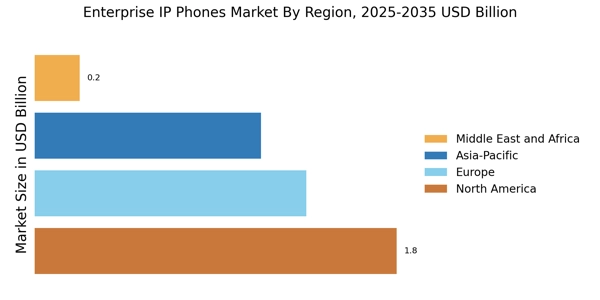
Regional Insights

North America : Technology Adoption Leader

North America is the largest market for Enterprise IP Phones, holding approximately 40% of the global share. The region's growth is driven by rapid technological advancements, increasing demand for unified communications, and a strong focus on remote work solutions. Regulatory support for digital transformation initiatives further catalyzes market expansion, making it a hub for innovation in communication technologies. The competitive landscape is characterized by major players such as Cisco Systems and Avaya, which dominate the market with their advanced product offerings. The presence of established companies fosters a robust ecosystem, encouraging innovation and collaboration. Additionally, the U.S. and Canada are leading countries in this sector, contributing significantly to market growth through investments in infrastructure and technology upgrades.

Europe : Emerging Market Dynamics

Europe is witnessing a significant transformation in the Enterprise IP Phones market, holding around 30% of the global share. The region's growth is fueled by increasing investments in digital infrastructure, a shift towards remote work, and stringent regulations promoting digital communication. Countries like Germany and the UK are at the forefront, driving demand for advanced communication solutions and fostering a competitive environment. Leading players such as Alcatel-Lucent and Unify are pivotal in shaping the market landscape, offering innovative solutions tailored to diverse business needs. The competitive dynamics are further enhanced by the presence of various local and international companies, ensuring a rich variety of options for consumers. The European market is characterized by a strong emphasis on compliance and security, influencing product development and market strategies.

Asia-Pacific : Rapid Growth and Innovation

Asia-Pacific is rapidly emerging as a key player in the Enterprise IP Phones market, accounting for approximately 25% of the global share. The region's growth is driven by increasing urbanization, a burgeoning middle class, and rising demand for advanced communication technologies. Countries like Japan and China are leading this growth, supported by government initiatives aimed at enhancing digital infrastructure and connectivity. The competitive landscape is vibrant, with key players such as NEC Corporation and Panasonic making significant strides in product innovation. The presence of numerous local manufacturers also contributes to a diverse market, catering to various consumer needs. As businesses increasingly adopt digital solutions, the demand for Enterprise IP Phones is expected to surge, further solidifying the region's position in the global market.

Middle East and Africa : Untapped Market Potential

The Middle East and Africa region is gradually emerging in the Enterprise IP Phones market, holding about 5% of the global share. The growth is primarily driven by increasing investments in telecommunications infrastructure and a rising demand for efficient communication solutions. Countries like South Africa and the UAE are leading the charge, supported by government initiatives aimed at enhancing digital connectivity and business communication. The competitive landscape is still developing, with a mix of local and international players vying for market share. Companies like Grandstream Networks and Yealink are making inroads, offering cost-effective solutions tailored to the unique needs of the region. As businesses continue to recognize the importance of effective communication, the demand for Enterprise IP Phones is expected to grow, presenting significant opportunities for market expansion.

Enterprise Ip Phones Market Regional Image

Key Players and Competitive Insights

The Enterprise IP Phones Market has witnessed significant growth due to the increasing demand for advanced communication systems and the proliferation of VoIP technologies. This market is characterized by the presence of numerous players, each striving to distinguish themselves through innovation, product quality, and customer service. The competitive landscape is dynamic, with companies constantly updating their offerings to meet the evolving needs of businesses. As enterprises prioritize seamless communication solutions, the competition among manufacturers intensifies, emphasizing the necessity for robust features, compatibility with existing systems, and cost-effectiveness. 

The landscape is also shaped by trends such as the rise of remote work, prompting businesses to invest in reliable and scalable IP phone solutions, further driving the competition in this vibrant market. Avaya has established a commanding presence in the Enterprise IP Phones Market, leveraging its extensive experience and robust product portfolio. The company's strength lies in its comprehensive range of IP phone solutions that cater to various enterprise needs, from small businesses to large organizations. Avaya's commitment to innovation is evident through its focus on integrating advanced features such as cloud capabilities, mobility support, and enhanced security protocols.

Moreover, Avaya's strong customer support and partnership ecosystem contribute to its ability to maintain a competitive edge. Its reputation for reliability and user-friendly interfaces resonates well with enterprises seeking efficient communication solutions, positioning Avaya as a formidable contender within the market.

Unify has carved out a significant niche in the Enterprise IP Phones Market, driven by its dedication to delivering high-quality communication solutions tailored to enterprise requirements. The company’s offerings are distinguished by their emphasis on interoperability and scalability, allowing businesses to seamlessly integrate Unify's IP phones into existing communication infrastructures. Unify focuses on fostering collaborative experiences through its devices, which feature intuitive design and advanced functionalities that enhance user engagement and productivity.

Additionally, Unify’s strong emphasis on customer-centric solutions ensures that businesses receive the necessary support, fostering long-term relationships and reinforcing its position as a key player in the competitive landscape of the enterprise IP phone market. As enterprises increasingly seek sophisticated communication systems, Unify remains poised to capitalize on emerging opportunities through its innovative product advancements and targeted market strategies.

Key Companies in the Enterprise Ip Phones Market market include

Industry Developments

Recent developments in the Enterprise IP Phones Market indicate a significant shift towards advanced communication solutions driven by the rise in remote work and the need for cost-effective connectivity. Innovations in VoIP technology have become more prominent, making IP phones more accessible and functional for businesses. Companies are increasingly focusing on integrating AI and cloud-based features into their products, which enhances user experience and improves operational efficiency. Additionally, partnerships between telecommunication providers and technology firms are generating new opportunities for market growth, especially in emerging regions.

As businesses seek to upgrade their communication infrastructure, the demand for high-quality IP phones that support advanced features, such as video conferencing and integration with other digital platforms, is anticipated to increase. This evolving landscape reflects the broader trend of digital transformation in workplaces, with an emphasis on enhancing collaboration and productivity through modern communication tools. Overall, the market is experiencing robust activity, positioning itself for sustained growth as enterprises adapt to new communication needs.

Future Outlook

Enterprise Ip Phones Market Future Outlook

The Enterprise IP Phones Market is projected to grow at an 8.67% CAGR from 2024 to 2035, driven by advancements in VoIP technology and increasing demand for unified communications.

New opportunities lie in:

  • Integration of AI-driven analytics for enhanced user experience.
  • Development of cloud-based IP phone solutions for remote work.
  • Expansion into emerging markets with tailored pricing strategies.

By 2035, the market is expected to solidify its position as a leader in communication technology.

Market Segmentation

Enterprise Ip Phones Market Type Outlook

  • Desk Phones
  • Conference Phones
  • Wireless IP Phones
  • Video IP Phones

Enterprise Ip Phones Market Features Outlook

  • Call Management
  • Voicemail
  • Video Conferencing
  • Collaboration Tools
  • Integrations

Enterprise Ip Phones Market User Size Outlook

  • Small Enterprises
  • Medium Enterprises
  • Large Enterprises

Enterprise Ip Phones Market Deployment Model Outlook

  • On-Premises
  • Cloud-Based
  • Hybrid

Enterprise Ip Phones Market Connectivity Technology Outlook

  • Wired
  • Wireless

Report Scope

MARKET SIZE 20244.607(USD Billion)
MARKET SIZE 20255.007(USD Billion)
MARKET SIZE 203511.5(USD Billion)
COMPOUND ANNUAL GROWTH RATE (CAGR)8.67% (2024 - 2035)
REPORT COVERAGERevenue Forecast, Competitive Landscape, Growth Factors, and Trends
BASE YEAR2024
Market Forecast Period2025 - 2035
Historical Data2019 - 2024
Market Forecast UnitsUSD Billion
Key Companies ProfiledMarket analysis in progress
Segments CoveredMarket segmentation analysis in progress
Key Market OpportunitiesIntegration of artificial intelligence enhances functionality in the Enterprise IP Phones Market.
Key Market DynamicsRising demand for remote communication solutions drives innovation and competition in the Enterprise IP Phones market.
Countries CoveredNorth America, Europe, APAC, South America, MEA

Leave a Comment

FAQs

What is the projected market valuation for the Enterprise IP Phones Market in 2035?

The projected market valuation for the Enterprise IP Phones Market in 2035 is expected to reach 11.5 USD Billion.

What was the overall market valuation for the Enterprise IP Phones Market in 2024?

The overall market valuation for the Enterprise IP Phones Market in 2024 was 4.607 USD Billion.

What is the expected CAGR for the Enterprise IP Phones Market during the forecast period 2025 - 2035?

The expected CAGR for the Enterprise IP Phones Market during the forecast period 2025 - 2035 is 8.67%.

Which companies are considered key players in the Enterprise IP Phones Market?

Key players in the Enterprise IP Phones Market include Cisco Systems, Avaya, Mitel Networks, Alcatel-Lucent, Unify, NEC Corporation, Panasonic, Grandstream Networks, and Yealink.

What are the projected revenues for Desk Phones in the Enterprise IP Phones Market by 2035?

The projected revenues for Desk Phones in the Enterprise IP Phones Market are expected to grow from 1.5 USD Billion in 2024 to 3.5 USD Billion by 2035.

How does the Cloud-Based deployment model compare to On-Premises in terms of market valuation?

The Cloud-Based deployment model is projected to increase from 2.0 USD Billion in 2024 to 5.0 USD Billion by 2035, whereas On-Premises is expected to grow from 1.5 USD Billion to 3.5 USD Billion.

What is the expected growth for Wireless IP Phones in the Enterprise IP Phones Market?

Wireless IP Phones are anticipated to grow from 1.2 USD Billion in 2024 to 2.8 USD Billion by 2035.

What segment shows the highest projected revenue growth in the Enterprise IP Phones Market?

The Video IP Phones segment shows a projected revenue growth from 1.0 USD Billion in 2024 to 3.0 USD Billion by 2035.

What is the expected market size for Large Enterprises in the Enterprise IP Phones Market by 2035?

The expected market size for Large Enterprises in the Enterprise IP Phones Market is projected to reach 4.0 USD Billion by 2035.

Which feature segment is expected to see the most significant growth in the Enterprise IP Phones Market?

The Video Conferencing feature segment is expected to grow from 1.2 USD Billion in 2024 to 3.0 USD Billion by 2035.

Download Free Sample

Kindly complete the form below to receive a free sample of this Report

Compare Licence

×
Features License Type
Single User Multiuser License Enterprise User
Price $4,950 $5,950 $7,250
Maximum User Access Limit 1 User Upto 10 Users Unrestricted Access Throughout the Organization
Free Customization
Direct Access to Analyst
Deliverable Format
Platform Access
Discount on Next Purchase 10% 15% 15%
Printable Versions