×
Request Free Sample ×

Kindly complete the form below to receive a free sample of this Report

* Please use a valid business email

Leading companies partner with us for data-driven Insights

clients tt-cursor
Hero Background

Enterprise Network Equipment Market

ID: MRFR/ICT/32240-HCR
100 Pages
Aarti Dhapte
October 2025

Enterprise Network Equipment Market Research Report: By Product Type (Routers, Switches, Firewalls, Access Points, Load Balancers), By Networking Technology (Ethernet, Wireless, SD-WAN, MPLS, VPN), By End User (Small and Medium Enterprises, Large Enterprises, Government Organizations, Educational Institutions), By Deployment Type (On-Premises, Cloud-Based, Hybrid) and By Regional (North America, Europe, South America, Asia Pacific, Middle East and Africa) - Forecast to 2035.

Share:
Download PDF ×

We do not share your information with anyone. However, we may send you emails based on your report interest from time to time. You may contact us at any time to opt-out.

Enterprise Network Equipment Market
 Infographic
Purchase Options

Enterprise Network Equipment Market Summary

As per MRFR analysis, the Enterprise Network Equipment Market Size was estimated at 62.94 USD Billion in 2024. The Enterprise Network Equipment industry is projected to grow from 66.25 USD Billion in 2025 to 110.52 USD Billion by 2035, exhibiting a compound annual growth rate (CAGR) of 5.25 during the forecast period 2025 - 2035.

Key Market Trends & Highlights

The Enterprise Network Equipment Market is experiencing robust growth driven by technological advancements and evolving business needs.

  • North America remains the largest market for enterprise network equipment, reflecting a strong demand for advanced networking solutions.
  • The Asia-Pacific region is emerging as the fastest-growing market, propelled by rapid digital transformation initiatives.
  • Routers continue to dominate the market as the largest segment, while switches are witnessing the fastest growth due to increasing network complexity.
  • Key market drivers include the growing adoption of IoT devices and the expansion of 5G technology, which are enhancing connectivity and security needs.

Market Size & Forecast

2024 Market Size 62.94 (USD Billion)
2035 Market Size 110.52 (USD Billion)
CAGR (2025 - 2035) 5.25%

Major Players

Cisco Systems (US), Juniper Networks (US), Arista Networks (US), Hewlett Packard Enterprise (US), Nokia (FI), Huawei Technologies (CN), Extreme Networks (US), Dell Technologies (US), ZTE Corporation (CN)

Enterprise Network Equipment Market Trends

The Enterprise Network Equipment Market is currently experiencing a dynamic evolution, driven by the increasing demand for robust connectivity solutions across various sectors. Organizations are increasingly recognizing the necessity of reliable network infrastructure to support their operations, which has led to a surge in investments in advanced networking technologies. This trend is further fueled by the growing adoption of cloud computing and the Internet of Things (IoT), as businesses seek to enhance their operational efficiency and improve data management capabilities. As a result, manufacturers are focusing on developing innovative products that cater to the diverse needs of enterprises, ensuring seamless integration and scalability. Moreover, the market landscape is characterized by a heightened emphasis on security and performance. With the rise in cyber threats, enterprises are prioritizing secure network solutions that can safeguard sensitive information while maintaining high-speed connectivity. This shift is prompting vendors to incorporate advanced security features into their offerings, thereby enhancing the overall value proposition of their products. Additionally, the increasing trend towards remote work is reshaping the demand for network equipment, as organizations seek to provide their employees with reliable access to corporate resources from various locations. Overall, the Enterprise Network Equipment Market appears poised for continued growth as it adapts to the evolving technological landscape and the changing needs of businesses.

Increased Demand for Cloud Solutions

The shift towards cloud-based services is driving the need for advanced networking equipment. Organizations are seeking solutions that facilitate seamless connectivity to cloud platforms, enhancing their operational capabilities.

Focus on Security Enhancements

As cyber threats become more sophisticated, there is a growing emphasis on security features within network equipment. Enterprises are prioritizing solutions that offer robust protection against potential vulnerabilities.

Rise of Remote Work Infrastructure

The trend towards remote work is reshaping the requirements for network equipment. Companies are investing in solutions that ensure reliable access to resources, regardless of employee location.

Enterprise Network Equipment Market Drivers

Expansion of 5G Technology

The rollout of 5G technology is poised to significantly impact the Enterprise Network Equipment Market. With its promise of ultra-fast data speeds and low latency, 5G enables enterprises to enhance their connectivity capabilities. This technology is expected to facilitate the deployment of advanced applications such as augmented reality, virtual reality, and real-time data analytics. As businesses seek to leverage these capabilities, the demand for compatible network equipment is likely to surge. Market analysts suggest that the 5G infrastructure investment could reach trillions of dollars in the coming years, further driving the growth of the Enterprise Network Equipment Market. The transition to 5G not only transforms communication but also compels enterprises to upgrade their network equipment to remain competitive.

Growing Adoption of IoT Devices

The proliferation of Internet of Things (IoT) devices is a key driver for the Enterprise Network Equipment Market. As organizations increasingly integrate IoT solutions into their operations, the demand for robust network infrastructure rises. This trend is evidenced by the projected increase in connected devices, which is expected to reach over 30 billion by 2030. Consequently, enterprises require advanced networking equipment to manage the influx of data generated by these devices. The need for reliable connectivity and low latency further emphasizes the importance of investing in high-performance network equipment. This growing adoption of IoT not only enhances operational efficiency but also necessitates the evolution of the Enterprise Network Equipment Market to accommodate the unique requirements of IoT applications.

Increased Focus on Cybersecurity

As cyber threats become more sophisticated, the emphasis on cybersecurity within the Enterprise Network Equipment Market intensifies. Organizations are increasingly aware of the potential risks associated with inadequate network security, leading to a surge in demand for equipment that incorporates advanced security features. This trend is reflected in the market, where the cybersecurity segment is projected to grow at a compound annual growth rate of over 10% through the next five years. Enterprises are investing in network equipment that offers integrated security solutions, such as firewalls and intrusion detection systems, to safeguard their data and infrastructure. This heightened focus on cybersecurity not only protects sensitive information but also drives innovation within the Enterprise Network Equipment Market, as manufacturers strive to meet evolving security requirements.

Rising Demand for High-Speed Connectivity

The increasing reliance on data-intensive applications is driving the demand for high-speed connectivity within the Enterprise Network Equipment Market. As businesses adopt cloud computing, big data analytics, and video conferencing solutions, the need for faster and more reliable network infrastructure becomes paramount. Market data indicates that the demand for high-speed internet connections is expected to grow by over 25% in the next few years. This trend compels enterprises to invest in advanced networking equipment capable of supporting high bandwidth and low latency. The shift towards high-speed connectivity not only enhances productivity but also fosters innovation, as organizations can leverage new technologies and services. Consequently, the Enterprise Network Equipment Market is likely to experience substantial growth as it adapts to these evolving connectivity demands.

Emergence of Software-Defined Networking (SDN)

The emergence of Software-Defined Networking (SDN) is transforming the landscape of the Enterprise Network Equipment Market. SDN allows for greater flexibility and control over network resources, enabling organizations to optimize their network performance. This technology facilitates the centralization of network management, which can lead to cost savings and improved operational efficiency. As enterprises increasingly adopt SDN solutions, the demand for compatible network equipment is expected to rise. Market analysts predict that the SDN market will grow significantly, with a compound annual growth rate exceeding 20% over the next several years. This shift towards SDN not only enhances network agility but also drives innovation within the Enterprise Network Equipment Market, as vendors develop new solutions to meet the changing needs of businesses.

Market Segment Insights

By Type: Routers (Largest) vs. Switches (Fastest-Growing)

In the Enterprise Network Equipment Market, Routers lead with the largest share, providing critical connectivity across enterprises. They enable seamless communication and data transfer, fundamental for operational efficiency. Switches follow closely in terms of market presence, offering increasing functionality for data management and traffic handling within networks. Together, Routers and Switches form the backbone of enterprise networks, ensuring reliability and performance. The growth of the segment is being driven by the rising demand for enhanced network performance and scalability. As businesses increasingly adopt cloud services and IoT solutions, the need for efficient data routing and switching is more significant than ever. Switches, particularly, are witnessing rapid growth as enterprises upgrade to high-speed data handling capabilities, marking them as the fastest-growing segment in this landscape.

Routers (Dominant) vs. Firewalls (Emerging)

Routers serve as the dominant component within the Enterprise Network Equipment Market, providing essential connectivity solutions for data routing across networks. They are fundamental to enterprise operations, allowing for high-speed data transfer and communication. Conversely, Firewalls have emerged as an essential line of defense in cybersecurity, reflecting an increasing market focus on security enhancements. As more organizations face cyber threats, the demand for sophisticated firewall solutions is on the rise. This trend indicates a transition towards comprehensive network security, contributing to the rapid growth of Firewalls as businesses prioritize safeguarding their data and network infrastructure.

By Networking Technology: Ethernet (Largest) vs. Wireless (Fastest-Growing)

In the Enterprise Network Equipment Market, Ethernet holds a significant share, establishing itself as the cornerstone of wired networking solutions. The reliability and performance of Ethernet technology have made it a preferred choice for enterprises, ensuring robust connectivity and bandwidth for various applications. On the other hand, wireless technology is rapidly gaining traction, driven by the increasing demand for mobility and flexibility in network connectivity. Businesses are increasingly investing in wireless solutions to adapt to mobile workforces and enhance user experience.

Technology: Ethernet (Dominant) vs. Wireless (Emerging)

Ethernet technologies are characterized by their provision of stable and high-speed connectivity, serving as the foundational backbone for enterprise networks. Its capability to support large-scale data transfer while maintaining low latency has made Ethernet the dominant technology in network infrastructure. Conversely, wireless technology is emerging as a vital alternative, offering flexibility and ease of deployment that Ethernet cannot match. Innovations in Wi-Fi standards have led to enhanced performance and better coverage, making it an appealing choice for businesses aiming to empower remote work and enhance user mobility. This growing adoption of wireless solutions is expected to continue as organizations seek to modernize their network infrastructures.

By End User: Large Enterprises (Largest) vs. Small and Medium Enterprises (Fastest-Growing)

In the Enterprise Network Equipment Market, large enterprises account for a significant portion of the overall market share due to their substantial investments in advanced networking technologies. These organizations typically require sophisticated network solutions to support their extensive operations and large-scale connectivity needs. On the other hand, small and medium enterprises (SMEs) have increasingly begun to embrace modern networking solutions, leading to a growing share in the market that is quickly catching up to larger counterparts. The growth trends in this segment indicate that SMEs are emerging as a fast-growing subdivision within the enterprise network landscape. The adoption of cloud-based services and scalable networking solutions is democratizing access to advanced networking technologies, enabling SMEs to enhance their connectivity without the burden of high costs. Moreover, digital transformation initiatives are prompting these smaller organizations to invest more in their networking infrastructure, contributing to their rapid growth.

Large Enterprises (Dominant) vs. Small and Medium Enterprises (Emerging)

Large enterprises are characterized by their extensive operations and complex networking needs. They typically require robust, scalable network solutions to manage their vast internal and external communication channels effectively. These organizations often drive innovation in the Enterprise Network Equipment Market by demanding high-performance equipment and next-generation technologies to support their critical business functions. Meanwhile, small and medium enterprises are becoming an emerging segment in this market. With lower capital expenditure and the rise of affordable network solutions, SMEs are quickly adopting enterprise-grade equipment. Their agility and responsiveness to market changes offer a unique advantage, positioning them as crucial players in the future of enterprise networking.

By Deployment Type: On-Premises (Largest) vs. Cloud-Based (Fastest-Growing)

The Enterprise Network Equipment Market is primarily segmented into three deployment types: On-Premises, Cloud-Based, and Hybrid. On-Premises solutions currently hold the largest market share due to their established presence in many enterprises, providing organizations with enhanced control over their network environments. Meanwhile, Cloud-Based systems have seen a significant increase in adoption, reflecting growing trends in digital transformation and remote work, which has shifted preferences towards flexible and scalable solutions.

On-Premises (Dominant) vs. Cloud-Based (Emerging)

On-Premises deployment remains the dominant choice for many organizations, particularly those in highly regulated industries, as it offers better data security and compliance capabilities. These systems require significant upfront investment and maintenance but ensure full control over sensitive data. Conversely, Cloud-Based deployments are emerging rapidly, appealing to businesses seeking agility and cost-efficiency. They facilitate remote access and easy scalability, which is essential for dynamic and growing businesses. This shift is driven by the increasing demand for flexible networking solutions that can adapt to changing business needs and support a mobile workforce.

Get more detailed insights about Enterprise Network Equipment Market

Regional Insights

North America : Technology Leadership and Innovation

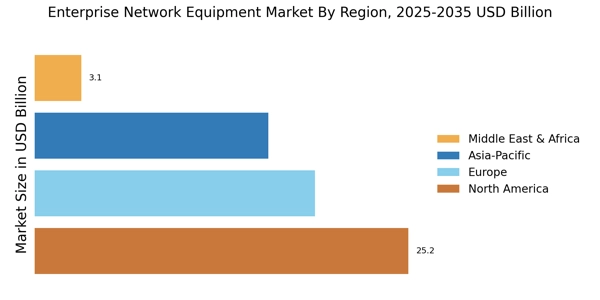
North America remains the largest market for enterprise network equipment, holding approximately 40% of the global share. The region's growth is driven by rapid technological advancements, increasing demand for cloud services, and robust investments in IT infrastructure. Regulatory support for digital transformation initiatives further catalyzes market expansion, making it a key player in the global landscape. The United States leads the market, with major players like Cisco Systems, Juniper Networks, and Arista Networks headquartered here. The competitive landscape is characterized by continuous innovation and strategic partnerships among these companies. Additionally, the presence of advanced research institutions fosters a culture of innovation, ensuring that North America remains at the forefront of network technology development.

Europe : Regulatory Support and Growth

Europe is the second-largest market for enterprise network equipment, accounting for around 30% of the global share. The region's growth is propelled by stringent regulations aimed at enhancing cybersecurity and data protection, alongside increasing investments in 5G technology. The European Union's Digital Single Market strategy further supports the expansion of digital infrastructure, creating a favorable environment for market players. Leading countries in this region include Germany, the UK, and France, where companies like Nokia and Huawei Technologies are prominent. The competitive landscape is marked by a mix of established firms and innovative startups, driving advancements in network solutions. The presence of regulatory bodies ensures compliance and fosters a secure environment for technological growth, enhancing the overall market dynamics.

Asia-Pacific : Rapid Growth and Adoption

Asia-Pacific is witnessing rapid growth in the enterprise network equipment market, holding approximately 25% of the global share. The region's expansion is driven by increasing internet penetration, the rise of smart cities, and significant investments in telecommunications infrastructure. Government initiatives aimed at digital transformation and smart technology adoption further catalyze market growth, making it a key area for future developments. China and India are the leading countries in this region, with major players like Huawei Technologies and ZTE Corporation dominating the market. The competitive landscape is characterized by aggressive pricing strategies and a focus on innovation. As the demand for advanced networking solutions continues to rise, the presence of both local and international players enhances the market's dynamism and competitiveness.

Middle East and Africa : Emerging Market Potential

The Middle East and Africa region is emerging as a significant player in the enterprise network equipment market, holding about 5% of the global share. The growth is driven by increasing investments in digital infrastructure, government initiatives to enhance connectivity, and the rising demand for cloud-based solutions. The region's diverse economic landscape presents unique opportunities for market expansion, particularly in sectors like telecommunications and finance. Leading countries include South Africa and the UAE, where companies are increasingly adopting advanced networking technologies. The competitive landscape is evolving, with both local and international players vying for market share. As the region continues to invest in technology and infrastructure, the potential for growth in the enterprise network equipment market remains substantial.

Enterprise Network Equipment Market
 Regional Image

Key Players and Competitive Insights

The Enterprise Network Equipment Market is currently characterized by a dynamic competitive landscape, driven by rapid technological advancements and increasing demand for robust network infrastructure. Key players such as Cisco Systems (US), Juniper Networks (US), and Arista Networks (US) are strategically positioned to leverage innovation and digital transformation. Cisco Systems (US) continues to focus on enhancing its software capabilities, while Juniper Networks (US) emphasizes its commitment to AI-driven networking solutions. Arista Networks (US) is also making strides in cloud networking, which collectively shapes a competitive environment that prioritizes agility and technological prowess.

In terms of business tactics, companies are increasingly localizing manufacturing and optimizing supply chains to enhance operational efficiency. The market appears moderately fragmented, with several key players exerting substantial influence. This structure allows for a diverse range of offerings, catering to various customer needs while fostering healthy competition among established and emerging players.

In August 2025, Cisco Systems (US) announced a strategic partnership with a leading cloud service provider to enhance its cloud networking solutions. This collaboration is expected to bolster Cisco's position in the cloud segment, allowing it to offer more integrated solutions that meet the evolving demands of enterprises. The partnership signifies a shift towards more collaborative approaches in the industry, aligning with the growing trend of cloud adoption.

In September 2025, Juniper Networks (US) unveiled its latest AI-driven network management platform, which aims to simplify network operations for enterprises. This launch reflects Juniper's focus on leveraging artificial intelligence to enhance network performance and reliability. By integrating AI capabilities, Juniper positions itself as a leader in the next generation of network management, potentially attracting a broader customer base seeking advanced solutions.

In July 2025, Arista Networks (US) expanded its product portfolio by introducing a new line of high-performance switches designed for data centers. This move is indicative of Arista's commitment to innovation and its strategy to capture market share in the growing data center segment. The introduction of these switches is likely to enhance Arista's competitive edge, particularly as enterprises increasingly prioritize high-speed connectivity and scalability.

As of October 2025, the competitive trends in the Enterprise Network Equipment Market are heavily influenced by digitalization, sustainability, and the integration of AI technologies. Strategic alliances are becoming more prevalent, as companies recognize the need for collaboration to drive innovation and meet customer demands. Looking ahead, competitive differentiation is expected to evolve, with a notable shift from price-based competition towards a focus on technological innovation, reliability in supply chains, and the ability to deliver comprehensive solutions that address the complexities of modern networking.

Key Companies in the Enterprise Network Equipment Market market include

Industry Developments

  • Q2 2024: Hewlett-Packard Enterprise (HPE) launches HPE Aruba Networking Enterprise Private 5G HPE expanded its networking solutions by launching the HPE Aruba Networking Enterprise Private 5G, integrating with its GreenLake cloud platform to deliver secure, high-speed connectivity for enterprise environments.
  • Q1 2024: Huawei introduces Net5.5G Converged WAN solution at MWC Barcelona Huawei unveiled its Net5.5G Converged WAN solution, designed to accelerate intelligent transformation for enterprises by providing secure WANs with simplified architecture and intelligent operations.

Future Outlook

Enterprise Network Equipment Market Future Outlook

The Enterprise Network Equipment Market is projected to grow at a 5.25% CAGR from 2024 to 2035, driven by increasing demand for cloud services, IoT integration, and enhanced cybersecurity measures.

New opportunities lie in:

  • Development of AI-driven network management solutions.
  • Expansion into edge computing infrastructure.
  • Integration of advanced security protocols in network devices.

By 2035, the market is expected to be robust, reflecting substantial growth and innovation.

Market Segmentation

Enterprise Network Equipment Market Type Outlook

  • Routers
  • Switches
  • Firewalls
  • Access Points
  • Load Balancers

Enterprise Network Equipment Market End User Outlook

  • Small and Medium Enterprises
  • Large Enterprises
  • Government Organizations
  • Educational Institutions

Enterprise Network Equipment Market Deployment Type Outlook

  • On-Premises
  • Cloud-Based
  • Hybrid

Enterprise Network Equipment Market Networking Technology Outlook

  • Ethernet
  • Wireless
  • SD-WAN
  • MPLS
  • VPN

Report Scope

MARKET SIZE 202462.94(USD Billion)
MARKET SIZE 202566.25(USD Billion)
MARKET SIZE 2035110.52(USD Billion)
COMPOUND ANNUAL GROWTH RATE (CAGR)5.25% (2024 - 2035)
REPORT COVERAGERevenue Forecast, Competitive Landscape, Growth Factors, and Trends
BASE YEAR2024
Market Forecast Period2025 - 2035
Historical Data2019 - 2024
Market Forecast UnitsUSD Billion
Key Companies ProfiledMarket analysis in progress
Segments CoveredMarket segmentation analysis in progress
Key Market OpportunitiesIntegration of artificial intelligence in network management enhances efficiency in the Enterprise Network Equipment Market.
Key Market DynamicsRising demand for advanced cybersecurity solutions drives innovation in the Enterprise Network Equipment Market.
Countries CoveredNorth America, Europe, APAC, South America, MEA

Leave a Comment

FAQs

What is the projected market valuation of the Enterprise Network Equipment Market by 2035?

The projected market valuation for the Enterprise Network Equipment Market is 110.52 USD Billion by 2035.

What was the overall market valuation of the Enterprise Network Equipment Market in 2024?

The overall market valuation of the Enterprise Network Equipment Market was 62.94 USD Billion in 2024.

What is the expected CAGR for the Enterprise Network Equipment Market during the forecast period 2025 - 2035?

The expected CAGR for the Enterprise Network Equipment Market during the forecast period 2025 - 2035 is 5.25%.

Which companies are considered key players in the Enterprise Network Equipment Market?

Key players in the Enterprise Network Equipment Market include Cisco Systems, Juniper Networks, Arista Networks, and others.

What are the projected valuations for routers in the Enterprise Network Equipment Market by 2035?

The projected valuation for routers in the Enterprise Network Equipment Market is expected to reach between 25.0 and 35.0 USD Billion by 2035.

How do the projected valuations for switches compare to those for firewalls by 2035?

By 2035, the projected valuation for switches is anticipated to be between 35.0 and 45.0 USD Billion, whereas firewalls are expected to reach between 18.0 and 25.0 USD Billion.

What is the expected market size for cloud-based deployment in the Enterprise Network Equipment Market by 2035?

The expected market size for cloud-based deployment in the Enterprise Network Equipment Market is projected to be between 20.0 and 35.0 USD Billion by 2035.

What segment is expected to have the highest valuation in the Enterprise Network Equipment Market by 2035?

Large enterprises are expected to have the highest valuation in the Enterprise Network Equipment Market, projected between 25.0 and 45.0 USD Billion by 2035.

What is the anticipated growth for wireless networking technology in the Enterprise Network Equipment Market by 2035?

The anticipated growth for wireless networking technology is projected to reach between 15.0 and 25.0 USD Billion by 2035.

How does the market for access points compare to that of load balancers by 2035?

By 2035, the market for access points is projected to be between 15.0 and 25.0 USD Billion, while load balancers are expected to reach between 17.52 and 25.0 USD Billion.

Download Free Sample

Kindly complete the form below to receive a free sample of this Report

Compare Licence

×
Features License Type
Single User Multiuser License Enterprise User
Price $4,950 $5,950 $7,250
Maximum User Access Limit 1 User Upto 10 Users Unrestricted Access Throughout the Organization
Free Customization
Direct Access to Analyst
Deliverable Format
Platform Access
Discount on Next Purchase 10% 15% 15%
Printable Versions