×
Request Free Sample ×

Kindly complete the form below to receive a free sample of this Report

* Please use a valid business email

Leading companies partner with us for data-driven Insights

clients tt-cursor
Hero Background

Europe Applied Ai In Education Market

ID: MRFR/ICT/63184-HCR
200 Pages
Aarti Dhapte
October 2025

Europe Applied AI in Education Market Research Report By Component (Solutions, Services), By Deployment (Cloud-based, On-premises), By Technology (Machine Learning, Computer Vision, Virtual Assistants/Chatbots), By Application (Virtual Facilitators for IT Automation, Intelligent Tutoring Systems, Content Delivery Systems, Fraud and Risk Management, Student-centric Recommendation Systems) and By Regional (Germany, UK, France, Russia, Italy, Spain, Rest of Europe) - Forecast to 2035

Share:
Download PDF ×

We do not share your information with anyone. However, we may send you emails based on your report interest from time to time. You may contact us at any time to opt-out.

Europe Applied Ai In Education Market Infographic
Purchase Options

Europe Applied Ai In Education Market Summary

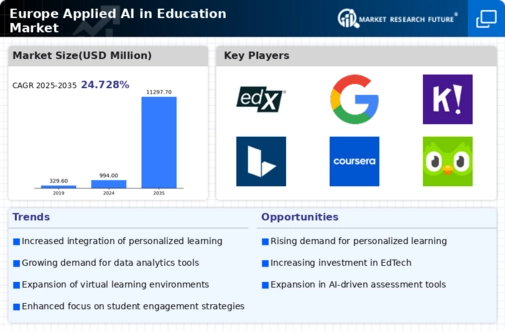
As per MRFR analysis, the applied AI in education market size was estimated at 996.96 USD Million in 2024. The applied ai-in-education market is projected to grow from 1242.21 USD Million in 2025 to 11200.0 USD Million by 2035, exhibiting a compound annual growth rate (CAGR) of 24.6% during the forecast period 2025 - 2035.

Key Market Trends & Highlights

The Europe applied AI-in-education market is experiencing robust growth driven by innovative solutions and increasing demand for personalized learning.

  • Personalized learning solutions are gaining traction, particularly in Germany, which is the largest market for applied AI in education.
  • Data analytics in education is becoming increasingly vital, with the UK emerging as the fastest-growing region in this sector.
  • Automation of administrative tasks is streamlining operations, allowing educators to focus more on teaching and student engagement.
  • The integration of AI technologies and government initiatives are key drivers propelling market expansion across Europe.

Market Size & Forecast

2024 Market Size 996.96 (USD Million)
2035 Market Size 11200.0 (USD Million)
CAGR (2025 - 2035) 24.6%

Major Players

Google (US), Microsoft (US), IBM (US), Pearson (GB), Coursera (US), Duolingo (US), Knewton (US), Squirrel AI (CN), Edmodo (US)

Europe Applied Ai In Education Market Trends

the applied AI in education market is experiencing a transformative phase, driven by advancements in technology and an increasing demand for personalized learning experiences. Educational institutions are increasingly adopting artificial intelligence tools to enhance teaching methodologies and improve student engagement. This shift appears to be influenced by the need for more efficient administrative processes and the desire to provide tailored educational content that meets diverse learner needs. As a result, the integration of ai technologies into educational frameworks is becoming more prevalent, suggesting a potential for significant growth in this sector. Moreover, the emphasis on data-driven decision-making in education is likely to propel the applied ai-in-education market further. Institutions are utilizing ai to analyze student performance and learning patterns, which may lead to improved educational outcomes. The focus on lifelong learning and upskilling in the workforce also indicates a growing market for ai-driven educational solutions. As the landscape evolves, stakeholders in the education sector are expected to explore innovative applications of ai, potentially reshaping the future of learning and teaching methodologies.

Personalized Learning Solutions

The demand for personalized learning experiences is rising, with ai technologies enabling tailored educational content. This trend suggests that institutions are increasingly focusing on individual student needs, allowing for customized learning paths that enhance engagement and retention.

Data Analytics in Education

The application of data analytics is becoming more prominent, as educational institutions leverage ai to assess student performance. This trend indicates a shift towards data-driven strategies that aim to improve educational outcomes and inform teaching practices.

Automation of Administrative Tasks

There is a growing trend towards automating administrative processes within educational institutions. By utilizing ai, schools and universities can streamline operations, reduce workload, and allocate resources more effectively, thereby enhancing overall efficiency.

Europe Applied Ai In Education Market Drivers

Integration of AI Technologies

The integration of AI technologies into educational frameworks is a pivotal driver for the applied ai-in-education market in Europe. Educational institutions are increasingly adopting AI tools to enhance learning experiences and streamline operations. For instance, AI-driven platforms can analyze student performance data, enabling personalized learning pathways. In 2025, it is estimated that the market for AI in education will reach approximately €1.5 billion, reflecting a growing recognition of AI's potential to transform traditional educational methodologies. This integration not only improves student engagement but also equips educators with valuable insights, thereby fostering a more effective learning environment.

Government Initiatives and Funding

Government initiatives and funding play a crucial role in propelling the applied ai-in-education market in Europe. Various European governments are investing in AI research and development, particularly in the education sector. For example, the European Commission has allocated substantial funds to support AI projects aimed at enhancing educational outcomes. In 2025, public funding for AI in education is projected to exceed €500 million, indicating a strong commitment to leveraging technology for educational advancement. These initiatives not only facilitate the development of innovative AI solutions but also encourage collaboration between educational institutions and tech companies, fostering a vibrant ecosystem for AI in education.

Increased Focus on Skill Development

An increased focus on skill development is emerging as a significant driver for the applied ai-in-education market in Europe. As the job market evolves, educational institutions are recognizing the necessity of equipping students with relevant skills. AI technologies are being employed to create adaptive learning systems that cater to individual skill gaps. By 2025, it is projected that the demand for AI-driven skill development tools will grow by over 40%, reflecting a shift towards competency-based education. This emphasis on skill development not only prepares students for future employment but also aligns educational outcomes with industry needs, thereby enhancing the overall effectiveness of the education system.

Rising Demand for Remote Learning Solutions

The rising demand for remote learning solutions significantly influences the applied ai-in-education market in Europe. As educational institutions adapt to changing learning environments, AI technologies are being utilized to create effective remote learning platforms. These platforms often incorporate AI-driven tools that facilitate real-time feedback and personalized learning experiences. In 2025, it is anticipated that the market for remote learning solutions will account for approximately 30% of the overall ai-in-education market share in Europe. This shift towards remote learning not only enhances accessibility for students but also drives innovation in educational technology, further solidifying the role of AI in education.

Collaboration Between Educational Institutions and Tech Companies

Collaboration between educational institutions and tech companies is a vital driver for the applied ai-in-education market in Europe. Partnerships are being formed to develop innovative AI solutions tailored to educational needs. These collaborations often result in the creation of cutting-edge tools that enhance teaching and learning processes. In 2025, it is expected that such partnerships will contribute to a market growth rate of approximately 25%, as institutions seek to leverage technological advancements. This synergy not only fosters innovation but also ensures that educational practices remain relevant in an increasingly digital world, thereby reinforcing the importance of AI in education.


Market Segment Insights

By Component: Solutions (Largest) vs. Services (Fastest-Growing)

In the Component segment of the applied ai-in-education market, Solutions hold a significant market share, driven by the increasing adoption of technology in classrooms across Europe. These solutions encompass software applications, AI-driven tools, and data management systems that enhance learning and administrative efficiency. On the other hand, Services, which include AI consultancy, implementation, and support, are emerging rapidly, reflecting a shift towards integrated solutions as educational institutions look to leverage AI's potential fully. The growth in the Solutions value is propelled by ongoing investments in educational technology and the demand for tailored software that meets specific learning needs. Meanwhile, the Services segment is witnessing a surge due to the increasing complexity of AI implementations and the need for continuous support and training. Organizations are prioritizing partnerships with service providers who can offer expertise in deploying AI technologies effectively, thereby solidifying the Services' position as the fastest-growing component in this market.

Solutions: (Dominant) vs. Services (Emerging)

Solutions in the applied ai-in-education market are characterized by a robust offering of software applications designed to streamline educational processes and enhance user engagement. They are seen as the dominant force, accommodating a wide range of functionalities from personalized learning to administrative aids. Conversely, the Services aspect is emerging rapidly, focusing on consultancy and operational support related to AI implementation. It addresses the growing need for expertise in integrating AI solutions effectively within educational frameworks. The services are gaining traction as institutions recognize that merely adopting technology is insufficient without the right guidance and ongoing assistance. Together, these components reflect the growing commitment to innovation in education.

By Deployment: Cloud-based (Largest) vs. On-premises (Fastest-Growing)

The market dynamics show a clear preference for cloud-based solutions, which currently constitute the largest share in the deployment segment. Institutions favor cloud solutions due to their scalability, ease of access, and lower upfront costs. On-premises solutions, while trailing in market share, hold a dedicated user base that prioritizes data security and control over their technological resources. Growth trends indicate that the on-premises deployment is becoming the fastest-growing segment, driven by increasing concerns about data privacy and the need for customized solutions. As educational entities adapt to more stringent data regulations, there is a renewed interest in on-premises systems, despite the widespread adoption of cloud-based platforms. Both segments contribute to enhancing AI capabilities in education, but their growth narratives diverge significantly.

Deployment: Cloud-based (Dominant) vs. On-premises (Emerging)

Cloud-based deployment stands out as the dominant force in the education sector, leveraging its flexibility and cost-effectiveness. This model enables institutions to effortlessly integrate AI technologies, allowing for real-time updates and significant scalability. On the other hand, on-premises solutions are emerging as a strong contender, characterized by their robustness and security features that appeal to institutions handling sensitive data. These systems require substantial initial investment but are favored by organizations that prioritize data sovereignty and control over infrastructure. Together, these deployment models reflect the evolving landscape of educational technology, each catering to specific institutional needs and preferences.

By Technology: Machine Learning (Largest) vs. Virtual Assistants/Chatbots (Fastest-Growing)

In the applied ai-in-education market, Machine Learning holds the largest market share, significantly influencing the landscape of educational technologies. Virtual Assistants and Chatbots, while currently smaller in market share, are rapidly gaining traction due to increasing demands for personalized learning experiences. Together, these technologies shape innovative solutions that enhance educational outcomes and accessibility. The growth trends for these technologies are propelled by advancements in processing power and increasing data availability. Educational institutions are progressively investing in Machine Learning to analyze student performance and optimize learning pathways. Conversely, Virtual Assistants and Chatbots are emerging rapidly due to their ability to provide 24/7 support and enhance engagement, making them desirable tools for modern educational settings.

Technology: Machine Learning (Dominant) vs. Virtual Assistants/Chatbots (Emerging)

Machine Learning is dominating the applied ai-in-education sector as it enables data-driven insights into student behaviors and learning patterns. Its widespread applications include adaptive learning technologies and predictive analytics that allow educators to tailor their teaching methods. On the other hand, Virtual Assistants and Chatbots represent an emerging segment within this marketplace, offering instant interaction capabilities that enhance user experience. These tools facilitate administrative tasks, assist in tutoring, and offer personalized guidance to students, making them crucial for schools looking to adopt innovative technological solutions.

By Application: Intelligent Tutoring Systems (Largest) vs. Student-centric Recommendation Systems (Fastest-Growing)

The distribution of market share among the application segment values reveals that Intelligent Tutoring Systems hold the largest share, significantly contributing to overall advancements within educational technologies. Following closely are Virtual Facilitators for IT Automation and Content Delivery Systems, which also present substantial market presence but cater to distinct educational needs. Fraud and Risk Management solutions remain vital for safeguarding institutions, emphasizing the diverse applications of AI in education. Growth trends in the application segment indicate a rapid expansion driven by increased investment in personalized learning experiences and technological advancements. The demand for Intelligent Tutoring Systems continues to rise due to their effectiveness in enhancing student engagement and performance. Meanwhile, Student-centric Recommendation Systems are emerging as critical tools in facilitating tailored learning paths, making them the fastest-growing area, reflecting a shift towards more individualized educational experiences.

Intelligent Tutoring Systems (Dominant) vs. Student-centric Recommendation Systems (Emerging)

Intelligent Tutoring Systems represent a dominant force in the application segment, providing personalized learning experiences by adapting to individual student needs and performance levels. These systems utilize AI algorithms to assess learner progress, offering tailored feedback and support. In contrast, Student-centric Recommendation Systems are emerging as vital tools aimed at enhancing student engagement through personalized content suggestions and learning pathways. They leverage data analytics to optimize learning experiences and are gaining traction as educational institutions increasingly prioritize individualized experiences. Together, these systems illustrate the growing trend of AI integration in education, emphasizing tailored solutions that cater to unique learner requirements while improving educational outcomes.

Get more detailed insights about Europe Applied Ai In Education Market

Regional Insights

Germany : Strong Infrastructure and Innovation

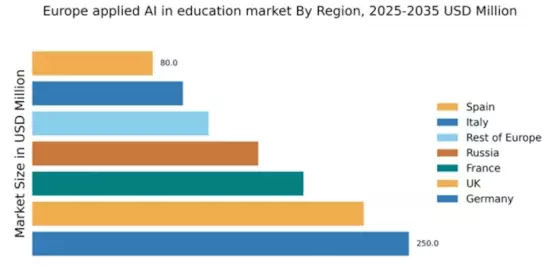
Germany holds a dominant position in the European AI-in-education market, valued at $250.0 million, representing approximately 30% of the total market share. Key growth drivers include robust government initiatives promoting digital education, significant investments in technology infrastructure, and a strong emphasis on STEM education. Demand trends show increasing adoption of AI tools in both K-12 and higher education, supported by favorable regulatory policies aimed at enhancing digital literacy and educational outcomes.

UK : Innovative Learning Solutions Emerging

The UK market for AI in education is valued at $220.0 million, accounting for about 26% of the European market. Growth is driven by a strong focus on personalized learning and the integration of AI tools in classrooms. The UK government has launched several initiatives to support digital education, including funding for AI research in educational settings. Consumption patterns indicate a rising demand for online learning platforms and adaptive learning technologies, reflecting a shift towards flexible education solutions.

France : Government Support and Investment

France's AI-in-education market is valued at $180.0 million, representing roughly 22% of the European market. Key growth drivers include government-backed initiatives aimed at integrating AI into educational curricula and significant investments in digital infrastructure. Demand trends show a growing interest in AI-driven tutoring systems and educational software, supported by policies promoting innovation in education. The French education system is increasingly adopting blended learning models, combining traditional and digital methods.

Russia : Focus on Digital Transformation

Russia's AI-in-education market is valued at $150.0 million, making up about 18% of the European market. The growth is fueled by a national strategy for digital transformation in education, emphasizing the use of AI to enhance learning outcomes. Demand trends indicate a rising interest in online education platforms and AI-based assessment tools. The Russian government is actively promoting digital literacy initiatives, which are crucial for the integration of AI technologies in schools and universities.

Italy : Investment in Digital Learning

Italy's AI-in-education market is valued at $100.0 million, representing approximately 12% of the European market. The growth is driven by increasing investments in digital learning solutions and a focus on enhancing educational quality through technology. Demand trends show a rising adoption of AI tools in vocational training and higher education. The Italian government has introduced policies to support digital education initiatives, fostering a conducive environment for AI integration in schools.

Spain : Innovative Approaches to Learning

Spain's AI-in-education market is valued at $80.0 million, accounting for about 10% of the European market. The growth is supported by a strong emphasis on innovative teaching methods and the integration of AI technologies in educational institutions. Demand trends indicate a shift towards personalized learning experiences, with increasing adoption of AI-driven platforms. The Spanish government is implementing policies to enhance digital education, promoting the use of technology in classrooms and online learning environments.

Rest of Europe : Varied Market Dynamics Across Regions

The Rest of Europe market for AI in education is valued at $116.96 million, reflecting diverse growth opportunities across various countries. Key growth drivers include localized government initiatives and varying levels of investment in digital education. Demand trends show a mix of traditional and innovative educational approaches, with some regions focusing on vocational training and others on higher education. The competitive landscape features both local and international players, adapting to regional market needs.

Europe Applied Ai In Education Market Regional Image

Key Players and Competitive Insights

The applied ai-in-education market is currently characterized by a dynamic competitive landscape, driven by rapid technological advancements and an increasing demand for personalized learning experiences. Major players such as Google (US), Microsoft (US), and Pearson (GB) are strategically positioning themselves through innovation and partnerships. Google (US) focuses on enhancing its educational tools with AI capabilities, while Microsoft (US) emphasizes integrating AI into its existing platforms to improve user engagement and learning outcomes. Pearson (GB) is actively pursuing digital transformation initiatives, aiming to leverage AI for content personalization and adaptive learning solutions. Collectively, these strategies contribute to a competitive environment that is increasingly centered around technological integration and user-centric solutions.

Key business tactics within this market include localized content development and strategic partnerships aimed at enhancing educational offerings. The competitive structure appears moderately fragmented, with a mix of established corporations and emerging startups vying for market share. The influence of key players is significant, as their investments in AI technologies and educational resources shape the overall direction of the market.

In October 2025, Google (US) announced the launch of its AI-driven educational platform, which utilizes machine learning algorithms to tailor learning experiences to individual student needs. This strategic move is likely to enhance user engagement and retention, positioning Google (US) as a leader in personalized education solutions. The platform's ability to analyze student performance data in real-time may provide educators with valuable insights, thereby improving teaching methodologies.

In September 2025, Microsoft (US) expanded its partnership with various educational institutions across Europe to implement AI tools in classrooms. This initiative aims to facilitate a more interactive learning environment and improve educational outcomes. By collaborating with schools, Microsoft (US) not only strengthens its market presence but also demonstrates a commitment to enhancing educational experiences through technology.

In August 2025, Pearson (GB) launched a new suite of AI-powered learning resources designed to adapt to the unique learning styles of students. This initiative reflects Pearson's (GB) focus on digital transformation and its intent to remain competitive in a rapidly evolving market. The introduction of these resources is expected to attract a broader audience, as they cater to diverse educational needs and preferences.

As of November 2025, current trends in the applied ai-in-education market include a pronounced shift towards digitalization and the integration of AI technologies. Strategic alliances among key players are increasingly shaping the competitive landscape, fostering innovation and collaboration. The evolution of competitive differentiation appears to be moving away from price-based strategies towards a focus on technological innovation, enhanced user experiences, and supply chain reliability. This shift suggests that companies will need to prioritize their R&D efforts and forge strategic partnerships to maintain a competitive edge in the future.

Key Companies in the Europe Applied Ai In Education Market market include

Industry Developments

The Europe Applied AI in Education Market has seen significant growth and activity in recent months. Companies like edX and Coursera have advanced their online education offerings by integrating AI-driven personalized learning experiences, which have become increasingly popular due to the rise of remote learning. In addition, Duolingo has launched new features using AI to enhance language learning, catering to the growing demand for interactive educational tools. In partnership with Emeritus, Cambridge Judge Business School Executive Education introduced the AI Leadership Program in July 2025. In order to promote innovation, quicken organizational growth, and strengthen resilience in the education sector, this initiative will investigate future-focused AI frameworks and tactics. Alibaba Cloud introduced new AI tools and educational collaborations in Europe in June 2025.

As the need for AI in education grows, Alibaba's Platform for AI (PAI) has been upgraded to increase scalability and efficiency for AI workloads throughout its Frankfurt cloud area. Through education, training, skilling, and reskilling initiatives, the European Commission launched the €200 billion InvestAI project in February 2025 with the goal of bolstering the EU's generative AI talent pool. AI education is a key component of this strategy, which aims to equip the workforce for upcoming difficulties.As Artificial Intelligence continues to transform education, the market in Europe is expected to leverage these innovations further, responding to current educational challenges and opportunities.


Future Outlook

Europe Applied Ai In Education Market Future Outlook

the applied AI in education market is expected to grow at a 24.6% CAGR from 2024 to 2035, driven by technological advancements, increased investment, and demand for personalized learning solutions.

New opportunities lie in:

  • Development of AI-driven personalized learning platforms for diverse learning styles.
  • Integration of AI analytics tools for real-time student performance tracking.
  • Creation of AI-based tutoring systems to enhance student engagement and outcomes.

By 2035, the market is expected to be robust, reflecting substantial growth and innovation.

Market Segmentation

Europe Applied Ai In Education Market Component Outlook

  • Solutions
  • Services

Europe Applied Ai In Education Market Deployment Outlook

  • Cloud-based
  • On-premises

Europe Applied Ai In Education Market Technology Outlook

  • Machine Learning
  • Computer Vision
  • Virtual Assistants/Chatbots

Europe Applied Ai In Education Market Application Outlook

  • Virtual Facilitators for IT Automation
  • Intelligent Tutoring Systems
  • Content Delivery Systems
  • Fraud and Risk Management
  • Student-centric Recommendation Systems

Report Scope

MARKET SIZE 2024 996.96(USD Million)
MARKET SIZE 2025 1242.21(USD Million)
MARKET SIZE 2035 11200.0(USD Million)
COMPOUND ANNUAL GROWTH RATE (CAGR) 24.6% (2024 - 2035)
REPORT COVERAGE Revenue Forecast, Competitive Landscape, Growth Factors, and Trends
BASE YEAR 2024
Market Forecast Period 2025 - 2035
Historical Data 2019 - 2024
Market Forecast Units USD Million
Key Companies Profiled ["Google (US)", "Microsoft (US)", "IBM (US)", "Pearson (GB)", "Coursera (US)", "Duolingo (US)", "Knewton (US)", "Squirrel AI (CN)", "Edmodo (US)"]
Segments Covered Component, Deployment, Technology, Application
Key Market Opportunities Integration of personalized learning solutions leveraging artificial intelligence to enhance student engagement and outcomes.
Key Market Dynamics Growing demand for personalized learning solutions drives innovation in the applied ai-in-education market.
Countries Covered Germany, UK, France, Russia, Italy, Spain, Rest of Europe

Leave a Comment

FAQs

What is the expected market size of the Europe Applied AI in Education Market by 2035?

The Europe Applied AI in Education Market is expected to be valued at approximately 11298.05 million USD by 2035.

What is the CAGR for the Europe Applied AI in Education Market from 2025 to 2035?

The market is projected to grow at a CAGR of 24.728% from 2025 to 2035.

Which region holds the largest market share in the Europe Applied AI in Education Market in 2024?

Germany holds the largest market share in the Europe Applied AI in Education Market, valued at 300.0 million USD in 2024.

What will be the market size for Solutions and Services in the Europe Applied AI in Education Market by 2035?

By 2035, the Solutions segment is expected to be valued at 4687.75 million USD, while the Services segment is projected to reach 6609.3 million USD.

What is the market size in the UK for the Europe Applied AI in Education Market for 2024?

The market size in the UK for the Europe Applied AI in Education Market is valued at 250.0 million USD in 2024.

Who are the key players in the Europe Applied AI in Education Market?

Some of the key players in the market include Google, IBM, Microsoft, and Coursera.

What will the market value be for France by 2035?

The market value for France in the Europe Applied AI in Education Market is expected to reach 2500.0 million USD by 2035.

How will the market in Italy grow from 2024 to 2035?

The market in Italy is projected to grow from 94.0 million USD in 2024 to 1073.05 million USD by 2035.

What challenges may impact the growth of the Europe Applied AI in Education Market?

Key challenges include adapting to rapidly evolving technology and ensuring data privacy and security.

How much is the Russia market valued at in 2024?

The Russia segment of the Europe Applied AI in Education Market is valued at 150.0 million USD in 2024.

Download Free Sample

Kindly complete the form below to receive a free sample of this Report

Compare Licence

×
Features License Type
Single User Multiuser License Enterprise User
Price $4,950 $5,950 $7,250
Maximum User Access Limit 1 User Upto 10 Users Unrestricted Access Throughout the Organization
Free Customization
Direct Access to Analyst
Deliverable Format
Platform Access
Discount on Next Purchase 10% 15% 15%
Printable Versions