×
Request Free Sample ×

Kindly complete the form below to receive a free sample of this Report

* Please use a valid business email

Leading companies partner with us for data-driven Insights

clients tt-cursor
Hero Background

Europe Chemical Distribution Market

ID: MRFR/CnM/46165-HCR
111 Pages
Chitranshi Jaiswal
October 2025

Europe Chemical Distribution Market Research Report By Product Type (specialty chemicals, commodity chemicals), By End User (automotive, electronics, construction, oil & gas, petroleum, pharmaceuticals, textiles, others) and By Regional (Germany, UK, France, Russia, Italy, Spain, Rest of Europe)- Forecast to 2035.

Share:
Download PDF ×

We do not share your information with anyone. However, we may send you emails based on your report interest from time to time. You may contact us at any time to opt-out.

Europe Chemical Distribution Market Infographic
Purchase Options

Europe Chemical Distribution Market Summary

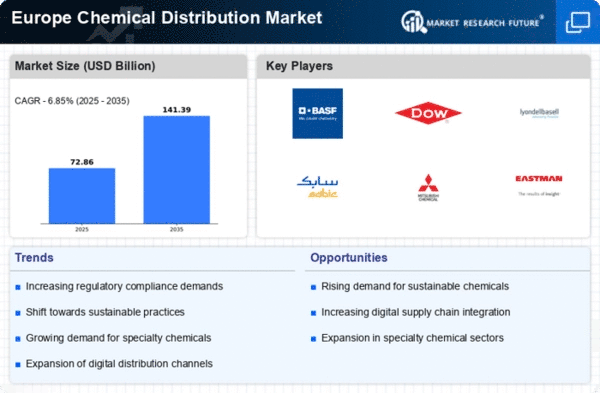
As per MRFR analysis, the Europe chemical distribution market size was estimated at 68.19 USD Billion in 2024. The Europe chemical distribution market is projected to grow from 72.86 USD Billion in 2025 to 141.39 USD Billion by 2035, exhibiting a compound annual growth rate (CAGR) of 6.85% during the forecast period 2025 - 2035.

Key Market Trends & Highlights

The Europe chemical distribution market is currently experiencing a transformative phase driven by sustainability and digitalization.

  • Germany remains the largest market for chemical distribution, showcasing robust demand across various sectors.
  • The UK is emerging as the fastest-growing region, reflecting a shift towards innovative distribution practices.
  • Sustainability initiatives and digital transformation are reshaping operational strategies within the market.
  • Regulatory compliance pressure and the growing demand for specialty chemicals are key drivers influencing market dynamics.

Market Size & Forecast

2024 Market Size 68.19 (USD Billion)
2035 Market Size 141.39 (USD Billion)
CAGR (2025 - 2035) 6.85%

Major Players

BASF (DE), Dow (US), LyondellBasell (US), SABIC (SA), Mitsubishi Chemical (JP), Eastman Chemical (US), Univar Solutions (US), Huntsman Corporation (US), Solvay (BE)

Europe Chemical Distribution Market Trends

The chemical distribution market is currently experiencing a dynamic phase. This phase is characterized by evolving regulatory frameworks and increasing demand for sustainable practices. As environmental concerns gain prominence, distributors are adapting their operations to comply with stringent regulations aimed at reducing carbon footprints. This shift not only influences sourcing and logistics but also encourages innovation in product offerings. Furthermore, the market is witnessing a rise in digitalization, with companies leveraging technology to enhance supply chain efficiency and customer engagement. The integration of advanced analytics and automation tools appears to streamline operations, potentially leading to cost reductions and improved service delivery. In addition, the chemical distribution market is seeing a notable trend towards consolidation. Mergers and acquisitions are becoming more prevalent as companies seek to expand their market presence and diversify their product portfolios. This consolidation may lead to enhanced competitiveness and the ability to offer a broader range of solutions to customers. Overall, the landscape of the chemical distribution market is shifting, driven by regulatory changes, technological advancements, and strategic partnerships that aim to meet the evolving needs of the industry.

Sustainability Initiatives

The emphasis on sustainability is reshaping the chemical distribution market. Distributors are increasingly adopting eco-friendly practices, such as reducing waste and optimizing transportation routes. This trend aligns with regulatory pressures and consumer preferences for greener products.

Digital Transformation

Digitalization is transforming operations within the chemical distribution market. Companies are implementing advanced technologies to enhance supply chain management, improve customer interactions, and increase operational efficiency. This shift is likely to redefine traditional distribution models.

Consolidation Trends

The chemical distribution market is experiencing a wave of consolidation as companies pursue mergers and acquisitions. This trend may enhance market competitiveness and enable firms to offer a wider array of products and services, responding effectively to customer demands.

Europe Chemical Distribution Market Drivers

Regulatory Compliance Pressure

The chemical distribution market in Europe faces increasing regulatory compliance pressure, driven by stringent environmental and safety regulations. The European Union's REACH (Registration, Evaluation, Authorisation and Restriction of Chemicals) regulation mandates comprehensive data on chemical substances, compelling distributors to invest in compliance measures. This has led to a projected increase in compliance-related costs by approximately 15% over the next five years. As companies strive to meet these regulations, the demand for specialized distribution services that ensure compliance is likely to rise, thereby shaping the market dynamics. Furthermore, the emphasis on sustainability within these regulations may push distributors to adopt greener practices, influencing their operational strategies and supply chain management in the chemical distribution market.

Shift Towards Circular Economy

The shift towards a circular economy is influencing the chemical distribution market in Europe. This paradigm encourages the reuse and recycling of materials, which is reshaping supply chains and distribution strategies. Companies are increasingly seeking sustainable sourcing options and eco-friendly products, prompting distributors to align their offerings with these principles. The European Commission's Circular Economy Action Plan aims to make sustainable products the norm, which could lead to a 30% reduction in resource consumption by 2030. This transition presents both challenges and opportunities for distributors, as they must innovate to meet the evolving demands of environmentally conscious consumers in the chemical distribution market.

Growing Demand for Specialty Chemicals

The growing demand for specialty chemicals is a significant driver in the chemical distribution market in Europe. Industries such as automotive, pharmaceuticals, and agriculture are increasingly relying on specialty chemicals for their unique properties and applications. The market for specialty chemicals is projected to grow at a CAGR of 4.5% through 2027, indicating a robust demand trajectory. This trend compels distributors to adapt their product offerings and supply chains to meet the specific needs of these industries. As a result, distributors are likely to focus on sourcing high-quality specialty chemicals, enhancing their value proposition in the chemical distribution market.

Technological Advancements in Logistics

Technological advancements in logistics are transforming the chemical distribution market in Europe. Innovations such as automated warehousing, real-time tracking systems, and advanced inventory management software are enhancing operational efficiency. The integration of Internet of Things (IoT) technologies allows for better monitoring of chemical storage conditions, ensuring safety and compliance. It is estimated that logistics technology investments could increase by 20% in the next few years, reflecting the industry's shift towards digitalization. These advancements not only streamline operations but also reduce costs associated with inventory management and transportation, thereby providing a competitive edge to distributors in the chemical distribution market.

Increased Focus on Supply Chain Resilience

Increased focus on supply chain resilience is becoming a critical driver in the chemical distribution market in Europe. Recent disruptions have highlighted vulnerabilities in traditional supply chains, prompting companies to reassess their strategies. Distributors are now prioritizing diversification of suppliers and logistics partners to mitigate risks associated with supply chain disruptions. This shift is likely to lead to a 25% increase in investments in supply chain resilience initiatives over the next few years. By enhancing their supply chain strategies, distributors can ensure a more reliable flow of chemicals, thereby strengthening their position in the competitive landscape of the chemical distribution market.

Market Segment Insights

By Product: Specialty Chemicals (Largest) vs. Commodity Chemicals (Fastest-Growing)

In the Europe chemical distribution market, Specialty Chemicals dominate significantly, accounting for the largest share among product segments. These chemicals cater to a specific need, often tailored for niche applications in various industries such as automotive, pharmaceuticals, and agriculture. In contrast, Commodity Chemicals hold an emerging yet rapidly increasing position, appealing to broader markets where cost-efficiency and volume are key considerations. The growth trends in this segment indicate a strong upwards trajectory for Specialty Chemicals driven by innovation and demand for advanced materials. Conversely, Commodity Chemicals are witnessing a surge as industries seek affordable bulk chemicals, responding to market demands for versatility and scalability. This dual dynamic creates a competitive landscape, with both segments contributing uniquely to market evolution.

Specialty Chemicals (Dominant) vs. Commodity Chemicals (Emerging)

Specialty Chemicals are characterized by their specific formulations and applications, predominating in sectors that require customized solutions, such as agrochemicals and high-performance materials. They tend to offer higher margins, thus solidifying their dominant position within the market. On the other hand, Commodity Chemicals, which include basic chemicals like polyethylene and sulfuric acid, serve as foundational inputs for various manufacturing processes. Their market presence is growing rapidly due to the increasing demand for cost-effective solutions in mainstream applications, making them an emerging force in the market. Both segments are thus critical, with Specialty Chemicals showcasing high value and innovation, while Commodity Chemicals address the essential needs of large-scale production.

By End Use: Pharmaceuticals (Largest) vs. Automotive (Fastest-Growing)

The market distribution among various end uses in chemical distribution reveals that Pharmaceuticals holds the largest share, reflecting its critical need for chemical products in drug development and production. Other significant segments include Automotive, Oil & Gas, and Construction, each contributing significantly, yet Pharmaceuticals remains the primary driver of revenue in the market. Growth trends indicate that while Pharmaceuticals maintains dominance, the Automotive sector is emerging as the fastest-growing segment due to increasing demand for lightweight materials and innovations in electric and hybrid vehicles. Additionally, trends such as e-mobility and sustainability create a favorable environment for chemical applications in automotive, propelling its accelerated growth within the market.

Pharmaceuticals (Dominant) vs. Automotive (Emerging)

Pharmaceuticals stands out as the dominant end-use segment, driven by a consistent demand for various chemicals utilized in drug formulation and manufacturing, ensuring its stronghold in the chemical distribution ecosystem. The focus on research and development in this sector fuels innovation, leading to the development of advanced chemical products. In contrast, the Automotive sector is rapidly evolving as an emerging segment, motivated by the shift towards electric vehicles and the integration of new technologies. This evolution demands innovative chemical solutions, particularly for materials that enhance performance while meeting regulatory standards. As both segments adapt to changing market dynamics, they highlight the importance of chemical distribution in fostering advancements across multiple industries.

Get more detailed insights about Europe Chemical Distribution Market

Regional Insights

Germany : Strong Growth and Innovation Hub

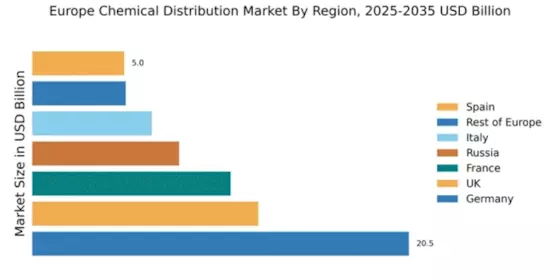
Germany holds a commanding 20.5% market share in the European chemical distribution sector, valued at approximately €50 billion. Key growth drivers include robust industrial output, a strong automotive sector, and increasing demand for sustainable chemicals. Regulatory policies favoring green technologies and significant government initiatives to promote innovation further enhance market dynamics. The country’s advanced infrastructure supports efficient logistics and distribution, making it a prime location for chemical companies.

UK : Navigating Post-Brexit Dynamics

Key markets include London, Manchester, and Birmingham, where a mix of multinational and local players operate. Major companies like BASF and Univar Solutions have a significant presence, contributing to a competitive landscape. The business environment is characterized by innovation in sectors such as healthcare and automotive, with increasing investments in R&D to meet changing consumer demands.

France : Innovation and Sustainability Focus

Key markets include Paris, Lyon, and Marseille, where major players like Solvay and Dow operate. The competitive landscape features a mix of global and local firms, fostering innovation and collaboration. The business environment is dynamic, with a focus on high-value applications in sectors such as cosmetics and food additives, driving growth and investment.

Russia : Growth Amid Economic Challenges

Key markets include Moscow and St. Petersburg, where major players like SABIC and LyondellBasell are establishing a foothold. The competitive landscape is characterized by a mix of state-owned and private enterprises, navigating a complex business environment. The chemical sector is vital for agriculture and construction, with significant investments aimed at modernizing production facilities.

Italy : Focus on Specialty Chemicals

Key markets include Milan, Turin, and Bologna, where major players like Mitsubishi Chemical and Huntsman Corporation are active. The competitive landscape features a blend of established firms and innovative startups, fostering a dynamic business environment. The chemical sector plays a crucial role in textiles and automotive applications, driving investment and development.

Spain : Strategic Location for Distribution

Key markets include Barcelona and Madrid, where major players like Eastman Chemical and Univar Solutions are establishing operations. The competitive landscape is characterized by a mix of local and international firms, creating a vibrant business environment. The chemical sector is essential for construction and agriculture, with ongoing investments in innovation and sustainability.

Rest of Europe : Varied Growth Across Regions

Key markets include countries like Belgium, Netherlands, and Switzerland, where major players like Solvay and BASF have a presence. The competitive landscape is diverse, with a mix of local and multinational firms operating in various sectors. The chemical industry plays a vital role in pharmaceuticals, agriculture, and manufacturing, driving investment and development across the region.


Europe Chemical Distribution Market Regional Image

Key Players and Competitive Insights

The chemical distribution market in Europe is characterized by a dynamic competitive landscape, driven by factors such as increasing demand for specialty chemicals, sustainability initiatives, and digital transformation. Major players like BASF (DE), Dow (US), and Univar Solutions (US) are strategically positioning themselves through innovation and regional expansion. BASF (DE) focuses on sustainable solutions, while Dow (US) emphasizes digitalization to enhance operational efficiency. Univar Solutions (US) is actively pursuing partnerships to broaden its product offerings, collectively shaping a competitive environment that prioritizes adaptability and responsiveness to market needs.

Key business tactics within this market include localizing manufacturing and optimizing supply chains to enhance efficiency and reduce costs. The competitive structure appears moderately fragmented, with several key players exerting influence over market dynamics. This fragmentation allows for niche players to thrive, while larger companies leverage their scale to optimize operations and expand their market reach.

In October 2025, BASF (DE) announced a significant investment in a new production facility in Germany aimed at increasing its capacity for sustainable chemical production. This move is strategically important as it aligns with the growing demand for eco-friendly products and positions BASF (DE) as a leader in sustainability within the sector. The facility is expected to enhance their competitive edge by meeting regulatory requirements and consumer preferences for greener alternatives.

In September 2025, Dow (US) launched a new digital platform designed to streamline customer interactions and improve supply chain transparency. This initiative is crucial as it reflects the ongoing trend towards digitalization in the chemical distribution market. By enhancing customer engagement and operational efficiency, Dow (US) aims to solidify its market position and respond more effectively to customer needs.

In August 2025, Univar Solutions (US) entered into a strategic partnership with a leading technology firm to develop advanced analytics capabilities for its distribution network. This collaboration is likely to enhance Univar's ability to optimize inventory management and improve service delivery. Such strategic alliances are becoming increasingly vital in a market where data-driven decision-making is essential for maintaining competitiveness.

As of November 2025, current trends in the chemical distribution market include a strong emphasis on digitalization, sustainability, and the integration of AI technologies. Strategic alliances are shaping the landscape, enabling companies to leverage shared resources and expertise. Looking ahead, competitive differentiation is expected to evolve, with a shift from price-based competition towards innovation, technology adoption, and supply chain reliability. Companies that can effectively navigate these trends are likely to emerge as leaders in the market.

Key Companies in the Europe Chemical Distribution Market market include

Industry Developments

In recent developments, the Europe Chemical Distribution Market has seen notable activity, particularly with companies such as Brenntag and Univar Solutions focusing on expanding their supply chains amid rising demand for chemicals driven by various industries. In October 2023, Nexeo Plastics announced a strategic partnership aimed at enhancing their distribution capabilities across Europe, targeting increased service efficiency and customer satisfaction. Additionally, in September 2023, IMCD reported a significant uptick in their market valuation, which reflects positively on the overall stability of the chemical distribution sector in Europe.

On the mergers and acquisitions front, Azelis expanded its footprint in Europe by acquiring a major distribution portfolio from an unnamed competitor in November 2022. This acquisition is expected to consolidate Azelis's market presence in specific segments. In August 2022, Tricon Energy also announced a merger with a European-based essential chemical supplier, aiming to streamline operations and leverage synergies in logistics and product offering. These movements indicate robust growth and strategic positioning as companies adapt to shifting market needs and competitive pressures in the chemical distribution landscape across Europe.

Future Outlook

Europe Chemical Distribution Market Future Outlook

The chemical distribution market is projected to grow at a 6.85% CAGR from 2024 to 2035, driven by increasing demand for specialty chemicals and sustainable practices.

New opportunities lie in:

  • Expansion of digital supply chain platforms for real-time inventory management.
  • Investment in eco-friendly packaging solutions to meet regulatory demands.
  • Development of customized chemical blends for niche industries.

By 2035, the market is expected to achieve robust growth, driven by innovation and sustainability.

Market Segmentation

Europe Chemical Distribution Market End Use Outlook

  • Automotive
  • Electronics
  • Construction
  • Oil & Gas
  • Petroleum
  • Pharmaceuticals
  • Textiles
  • Others

Europe Chemical Distribution Market Product Outlook

  • Specialty Chemicals
  • Commodity Chemicals

Report Scope

MARKET SIZE 202468.19(USD Billion)
MARKET SIZE 202572.86(USD Billion)
MARKET SIZE 2035141.39(USD Billion)
COMPOUND ANNUAL GROWTH RATE (CAGR)6.85% (2024 - 2035)
REPORT COVERAGERevenue Forecast, Competitive Landscape, Growth Factors, and Trends
BASE YEAR2024
Market Forecast Period2025 - 2035
Historical Data2019 - 2024
Market Forecast UnitsUSD Billion
Key Companies Profiled["BASF (DE)", "Dow (US)", "LyondellBasell (US)", "SABIC (SA)", "Mitsubishi Chemical (JP)", "Eastman Chemical (US)", "Univar Solutions (US)", "Huntsman Corporation (US)", "Solvay (BE)"]
Segments CoveredProduct, End Use
Key Market OpportunitiesAdoption of sustainable practices in chemical distribution enhances compliance and meets evolving consumer demands.
Key Market DynamicsRegulatory changes drive innovation and consolidation in the chemical distribution market across Europe.
Countries CoveredGermany, UK, France, Russia, Italy, Spain, Rest of Europe

Leave a Comment

FAQs

What is the current market size of the Europe Chemical Distribution Market for 2024?

The Europe Chemical Distribution Market is expected to be valued at 68.19 billion USD in 2024.

What is the projected market size for the Europe Chemical Distribution Market in 2035?

By 2035, the Europe Chemical Distribution Market is projected to reach a value of 133.53 billion USD.

What is the expected CAGR for the Europe Chemical Distribution Market from 2025 to 2035?

The market is expected to experience a compound annual growth rate (CAGR) of 6.3% from 2025 to 2035.

Which region holds the largest market share within the Europe Chemical Distribution Market?

Germany holds the largest market share, valued at 27.18 billion USD in 2024.

What is the market size of specialty chemicals in the Europe Chemical Distribution Market for 2024?

Specialty chemicals are valued at 38.74 billion USD in the Europe Chemical Distribution Market for 2024.

How much is the commodity chemicals segment expected to be valued at in 2035?

The commodity chemicals segment is expected to reach a value of 57.17 billion USD in 2035.

Who are the major players in the Europe Chemical Distribution Market?

Some key players in the market include OMNOVA Solutions, Azelis, Brenntag, and Univar Solutions.

What is the market size for the UK region in the Europe Chemical Distribution Market for 2024?

The UK region is valued at 15.3 billion USD in the Europe Chemical Distribution Market for 2024.

What growth trends are anticipated for the Europe Chemical Distribution Market?

The market is expected to grow due to increased demand for specialty chemicals across various industries.

What is the estimated market value for the France region in 2035?

The France region is estimated to be valued at 21.43 billion USD in 2035.

Download Free Sample

Kindly complete the form below to receive a free sample of this Report

Compare Licence

×
Features License Type
Single User Multiuser License Enterprise User
Price $4,950 $5,950 $7,250
Maximum User Access Limit 1 User Upto 10 Users Unrestricted Access Throughout the Organization
Free Customization
Direct Access to Analyst
Deliverable Format
Platform Access
Discount on Next Purchase 10% 15% 15%
Printable Versions