×
Request Free Sample ×

Kindly complete the form below to receive a free sample of this Report

* Please use a valid business email

Leading companies partner with us for data-driven Insights

clients tt-cursor
Hero Background

Europe Digital Map Market

ID: MRFR/ICT/58612-HCR
200 Pages
Aarti Dhapte
October 2025

Europe Digital Map Market Research Report By Application (Navigation, Fleet Management, Location-Based Services, Geographic Information System, Urban Planning), By Technology (Cartography, Remote Sensing, GPS Technology, Geospatial Analysis), By End Use (Transportation, Retail, Healthcare, Government), By Format (2D Maps, 3D Maps, Vector Maps, Raster Maps) and By Regional (Germany, UK, France, Russia, Italy, Spain, Rest of Europe)-Forecast to 2035

Share:
Download PDF ×

We do not share your information with anyone. However, we may send you emails based on your report interest from time to time. You may contact us at any time to opt-out.

Europe Digital Map Market Infographic
Purchase Options

Europe Digital Map Market Summary

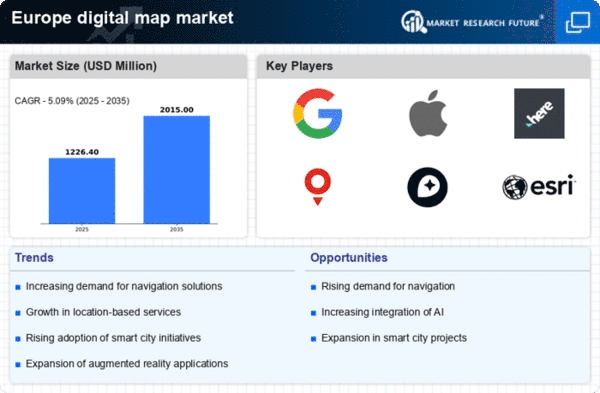
As per MRFR analysis, the Europe digital map market Size was estimated at 1167.0 USD Million in 2024. The Europe digital map market is projected to grow from 1226.4 USD Million in 2025 to 2015.0 USD Million by 2035, exhibiting a compound annual growth rate (CAGR) of 5.09% during the forecast period 2025 - 2035.

Key Market Trends & Highlights

The Europe digital map market is experiencing robust growth driven by technological advancements and increasing demand for navigation solutions.

  • The integration of AI and Machine Learning is transforming the capabilities of digital mapping solutions across Europe.
  • Germany remains the largest market for digital maps, while the UK is recognized as the fastest-growing region in this sector.
  • There is a notable focus on real-time data, enhancing the accuracy and relevance of digital maps for users.
  • Rising demand for navigation solutions and government initiatives for smart cities are key drivers propelling market expansion.

Market Size & Forecast

2024 Market Size 1167.0 (USD Million)
2035 Market Size 2015.0 (USD Million)
CAGR (2025 - 2035) 5.09%

Major Players

Google (US), Apple (US), HERE Technologies (NL), TomTom (NL), Mapbox (US), Esri (US), OpenStreetMap (GB), Navteq (US), Bing Maps (US)

Europe Digital Map Market Trends

The digital map market is currently experiencing notable growth, driven by advancements in technology and increasing demand for location-based services. The proliferation of smartphones and the integration of GPS technology into various applications have significantly enhanced the accessibility and utility of digital maps. As consumers and businesses alike seek more efficient navigation solutions, the market is adapting to meet these evolving needs. Furthermore, the rise of smart cities and the emphasis on urban planning are contributing to the expansion of this sector, as accurate mapping becomes essential for infrastructure development and resource management. In addition, the digital map market is witnessing a shift towards more interactive and user-friendly platforms. Innovations such as augmented reality and real-time data integration are enhancing user experiences, making navigation more intuitive. The growing interest in environmental sustainability is also influencing the market, as stakeholders seek to incorporate eco-friendly practices into mapping technologies. Overall, the digital map market is poised for continued evolution, reflecting broader trends in technology and societal needs.

Integration of AI and Machine Learning

The incorporation of artificial intelligence and machine learning technologies is transforming the digital map market. These advancements enable more accurate data analysis and predictive modeling, enhancing the functionality of mapping applications. As a result, users benefit from improved route optimization and personalized navigation experiences.

Focus on Real-Time Data

There is a growing emphasis on real-time data integration within the digital map market. This trend allows users to access up-to-date information regarding traffic conditions, weather changes, and other relevant factors. Such capabilities are increasingly vital for businesses and individuals who rely on timely information for decision-making.

Expansion of Geographic Information Systems (GIS)

The digital map market is seeing a significant expansion in the use of Geographic Information Systems (GIS). These systems facilitate the collection, analysis, and visualization of spatial data, which is crucial for urban planning, environmental monitoring, and resource management. The increasing adoption of GIS technologies indicates a shift towards more data-driven approaches in various sectors.

Europe Digital Map Market Drivers

Rising Demand for Navigation Solutions

The digital map market in Europe experiences a notable surge in demand for navigation solutions, driven by the increasing reliance on mobile applications and in-car navigation systems. As urbanization accelerates, the need for efficient route planning and real-time traffic updates becomes paramount. In 2025, the market for navigation applications is projected to reach approximately €3 billion, reflecting a growth rate of around 15% annually. This trend indicates a shift towards more sophisticated navigation tools that integrate user preferences and real-time data, enhancing the overall user experience. Consequently, the digital map market is poised to benefit from this growing demand, as consumers seek more reliable and accurate navigation solutions.

Government Initiatives for Smart Cities

European governments are increasingly investing in smart city initiatives, which significantly impacts the digital map market. These initiatives often include the development of advanced infrastructure that relies on accurate mapping and geographic data. For instance, the European Union has allocated over €100 billion for smart city projects, emphasizing the importance of digital mapping technologies in urban planning and management. This funding is likely to stimulate the demand for digital maps that support various applications, such as traffic management, public transportation, and environmental monitoring. As cities evolve into smart ecosystems, the digital map market is expected to play a crucial role in facilitating these transformations.

Growth of E-commerce and Delivery Services

The rapid expansion of e-commerce in Europe has a profound effect on the digital map market. With online shopping becoming increasingly prevalent, logistics and delivery services require precise mapping solutions to optimize routes and ensure timely deliveries. In 2025, the e-commerce sector in Europe is anticipated to surpass €800 billion, leading to a corresponding increase in demand for digital mapping technologies that enhance operational efficiency. Companies are likely to invest in advanced mapping solutions to improve last-mile delivery processes, thereby driving growth in the digital map market. This trend underscores the critical role of accurate and reliable mapping in supporting the logistics of the burgeoning e-commerce landscape.

Increased Focus on Environmental Sustainability

The digital map market in Europe is witnessing a growing emphasis on environmental sustainability, driven by heightened awareness of climate change and ecological preservation. Mapping technologies are being utilized to support sustainable practices, such as urban planning that minimizes environmental impact and promotes green spaces. In 2025, investments in sustainable urban development are expected to reach €50 billion across Europe, highlighting the role of digital maps in facilitating these initiatives. This focus on sustainability may lead to the development of specialized mapping solutions that cater to eco-friendly projects, thereby expanding the digital map market. As stakeholders prioritize sustainability, the demand for innovative mapping technologies is likely to increase.

Advancements in Augmented Reality (AR) Applications

The integration of augmented reality (AR) into various applications is emerging as a key driver for the digital map market in Europe. AR technology enhances user interaction with digital maps, providing immersive experiences that can transform navigation and location-based services. As of 2025, the AR market in Europe is projected to grow at a CAGR of 25%, indicating a strong potential for digital maps to incorporate AR features. This growth suggests that businesses may increasingly adopt AR-enabled mapping solutions to engage users more effectively, thereby expanding the scope and functionality of digital maps. The convergence of AR and digital mapping technologies is likely to create new opportunities within the market.

Market Segment Insights

By Application: Navigation (Largest) vs. Fleet Management (Fastest-Growing)

In the Europe digital map market, the application segment is primarily divided among Navigation, Fleet Management, Location-Based Services, Geographic Information System, and Urban Planning. Navigation holds the largest market share, driven by increasing demand for precise routing and real-time traffic updates, critical for personal and commercial users alike. Fleet Management and Location-Based Services also occupy significant shares, owing to the ongoing digital transformation in logistics and the growing consumer preference for location-specific applications. As for growth trends, Fleet Management is identified as the fastest-growing segment, propelled by advancements in technology and the need for operational efficiency among businesses. The increasing integration of IoT and AI into digital mapping solutions is enhancing the capabilities of these applications. Additionally, Urban Planning is emerging as an important area, encouraged by the focus on sustainable development and smart city initiatives across the region.

Navigation (Dominant) vs. Fleet Management (Emerging)

Navigation is the dominant segment in this market, characterized by its widespread adoption across various sectors including personal vehicle navigation, public transportation, and emergency services. It emphasizes the importance of real-time updates, accuracy, and user-friendly interfaces. In contrast, Fleet Management, though currently smaller in market share, is an emerging segment that leverages technological innovations to optimize logistics, reduce costs, and improve overall efficiency. Fleet Management solutions integrate mapping data with vehicle tracking and telemetry, enabling companies to make data-driven decisions. As businesses recognize the value of efficient route planning and resource allocation, Fleet Management is expected to gain further traction, making it a key area of interest for future investments.

By Technology: GPS Technology (Largest) vs. Remote Sensing (Fastest-Growing)

In the digital map market, GPS Technology holds the largest market share, driven by its widespread adoption in personal navigation, automotive applications, and mobile devices. This segment's robustness is supported by continuous advancements in satellite technology, which enhance the accuracy and reliability of GPS systems. On the other hand, Remote Sensing is rapidly gaining traction, particularly in applications such as environmental monitoring and urban planning, showing significant growth potential in the coming years. The growth trends within this segment are fueled by increasing demand for accurate location data and the integration of GPS and Remote Sensing technologies in various industries. The rise of smart cities and the push for sustainable development practices contribute to the expansion of these technologies. Furthermore, advancements in geospatial analytics are making it easier to harness data from these technologies, boosting their adoption rates across diverse sectors.

Technology: GPS Technology (Dominant) vs. Remote Sensing (Emerging)

GPS Technology is characterized by its established market presence and critical role in navigation and location services. It dominates due to its reliability and integration across various devices, including smartphones and vehicles, making it indispensable for consumers and businesses alike. In contrast, Remote Sensing is an emerging segment that utilizes satellite and aerial imagery to collect data about the Earth's surface. It is increasingly recognized for its applications in agriculture, disaster management, and climate change monitoring. This segment is poised for rapid growth as more industries recognize the value of high-resolution geographic data, paving the way for innovative applications and enhanced decision-making processes.

By End Use: Transportation (Largest) vs. Healthcare (Fastest-Growing)

In the digital map market, the end use segment showcases a varied distribution of market shares. Transportation is currently the largest segment, leveraging the vast number of applications related to logistics, navigation, and fleet management. Retail follows closely, as digital maps aid in enhancing customer experiences and optimizing store operations. Meanwhile, government and healthcare sectors also contribute significantly, with applications tailored to urban planning and patient management. As digitalization continues to accelerate, growth trends indicate a surge in the healthcare and government segments. The integration of IoT and AI technologies in digital mapping solutions drives the healthcare segment's rapid expansion. Additionally, government initiatives aimed at infrastructure improvement are boosting demand within this segment. Factors like the increasing need for location-based services and enhanced mapping accuracy compel further advancements across all end-use sectors.

Transportation: Dominant vs. Healthcare: Emerging

Transportation serves as the dominant end use for digital maps, significantly impacting logistics, ridesharing, and navigation systems, where real-time data plays a crucial role. The focus on efficiency and user experience continues to drive advancements in mapping technologies for this sector. In contrast, healthcare is emerging as a key player in the digital map market, highlighting its potential to transform patient care and operational efficiencies. Digital maps are being utilized for optimizing health facilities' geographical placement and integrating with telehealth services. This shift promotes better healthcare delivery and accessibility, making healthcare a noteworthy segment poised for substantial growth.

By Format: 2D Maps (Largest) vs. 3D Maps (Fastest-Growing)

In the digital map market segment, 2D Maps hold the largest share due to their wide-ranging applications, versatility, and ease of understanding. They are predominantly used in navigation, planning, and various business applications, thereby capturing a significant segment of the market. On the other hand, 3D Maps, while currently smaller in market share, are rapidly gaining traction, particularly in industries that require detailed visualization such as real estate, tourism, and urban planning. Growth trends indicate that the demand for 3D Maps is driven by advancements in technology that enable more realistic representations and enhanced user experiences. Industries are increasingly adopting 3D mapping solutions to improve decision-making processes. Meanwhile, 2D Maps continue to be refined with technological improvements, ensuring their relevance amid the rising popularity of 3D solutions. Consumers are looking for both functional and aesthetic aspects in digital mapping solutions, contributing to the growth of various formats.

2D Maps (Dominant) vs. 3D Maps (Emerging)

2D Maps are recognized as the dominant format primarily because of their longstanding presence in the digital mapping landscape and their effectiveness in conveying straightforward information. They are widely utilized across multiple sectors, including logistics, education, and municipal planning, making them a reliable choice for users seeking clarity and directness. On the contrary, 3D Maps represent an emerging alternative, being particularly beneficial for applications that require depth and spatial understanding, such as virtual tours and gaming. As technologies evolve, 3D Maps are expected to enhance their appeal, catering to users who desire immersive experiences and complex visualizations, positioning them for substantial growth.

Get more detailed insights about Europe Digital Map Market

Regional Insights

Germany : Strong Infrastructure and Innovation Drive Growth

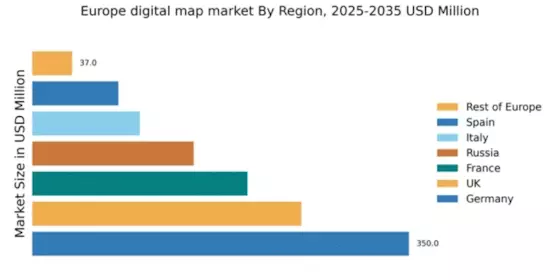
Germany holds a dominant position in the European digital map market, with a market value of $350.0 million, accounting for approximately 35% of the total market share. Key growth drivers include the rapid adoption of smart city initiatives, advancements in autonomous vehicle technology, and increasing demand for location-based services. Government policies promoting digital infrastructure and investments in 5G networks further enhance market potential, while a robust industrial base supports diverse applications.

UK : Innovation and Competition Fuel Growth

The UK digital map market is valued at $250.0 million, representing about 25% of the European market. Growth is driven by the increasing use of digital navigation in logistics and transportation, alongside a surge in mobile app development. The UK government supports this sector through initiatives aimed at enhancing digital connectivity and data accessibility, which are crucial for urban planning and smart city projects. The demand for real-time data is also on the rise, reflecting changing consumer behaviors.

France : Government Support and Urbanization Trends

France's digital map market is valued at $200.0 million, capturing around 20% of the European market. Key growth drivers include urbanization, which fuels demand for accurate mapping solutions, and government initiatives aimed at improving transportation infrastructure. The French government is actively investing in digital technologies, enhancing the overall business environment. The rise of e-commerce and delivery services also contributes to increased demand for precise location data and mapping solutions.

Russia : Geopolitical Factors Shape Landscape

Russia's digital map market is valued at $150.0 million, accounting for about 15% of the European market. Growth is driven by the increasing need for accurate navigation in vast and diverse terrains, alongside government initiatives to enhance digital infrastructure. The competitive landscape is characterized by local players like Yandex Maps, which dominate the market. Urban centers such as Moscow and St. Petersburg are key markets, with demand driven by logistics, transportation, and tourism sectors.

Italy : Cultural Heritage and Tourism Influence Market

Italy's digital map market is valued at $100.0 million, representing about 10% of the European market. The growth is fueled by the tourism sector, which relies heavily on accurate mapping for navigation and cultural heritage promotion. Government initiatives aimed at enhancing digital infrastructure and promoting smart tourism are also significant. Key cities like Rome and Milan are central to market dynamics, with competition from both local and international players enhancing service offerings.

Spain : Tourism and Urban Development Drive Growth

Spain's digital map market is valued at $80.0 million, capturing approximately 8% of the European market. The growth is primarily driven by the tourism industry, which demands accurate and user-friendly navigation solutions. Government support for digital transformation initiatives and urban development projects further boosts market potential. Major cities like Barcelona and Madrid are key markets, with a competitive landscape featuring both local and international players, enhancing the overall service quality.

Rest of Europe : Varied Demand Across Sub-regions

The Rest of Europe digital map market is valued at $37.0 million, representing about 3.7% of the total European market. This sub-region encompasses a variety of countries with distinct market needs, driven by local industries such as agriculture, logistics, and tourism. Government initiatives aimed at improving digital infrastructure and connectivity are crucial for market growth. The competitive landscape varies significantly, with local players often dominating niche markets, catering to specific regional demands.


Europe Digital Map Market Regional Image

Key Players and Competitive Insights

The digital map market in Europe is characterized by a dynamic competitive landscape, driven by rapid technological advancements and increasing demand for location-based services. Major players such as Google (US), HERE Technologies (NL), and TomTom (NL) are at the forefront, each adopting distinct strategies to enhance their market positioning. Google (US) continues to leverage its vast data resources and AI capabilities to improve user experience and expand its mapping services, while HERE Technologies (NL) focuses on partnerships with automotive manufacturers to integrate its mapping solutions into vehicles, thereby enhancing navigation and safety features. TomTom (NL) emphasizes innovation in real-time traffic data and navigation solutions, positioning itself as a leader in the automotive sector. Collectively, these strategies contribute to a competitive environment that is increasingly focused on technological integration and user-centric solutions.

In terms of business tactics, companies are increasingly localizing their operations and optimizing supply chains to enhance efficiency and responsiveness to market demands. The competitive structure of the digital map market appears moderately fragmented, with several key players exerting influence over various segments. This fragmentation allows for niche players to emerge, fostering innovation and competition, while larger companies consolidate their market share through strategic partnerships and acquisitions.

In October 2025, HERE Technologies (NL) announced a collaboration with a leading European automotive manufacturer to develop advanced mapping solutions for autonomous vehicles. This partnership is strategically significant as it positions HERE at the forefront of the autonomous driving revolution, potentially increasing its market share in a rapidly growing segment. The integration of high-definition maps into autonomous systems is crucial for safety and efficiency, indicating HERE's commitment to innovation in this area.

In September 2025, TomTom (NL) launched a new suite of APIs aimed at enhancing location-based services for businesses. This move is indicative of TomTom's strategy to diversify its offerings and cater to the growing demand for customized mapping solutions across various industries. By providing developers with robust tools, TomTom is likely to strengthen its position in the B2B sector, which is becoming increasingly competitive.

In November 2025, Google (US) unveiled an upgraded version of its mapping platform, incorporating advanced AI features that enhance user interaction and personalization. This development underscores Google's focus on maintaining its competitive edge through continuous innovation. The integration of AI not only improves user experience but also allows for more accurate data collection and analysis, which could lead to better-targeted advertising and service offerings.

As of November 2025, current trends in the digital map market are heavily influenced by digitalization, sustainability, and the integration of AI technologies. Strategic alliances are becoming increasingly important, as companies seek to combine resources and expertise to enhance their offerings. The competitive landscape is shifting from traditional price-based competition to a focus on innovation, technology, and supply chain reliability. This evolution suggests that companies that prioritize technological advancements and strategic partnerships will likely emerge as leaders in the digital map market.

Key Companies in the Europe Digital Map Market market include

Industry Developments

The Europe Digital Map Market has seen significant developments, particularly with companies like Google, HERE Technologies, and TomTom advancing their offerings. Notably, in September 2023, HERE Technologies expanded its collaboration with the European Space Agency to enhance geospatial data integration for urban mobility solutions. Furthermore, OpenStreetMap continues to drive innovation with contributions from volunteers, fostering a community-driven approach to map development.

In terms of acquisitions, Foursquare announced the acquisition of a European location data platform in August 2023 to enhance its mapping technologies and expand its European presence. Following its recent partnerships, Apple aims to enhance its map features across Europe, focusing on improved navigation and user experience.

In recent years, Mapbox has also seen growth in demand, attributed to the increased adoption of digital mapping services in logistics and travel sectors. Such developments indicate a robust growth trajectory within the European Digital Map sector, reflecting the increasing reliance on accurate geographic information and navigation solutions across various industries. Additionally, the European Commission continues to support digital transformation initiatives which are expected to further boost this market.

Future Outlook

Europe Digital Map Market Future Outlook

The digital map market is projected to grow at a 5.09% CAGR from 2024 to 2035, driven by advancements in AI, increased demand for navigation, and smart city initiatives.

New opportunities lie in:

  • Development of subscription-based mapping services for businesses
  • Integration of augmented reality features in navigation apps
  • Partnerships with automotive manufacturers for in-car navigation systems

By 2035, the digital map market is expected to be robust, driven by innovative technologies and strategic partnerships.

Market Segmentation

Europe Digital Map Market Format Outlook

  • 2D Maps
  • 3D Maps
  • Vector Maps
  • Raster Maps

Europe Digital Map Market End Use Outlook

  • Transportation
  • Retail
  • Healthcare
  • Government

Europe Digital Map Market Technology Outlook

  • Cartography
  • Remote Sensing
  • GPS Technology
  • Geospatial Analysis

Europe Digital Map Market Application Outlook

  • Navigation
  • Fleet Management
  • Location-Based Services
  • Geographic Information System
  • Urban Planning

Report Scope

MARKET SIZE 2024 1167.0(USD Million)
MARKET SIZE 2025 1226.4(USD Million)
MARKET SIZE 2035 2015.0(USD Million)
COMPOUND ANNUAL GROWTH RATE (CAGR) 5.09% (2024 - 2035)
REPORT COVERAGE Revenue Forecast, Competitive Landscape, Growth Factors, and Trends
BASE YEAR 2024
Market Forecast Period 2025 - 2035
Historical Data 2019 - 2024
Market Forecast Units USD Million
Key Companies Profiled ["Google (US)", "Apple (US)", "HERE Technologies (NL)", "TomTom (NL)", "Mapbox (US)", "Esri (US)", "OpenStreetMap (GB)", "Navteq (US)", "Bing Maps (US)"]
Segments Covered Application, Technology, End Use, Format
Key Market Opportunities Integration of augmented reality features enhances user engagement in the digital map market.
Key Market Dynamics Rising demand for real-time navigation solutions drives innovation and competition in the digital map sector.
Countries Covered Germany, UK, France, Russia, Italy, Spain, Rest of Europe

Leave a Comment

FAQs

What is the expected market size of the Europe Digital Map Market in 2024?

The Europe Digital Map Market is expected to be valued at 972.5 million USD in 2024.

What will be the market size of the Europe Digital Map Market in 2035?

In 2035, the market size is projected to reach 2000.0 million USD.

What is the expected CAGR for the Europe Digital Map Market from 2025 to 2035?

The expected CAGR for the Europe Digital Map Market is 6.774% from 2025 to 2035.

Which region is expected to dominate the Europe Digital Map Market by 2035?

Germany is expected to dominate with a market size of 500.0 million USD by 2035.

What is the market value for Navigation in the Europe Digital Map Market in 2024?

The market value for Navigation is anticipated to be 400.0 million USD in 2024.

What is the expected market size for Fleet Management in 2035?

The Fleet Management market size is projected to reach 350.0 million USD by 2035.

Who are the major players in the Europe Digital Map Market?

Key players include OpenStreetMap, HERE Technologies, TomTom, and Google, among others.

What market size is expected for Location-Based Services in 2024?

The market for Location-Based Services is expected to be valued at 250.0 million USD in 2024.

What will the Geographic Information System segment value be in 2035?

By 2035, the Geographic Information System segment is anticipated to reach a value of 250.0 million USD.

What is the market size for Italy in the Europe Digital Map Market toward 2035?

Italy's market size is projected to be around 350.0 million USD by 2035.

Download Free Sample

Kindly complete the form below to receive a free sample of this Report

Compare Licence

×
Features License Type
Single User Multiuser License Enterprise User
Price $4,950 $5,950 $7,250
Maximum User Access Limit 1 User Upto 10 Users Unrestricted Access Throughout the Organization
Free Customization
Direct Access to Analyst
Deliverable Format
Platform Access
Discount on Next Purchase 10% 15% 15%
Printable Versions