×
Request Free Sample ×

Kindly complete the form below to receive a free sample of this Report

* Please use a valid business email

Leading companies partner with us for data-driven Insights

clients tt-cursor
Hero Background

Europe Industrial Services Market

ID: MRFR/ICT/58689-HCR
200 Pages
Aarti Dhapte
October 2025

Europe Industrial Services Market Research Report By Type (Installation & Commissioning, Engineering & Consulting), By Application (Human Machine Interface, Distributed Control System, Valves & Actuators), By End User (Automotive, Metal & Mining, Food & Beverages, Paper, Oil & Gas) and By Regional (Germany, UK, France, Russia, Italy, Spain, Rest of Europe)- Forecast to 2035

Share:
Download PDF ×

We do not share your information with anyone. However, we may send you emails based on your report interest from time to time. You may contact us at any time to opt-out.

Europe Industrial Services Market Infographic
Purchase Options

Europe Industrial Services Market Summary

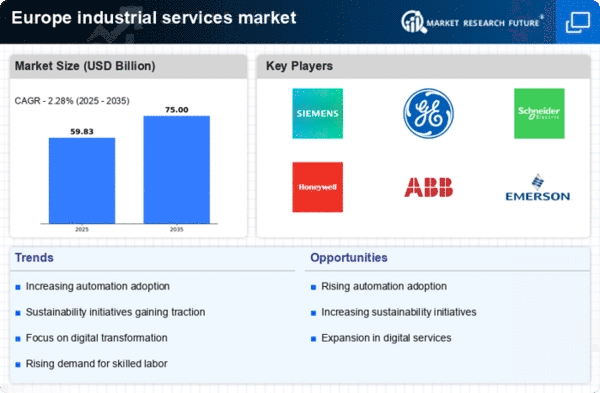
As per MRFR analysis, the industrial services market Size was estimated at 58.5 USD Billion in 2024. The industrial services market is projected to grow from 59.83 USD Billion in 2025 to 75.0 USD Billion by 2035, exhibiting a compound annual growth rate (CAGR) of 2.28% during the forecast period 2025 - 2035.

Key Market Trends & Highlights

The Europe industrial services market is experiencing a transformative shift driven by digitalization and sustainability.

  • Germany remains the largest market for industrial services, showcasing robust demand across various sectors.
  • The UK is emerging as the fastest-growing region, propelled by innovative business models and technological adoption.
  • Digital transformation and sustainability initiatives are reshaping service delivery and operational frameworks across the continent.
  • Technological advancements and a focus on operational efficiency are key drivers fueling growth in the industrial services market.

Market Size & Forecast

2024 Market Size 58.5 (USD Billion)
2035 Market Size 75.0 (USD Billion)
CAGR (2025 - 2035) 2.28%

Major Players

Siemens (DE), General Electric (US), Schneider Electric (FR), Honeywell (US), ABB (CH), Emerson Electric (US), Rockwell Automation (US), Konecranes (FI), Thyssenkrupp (DE)

Europe Industrial Services Market Trends

The industrial services market is currently experiencing a dynamic transformation, driven by technological advancements and evolving customer expectations. Companies are increasingly adopting automation and digital solutions to enhance operational efficiency and reduce costs. This shift is evident in the growing integration of IoT devices and data analytics, which enable real-time monitoring and predictive maintenance. As a result, businesses are better positioned to respond to market demands and optimize their service offerings. Furthermore, sustainability has emerged as a critical focus, with organizations striving to minimize their environmental impact while maintaining profitability. This trend is likely to shape investment strategies and service development in the coming years. In addition, the competitive landscape of the industrial services market is becoming more complex. New entrants are leveraging innovative business models, which challenge established players to adapt and evolve. Collaboration between service providers and technology firms is increasingly common, fostering the development of tailored solutions that meet specific industry needs. As the market continues to mature, stakeholders must remain agile and responsive to changes in consumer preferences and regulatory requirements. Overall, the industrial services market is poised for growth, driven by innovation, sustainability, and strategic partnerships.

Digital Transformation

The industrial services market is witnessing a significant shift towards digital transformation. Companies are increasingly implementing advanced technologies such as IoT and AI to enhance service delivery and operational efficiency. This trend enables real-time data analysis, predictive maintenance, and improved customer engagement, ultimately leading to better service outcomes.

Sustainability Initiatives

Sustainability has become a pivotal focus within the industrial services market. Organizations are actively seeking to reduce their carbon footprint and implement eco-friendly practices. This shift not only aligns with regulatory requirements but also meets the growing demand from consumers for environmentally responsible services.

Collaborative Business Models

The emergence of collaborative business models is reshaping the industrial services market. Partnerships between service providers and technology firms are becoming more prevalent, allowing for the development of customized solutions. This collaboration enhances service offerings and enables companies to better address the unique challenges faced by various industries.

Europe Industrial Services Market Drivers

Regulatory Compliance

In Europe, stringent regulatory frameworks are shaping the industrial services market. Compliance with environmental regulations and safety standards is becoming increasingly critical for companies operating in this sector. The European Union has implemented various directives aimed at reducing carbon emissions and enhancing workplace safety. As a result, businesses are compelled to invest in services that ensure adherence to these regulations. It is estimated that compliance-related expenditures could account for up to 15% of operational budgets in the industrial services market by 2025. This regulatory landscape not only drives demand for compliance services but also encourages innovation in service delivery, as companies seek to meet evolving standards.

Technological Advancements

The industrial services market in Europe is experiencing a notable shift due to rapid technological advancements. Automation and artificial intelligence are increasingly integrated into industrial processes, enhancing efficiency and reducing operational costs. For instance, the adoption of IoT devices has surged, with an estimated 30% of European manufacturers implementing smart technologies by 2025. This trend not only streamlines operations but also improves predictive maintenance, thereby minimizing downtime. As companies seek to remain competitive, investments in advanced technologies are projected to reach €50 billion annually by 2026. Consequently, the industrial services market is likely to witness significant growth as businesses leverage these innovations to optimize their service offerings.

Emerging Market Opportunities

The industrial services market in Europe is poised for growth due to emerging market opportunities. As industries evolve, new sectors such as renewable energy and electric vehicle manufacturing are gaining traction. These sectors require specialized industrial services, creating a demand for tailored solutions. For instance, the renewable energy sector is expected to grow by 30% by 2030, necessitating a range of services from installation to maintenance. This shift presents a lucrative opportunity for service providers to diversify their offerings and cater to these burgeoning markets. As companies adapt to these changes, the industrial services market is likely to expand, driven by the need for innovative solutions in response to evolving industry demands.

Focus on Operational Efficiency

The pursuit of operational efficiency is a driving force within the industrial services market in Europe. Companies are increasingly recognizing the importance of optimizing their processes to enhance productivity and reduce costs. This focus is reflected in the growing demand for consultancy services that specialize in process improvement and lean manufacturing techniques. Recent studies indicate that organizations that implement efficiency-enhancing strategies can achieve cost reductions of up to 20%. As competition intensifies, businesses are likely to allocate more resources towards operational efficiency initiatives, thereby propelling growth in the industrial services market. This trend underscores the necessity for service providers to offer tailored solutions that address specific operational challenges.

Investment in Workforce Development

The industrial services market in Europe is witnessing a heightened emphasis on workforce development. As technological advancements reshape the landscape, there is a pressing need for skilled labor capable of operating sophisticated machinery and systems. Companies are increasingly investing in training programs to upskill their workforce, ensuring they remain competitive in a rapidly evolving market. It is projected that the demand for skilled workers in the industrial services sector will grow by 25% over the next five years. This investment not only enhances productivity but also fosters employee retention, as workers are more likely to remain with organizations that prioritize their professional development. Consequently, the focus on workforce development is likely to drive growth in the industrial services market.

Market Segment Insights

By Service Type: Maintenance Services (Largest) vs. Repair Services (Fastest-Growing)

The Service Type segment in Europe shows a distinct distribution among its various components. Maintenance Services holds the largest share, indicating a strong demand for preventative measures and upkeep in industrial operations. Repair Services, while not as dominant, is witnessing significant uptake, reflecting urgent needs for quick solutions that minimize downtime. Operational Services and Installation Services, while essential, maintain smaller shares, focusing on optimizing efficiency and seamless setups respectively. The growth trends in this segment are driven by increasing industrial activity and technological advancements. Maintenance Services' stability is attributed to the need for reliable machinery and equipment functions. Conversely, Repair Services is gaining traction due to rising operational costs and the necessity for quick fixes in a competitive environment. Overall, there is a noticeable shift towards both preventative and responsive service types, adapting to evolving market demands.

Maintenance Services (Dominant) vs. Installation Services (Emerging)

Maintenance Services, as the dominant offering in the Service Type segment, emphasizes ongoing upkeep and reliability within industrial setups. Companies investing in these services enjoy fewer disruptions and enhanced equipment lifespan, making it a favored choice among industrial clients seeking efficiency. In contrast, Installation Services represent an emerging trend within this market, focusing on the initial setup of equipment and systems. With the growing complexity of technology and machinery installations, demand for skilled installation services rises. This segment is characterized by innovation and adaptability, as providers streamline processes to meet tighter deadlines and ensure seamless integration into existing systems, making it a critical player as industries evolve.

By End Use Industry: Manufacturing (Largest) vs. Oil and Gas (Fastest-Growing)

In the industrial services market, the distribution of market share among the end use industries highlights the dominance of the Manufacturing sector, which plays a crucial role in driving demand for various services. This segment benefits from high levels of automation and the need for efficient production processes. Conversely, the Oil and Gas industry is gaining traction, reflecting a growing dependency on specialized services to enhance operational efficiency and safety, thus capturing a significant portion of market interest. The growth trends in this segment are primarily driven by advancements in technology and infrastructure development. Manufacturing continues to enhance its efficiency through automation, while the Oil and Gas sector sees increased exploration and drilling activities that necessitate innovative service solutions. Emerging regulations focused on sustainability also bolster growth, compelling companies to seek services that improve their environmental footprint. As a result, both sectors are poised for significant development in the coming years.

Manufacturing: Dominant vs. Oil and Gas: Emerging

The Manufacturing sector stands out as a dominant force in the industrial services market, characterized by a diverse range of activities including assembly, fabrication, and maintenance. This segment heavily relies on technological advancements, such as automation and Industry 4.0 initiatives, to boost productivity and reduce operational costs. On the other hand, the Oil and Gas industry, while emerging, is rapidly expanding due to increased investments in exploration and production activities. This segment demands specialized services that cater to strict safety and environmental regulations. As sustainability becomes paramount, both segments are evolving, with Manufacturing focusing on enhanced operational efficiencies and Oil and Gas adapting to new regulatory landscapes, thus shaping future service demands.

By Service Delivery Model: On-site Services (Largest) vs. Remote Services (Fastest-Growing)

In the Europe industrial services market, On-site Services dominate the segment, capturing a substantial share due to their direct engagement and hands-on approach with clients. This model is preferred for critical operations requiring immediate and tailored support, making it a staple in various industries. Conversely, Remote Services are rapidly gaining traction, appealing particularly to companies looking for flexibility and cost-effectiveness in their operations. The growth of Remote Services is driven by advancements in technology and increasing demand for efficient, scalable solutions. As businesses adapt to digitalization, these services enable remote monitoring and management, which enhances operational efficiency. The ongoing shift towards automation and smart technologies is expected to further propel Remote Services, making them a key player alongside On-site Services in the market.

On-site Services (Dominant) vs. Remote Services (Emerging)

On-site Services are characterized by their personalized, hands-on approach, providing tailored solutions directly at the client's location. This model is essential for industries where immediate response and maintenance are critical, such as manufacturing and energy. Its dominance is attributed to the established relationships providers build with clients and the trust they establish through consistent service delivery. On the other hand, Remote Services are emerging as a flexible alternative, leveraging technology to offer support and monitoring from a distance. This segment is ideal for companies looking to optimize costs while maintaining service quality, and it is especially favored in sectors where downtime can be costly. As technology evolves, both segments will continue to play pivotal roles in the evolving landscape of industrial services.

By Technology Used: Artificial Intelligence (Largest) vs. Automation (Fastest-Growing)

In the Technology Used segment, Artificial Intelligence holds the largest market share, driven by its widespread application across various industrial processes. Automation follows as a rapidly expanding area, contributing significantly to efficiency and cost reduction. Other technologies like IoT and Cloud Computing also play crucial roles, enhancing data connectivity and operational scalability, although their share is comparatively smaller. As industries increasingly adopt these technologies, the competitive landscape is becoming more defined. Growth trends indicate a robust upward trajectory for Automation as industries prioritize smart solutions. Artificial Intelligence continues to evolve, integrating machine learning and deep learning to enhance decision-making processes. Meanwhile, the adoption of IoT devices and Cloud Computing is accelerating, attributed to the demand for real-time data and remote access capabilities, showcasing a shift toward more interconnected and agile operational frameworks.

Technology: Automation (Dominant) vs. IoT (Emerging)

Automation is a dominant force in industrial services, characterized by its ability to streamline processes, reduce human error, and lower operational costs. It encompasses a range of applications, from robotics in manufacturing to automated maintenance systems, making it a key player in enhancing productivity. In contrast, IoT emerges as a transformative technology, connecting devices and enabling data flow across systems. IoT's capacity to provide insights through data analytics and real-time monitoring presents significant opportunities for industries looking to innovate and stay competitive. Together, these technologies not only coexist but also complement each other, driving the evolution of industrial operations in the region.

Get more detailed insights about Europe Industrial Services Market

Regional Insights

Germany : Strong Growth Driven by Innovation

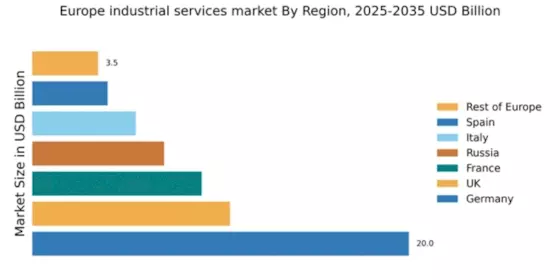
Germany holds a commanding 20.0% market share in the European industrial services sector, valued at approximately €50 billion. Key growth drivers include a robust manufacturing base, increasing automation, and a strong push towards Industry 4.0. Demand trends show a shift towards smart technologies and sustainable practices, supported by government initiatives like the "Industrie 4.0" strategy. Infrastructure investments in transportation and energy are also pivotal for industrial development.

UK : Diverse Industries Fuel Growth

The UK accounts for 10.5% of the European industrial services market, valued at around €25 billion. Growth is driven by sectors such as aerospace, automotive, and renewable energy. Demand for advanced manufacturing solutions is rising, alongside government support for green technologies. Regulatory frameworks are evolving to enhance sustainability and innovation, fostering a conducive environment for industrial services.

France : Strong Regulatory Support for Growth

France captures 9.0% of the European market, valued at approximately €22 billion. The growth is propelled by investments in renewable energy and smart manufacturing. Demand for energy-efficient solutions is increasing, supported by government policies aimed at reducing carbon emissions. The French government’s "France 2030" plan emphasizes innovation and sustainability, driving industrial service demand.

Russia : Resource-Rich Economy Drives Demand

Russia holds a 7.0% share of the European industrial services market, valued at about €15 billion. Key growth drivers include the oil and gas sector, which demands advanced industrial services. The government is investing in infrastructure and modernization initiatives, aiming to enhance industrial capabilities. Demand trends indicate a growing interest in automation and digitalization across various sectors.

Italy : Heritage Meets Modern Innovation

Italy represents 5.5% of the European market, valued at around €12 billion. The industrial services sector is bolstered by a strong manufacturing heritage, particularly in machinery and automotive. Growth is driven by innovation in design and production processes, supported by government initiatives promoting digital transformation. Demand for high-quality, customized solutions is on the rise, reflecting changing consumption patterns.

Spain : Investment in Infrastructure and Technology

Spain accounts for 4.0% of the European industrial services market, valued at approximately €10 billion. Key growth drivers include investments in renewable energy and infrastructure development. The government is actively promoting industrial modernization through various initiatives, enhancing the business environment. Demand for automation and smart technologies is increasing, particularly in sectors like construction and manufacturing.

Rest of Europe : Varied Markets with Unique Needs

The Rest of Europe holds a 3.5% market share, valued at around €8 billion. This sub-region encompasses a variety of markets, each with distinct industrial service needs. Growth is driven by localized demand for tailored solutions, influenced by regional economic conditions and regulatory frameworks. Countries like Belgium and the Netherlands are emerging as key players, focusing on sustainability and innovation in industrial services.


Europe Industrial Services Market Regional Image

Key Players and Competitive Insights

The industrial services market in Europe is characterized by a dynamic competitive landscape, driven by technological advancements and a growing emphasis on sustainability. Key players such as Siemens (DE), Schneider Electric (FR), and ABB (CH) are at the forefront, leveraging innovation and strategic partnerships to enhance their market positions. Siemens (DE) focuses on digital transformation and smart infrastructure, while Schneider Electric (FR) emphasizes energy efficiency and sustainability in its service offerings. ABB (CH) is increasingly investing in automation and robotics, which collectively shapes a competitive environment that prioritizes technological integration and environmental responsibility.

In terms of business tactics, companies are increasingly localizing manufacturing and optimizing supply chains to enhance operational efficiency. The market structure appears moderately fragmented, with a mix of large multinational corporations and smaller specialized firms. The collective influence of these key players fosters a competitive atmosphere where innovation and customer-centric solutions are paramount.

In October 2025, Siemens (DE) announced a strategic partnership with a leading AI firm to enhance its digital services portfolio. This collaboration aims to integrate advanced AI capabilities into Siemens' existing industrial solutions, potentially revolutionizing predictive maintenance and operational efficiency for clients. Such a move underscores Siemens' commitment to remaining at the cutting edge of technological advancements in the industrial services sector.

In September 2025, Schneider Electric (FR) launched a new initiative focused on carbon neutrality for its operations by 2030. This ambitious goal not only aligns with global sustainability trends but also positions Schneider as a leader in environmentally responsible industrial services. The initiative is expected to enhance the company's reputation and attract clients who prioritize sustainability in their supply chains.

In August 2025, ABB (CH) unveiled a new automation platform designed to streamline operations for manufacturing clients. This platform integrates IoT technology and machine learning, allowing for real-time data analysis and improved decision-making processes. The introduction of this platform reflects ABB's strategic focus on enhancing operational efficiency and reducing downtime for its customers, thereby solidifying its competitive edge in the market.

As of November 2025, current trends in the industrial services market include a pronounced shift towards digitalization, sustainability, and AI integration. Strategic alliances are increasingly shaping the competitive landscape, enabling companies to pool resources and expertise. Looking ahead, competitive differentiation is likely to evolve from traditional price-based competition to a focus on innovation, technological advancements, and supply chain reliability. This shift suggests that companies that prioritize these areas will be better positioned to thrive in an increasingly complex market.

Key Companies in the Europe Industrial Services Market market include

Industry Developments

The Europe Industrial Services Market has recently seen notable developments with key players like Thyssenkrupp, Schneider Electric, and Honeywell increasingly focusing on digital transformation and sustainability initiatives. Siemens has reported strong growth in its automation services due to heightened demand for smart manufacturing solutions, while Bosch is enhancing its portfolio with advanced predictive maintenance services. 

A significant acquisition occurred in August 2023 when Emerson Electric acquired a European automation technology firm to expand its market presence and technological capabilities. Meanwhile, General Electric continues to invest in renewable energy services, reflecting the growing trend towards sustainable industrial practices. 

Market valuations across these companies have generally seen an upward trend, substantially impacting investment strategies and R&D efforts in the region. Over the past few years, developments like KUKA's advancements in robotics and ABB's focus on electric vehicle infrastructure have reinforced the competitive landscape in Europe. Additionally, initiatives related to Industry 4.0 are driving innovations, affecting service delivery and client engagement models across various sectors within the industrial services market.

Future Outlook

Europe Industrial Services Market Future Outlook

The industrial services market is projected to grow at a 2.28% CAGR from 2024 to 2035, driven by technological advancements, sustainability initiatives, and increasing demand for efficiency.

New opportunities lie in:

  • Development of predictive maintenance solutions leveraging IoT technology.
  • Expansion of energy-efficient service offerings to meet regulatory standards.
  • Implementation of automated inventory management systems for enhanced operational efficiency.

By 2035, the industrial services market is expected to achieve robust growth, driven by innovation and efficiency.

Market Segmentation

Europe Industrial Services Market Service Type Outlook

  • Maintenance Services
  • Repair Services
  • Operational Services
  • Installation Services

Europe Industrial Services Market Technology Used Outlook

  • Automation
  • Artificial Intelligence
  • IoT
  • Cloud Computing

Europe Industrial Services Market End Use Industry Outlook

  • Manufacturing
  • Oil and Gas
  • Construction
  • Mining
  • Energy

Europe Industrial Services Market Service Delivery Model Outlook

  • On-site Services
  • Remote Services
  • Managed Services

Report Scope

MARKET SIZE 2024 58.5(USD Billion)
MARKET SIZE 2025 59.83(USD Billion)
MARKET SIZE 2035 75.0(USD Billion)
COMPOUND ANNUAL GROWTH RATE (CAGR) 2.28% (2024 - 2035)
REPORT COVERAGE Revenue Forecast, Competitive Landscape, Growth Factors, and Trends
BASE YEAR 2024
Market Forecast Period 2025 - 2035
Historical Data 2019 - 2024
Market Forecast Units USD Billion
Key Companies Profiled ["Siemens (DE)", "General Electric (US)", "Schneider Electric (FR)", "Honeywell (US)", "ABB (CH)", "Emerson Electric (US)", "Rockwell Automation (US)", "Konecranes (FI)", "Thyssenkrupp (DE)"]
Segments Covered Service Type, End Use Industry, Service Delivery Model, Technology Used
Key Market Opportunities Integration of advanced automation and digitalization in the industrial services market enhances operational efficiency.
Key Market Dynamics Technological advancements drive efficiency in industrial services, reshaping competitive dynamics and service delivery models.
Countries Covered Germany, UK, France, Russia, Italy, Spain, Rest of Europe

Leave a Comment

FAQs

What is the expected market size of the Europe Industrial Services Market in 2024?

The Europe Industrial Services Market is expected to be valued at approximately 8.96 billion USD in 2024.

What will be the estimated market valuation in 2035?

By 2035, the Europe Industrial Services Market is projected to reach a value of around 16.62 billion USD.

What is the anticipated CAGR for the Europe Industrial Services Market from 2025 to 2035?

The market is expected to grow at a CAGR of 5.786 percent from 2025 to 2035.

Which region is expected to have the largest market share in 2024?

In 2024, Germany is expected to hold the largest market share in the Europe Industrial Services Market with a value of 3.5 billion USD.

What are the projected market values for the UK and France in 2024?

The UK market is projected to be valued at 2.0 billion USD and France at 1.5 billion USD in 2024.

Who are the key players in the Europe Industrial Services Market?

Major players in the market include Thyssenkrupp, Schneider Electric, Honeywell, General Electric, Siemens, and Bosch.

What is the value of the Installation & Commissioning segment in 2024?

The Installation & Commissioning segment of the Europe Industrial Services Market is expected to be valued at approximately 3.57 billion USD in 2024.

How much is the Engineering & Consulting segment expected to be worth in 2035?

The Engineering & Consulting segment is projected to reach a value of about 9.96 billion USD by 2035.

What are the forecasted market values for Russia and Italy in 2035?

By 2035, Russia's market value is expected to be around 1.94 billion USD, while Italy's is projected to be approximately 1.96 billion USD.

What are the main growth drivers for the Europe Industrial Services Market?

The main growth drivers include increased industrial automation, technological advancements, and a rising demand for efficient energy management.

Download Free Sample

Kindly complete the form below to receive a free sample of this Report

Compare Licence

×
Features License Type
Single User Multiuser License Enterprise User
Price $4,950 $5,950 $7,250
Maximum User Access Limit 1 User Upto 10 Users Unrestricted Access Throughout the Organization
Free Customization
Direct Access to Analyst
Deliverable Format
Platform Access
Discount on Next Purchase 10% 15% 15%
Printable Versions