×
Request Free Sample ×

Kindly complete the form below to receive a free sample of this Report

* Please use a valid business email

Leading companies partner with us for data-driven Insights

clients tt-cursor
Hero Background

Europe Iot Platform Market

ID: MRFR/ICT/59100-HCR
200 Pages
Aarti Dhapte
October 2025

Europe IoT Platform Market Research Report By Platform (IoT Connectivity Platforms, IoT Device Management Platforms, IoT Application Enablement Platforms, loT Analytics Platforms, IoT Hardware Development Platforms, IoT Integration Platforms), By Organization Size (Small & Medium Enterprises, Large Enterprises), By Deployment Model (Cloud, On-Premises), By Application (Consumer IoT, Enterprise IoT, Industrial IoT), By End Use Vertical (Smart Manufacturing, Smart Infrastructure, Smart Grid & Utilities, Connected Healthcare, Smart Reta... read more

Share:
Download PDF ×

We do not share your information with anyone. However, we may send you emails based on your report interest from time to time. You may contact us at any time to opt-out.

Europe Iot Platform Market Infographic
Purchase Options

Europe Iot Platform Market Summary

As per MRFR analysis, the iot platform market Size was estimated at 39.92 USD Million in 2024. The iot platform market is projected to grow from 43.42 USD Million in 2025 to 100.75 USD Million by 2035, exhibiting a compound annual growth rate (CAGR) of 8.78% during the forecast period 2025 - 2035.

Key Market Trends & Highlights

The Europe IoT platform market is experiencing robust growth driven by technological advancements and increasing demand for smart solutions.

  • Germany remains the largest market for IoT platforms, showcasing a strong emphasis on interoperability and data security.
  • The UK is emerging as the fastest-growing region, with significant investments in smart infrastructure and enhanced connectivity.
  • There is a notable integration of AI and machine learning within IoT platforms, which appears to enhance operational efficiency.
  • Key market drivers include the increased adoption of smart devices and a growing focus on sustainability, which are shaping the future of the market.

Market Size & Forecast

2024 Market Size 39.92 (USD Million)
2035 Market Size 100.75 (USD Million)
CAGR (2025 - 2035) 8.78%

Major Players

Microsoft (US), Amazon (US), IBM (US), Google (US), Cisco (US), Oracle (US), Siemens (DE), SAP (DE), GE (US)

Europe Iot Platform Market Trends

The iot platform market is currently experiencing a transformative phase, driven by the increasing adoption of connected devices across various sectors. This trend is largely influenced by the growing demand for automation and data analytics, which are essential for enhancing operational efficiency. As organizations strive to leverage real-time data, the integration of advanced technologies such as artificial intelligence and machine learning into iot platforms appears to be a key focus. Furthermore, the emphasis on security and privacy in data management is becoming more pronounced, as stakeholders seek to protect sensitive information from potential breaches. In addition, the regulatory landscape is evolving, with governments implementing policies that encourage innovation while ensuring compliance with data protection standards. This regulatory support is likely to foster a more conducive environment for the growth of the iot platform market. Moreover, the increasing collaboration between technology providers and industry players suggests a trend towards more tailored solutions that meet specific business needs. As the market continues to mature, it seems poised for sustained growth, driven by technological advancements and a commitment to enhancing user experiences.

Rising Demand for Interoperability

The need for seamless communication between diverse devices is becoming increasingly critical. Organizations are prioritizing platforms that support interoperability, allowing various devices to work together efficiently. This trend is likely to enhance user experience and streamline operations across different sectors.

Focus on Data Security

As the volume of data generated by connected devices grows, so does the concern for data security. Stakeholders are increasingly seeking solutions that prioritize robust security measures. This focus on safeguarding sensitive information is expected to shape the development of new iot platforms.

Integration of AI and Machine Learning

The incorporation of artificial intelligence and machine learning into iot platforms is gaining traction. These technologies are being utilized to analyze data more effectively, enabling predictive maintenance and improved decision-making. This trend is likely to enhance operational efficiency and drive innovation in the market.

Europe Iot Platform Market Drivers

Growing Focus on Sustainability

Sustainability has emerged as a critical concern for businesses and consumers in Europe, influencing the IoT platform market. Organizations are increasingly seeking IoT solutions that can help them monitor and reduce their environmental impact. For instance, IoT platforms that facilitate energy management and resource optimization are gaining traction as companies aim to meet sustainability targets. The European Commission has set ambitious goals to reduce greenhouse gas emissions by at least 55% by 2030, which is likely to drive demand for IoT technologies that support these objectives. As a result, the IoT platform market may witness a surge in interest from companies looking to implement sustainable practices through innovative IoT solutions.

Investment in Smart Infrastructure

The European Union's commitment to developing smart infrastructure is a significant catalyst for the IoT platform market. Initiatives aimed at modernizing transportation, energy, and urban development are driving investments in IoT technologies. For example, the EU has allocated over €100 billion for digital transformation projects, which include the deployment of IoT solutions. This investment is likely to enhance connectivity and efficiency in various sectors, creating a favorable environment for IoT platform providers. As cities and industries adopt smart technologies, the demand for integrated IoT platforms that can support these initiatives will likely increase. Consequently, the IoT platform market is poised for growth as stakeholders seek to capitalize on these advancements.

Increased Adoption of Smart Devices

The proliferation of smart devices across various sectors in Europe is a primary driver for the IoT platform market. As consumers and businesses increasingly adopt smart technologies, the demand for robust IoT platforms that can manage and integrate these devices grows. In 2025, it is estimated that the number of connected devices in Europe will reach approximately 1.5 billion, leading to a surge in data generation and necessitating advanced IoT solutions. This trend indicates a shift towards more interconnected environments, where IoT platforms play a crucial role in ensuring seamless communication and functionality among devices. Consequently, the IoT platform market is likely to experience substantial growth as organizations seek to leverage these technologies for enhanced operational efficiency and improved customer experiences.

Regulatory Compliance and Standards

The evolving regulatory landscape in Europe significantly impacts the IoT platform market. Governments are increasingly implementing regulations aimed at ensuring data privacy, security, and interoperability among IoT devices. For instance, the General Data Protection Regulation (GDPR) has set stringent guidelines for data handling, compelling businesses to adopt IoT platforms that comply with these standards. This regulatory pressure is expected to drive the market as organizations prioritize compliance to avoid hefty fines and reputational damage. Furthermore, adherence to these regulations may enhance consumer trust in IoT solutions, thereby fostering market growth. As a result, the demand for compliant IoT platforms is anticipated to rise, positioning the industry for continued expansion in the coming years.

Enhanced Connectivity through 5G Technology

The rollout of 5G technology across Europe is poised to revolutionize the IoT platform market. With its promise of higher speeds, lower latency, and greater capacity, 5G is expected to enable a new wave of IoT applications that require real-time data processing and communication. This technological advancement could facilitate the deployment of more sophisticated IoT solutions, particularly in sectors such as healthcare, manufacturing, and transportation. As 5G networks become more widespread, the demand for IoT platforms that can leverage this technology is likely to increase. Consequently, the IoT platform market may experience accelerated growth as businesses seek to harness the capabilities of 5G to enhance their operations and service offerings.
Market Segment Insights

By Platform: IoT Connectivity Platforms (Largest) vs. IoT Device Management Platforms (Fastest-Growing)

The Europe IoT platform market is primarily dominated by IoT Connectivity Platforms, which capture the largest share due to their essential role in facilitating seamless communication among devices. Following closely are IoT Device Management Platforms, which have gained traction as organizations seek to efficiently manage and monitor a growing number of connected devices. Other segments like IoT Application Enablement Platforms and IoT Analytics Platforms also contribute to the market but occupy smaller shares in comparison. Growth trends in this segment are driven by the rising adoption of IoT across various industries, including manufacturing, healthcare, and smart cities. Factors such as increased investment in digital transformation initiatives, the proliferation of 5G, and heightened focus on operational efficiency are propelling the growth of IoT Device Management Platforms. As organizations realize the potential of connected devices, the demand for IoT Connectivity Platforms continues to surge, highlighting a robust ecosystem.

IoT Connectivity Platforms (Dominant) vs. IoT Device Management Platforms (Emerging)

IoT Connectivity Platforms are characterized by their foundational role in enabling communication between IoT devices, making them a dominant force in the market. These platforms offer robust connectivity solutions that ensure reliable data transmission and support the integration of diverse devices. In contrast, IoT Device Management Platforms are emerging as vital tools for businesses looking to maintain visibility and control over their IoT deployment. They provide essential features such as device provisioning, monitoring, and security management, which are becoming increasingly important as the volume of connected devices rises. Together, these segments illustrate the diverse needs of organizations in the IoT landscape, with Connectivity Platforms leading in scale and Device Management Platforms rapidly gaining ground as critical enablers of IoT solutions.

By Organization Size: Small & Medium Enterprises (Largest) vs. Large Enterprises (Fastest-Growing)

The distribution of market share in the organization size segment shows that Small & Medium Enterprises (SMEs) hold a significant portion, reflecting their increasing adoption of IoT solutions to enhance operational efficiency and innovation. In contrast, Large Enterprises are gaining traction, driven by their extensive resources and the need for advanced IoT technologies to maintain a competitive edge in the market. Growth trends indicate that the IoT platform segment for Large Enterprises is rapidly expanding as these organizations seek to leverage IoT for data analytics, automation, and improved customer experiences. SMEs, while currently holding the largest share, are also showing remarkable growth as they digitally transform and invest in IoT technologies to streamline processes and remain competitive in a changing landscape.

Small & Medium Enterprises (Dominant) vs. Large Enterprises (Emerging)

Small & Medium Enterprises (SMEs) have established themselves as the dominant players in the organization size segment, characterized by their agility and innovative approach to adopting IoT solutions. These organizations leverage IoT platforms to enhance their operational efficiency, reduce costs, and improve customer engagement. On the other hand, Large Enterprises are emerging as significant contributors to this segment, utilizing their scalability and extensive resources to implement sophisticated IoT strategies. These enterprises are often at the forefront of technological advancements, adopting IoT for comprehensive data analytics, automation, and enhanced connectivity. Both segments play crucial roles in driving growth and shaping the future of IoT platforms.

By Deployment Model: Cloud (Largest) vs. On-Premises (Fastest-Growing)

In the deployment model segment, the Cloud solution currently dominates the market, holding a significant share due to its scalability and flexibility advantages. Enterprises across various sectors have increasingly adopted Cloud-based IoT platforms for their operational needs, leading to consistent growth in this area. Conversely, the On-Premises model, while smaller in terms of overall market share, is experiencing rapid adoption as organizations prioritize data security and privacy, thus representing the fastest-growing segment. The growth trends for these segments are driven by differing organizational requirements. The Cloud deployment is favored for its ability to handle large-scale data and integrate seamlessly with other cloud services, making it ideal for businesses seeking agility and cost efficiency. On the other hand, the On-Premises model is gaining traction among industries such as healthcare and finance, where stringent compliance regulations necessitate greater control over data storage and management, further propelling its growth.

Cloud (Dominant) vs. On-Premises (Emerging)

The Cloud deployment model stands out as the dominant force due to its extensive scalability and lower upfront costs, which appeal to businesses looking for efficient IoT solutions. It offers flexibility and remote accessibility, making it a preferred choice for organizations aiming to innovate rapidly. Meanwhile, the On-Premises deployment model represents an emerging trend within the market, particularly in sectors that handle sensitive data. This approach enables businesses to retain complete control over their IT environment, a critical factor for compliance and security. While currently not as prevalent as Cloud solutions, the increasing emphasis on data privacy is likely to foster a stronger market presence for On-Premises deployments in the near future.

By Application: Enterprise IoT (Largest) vs. Industrial IoT (Fastest-Growing)

The application segment of the IoT platform in Europe is characterized by distinct sharing structures among its key players. Enterprise IoT holds the largest market share, benefiting from the increasing adoption of IoT technologies for operational efficiency and productivity enhancements. In contrast, Industrial IoT showcases significant momentum, drawing attention from manufacturers and industry players keen on optimizing supply chains and enhancing automation. This robust diversification among application areas is indicative of a market with multiple avenues for growth and innovation. The growth trends in this segment are primarily driven by the rising demand for smart devices and analytics capabilities across various sectors. Enterprise IoT's dominance is supported by its integration into existing business processes, creating a conducive environment for innovation. Meanwhile, the Industrial IoT is emerging rapidly as key players invest in advanced technologies like AI and machine learning, positioning it as the fastest-growing segment due to the push for digital transformation within traditional manufacturing processes.

Enterprise IoT (Dominant) vs. Industrial IoT (Emerging)

Enterprise IoT acts as the dominant force within the application segment of the IoT platform in Europe, providing solutions that cater to large organizations focusing on enhanced operational efficiencies. This segment supports a wide range of applications, from supply chain management to customer engagement tools, making it essential for modern business practices. On the other hand, Industrial IoT stands as an emerging contender, driven by advancements in automation and predictive maintenance solutions. Its focus on streamlining production processes and maximizing uptime is attracting significant investments. The interplay between these two segments presents unique opportunities for growth, with Enterprise IoT leveraging its established presence while Industrial IoT capitalizes on the burgeoning need for digital transformation in industrial settings.

By End Use Vertical: Smart Manufacturing (Largest) vs. Connected Healthcare (Fastest-Growing)

The market share distribution among the end use verticals illustrates a dynamic landscape with Smart Manufacturing being the dominant player, capturing a notable share. Other segments like Smart Infrastructure and Smart Grid and Utilities also hold significant portions, while Connected Healthcare is emerging rapidly, driven by increasing demand for telehealth solutions and remote patient monitoring. Smart Retail and Smart Transportation are gaining traction as well, although they still represent smaller shares of the market. Growth trends in this segment are propelled by technological advancements and increased connectivity. The rise of 5G technology is enhancing the capabilities of Smart Transportation and Telecommunications, while sustainability concerns are fueling Smart Grid and Utilities. Additionally, the shift towards automation in manufacturing and the burgeoning telehealth sector are expected to drive substantial growth in these areas, presenting a promising outlook for the years ahead.

Smart Manufacturing (Dominant) vs. Connected Healthcare (Emerging)

Smart Manufacturing, as the dominant segment, is characterized by the integration of IoT technologies to enhance operational efficiencies and drive productivity. This includes the use of smart sensors, automated systems, and data analytics to optimize manufacturing processes. Companies are increasingly investing in IoT solutions to streamline operations and reduce costs. On the other hand, Connected Healthcare, while emerging, exhibits rapid growth due to the rising need for remote healthcare services and personalized treatment options. The adoption of wearable health devices and telemedicine platforms is revolutionizing healthcare delivery, suggesting a significant expansion potential in this sector. Both segments reflect the transformative impact of IoT across various industries, responding to the evolving needs of businesses and consumers.

Get more detailed insights about Europe Iot Platform Market

Regional Insights

Germany : Strong Growth and Innovation Hub

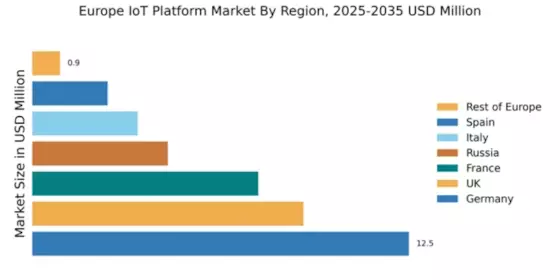
Germany holds a commanding 12.5% market share in the European IoT platform market, valued at approximately €3.5 billion. Key growth drivers include robust industrial automation, significant investments in smart manufacturing, and a strong push towards digital transformation. The government has implemented favorable regulatory policies, such as the Industry 4.0 initiative, which promotes IoT integration across sectors. Infrastructure development, particularly in urban areas like Berlin and Munich, supports this growth by enhancing connectivity and technological adoption.

UK : Innovation and Investment Drive Growth

The UK boasts a 9.0% market share in the IoT platform sector, translating to around €2.5 billion. Growth is fueled by increasing demand for smart city solutions and advancements in 5G technology. The UK government has launched initiatives like the Digital Strategy, which aims to enhance digital infrastructure and promote IoT adoption across various industries. The market is characterized by a strong focus on cybersecurity and data privacy, influencing consumption patterns.

France : Government Support and Innovation

France captures a 7.5% share of the IoT market, valued at approximately €2.1 billion. Key growth drivers include government initiatives like the French Tech program, which supports startups in the IoT space. Demand for smart home devices and industrial IoT applications is on the rise, driven by consumer interest and enterprise needs. Regulatory frameworks are evolving to support innovation while ensuring data protection and privacy.

Russia : Growth Amidst Challenges

Russia holds a 4.5% market share in the IoT platform market, valued at around €1.2 billion. Growth is driven by increasing investments in smart infrastructure and government initiatives aimed at digital transformation. However, challenges such as regulatory hurdles and economic sanctions impact market dynamics. Demand for IoT solutions in sectors like energy and transportation is growing, reflecting a shift towards modernization.

Italy : Manufacturing and Smart Cities Focus

Italy accounts for a 3.5% share of the IoT market, valued at approximately €1 billion. The growth is primarily driven by advancements in manufacturing technologies and the development of smart city projects in cities like Milan and Rome. Government initiatives, such as the National Industry 4.0 Plan, are fostering innovation and investment in IoT solutions. The competitive landscape includes local players and international giants, enhancing market dynamics.

Spain : Focus on Smart Solutions

Spain has a 2.5% market share in the IoT platform sector, valued at around €700 million. Growth is driven by increasing demand for smart agriculture and energy management solutions. The Spanish government is promoting digital transformation through initiatives like the Digital Spain 2025 agenda, which aims to enhance connectivity and IoT adoption. The market is characterized by a mix of local startups and established international players.

Rest of Europe : Varied Growth Across Regions

The Rest of Europe holds a modest 0.92% market share in the IoT platform market, valued at approximately €250 million. Growth is uneven, with some regions showing promise in specific sectors like agriculture and logistics. Government initiatives aimed at enhancing digital infrastructure are crucial for market development. Local dynamics vary significantly, with some areas focusing on niche applications while others lag in adoption.

Europe Iot Platform Market Regional Image

Key Players and Competitive Insights

The iot platform market is currently characterized by a dynamic competitive landscape, driven by rapid technological advancements and increasing demand for connected devices across various sectors. Key players such as Microsoft (US), Amazon (US), and Siemens (DE) are strategically positioning themselves through innovation and partnerships, which collectively shape the competitive environment. Microsoft (US) focuses on enhancing its Azure IoT platform, emphasizing integration with AI and machine learning capabilities, while Amazon (US) continues to expand its AWS IoT services, targeting scalability and ease of use for developers. Siemens (DE), on the other hand, leverages its industrial expertise to provide tailored solutions for manufacturing and smart infrastructure, indicating a trend towards sector-specific offerings.

The market structure appears moderately fragmented, with a mix of established players and emerging startups. Key business tactics include localizing manufacturing to reduce costs and optimize supply chains, which is particularly relevant in the context of increasing geopolitical tensions and supply chain disruptions. The collective influence of these major players fosters a competitive environment where innovation and customer-centric solutions are paramount.

In October 2025, Microsoft (US) announced a strategic partnership with a leading European telecommunications provider to enhance its IoT connectivity solutions. This collaboration aims to leverage 5G technology to improve data transmission speeds and reliability for IoT applications, which is crucial for industries such as automotive and healthcare. The strategic importance of this move lies in Microsoft's commitment to providing robust, scalable solutions that meet the evolving needs of its clients.

In September 2025, Amazon (US) unveiled a new suite of IoT tools designed to facilitate the integration of smart devices into existing infrastructures. This initiative is particularly significant as it addresses the growing demand for interoperability among various IoT devices, thereby enhancing user experience and operational efficiency. By simplifying the integration process, Amazon positions itself as a leader in the IoT space, appealing to a broader range of customers.

In August 2025, Siemens (DE) launched a new IoT platform specifically tailored for the energy sector, focusing on sustainability and efficiency. This platform aims to optimize energy consumption and reduce carbon footprints for industrial clients. The strategic importance of this launch reflects Siemens' commitment to sustainability, aligning with global trends towards greener technologies and practices.

As of November 2025, current competitive trends in the iot platform market are heavily influenced by digitalization, sustainability, and the integration of AI technologies. Strategic alliances are increasingly shaping the landscape, as companies recognize the need for collaborative approaches to address complex challenges. Looking ahead, competitive differentiation is likely to evolve from traditional price-based competition to a focus on innovation, technological advancements, and supply chain reliability, underscoring the importance of agility and responsiveness in a rapidly changing market.

Key Companies in the Europe Iot Platform Market market include

Industry Developments

Vodafone signaled early momentum toward more software-defined and cloud-native network infrastructure convergence with IoT devices in February 2023 when it signed a Memorandum of Understanding with other European operators to enhance Open RAN maturity, security, and energy efficiency.

Using Ericsson's software on Qualcomm's Snapdragon X35 platform, Vodafone Spain, Ericsson, and Qualcomm successfully demonstrated the first 5G Reduced Capability (RedCap) data call in Europe on September 21, 2023, at Vodafone's live CREATE test network in Ciudad Real.

This successfully paved the way for energy-efficient connectivity of IoT devices. Using its worldwide IoT connectivity platform, Vodafone Business extended its Internet in the Car service to 10 more European markets in July 2024, offering in-car broadband and infotainment features.

The first space-to-land mobile broadband research hub in Europe was opened on March 4, 2025, by Vodafone, AST SpaceMobile, and the University of Málaga. Its goal is to integrate satellite and terrestrial IoT connectivity in order to support the commercialization of direct-to-smartphone satellite services in Europe.At the same time, SAP and Microsoft strengthened SAP-backed enterprise IoT integration on Azure infrastructure by expanding the launch of the SAP Business Technology Platform with AI services running on Microsoft Azure across West Europe by mid-2024.

In November 2024, Vodafone Business IoT declared that its connectivity platform would support Oracle's Enterprise Communications Platform (ECP), which provides near-real-time analytics for industry applications and secure IoT device orchestration based on worldwide SIMs.

Europe IoT

Future Outlook

Europe Iot Platform Market Future Outlook

The IoT platform market is projected to grow at an 8.78% CAGR from 2024 to 2035, driven by advancements in connectivity, data analytics, and increased demand for automation.

New opportunities lie in:

  • Development of AI-driven predictive maintenance solutions for industrial IoT applications.
  • Expansion of IoT security services to protect connected devices and data.
  • Integration of edge computing capabilities to enhance real-time data processing efficiency.

By 2035, the IoT platform market is expected to achieve substantial growth, driven by innovation and strategic investments.

Market Segmentation

Europe Iot Platform Market Platform Outlook

  • IoT Connectivity Platforms
  • IoT Device Management Platforms
  • IoT Application Enablement Platforms
  • IoT Analytics Platforms
  • IoT Hardware Development Platforms
  • IoT Integration Platforms

Europe Iot Platform Market Application Outlook

  • Consumer IoT
  • Enterprise IoT
  • Industrial IoT

Europe Iot Platform Market Deployment Model Outlook

  • Cloud
  • On-Premises

Europe Iot Platform Market End Use Vertical Outlook

  • Smart Manufacturing
  • Smart Infrastructure
  • Smart Grid and Utilities
  • Connected Healthcare
  • Smart Retail
  • Smart Transportation
  • Telecommunications
  • Others (Smart Education
  • Smart Agriculture
  • Connected Banking)

Europe Iot Platform Market Organization Size Outlook

  • Small & Medium Enterprises
  • Large Enterprises

Report Scope

MARKET SIZE 202439.92(USD Million)
MARKET SIZE 202543.42(USD Million)
MARKET SIZE 2035100.75(USD Million)
COMPOUND ANNUAL GROWTH RATE (CAGR)8.78% (2024 - 2035)
REPORT COVERAGERevenue Forecast, Competitive Landscape, Growth Factors, and Trends
BASE YEAR2024
Market Forecast Period2025 - 2035
Historical Data2019 - 2024
Market Forecast UnitsUSD Million
Key Companies Profiled["Microsoft (US)", "Amazon (US)", "IBM (US)", "Google (US)", "Cisco (US)", "Oracle (US)", "Siemens (DE)", "SAP (DE)", "GE (US)"]
Segments CoveredPlatform, Organization Size, Deployment Model, Application, End Use Vertical
Key Market OpportunitiesIntegration of advanced analytics and AI capabilities in the iot platform market enhances operational efficiency and decision-making.
Key Market DynamicsRising regulatory pressures drive innovation and competition in the IoT platform market across Europe.
Countries CoveredGermany, UK, France, Russia, Italy, Spain, Rest of Europe

Leave a Comment

FAQs

What is the projected market size of the Europe IoT Platform Market in 2035?

The Europe IoT Platform Market is expected to be valued at approximately 617.23 million USD in 2035.

What is the expected compound annual growth rate (CAGR) for the Europe IoT Platform Market from 2025 to 2035?

The market is expected to grow at a CAGR of 23.625% from 2025 to 2035.

Which region is expected to dominate the Europe IoT Platform Market?

Germany is projected to have a dominant market share, valued at 160.0 million USD in 2035.

What is the market size for IoT Connectivity Platforms in 2035?

The market size for IoT Connectivity Platforms is expected to reach 157.0 million USD in 2035.

Who are the key players in the Europe IoT Platform Market?

Major players in the market include SAP, Cisco, Schneider Electric, GE Digital, and Vodafone.

What is the expected market value of IoT Device Management Platforms by 2035?

IoT Device Management Platforms are projected to be valued at 135.0 million USD in 2035.

How much will the IoT Application Enablement Platforms market be worth in 2035?

The IoT Application Enablement Platforms market is anticipated to be valued at 120.0 million USD in 2035.

Which European country is forecasted to have the lowest market size in 2035?

Russia is expected to have the lowest market size at 85.0 million USD in 2035.

What is the value of the IoT Analytics Platforms in 2024?

The IoT Analytics Platforms market is valued at 9.88 million USD in 2024.

What factors are driving the growth of the Europe IoT Platform Market?

The growth is driven by increasing demand for connected devices and advanced analytics capabilities.

Download Free Sample

Kindly complete the form below to receive a free sample of this Report

Compare Licence

×
Features License Type
Single User Multiuser License Enterprise User
Price $4,950 $5,950 $7,250
Maximum User Access Limit 1 User Upto 10 Users Unrestricted Access Throughout the Organization
Free Customization
Direct Access to Analyst
Deliverable Format
Platform Access
Discount on Next Purchase 10% 15% 15%
Printable Versions