×
Request Free Sample ×

Kindly complete the form below to receive a free sample of this Report

Leading companies partner with us for data-driven Insights

clients tt-cursor
Hero Background

Europe Learning Analytics Market

ID: MRFR/ICT/62555-HCR
200 Pages
Aarti Dhapte
October 2025

Europe Learning Analytics Market Research Report By Tools (Predictive Analytics, Content Analytics, Adaptive Learning Analytics, Others), By Deployment (On-Premises, On Cloud), By Applications (People Acquisition and Retention, Curriculum Development and Intervention Management, Performance Management, Budget and Finance Management, Operations Management) and By Regional (Germany, UK, France, Russia, Italy, Spain, Rest of Europe) - Forecast to 2035

Share:
Download PDF ×

We do not share your information with anyone. However, we may send you emails based on your report interest from time to time. You may contact us at any time to opt-out.

Europe Learning Analytics Market Infographic
Purchase Options

Europe Learning Analytics Market Summary

As per MRFR analysis, the learning analytics market Size was estimated at 1710.0 USD Million in 2024. The learning analytics market is projected to grow from 2051.49 USD Million in 2025 to 12672.8 USD Million by 2035, exhibiting a compound annual growth rate (CAGR) of 19.97% during the forecast period 2025 - 2035.

Key Market Trends & Highlights

The Europe learning analytics market is experiencing robust growth driven by technological advancements and evolving educational needs.

  • Germany remains the largest market for learning analytics, reflecting a strong emphasis on educational technology integration.
  • The UK is emerging as the fastest-growing region, showcasing a rising demand for innovative learning solutions.
  • Personalized learning solutions and the integration of AI technologies are becoming increasingly prevalent across educational institutions.
  • Key market drivers include the rising demand for data-driven insights and government initiatives supporting education technology.

Market Size & Forecast

2024 Market Size 1710.0 (USD Million)
2035 Market Size 12672.8 (USD Million)

Major Players

Blackboard (US), D2L (CA), Pearson (GB), McGraw-Hill (US), Instructure (US), SAS (US), Civitas Learning (US), Knewton (US), Edmentum (US)

Europe Learning Analytics Market Trends

The learning analytics market is currently experiencing a notable evolution, driven by the increasing demand for data-driven decision-making in educational institutions. As educators and administrators seek to enhance student outcomes, the integration of analytics tools into learning environments appears to be gaining traction. This trend is likely influenced by the growing emphasis on personalized learning experiences, which necessitate a deeper understanding of student performance and engagement metrics. Furthermore, advancements in technology, such as artificial intelligence and machine learning, are facilitating the development of sophisticated analytics solutions that can provide actionable insights. In addition, the regulatory landscape in Europe is evolving, with policies encouraging the adoption of data analytics in education. This shift may lead to increased investment in learning analytics tools, as institutions strive to comply with new standards and improve educational quality. The focus on data privacy and security is also paramount, prompting developers to create solutions that prioritize user confidentiality while delivering valuable insights. Overall, the learning analytics market is poised for growth, as stakeholders recognize the potential benefits of leveraging data to inform educational practices and strategies.

Personalized Learning Solutions

There is a growing trend towards personalized learning solutions within the learning analytics market. Educational institutions are increasingly utilizing analytics to tailor educational experiences to individual student needs. This approach not only enhances engagement but also improves academic performance by addressing specific learning gaps.

Integration of AI Technologies

The integration of artificial intelligence technologies into learning analytics tools is becoming more prevalent. These advanced systems can analyze vast amounts of data, providing educators with insights that were previously unattainable. This trend suggests a shift towards more intelligent and adaptive learning environments.

Focus on Data Privacy and Security

As the learning analytics market expands, there is an increasing emphasis on data privacy and security. Educational institutions are prioritizing the protection of student information, leading to the development of analytics solutions that comply with stringent data protection regulations. This focus is essential for building trust among users.

Europe Learning Analytics Market Drivers

Rising Demand for Data-Driven Insights

The learning analytics market in Europe experiences a notable surge in demand for data-driven insights. Educational institutions increasingly recognize the value of leveraging data to enhance student outcomes and optimize teaching methodologies. According to recent studies, approximately 70% of educational leaders in Europe indicate that data analytics plays a crucial role in decision-making processes. This trend is likely to propel investments in learning analytics solutions, as institutions seek to harness data to identify learning gaps and tailor educational experiences. The emphasis on measurable outcomes and accountability further drives the adoption of analytics tools, fostering a culture of continuous improvement within the learning analytics market.

Growing Importance of Lifelong Learning

The learning analytics market in Europe is increasingly influenced by the growing importance of lifelong learning. As the job market evolves, individuals are seeking continuous education and skill development to remain competitive. This trend is reflected in the rising enrollment in adult education programs and online courses, with a reported increase of 25% in adult learners over the past five years. Consequently, educational institutions are turning to learning analytics to track progress and outcomes for diverse learner populations. The emphasis on lifelong learning is likely to propel the demand for analytics solutions that cater to various educational contexts within the learning analytics market.

Increased Focus on Student-Centric Approaches

The learning analytics market in Europe is witnessing a shift towards student-centric educational approaches. Institutions are increasingly prioritizing personalized learning experiences that cater to individual student needs. This trend is supported by research indicating that personalized learning can improve student engagement and achievement by up to 30%. As educators seek to implement tailored strategies, the demand for learning analytics solutions that provide insights into student behavior and performance is likely to rise. Consequently, the learning analytics market is expected to expand as institutions invest in tools that facilitate personalized learning pathways.

Emergence of Collaborative Learning Environments

The learning analytics market in Europe is evolving with the emergence of collaborative learning environments. These environments encourage interaction among students, fostering peer-to-peer learning and knowledge sharing. Research suggests that collaborative learning can enhance critical thinking and problem-solving skills, which are essential in today's educational landscape. As institutions adopt collaborative models, the need for analytics tools that can assess group dynamics and individual contributions becomes apparent. This shift is likely to drive growth in the learning analytics market, as educators seek to understand and optimize collaborative learning experiences.

Government Initiatives Supporting Education Technology

In Europe, various government initiatives are actively promoting the integration of technology in education, thereby bolstering the learning analytics market. Programs aimed at enhancing digital literacy and providing funding for educational technology are becoming increasingly prevalent. For instance, the European Commission has allocated substantial resources to support digital education initiatives, with an estimated budget of €1 billion for the 2021-2027 period. Such investments are likely to facilitate the adoption of learning analytics tools, enabling institutions to better track student performance and engagement. As governments prioritize educational innovation, the learning analytics market is poised for significant growth.

Market Segment Insights

By Application: Academic Institutions (Largest) vs. Online Learning Platforms (Fastest-Growing)

In the Europe learning analytics market, the application segment showcases varied distribution among academic institutions, corporate training, government training programs, and online learning platforms. Academic institutions hold the largest market share, capitalizing on the need for enhanced educational outcomes through data-driven insights. Meanwhile, corporate training and government training programs maintain significant portions of the market, driven by a focus on workforce development and compliance. Online learning platforms, on the other hand, are rapidly increasing their share as digital transformation accelerates. Growth trends in this segment are primarily fueled by the rising integration of advanced analytics tools in educational settings. The shift towards personalized learning experiences and the demand for real-time assessment in online environments are compelling factors behind the growth of online learning platforms. Additionally, corporate training programs are evolving to meet the needs of a diverse workforce, emphasizing skill development through targeted analytics, and driving demand in the market.

Academic Institutions: Dominant vs. Online Learning Platforms: Emerging

Academic institutions are positioned as the dominant force in the application segment, leveraging established structures and significant investments in learning analytics to enhance student performance and curriculum effectiveness. Their historical reliance on data analytics fosters an environment ripe for innovation in educational methodologies. Conversely, online learning platforms are emerging rapidly, capitalizing on the growing trend of remote education and flexible learning solutions. These platforms utilize advanced technologies to offer personalized learning experiences and are increasingly adopted by learners seeking accessible education. This dynamic landscape highlights a shift in focus within the education sector, where online solutions are becoming essential for meeting diverse learner needs.

By Deployment Type: Cloud-Based (Largest) vs. On-Premises (Fastest-Growing)

In the deployment type segment of the market, Cloud-Based solutions are currently the largest, attracting a significant share due to their flexibility and scalability. Organizations are increasingly adopting these solutions as they offer easier access to analytics tools with reduced upfront costs. On-Premises solutions have seen a steady demand, yet their share is less than that of Cloud-Based options, primarily due to higher operational costs and maintenance requirements. Growth trends indicate a robust rise in Cloud-Based solutions driven by the shift towards remote learning and the need for real-time data access. On-Premises solutions, however, are gaining attention from institutions requiring enhanced control over data security and compliance. The Hybrid model is also emerging, blending the strengths of both On-Premises and Cloud-Based solutions, appealing to a diverse clientele that seeks versatility in deployment strategies.

Cloud-Based (Dominant) vs. On-Premises (Emerging)

Cloud-Based deployment is characterized by its accessibility, enabling users to access learning analytics from any location with internet connectivity. This mode promotes collaboration and instant data retrieval, making it appealing for modern educational institutions. In contrast, On-Premises systems provide control and security, catering to organizations that prioritize data governance and have specific compliance needs. While Cloud solutions dominate the market, On-Premises is considered an emerging option as educational institutions seek a balance between flexibility and security. Both deployment types are pivotal in shaping how analytics is utilized in educational settings, addressing diverse operational requirements.

By End-user: K-12 Schools (Largest) vs. Corporate Organizations (Fastest-Growing)

The distribution of market share among the end-user segment values reveals that K-12 Schools command a significant portion of the market, primarily due to the increasing adoption of technology in educational settings. This is coupled with a growing demand for personalized learning solutions that cater to diverse student needs. Meanwhile, Corporate Organizations are rapidly gaining traction, gradually increasing their market share as they focus on internal skill development and employee training through learning analytics. In terms of growth trends, Corporate Organizations are noted as the fastest-growing segment, driven by the need for organizations to enhance employee skills and productivity. The rise of remote work and e-learning tools has prompted companies to invest more in analytics solutions to gauge learning effectiveness. Conversely, K-12 Schools continue to see steady growth, driven by investments in educational technology and a rising emphasis on data-driven learning outcomes.

K-12 Schools: Dominant vs. Corporate Organizations: Emerging

K-12 Schools represent the dominant segment in the end-user landscape, characterized by large-scale implementation of learning analytics to improve educational outcomes. These institutions require robust data analytics solutions to track student performance, personalize learning experiences, and enhance teaching methodologies. On the other hand, Corporate Organizations are emerging as a key player, focusing on harnessing learning analytics for employee development. This segment is notable for its rapid adoption of analytics tools, enabling companies to better understand their training programs' effectiveness and driving investments in tailored learning solutions. Together, these segments reflect the diverse applications of learning analytics in fostering growth and development within educational and corporate environments.

By Technology: Machine Learning (Largest) vs. Artificial Intelligence (Fastest-Growing)

In the Europe learning analytics market, the distribution of market share among the technology segment values reveals that Machine Learning holds a significant portion, dominating analytics through its capability to provide scalable and efficient insights from educational data. Following closely, Big Data Analytics showcases its importance in integrating diverse data sources for a comprehensive understanding of learner performance and institutional decision-making. Data Mining, while having a smaller share, still plays a crucial role by uncovering hidden patterns in data, supporting the tailoring of learning experiences. Growth trends within the technology segment indicate a robust progression, with Artificial Intelligence emerging as the fastest-growing value due to its advanced applications such as personalized learning experiences and predictive analytics. The ongoing digital transformation in education, coupled with increased investment in educational technologies, drives the adoption of these tech innovations. As educational institutions recognize the need for data-driven decision-making, the demand for Machine Learning and Big Data Analytics is projected to grow substantially, fostering an environment ripe for technological advancement.

Learning Analytics Technology: Machine Learning (Dominant) vs. Artificial Intelligence (Emerging)

Machine Learning stands out as the dominant force within the learning analytics technology segment, offering educational institutions powerful tools to analyze large datasets and derive actionable insights. Its capability to automate and enhance learning processes has cemented its position as a foundational technology for many analytics solutions. In contrast, Artificial Intelligence, recognized as the emerging player, is positioned to transform the landscape with its ability to personalize learning paths and engage students more effectively. The rapid advancements in AI technologies, such as natural language processing and adaptive learning systems, are driving its adoption, marking it as a vital component for future growth in the analytics space.

Get more detailed insights about Europe Learning Analytics Market

Regional Insights

Germany : Strong Demand and Innovation Drive Growth

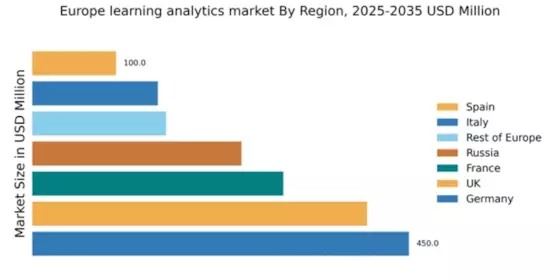
Germany holds a dominant position in the European learning analytics market, with a market value of $450.0 million, representing approximately 30% of the total market share. Key growth drivers include a robust education system, increasing digitalization in schools, and government initiatives promoting e-learning. The demand for personalized learning experiences is rising, supported by regulatory policies that encourage the integration of technology in education. Infrastructure development, particularly in urban areas, further enhances accessibility to learning analytics solutions.

UK : Innovative Solutions and Market Expansion

The UK learning analytics market is valued at $400.0 million, accounting for about 27% of the European market. Growth is driven by the increasing adoption of data-driven decision-making in educational institutions and a strong emphasis on student outcomes. The UK government supports this trend through funding initiatives aimed at enhancing digital learning capabilities. The demand for analytics tools is particularly high in higher education, where institutions seek to improve retention and engagement rates.

France : Government Support Fuels Market Growth

France's learning analytics market is valued at $300.0 million, representing roughly 20% of the European market. The growth is propelled by government initiatives aimed at modernizing the education system and increasing the use of technology in classrooms. Demand for analytics solutions is rising, particularly in urban centers like Paris and Lyon, where educational institutions are increasingly adopting data analytics to enhance learning outcomes. Regulatory frameworks are also evolving to support digital education initiatives.

Russia : Investment in Education Technology Rising

Russia's learning analytics market is valued at $250.0 million, making up about 17% of the European market. Key growth drivers include increased investment in educational technology and a growing awareness of the benefits of data analytics in education. Government policies are increasingly supportive of digital transformation in schools, with initiatives aimed at improving educational quality. Major cities like Moscow and St. Petersburg are leading the charge in adopting learning analytics solutions.

Italy : Focus on Educational Improvement Initiatives

Italy's learning analytics market is valued at $150.0 million, representing about 10% of the European market. The growth is driven by a focus on improving educational outcomes and the integration of technology in learning environments. Government initiatives aimed at enhancing digital literacy in schools are also contributing to market expansion. Key cities such as Rome and Milan are witnessing increased adoption of analytics tools to support personalized learning experiences.

Spain : Increased Adoption in Education Sector

Spain's learning analytics market is valued at $100.0 million, accounting for approximately 7% of the European market. The growth is fueled by a rising demand for data-driven insights in educational institutions and government support for digital education initiatives. Cities like Madrid and Barcelona are at the forefront of adopting learning analytics solutions, with a focus on improving student engagement and performance. The competitive landscape is evolving, with both local and international players entering the market.

Rest of Europe : Varied Market Dynamics Across Regions

The Rest of Europe learning analytics market is valued at $160.0 million, representing about 11% of the total market. Growth is driven by varying levels of digital adoption across different countries, with some regions experiencing rapid advancements in educational technology. Government initiatives aimed at enhancing digital learning are prevalent, although the pace of adoption varies. Countries like the Netherlands and Sweden are notable for their innovative approaches to learning analytics, fostering a competitive environment for market players.

Europe Learning Analytics Market Regional Image

Key Players and Competitive Insights

The learning analytics market in Europe is characterized by a dynamic competitive landscape, driven by the increasing demand for data-driven decision-making in educational institutions. Key players are focusing on innovation and strategic partnerships to enhance their offerings. Companies such as Blackboard (US), D2L (CA), and Pearson (GB) are at the forefront, leveraging advanced analytics and AI technologies to provide tailored solutions for educators and learners. Their collective strategies not only foster competition but also push the boundaries of what learning analytics can achieve, thereby shaping a more data-centric educational environment.

In terms of business tactics, companies are increasingly localizing their operations to better serve regional markets, optimizing supply chains to enhance efficiency. The competitive structure of the market appears moderately fragmented, with several players vying for market share. However, the influence of major companies like McGraw-Hill (US) and Instructure (US) is substantial, as they continue to innovate and expand their reach, thereby impacting the overall market dynamics.

In October 2025, D2L (CA) announced a strategic partnership with a leading European university to develop a customized learning analytics platform aimed at improving student engagement and retention. This move is significant as it not only enhances D2L's market presence in Europe but also demonstrates the growing trend of collaboration between educational institutions and technology providers to create tailored solutions that address specific challenges in the learning environment.

In September 2025, Pearson (GB) launched a new suite of analytics tools designed to provide educators with real-time insights into student performance. This initiative reflects Pearson's commitment to integrating advanced analytics into their educational products, thereby enabling educators to make informed decisions that can enhance learning outcomes. The strategic importance of this launch lies in its potential to position Pearson as a leader in the analytics space, particularly as educational institutions increasingly seek data-driven solutions.

In November 2025, McGraw-Hill (US) unveiled a new AI-driven analytics feature within its learning platform, aimed at personalizing the learning experience for students. This development underscores the growing trend of AI integration in educational technologies, which is likely to redefine how learning analytics are utilized. By focusing on personalization, McGraw-Hill is not only enhancing user experience but also setting a new standard for competitors in the market.

As of November 2025, the competitive trends in the learning analytics market are heavily influenced by digitalization, sustainability, and the integration of AI technologies. Strategic alliances are becoming increasingly important, as they allow companies to pool resources and expertise to innovate more effectively. Looking ahead, it appears that competitive differentiation will evolve from traditional price-based strategies to a focus on innovation, technological advancement, and supply chain reliability, thereby reshaping the landscape of the learning analytics market.

Key Companies in the Europe Learning Analytics Market market include

Industry Developments

The Europe Learning Analytics Market has been witnessing significant growth, driven largely by increased investments in digital education and the demand for data-driven decision-making in learning environments. Major companies such as Oracle, Google, and IBM have been developing robust analytics solutions to enhance user experience and improve learning outcomes across educational institutions.

The increasing emphasis on personalized learning experiences is expected to boost the demand for analytics solutions, with market valuation projected to rise in the coming years, driven by advancements in Artificial Intelligence and machine learning technologies applied within educational contexts. Several educational institutions are now harnessing these technologies to analyze student data more effectively, aiming to tailor educational experiences to individual learner needs.


Future Outlook

Europe Learning Analytics Market Future Outlook

The learning analytics market is projected to grow at a 19.97% CAGR from 2024 to 2035, driven by technological advancements, increased data utilization, and demand for personalized learning solutions.

New opportunities lie in:

  • Development of AI-driven predictive analytics tools for educational institutions.
  • Integration of learning analytics with existing LMS platforms for enhanced user experience.
  • Creation of subscription-based analytics services for corporate training programs.

By 2035, the learning analytics market is expected to achieve substantial growth and innovation.

Market Segmentation

Europe Learning Analytics Market End-user Outlook

  • K-12 Schools
  • Higher Education
  • Corporate Organizations
  • Training Providers

Europe Learning Analytics Market Technology Outlook

  • Data Mining
  • Big Data Analytics
  • Machine Learning
  • Artificial Intelligence

Europe Learning Analytics Market Application Outlook

  • Academic Institutions
  • Corporate Training
  • Government Training Programs
  • Online Learning Platforms

Europe Learning Analytics Market Deployment Type Outlook

  • On-Premises
  • Cloud-Based
  • Hybrid

Report Scope

MARKET SIZE 2024 1710.0(USD Million)
MARKET SIZE 2025 2051.49(USD Million)
MARKET SIZE 2035 12672.8(USD Million)
COMPOUND ANNUAL GROWTH RATE (CAGR) 19.97% (2024 - 2035)
REPORT COVERAGE Revenue Forecast, Competitive Landscape, Growth Factors, and Trends
BASE YEAR 2024
Market Forecast Period 2025 - 2035
Historical Data 2019 - 2024
Market Forecast Units USD Million
Key Companies Profiled ["Blackboard (US)", "D2L (CA)", "Pearson (GB)", "McGraw-Hill (US)", "Instructure (US)", "SAS (US)", "Civitas Learning (US)", "Knewton (US)", "Edmentum (US)"]
Segments Covered Application, Deployment Type, End-user, Technology
Key Market Opportunities Integration of artificial intelligence in learning analytics enhances personalized education experiences and outcomes.
Key Market Dynamics Growing emphasis on data privacy regulations influences the adoption of learning analytics solutions in educational institutions.
Countries Covered Germany, UK, France, Russia, Italy, Spain, Rest of Europe

Leave a Comment

FAQs

What is the expected market size of the Europe Learning Analytics Market by 2035?

The Europe Learning Analytics Market is expected to be valued at 12.68 USD Billion by 2035.

What is the projected compound annual growth rate (CAGR) for the Europe Learning Analytics Market between 2025 and 2035?

The market is expected to have a CAGR of 19.978% from 2025 to 2035.

Which region is expected to hold the largest market share in the Europe Learning Analytics Market by 2035?

Germany is anticipated to hold the largest market share, valued at 4.1 USD Billion by 2035.

What is the market value of predictive analytics in the Europe Learning Analytics Market for the year 2024?

The market value of predictive analytics is projected to be 0.5 USD Billion in 2024.

Who are the key players in the Europe Learning Analytics Market?

Major players include Oracle, Google, IBM, and Microsoft among others.

What is the market size for content analytics in the Europe Learning Analytics Market by 2035?

The content analytics segment is expected to reach 2.8 USD Billion by 2035.

How much is the adaptive learning analytics segment valued at in 2024?

The adaptive learning analytics segment is expected to be valued at 0.3 USD Billion in 2024.

What are the expected market values for the UK in the Europe Learning Analytics Market by 2035?

The UK market is projected to be valued at 3.5 USD Billion by 2035.

What is the estimated market size for 'others' in the Tools category for the year 2035?

The estimated market size for 'others' will reach 4.18 USD Billion by 2035.

What challenges may impact the growth of the Europe Learning Analytics Market from 2025 to 2035?

Challenges may include data privacy concerns and the need for integration with existing educational systems.

Download Free Sample

Kindly complete the form below to receive a free sample of this Report

Compare Licence

×
Features License Type
Single User Multiuser License Enterprise User
Price $4,950 $5,950 $7,250
Maximum User Access Limit 1 User Upto 10 Users Unrestricted Access Throughout the Organization
Free Customization
Direct Access to Analyst
Deliverable Format
Platform Access
Discount on Next Purchase 10% 15% 15%
Printable Versions