×
Request Free Sample ×

Kindly complete the form below to receive a free sample of this Report

* Please use a valid business email

Leading companies partner with us for data-driven Insights

clients tt-cursor
Hero Background

Europe Linux Operating System Market

ID: MRFR/ICT/63337-HCR
200 Pages
Aarti Dhapte
October 2025

Europe Linux Operating System Market Research Report By Distribution Channel (Direct Sales, Online Sales, Retail Sales), By Deployment Type (On-Premises, Cloud-Based), By End User (Individual Users, Small and Medium Enterprises, Large Enterprises, Government), By Application (Server Operating System, Desktop Operating System, Embedded Operating System) and By Regional (Germany, UK, France, Russia, Italy, Spain, Rest of Europe)- Forecast to 2035

Share:
Download PDF ×

We do not share your information with anyone. However, we may send you emails based on your report interest from time to time. You may contact us at any time to opt-out.

Europe Linux Operating System Market Infographic
Purchase Options

Europe Linux Operating System Market Summary

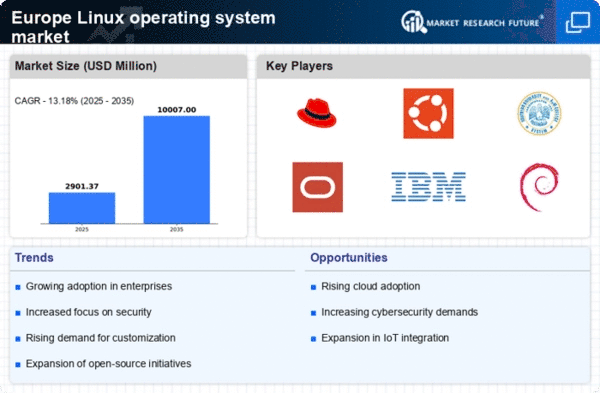
As per MRFR analysis, the Linux operating system market size was estimated at 2563.5 USD Million in 2024. The linux operating-system market is projected to grow from 2901.37 USD Million in 2025 to 10007.0 USD Million by 2035, exhibiting a compound annual growth rate (CAGR) of 13.18% during the forecast period 2025 - 2035.

Key Market Trends & Highlights

The Europe Linux operating-system market is experiencing robust growth driven by security demands and open-source collaboration.

  • Germany remains the largest market for Linux operating systems, reflecting a strong enterprise adoption.
  • The UK is emerging as the fastest-growing region, showcasing a rising interest in cloud-based solutions.
  • There is a notable increase in demand for security features, as organizations prioritize data protection.
  • Key market drivers include the increasing adoption of Linux in enterprises and government initiatives supporting open source.

Market Size & Forecast

2024 Market Size 2563.5 (USD Million)
2035 Market Size 10007.0 (USD Million)
CAGR (2025 - 2035) 13.18%

Major Players

Red Hat (US), Canonical (GB), SUSE (DE), Oracle (US), IBM (US), Debian (FR), Alpine Linux (US), Arch Linux (US)

Europe Linux Operating System Market Trends

The linux operating-system market in Europe is currently experiencing a notable transformation, driven by a combination of technological advancements and shifting user preferences. As organizations increasingly prioritize security and customization, the demand for linux-based solutions appears to be on the rise. This trend is particularly evident in sectors such as finance, healthcare, and education, where the need for robust, secure, and flexible operating systems is paramount. Furthermore, the growing adoption of cloud computing and virtualization technologies is likely to enhance the appeal of linux systems, as they offer efficient resource management and scalability. In addition, the open-source nature of linux operating systems fosters a collaborative environment that encourages innovation. This aspect is particularly attractive to developers and businesses seeking to tailor solutions to their specific needs. As a result, the linux operating-system market is poised for continued growth, with an increasing number of enterprises recognizing the benefits of integrating these systems into their IT infrastructure. The emphasis on sustainability and cost-effectiveness further supports this trend, as organizations look for ways to optimize their operations while minimizing expenses.

Rising Demand for Security Features

The Linux operating system market is witnessing a surge in demand for enhanced security features. Organizations are increasingly concerned about data breaches and cyber threats, prompting them to seek operating systems that offer robust security measures. Linux distributions are often perceived as more secure compared to their counterparts, making them a preferred choice for businesses handling sensitive information.

Growth of Open-Source Collaboration

The trend towards open-source collaboration is gaining momentum within the linux operating-system market. Developers and organizations are increasingly contributing to and utilizing open-source projects, which fosters innovation and accelerates the development of new features. This collaborative approach not only enhances the functionality of linux systems but also creates a vibrant community that supports users.

Adoption of Cloud-Based Solutions

The shift towards cloud-based solutions is significantly impacting the linux operating-system market. As more businesses migrate their operations to the cloud, the demand for linux-based cloud services is likely to increase. Linux systems are well-suited for cloud environments due to their flexibility, scalability, and cost-effectiveness, making them an attractive option for organizations looking to optimize their IT infrastructure.

Europe Linux Operating System Market Drivers

Expansion of Linux in Emerging Technologies

The Linux operating system market is poised for growth due to the expansion of Linux in emerging technologies such as artificial intelligence (AI), Internet of Things (IoT), and edge computing. These technologies require robust and adaptable operating systems, and Linux is well-suited to meet these demands. In Europe, the integration of Linux into IoT devices is particularly noteworthy, with a projected increase in Linux-based IoT deployments by 25% over the next few years. This trend is driven by the need for secure and efficient operating systems that can handle the complexities of interconnected devices. As organizations increasingly adopt Linux for these applications, the market is expected to expand, fostering innovation and collaboration within the industry.

Increasing Adoption of Linux in Enterprises

The linux operating-system market in Europe is experiencing a notable shift as enterprises increasingly adopt Linux-based solutions. This trend is driven by the need for cost-effective and customizable operating systems that can be tailored to specific business requirements. According to recent data, approximately 30% of European enterprises have transitioned to Linux, highlighting its growing acceptance. The flexibility and scalability of Linux make it an attractive option for businesses looking to optimize their IT infrastructure. Furthermore, the ability to run Linux on various hardware platforms enhances its appeal, allowing organizations to leverage existing resources while minimizing costs. As more enterprises recognize the benefits of Linux, the market is likely to expand, fostering innovation and competition within the industry.

Growing Interest in Sustainable IT Solutions

Sustainability is becoming a key consideration for organizations across Europe, influencing the linux operating-system market. As businesses strive to reduce their carbon footprint and enhance energy efficiency, Linux emerges as a viable solution due to its lightweight nature and lower resource requirements. Studies suggest that Linux can reduce energy consumption by up to 20% compared to other operating systems, making it an attractive option for environmentally conscious organizations. Additionally, the open-source nature of Linux allows for community-driven improvements that can further enhance its sustainability profile. As the demand for sustainable IT solutions continues to rise, the linux operating-system market is likely to benefit from increased adoption among organizations committed to environmental responsibility.

Government Initiatives Supporting Open Source

Government initiatives across Europe are playing a crucial role in promoting the linux operating-system market. Various European governments have launched programs aimed at encouraging the adoption of open-source software, including Linux. These initiatives often include funding for research and development, as well as incentives for businesses to transition to open-source solutions. For instance, the European Commission has allocated significant resources to support open-source projects, which has led to an increase in Linux usage among public sector organizations. This support not only enhances the credibility of Linux but also drives its adoption in the private sector. As government backing continues, the linux operating-system market is expected to witness sustained growth, fostering a more robust ecosystem for developers and users alike.

Rising Demand for Customization and Flexibility

The Linux operating system market is significantly influenced by the rising demand for customization and flexibility among users in Europe. Organizations are increasingly seeking operating systems that can be tailored to their specific needs, and Linux offers unparalleled customization options. This demand is particularly evident in sectors such as education, healthcare, and finance, where specialized applications are essential. Recent surveys indicate that over 40% of European IT managers prioritize customization when selecting an operating system. The ability to modify the Linux kernel and utilize various distributions allows businesses to create solutions that align with their operational requirements. Consequently, this trend is likely to drive further adoption of Linux, as organizations recognize the advantages of a tailored approach to their IT infrastructure.


Market Segment Insights

By Distribution Channel: Online Sales (Largest) vs. Direct Sales (Fastest-Growing)

In the European linux operating-system market, Online Sales has established itself as the largest distribution channel, catering to a significant portion of the user base. This channel benefits from the growing trend towards e-commerce and the increasing preference for digital solutions, allowing customers convenient access to a variety of linux distributions. Contrastingly, Direct Sales is witnessing rapid growth, driven by businesses seeking personalized solutions and support. This trend is propelled by the growing awareness of linux advantages and the demand for tailored enterprise deployments. As organizations prioritize flexibility and cost-effectiveness, Direct Sales are expected to become a prominent choice among emerging distribution channels.

Online Sales (Dominant) vs. Direct Sales (Emerging)

Online Sales has emerged as the dominant distribution channel in the Europe linux operating-system market, characterized by its wide reach and convenience for consumers. This channel thrives on e-commerce platforms that allow for instant access to various distributions and associated services. Meanwhile, Direct Sales is seen as an emerging segment, appealing to businesses requiring customized solutions. It offers personalized support and solutions, catering to organizations looking for specific linux operating system features. The balance between these channels reflects the diverse needs of users, from casual consumers to enterprise clients, and indicates a dynamic shift in how linux operating systems are marketed and sold.

By Deployment Type: On-Premises (Largest) vs. Cloud-Based (Fastest-Growing)

The deployment type segment in the Linux operating-system landscape exhibits a marked preference for On-Premises solutions, which dominate the market with a substantial share. This preference stems from the control and security that on-premises deployments afford organizations, which many enterprises prioritize. Conversely, Cloud-Based solutions are emerging as a significant alternative, gradually increasing their market share as businesses shift towards more flexible and scalable options. The growth trajectory of Cloud-Based deployments is driven by various factors, including the increasing demand for remote accessibility, lower operational costs, and enhanced collaboration capabilities. As organizations embrace digital transformation, the demand for Cloud-Based Linux operating systems is surging, positioning them as the fastest-growing segment. This shift indicates a broader trend towards more agile and efficient IT infrastructures, making Cloud-Based solutions a compelling option for modern enterprises.

On-Premises (Dominant) vs. Cloud-Based (Emerging)

On-Premises deployments stand out as the dominant choice in the Linux operating-system landscape, offering organizations unparalleled control over their IT environments. These solutions are particularly favored by enterprises that prioritize security, compliance, and customization, allowing them to tailor their systems to specific needs. The stability and performance provided by On-Premises solutions are critical for mission-critical applications, which remain a cornerstone for various industries. In contrast, Cloud-Based deployments are positioned as an emerging option, gaining traction due to their scalability and ease of deployment. They cater to businesses looking for agile solutions to adapt to rapid changes in the market, enabling companies to utilize resources more efficiently and collaborate more effectively across distributed teams.

By End User: Individual Users (Largest) vs. Small and Medium Enterprises (Fastest-Growing)

The market share distribution among the end user segments reveals that Individual Users hold the largest share, showcasing a broad base of enthusiasm for Linux operating systems. This segment includes tech-savvy individuals and hobbyists, contributing significantly to its dominance, while Small and Medium Enterprises (SMEs) are swiftly gaining traction, utilizing Linux for its cost-effectiveness and flexibility. Growth trends indicate an increasing adoption among Small and Medium Enterprises due to the rise of remote work and digital transformation initiatives. These enterprises find Linux appealing as it provides an efficient, secure, and scalable solution to meet their evolving needs. Furthermore, the trend of customization and open-source benefits drives interest across various sectors, enabling service innovation and competitive advantage.

Individual Users: Dominant vs. Small and Medium Enterprises: Emerging

Individual Users, characterized by their diverse applications and preferences, dominate the market, primarily driven by their need for a stable, customizable platform. This segment often includes developers and enthusiasts who appreciate open-source flexibility. Conversely, Small and Medium Enterprises are emerging as significant players, leveraging Linux to optimize costs and enhance operational efficiency. These businesses aim to minimize licensing costs without compromising performance and security. They benefit from community support and diverse distributions tailored to specific use cases, which facilitates their growth in the Europe linux operating-system market.

By Application: Server Operating System (Largest) vs. Embedded Operating System (Fastest-Growing)

The application segment of the Linux operating system market is characterized by a competitive landscape where Server Operating Systems hold the largest market share. They have become vital for businesses needing reliable, scalable, and efficient computing environments. In contrast, Desktop Operating Systems are steadily losing ground, while Embedded Operating Systems are rapidly increasing their share, thanks to the rising demand for IoT devices and automation solutions. The growth trends within this segment highlight the shifting preferences of consumers and businesses alike. Server Operating Systems continue to be dominated by major distributions that emphasize stability and security, ensuring a robust presence in enterprise sectors. Conversely, Embedded Operating Systems are experiencing the fastest growth as they support a myriad of applications across industries, driven by the Internet of Things and smart technologies that require specialized operating environments and lower power consumption.

Server Operating System: Dominant vs. Embedded Operating System: Emerging

The Server Operating System segment is recognized as the dominant player in the application landscape due to its critical role in managing network resources and serving enterprise applications. It caters primarily to businesses requiring high uptime and security. On the other hand, the Embedded Operating System is emerging as a significant player, particularly in sectors like automotive, healthcare, and consumer electronics. This segment is tailored for specific functionalities, ensuring efficiency and lower overhead, thus supporting the growing trend of IoT devices and automation. The rise of smart appliances and connected devices propels the demand for embedded solutions, marking them as vital for future technological advancements in various industries.

Get more detailed insights about Europe Linux Operating System Market

Regional Insights

Germany : Strong Demand and Innovation Hub

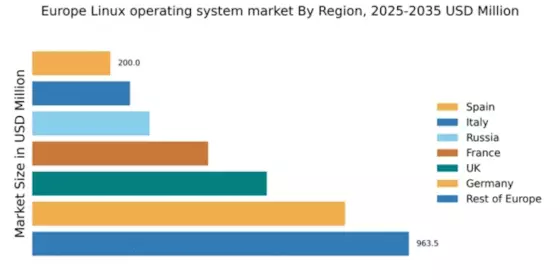
Germany holds a commanding 29.5% market share in the European Linux operating system market, valued at $800.0 million. Key growth drivers include a robust IT infrastructure, increasing adoption of open-source solutions, and government initiatives promoting digital transformation. The demand for Linux is bolstered by trends in cloud computing and enterprise resource planning, supported by favorable regulatory policies that encourage innovation and investment in technology.

UK : Innovation and Adoption on the Rise

The UK accounts for 24.5% of the European Linux market, with a value of $600.0 million. Growth is driven by increasing cloud adoption, a thriving tech startup scene, and government support for digital skills training. The demand for Linux is particularly strong in sectors like finance and education, where security and flexibility are paramount. Regulatory frameworks are evolving to support open-source initiatives, enhancing the business environment for Linux solutions.

France : Focus on Security and Compliance

France represents 18.8% of the Linux market in Europe, valued at $450.0 million. The growth is fueled by a focus on cybersecurity and compliance with EU regulations. Demand trends show a rising preference for Linux in public sector projects and educational institutions, driven by government initiatives promoting open-source software. The French market is characterized by a strong emphasis on data protection and privacy, influencing consumption patterns.

Russia : Government Support and Local Development

Russia holds a 12.5% share of the European Linux market, valued at $300.0 million. Key growth drivers include government initiatives to promote domestic software solutions and a growing interest in open-source technologies. Demand is particularly strong in the public sector, where local authorities are encouraged to adopt Linux for cost efficiency. The competitive landscape features local players alongside international firms, fostering a diverse market environment.

Italy : Focus on SMEs and Innovation

Italy accounts for 10.4% of the Linux market in Europe, valued at $250.0 million. Growth is driven by the increasing adoption of Linux among small and medium-sized enterprises (SMEs) seeking cost-effective solutions. Demand trends indicate a shift towards cloud-based services and digital transformation initiatives. The Italian government supports open-source adoption through various programs, enhancing the overall business climate for Linux solutions.

Spain : Growing Demand in Tech Sector

Spain represents 8.3% of the European Linux market, valued at $200.0 million. The growth is driven by a burgeoning tech sector and increasing awareness of open-source benefits. Demand is particularly strong in industries such as telecommunications and education, where flexibility and cost savings are crucial. Government initiatives promoting digitalization and innovation are further enhancing the market environment for Linux adoption.

Rest of Europe : Varied Adoption and Growth Trends

The Rest of Europe accounts for 39.5% of the Linux market, valued at $963.5 million. This diverse region showcases varying adoption rates and growth drivers, influenced by local regulations and market conditions. Demand trends indicate a rising interest in open-source solutions across multiple sectors, including healthcare and finance. The competitive landscape features a mix of local and international players, fostering innovation and collaboration.

Europe Linux Operating System Market Regional Image

Key Players and Competitive Insights

The linux operating-system market in Europe is characterized by a dynamic competitive landscape, driven by innovation, strategic partnerships, and a growing demand for open-source solutions. Key players such as Red Hat (US), Canonical (GB), and SUSE (DE) are at the forefront, each adopting distinct strategies to enhance their market positioning. Red Hat (US) focuses on expanding its hybrid cloud offerings, while Canonical (GB) emphasizes its commitment to IoT and edge computing. SUSE (DE), on the other hand, is leveraging its expertise in enterprise solutions to cater to the needs of large organizations, thereby shaping a competitive environment that is increasingly collaborative yet fiercely competitive.

The business tactics employed by these companies reflect a nuanced understanding of the market's structure, which appears moderately fragmented. Localizing manufacturing and optimizing supply chains are common strategies aimed at enhancing operational efficiency. The collective influence of these key players fosters a competitive atmosphere where innovation and customer-centric solutions are paramount, allowing them to navigate the complexities of the market effectively.

In October 2025, Red Hat (US) announced a strategic partnership with a leading cloud provider to enhance its hybrid cloud capabilities. This move is likely to bolster its market share by providing customers with more integrated solutions, thereby addressing the growing demand for cloud-native applications. Such partnerships are indicative of a broader trend towards collaboration in the industry, as companies seek to combine strengths to deliver comprehensive solutions.

In September 2025, Canonical (GB) launched a new version of its Ubuntu operating system, specifically designed for IoT devices. This release underscores Canonical's commitment to innovation in the IoT space, potentially positioning it as a leader in this rapidly evolving segment. By focusing on IoT, Canonical may attract a new customer base, further solidifying its presence in the market.

In August 2025, SUSE (DE) expanded its operations into Eastern Europe, aiming to tap into emerging markets with a growing demand for enterprise solutions. This strategic move not only enhances SUSE's geographical footprint but also reflects a proactive approach to capturing new business opportunities in regions that are increasingly adopting open-source technologies. Such expansions are crucial for sustaining growth in a competitive landscape.

As of November 2025, the linux operating-system market is witnessing trends that emphasize digitalization, sustainability, and the integration of AI technologies. Strategic alliances are becoming increasingly vital, as companies recognize the need to collaborate to stay competitive. The shift from price-based competition to a focus on innovation, technology, and supply chain reliability is evident, suggesting that future differentiation will hinge on the ability to deliver cutting-edge solutions that meet evolving customer needs.

Key Companies in the Europe Linux Operating System Market market include

Industry Developments

The Europe Linux Operating System Market has recently seen notable developments. In October 2023, Oracle announced enhancements to its cloud solutions that integrate deeply with Linux, aiming to better serve enterprises across Europe. Meanwhile, in September 2023, Red Hat unveiled new features in its OpenShift platform to boost performance and security, catering specifically to European data compliance regulations. In terms of market dynamics, SUSE reported significant growth in adoption rates among European SMEs, enhancing their portfolio with cloud-native solutions.

There have also been movements related to mergers and acquisitions; for instance, in June 2023, Canonical engaged in strategic partnerships to expand its service offerings in the European market, further solidifying its position. In 2021, IBM expanded its European footprint by acquiring various cloud resources and expertise, enhancing its Linux capabilities. 

Additionally, online communities surrounding Arch Linux and Debian continue to thrive, fostering innovation and collaboration, with active contributions from European developers. The overall market has seen increasing investments in Research and Development, driving competition and innovation across the segment, illustrating a rapidly evolving landscape.


Future Outlook

Europe Linux Operating System Market Future Outlook

The Linux operating-system market is projected to grow at 13.18% CAGR from 2024 to 2035, driven by cloud adoption, IoT integration, and enterprise demand for open-source solutions.

New opportunities lie in:

  • Development of tailored Linux distributions for specific industries
  • Expansion of Linux-based cloud services and infrastructure
  • Creation of training programs for Linux certification and skills enhancement

By 2035, The Linux operating system market is expected to achieve substantial growth and innovation.

Market Segmentation

Europe Linux Operating System Market End User Outlook

  • Individual Users
  • Small and Medium Enterprises
  • Large Enterprises
  • Government

Europe Linux Operating System Market Application Outlook

  • Server Operating System
  • Desktop Operating System
  • Embedded Operating System

Europe Linux Operating System Market Deployment Type Outlook

  • On-Premises
  • Cloud-Based

Europe Linux Operating System Market Distribution Channel Outlook

  • Direct Sales
  • Online Sales
  • Retail Sales

Report Scope

MARKET SIZE 2024 2563.5(USD Million)
MARKET SIZE 2025 2901.37(USD Million)
MARKET SIZE 2035 10007.0(USD Million)
COMPOUND ANNUAL GROWTH RATE (CAGR) 13.18% (2024 - 2035)
REPORT COVERAGE Revenue Forecast, Competitive Landscape, Growth Factors, and Trends
BASE YEAR 2024
Market Forecast Period 2025 - 2035
Historical Data 2019 - 2024
Market Forecast Units USD Million
Key Companies Profiled ["Red Hat (US)", "Canonical (GB)", "SUSE (DE)", "Oracle (US)", "IBM (US)", "Debian (FR)", "Alpine Linux (US)", "Arch Linux (US)"]
Segments Covered Distribution Channel, Deployment Type, End User, Application
Key Market Opportunities Growing demand for cloud computing solutions enhances opportunities in the linux operating-system market.
Key Market Dynamics Rising demand for open-source solutions drives innovation and competition in the Linux operating-system market.
Countries Covered Germany, UK, France, Russia, Italy, Spain, Rest of Europe

Leave a Comment

FAQs

What is the expected market size of the Europe Linux Operating System Market in 2024?

The Europe Linux Operating System Market is expected to be valued at 2.57 billion USD in 2024.

What is the projected market size for the Europe Linux Operating System Market by 2035?

By 2035, the Europe Linux Operating System Market is anticipated to reach 10.0 billion USD.

What is the compound annual growth rate (CAGR) for the Europe Linux Operating System Market from 2025 to 2035?

The market is expected to grow at a CAGR of 13.147% during the period from 2025 to 2035.

Which country holds the largest market share in the Europe Linux Operating System Market in 2024?

Germany holds the largest market share with a valuation of 0.75 billion USD in 2024.

Which key players are dominating the Europe Linux Operating System Market?

Major players include Oracle, Red Hat, IBM, and Ubuntu among others.

What market value does Online Sales contribute to the Europe Linux Operating System Market in 2024?

Online Sales is valued at 1.12 billion USD in the Europe Linux Operating System Market for the year 2024.

What is the expected market size for Retail Sales in the Europe Linux Operating System Market by 2035?

Retail Sales is projected to reach 1.5 billion USD in the Europe Linux Operating System Market by 2035.

Which region has the second-largest market size in the Europe Linux Operating System Market in 2024?

The UK has the second-largest market size with a value of 0.63 billion USD in 2024.

What is the anticipated market value for France in the Europe Linux Operating System Market by 2035?

The market value for France is expected to reach 2.0 billion USD by 2035.

How much is the market size projected for Italy in 2024?

The market size for Italy is projected to be 0.32 billion USD in 2024.

Download Free Sample

Kindly complete the form below to receive a free sample of this Report

Compare Licence

×
Features License Type
Single User Multiuser License Enterprise User
Price $4,950 $5,950 $7,250
Maximum User Access Limit 1 User Upto 10 Users Unrestricted Access Throughout the Organization
Free Customization
Direct Access to Analyst
Deliverable Format
Platform Access
Discount on Next Purchase 10% 15% 15%
Printable Versions