×
Request Free Sample ×

Kindly complete the form below to receive a free sample of this Report

* Please use a valid business email

Leading companies partner with us for data-driven Insights

clients tt-cursor
Hero Background

Europe Monosodium Glutamate Market

ID: MRFR/CnM/45686-HCR
111 Pages
Chitranshi Jaiswal
October 2025

Europe Monosodium Glutamate Market Research Report: By Application (Additives, Acidity Regulators, Preservatives, Others), By End User (Food Processing, Pharmaceuticals, Cosmetics, Animal Feed, Others), and By Regional (Germany, UK, France, Russia, Italy, Spain, Rest of Europe)- Forecast to 2035

Share:
Download PDF ×

We do not share your information with anyone. However, we may send you emails based on your report interest from time to time. You may contact us at any time to opt-out.

Europe Monosodium Glutamate Market Infographic
Purchase Options

Europe Monosodium Glutamate Market Summary

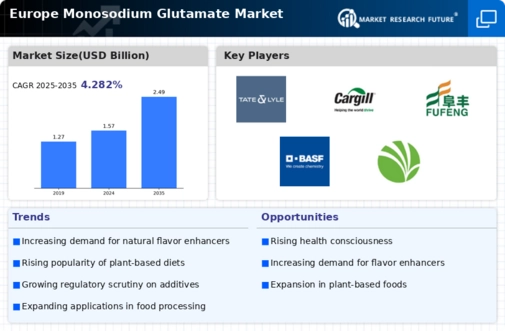
As per MRFR analysis, the Europe monosodium glutamate market size was estimated at 1428.0 USD Million in 2024. The Europe monosodium glutamate market is projected to grow from 1488.69 USD Million in 2025 to 2256.0 USD Million by 2035, exhibiting a compound annual growth rate (CAGR) of 4.25% during the forecast period 2025 - 2035.

Key Market Trends & Highlights

The Europe monosodium glutamate market is experiencing a notable shift towards natural ingredients and umami flavors, driven by health consciousness and culinary innovation.

  • Germany remains the largest market for monosodium glutamate, reflecting a strong consumer preference for flavor enhancement in various food products.
  • The UK is currently the fastest-growing region, indicating a rising interest in diverse culinary experiences and ethnic cuisines.
  • There is a marked trend towards the use of natural ingredients, as consumers increasingly seek healthier and more sustainable food options.
  • Key market drivers include growing health consciousness and the expansion of the processed food sector, which are shaping consumer choices in flavoring agents.

Market Size & Forecast

2024 Market Size 1428.0 (USD Million)
2035 Market Size 2256.0 (USD Million)
CAGR (2025 - 2035) 4.25%

Major Players

Ajinomoto (JP), MSG Asia (CN), Fufeng Group (CN), Meihua Group (CN), Shaanxi Sciphar Hi-Tech Industry (CN), Ningxia Eppen Biotech (CN), Sambavanam (IN), Hubei Shuanghui Investment & Development (CN)

Europe Monosodium Glutamate Market Trends

The monosodium glutamate market is currently experiencing notable shifts, driven by evolving consumer preferences and increasing demand for flavor enhancers in various food products. As culinary trends evolve, there is a growing inclination towards natural and clean-label ingredients, which influences the formulation of food items. This trend appears to be fostering a more favorable environment for monosodium glutamate, as manufacturers seek to balance flavor enhancement with consumer health concerns. Additionally, the rise of plant-based diets and the corresponding demand for umami flavors may further bolster the market's growth, as monosodium glutamate is often utilized to enhance the taste profile of vegetarian and vegan products. Moreover, regulatory frameworks in Europe are adapting to the changing landscape of food additives, which could impact the monosodium glutamate market. Stricter regulations regarding food safety and labeling may necessitate transparency in ingredient sourcing and usage. This situation presents both challenges and opportunities for manufacturers, as they navigate compliance while meeting consumer expectations. The market's trajectory seems poised for growth, with potential innovations in product formulations and applications that align with health-conscious trends. Overall, the future of the monosodium glutamate market appears promising, with a focus on quality, safety, and consumer satisfaction.

Shift Towards Natural Ingredients

There is a noticeable trend towards the use of natural ingredients in food products, which influences the monosodium glutamate market. Consumers are increasingly seeking clean-label options, prompting manufacturers to explore alternatives that align with this preference while still delivering flavor enhancement.

Rising Demand for Umami Flavors

The growing popularity of umami flavors, particularly in plant-based diets, is driving interest in monosodium glutamate. As more consumers adopt vegetarian and vegan lifestyles, the need for flavor enhancers that replicate savory tastes becomes more pronounced, potentially boosting market demand.

Regulatory Changes and Compliance

Regulatory frameworks in Europe are evolving, impacting the monosodium glutamate market. Stricter food safety and labeling regulations may require manufacturers to adapt their practices, ensuring transparency and compliance while addressing consumer health concerns.

Europe Monosodium Glutamate Market Drivers

Growing Health Consciousness

The increasing awareness of health and wellness among consumers in Europe is driving the monosodium glutamate market. As individuals become more discerning about their dietary choices, there is a notable shift towards products that enhance flavor without compromising health. This trend is reflected in the rising demand for low-sodium alternatives, where monosodium glutamate serves as a flavor enhancer that can reduce the need for excessive salt. In 2025, the market for low-sodium food products is projected to grow by approximately 15%, indicating a significant opportunity for monosodium glutamate market players to innovate and cater to health-conscious consumers. Furthermore, the emphasis on clean labels and transparency in food ingredients is likely to influence purchasing decisions, thereby shaping the competitive landscape of the monosodium glutamate market in Europe.

Rising Demand for Ethnic Cuisine

The growing popularity of ethnic cuisines across Europe is significantly influencing the monosodium glutamate market. As consumers become more adventurous in their culinary choices, there is an increasing demand for authentic flavors found in Asian and other international dishes. Monosodium glutamate is often used in these cuisines to enhance the umami taste, making it a sought-after ingredient in restaurants and home cooking alike. In 2025, the ethnic food market in Europe is anticipated to grow by 12%, indicating a strong potential for the monosodium glutamate market to capitalize on this trend. Food manufacturers and restaurants are likely to incorporate monosodium glutamate to meet consumer expectations for authentic taste experiences, thereby driving sales and market growth.

Expansion of Processed Food Sector

The processed food sector in Europe is experiencing robust growth, which is positively impacting the monosodium glutamate market. As busy lifestyles lead consumers to seek convenient meal options, the demand for ready-to-eat and packaged foods is on the rise. In 2025, the processed food market in Europe is expected to reach a valuation of over €300 billion, with flavor enhancers like monosodium glutamate playing a crucial role in improving taste and consumer satisfaction. This trend is particularly evident in the snack food segment, where flavor enhancement is essential for product differentiation. Consequently, the monosodium glutamate market is likely to benefit from partnerships with food manufacturers aiming to meet the evolving preferences of consumers seeking convenience without sacrificing flavor.

Sustainability and Ethical Sourcing

Sustainability concerns are becoming increasingly prominent in the European food industry, impacting the monosodium glutamate market. Consumers are more inclined to support brands that prioritize ethical sourcing and environmentally friendly practices. This shift is prompting manufacturers to explore sustainable production methods for monosodium glutamate, which could enhance brand loyalty and consumer trust. In 2025, the market for sustainable food products is projected to grow by 20%, suggesting that the monosodium glutamate market must adapt to these changing consumer preferences. By focusing on sustainability, companies can differentiate themselves in a competitive landscape, potentially leading to increased market share and profitability. This trend underscores the importance of aligning product offerings with the values of environmentally conscious consumers.

Culinary Innovation and Experimentation

Culinary innovation is a driving force in the monosodium glutamate market, as chefs and food manufacturers in Europe increasingly experiment with flavors and ingredients. The rise of fusion cuisine and gourmet cooking has led to a renewed interest in umami flavors, where monosodium glutamate is recognized for its ability to enhance taste profiles. In 2025, the gourmet food market is projected to grow by 10%, suggesting a favorable environment for the monosodium glutamate market. This trend is further supported by the increasing popularity of cooking shows and food blogs, which encourage home cooks to explore new flavor combinations. As culinary creativity flourishes, the demand for monosodium glutamate as a versatile ingredient is likely to expand, providing opportunities for manufacturers to introduce innovative products.


Market Segment Insights

By Application: Additives (Largest) vs. Preservatives (Fastest-Growing)

In the Europe monosodium glutamate market, the application segment is primarily dominated by additives, which capture a significant portion of the market share due to their extensive use in enhancing flavor profiles in various food products. Following closely are acidity regulators, which play a crucial role in maintaining the desired taste and pH levels of food items, and preservatives, which are also gaining traction due to increased health consciousness among consumers. Others comprise innovative applications that cater to niche markets and emerging trends. The growth trajectory of this segment is driven by an increasing demand for natural and functional food ingredients as consumers lean towards healthier eating. Additives are projected to retain their leading position, while preservatives are witnessing rapid growth as food safety concerns heighten. Market players are investing in R&D to develop innovative products, ensuring they keep pace with the evolving demands of the food industry.

Additives (Dominant) vs. Acidity Regulators (Emerging)

Additives hold a dominant position in the application segment of the Europe monosodium glutamate market, primarily due to their essential role in flavor enhancement and overall food quality improvement. This segment benefits from established consumer preferences for taste and palatability in products ranging from snacks to sauces. On the other hand, acidity regulators are emerging as an impactful segment, fueled by innovations in food preservation and safety. As food manufacturers seek to improve shelf-life and maintain freshness, the demand for high-quality acidity regulators is on the rise. This dynamic creates opportunities for companies to explore new formulations and educate consumers about the importance of such additives in food products.

By End-User: Food Processing (Largest) vs. Pharmaceuticals (Fastest-Growing)

In the Europe monosodium glutamate market, the distribution of market share among the end-user segments reveals that food processing holds the largest share. This segment is predominant due to its wide application in enhancing flavor and quality in various food products. Other significant segments include pharmaceuticals and cosmetics, but their shares are comparatively smaller as the market dynamics evolve. Animal feed and others also represent noteworthy portions, although they are not as pronounced as food processing. Growth trends indicate that while food processing remains dominant, the pharmaceuticals segment is observed to be the fastest-growing. This rapid growth is attributed to the increasing awareness regarding health and nutrition among consumers, leading to a rise in demand for monosodium glutamate in pharmaceutical applications. Additionally, expanding innovation in product formulations is driving growth across various segments, particularly in the health and wellness sectors.

Food Processing (Dominant) vs. Pharmaceuticals (Emerging)

Food processing is characterized by its extensive utilization of monosodium glutamate as a flavor enhancer, making it the dominant force in the market. This segment benefits from the large-scale production and widespread consumption of processed foods, as it significantly improves taste and consumer acceptance. On the other hand, the pharmaceuticals segment, while currently emerging, is gaining traction due to increased regulations around health products and a growing trend towards using natural flavor enhancers. This segment's expansion is further supported by ongoing research and development efforts aimed at integrating monosodium glutamate into new pharmaceutical formulations, enhancing efficacy and consumer appeal.

Get more detailed insights about Europe Monosodium Glutamate Market

Regional Insights

Germany : Strong Demand and Industrial Growth

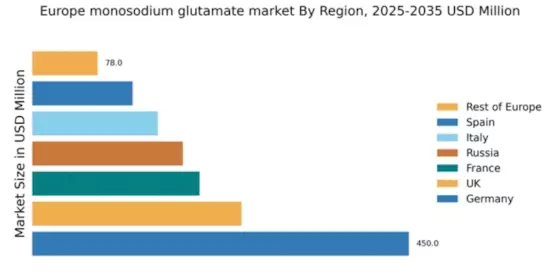
Germany holds a dominant position in the European monosodium glutamate (MSG) market, accounting for 450.0 million, representing approximately 38.5% of the total market share. Key growth drivers include a robust food processing industry, increasing consumer preference for umami flavors, and supportive government policies promoting food safety and quality. The country’s advanced infrastructure and industrial capabilities further enhance production efficiency and distribution networks.

UK : Growing Culinary Trends and Demand

The UK monosodium glutamate market is valued at 250.0 million, capturing about 21.4% of the European market. The growth is fueled by rising culinary trends, particularly in Asian cuisine, and an increasing focus on flavor enhancement in processed foods. Regulatory frameworks are evolving to ensure food safety, while initiatives to promote local sourcing are gaining traction, impacting MSG consumption positively.

France : Culinary Heritage Drives Consumption

France's monosodium glutamate market is valued at 200.0 million, representing 17.1% of the European market. The growth is driven by the country's rich culinary heritage, with chefs increasingly using MSG to enhance flavors in traditional dishes. Regulatory policies emphasize food quality and safety, while government initiatives support local food production, positively influencing MSG demand.

Russia : Diverse Applications and Growth Potential

Russia's monosodium glutamate market is valued at 180.0 million, accounting for 15.4% of the European market. The growth is driven by diverse applications in the food industry, including snacks and ready-to-eat meals. Government initiatives aimed at boosting domestic food production and improving food safety standards are also contributing to market expansion, alongside increasing consumer awareness of flavor enhancement.

Italy : Culinary Innovation and Demand Growth

Italy's monosodium glutamate market is valued at 150.0 million, representing 12.8% of the European market. The growth is attributed to the country's culinary innovation, with MSG being used to enhance flavors in both traditional and modern Italian cuisine. Regulatory policies focus on food safety, while local initiatives promote sustainable sourcing, positively impacting MSG consumption patterns.

Spain : Cultural Flavors and Market Growth

Spain's monosodium glutamate market is valued at 120.0 million, capturing 10.3% of the European market. The growth is driven by cultural flavors and the increasing popularity of Asian cuisine. Regulatory frameworks are adapting to ensure food safety, while local initiatives support the food industry, enhancing MSG demand in various culinary applications.

Rest of Europe : Diverse Opportunities and Growth Potential

The Rest of Europe monosodium glutamate market is valued at 78.0 million, accounting for 6.6% of the total market. Growth is driven by emerging markets in Eastern Europe, where increasing urbanization and changing dietary preferences are leading to higher MSG consumption. Regulatory policies are evolving to ensure food safety, while local initiatives are fostering industry growth and innovation.

Europe Monosodium Glutamate Market Regional Image

Key Players and Competitive Insights

The competitive dynamics within the monosodium glutamate market are characterized by a blend of innovation, strategic partnerships, and regional expansion. Key players such as Ajinomoto (Japan), MSG Asia (China), and Fufeng Group (China) are actively shaping the landscape through their operational focuses. Ajinomoto (Japan) emphasizes innovation in product development, particularly in enhancing the flavor profile of its offerings, which appears to resonate well with evolving consumer preferences. Meanwhile, MSG Asia (China) is strategically positioned to leverage its extensive distribution network across Asia, facilitating a robust supply chain that enhances market penetration. Fufeng Group (China) has adopted a dual approach of expanding its production capacity while also investing in sustainable practices, which seems to align with the growing demand for environmentally friendly products.

The market structure is moderately fragmented, with several players vying for market share. Key business tactics such as localizing manufacturing and optimizing supply chains are prevalent among these companies. This localized approach not only reduces operational costs but also enhances responsiveness to regional market demands. The collective influence of these key players fosters a competitive environment where innovation and operational efficiency are paramount, thereby driving overall market growth.

In October 2025, Ajinomoto (Japan) announced a significant investment in a new production facility in Eastern Europe, aimed at increasing its output capacity by 30%. This strategic move is likely to enhance its competitive edge by reducing lead times and improving supply chain efficiency in a region that has shown increasing demand for flavor enhancers. The establishment of this facility may also allow Ajinomoto (Japan) to better cater to local tastes and preferences, thereby solidifying its market position.

In September 2025, Fufeng Group (China) launched a new line of organic monosodium glutamate products, targeting health-conscious consumers. This initiative appears to be a response to the rising trend of clean-label products, which emphasizes transparency and health benefits. By diversifying its product range, Fufeng Group (China) is likely to attract a broader customer base, potentially increasing its market share in the premium segment.

In August 2025, MSG Asia (China) entered into a strategic partnership with a leading food manufacturer in Western Europe to co-develop new flavoring solutions. This collaboration seems to indicate a shift towards innovation-driven growth strategies, where companies are increasingly looking to leverage each other's strengths to enhance product offerings. Such partnerships may also facilitate knowledge sharing and technological advancements, further enriching the competitive landscape.

As of November 2025, current trends in the monosodium glutamate market are increasingly defined by digitalization, sustainability, and the integration of AI technologies. The emphasis on strategic alliances is reshaping the competitive environment, allowing companies to pool resources and expertise. Looking ahead, it appears that competitive differentiation will evolve from traditional price-based competition to a focus on innovation, technological advancements, and supply chain reliability. This shift may ultimately redefine market dynamics, compelling companies to adapt and innovate continuously.

Key Companies in the Europe Monosodium Glutamate Market market include

Future Outlook

Europe Monosodium Glutamate Market Future Outlook

The monosodium glutamate market is projected to grow at a 4.25% CAGR from 2024 to 2035, driven by increasing demand in food processing and flavor enhancement.

New opportunities lie in:

  • Expansion into plant-based food products
  • Development of clean-label MSG alternatives
  • Investment in automated production technologies

By 2035, the market is expected to achieve robust growth, driven by innovation and evolving consumer preferences.

Market Segmentation

Europe Monosodium Glutamate Market End-User Outlook

  • Food Processing
  • Pharmaceuticals
  • Cosmetics
  • Animal Feed
  • Others

Europe Monosodium Glutamate Market Application Outlook

  • Additives
  • Acidity Regulators
  • Preservatives
  • Others

Report Scope

MARKET SIZE 20241428.0(USD Million)
MARKET SIZE 20251488.69(USD Million)
MARKET SIZE 20352256.0(USD Million)
COMPOUND ANNUAL GROWTH RATE (CAGR)4.25% (2024 - 2035)
REPORT COVERAGERevenue Forecast, Competitive Landscape, Growth Factors, and Trends
BASE YEAR2024
Market Forecast Period2025 - 2035
Historical Data2019 - 2024
Market Forecast UnitsUSD Million
Key Companies Profiled["Ajinomoto (JP)", "MSG Asia (CN)", "Fufeng Group (CN)", "Meihua Group (CN)", "Shaanxi Sciphar Hi-Tech Industry (CN)", "Ningxia Eppen Biotech (CN)", "Sambavanam (IN)", "Hubei Shuanghui Investment & Development (CN)"]
Segments CoveredApplication, End-User
Key Market OpportunitiesGrowing demand for natural flavor enhancers presents opportunities in the monosodium glutamate market.
Key Market DynamicsRising consumer preference for natural flavor enhancers drives innovation in the monosodium glutamate market.
Countries CoveredGermany, UK, France, Russia, Italy, Spain, Rest of Europe

Leave a Comment

FAQs

What is the expected market size of the Europe Monosodium Glutamate Market in 2024?

The Europe Monosodium Glutamate Market is expected to be valued at 1.57 billion USD in 2024.

What is the projected market size of the Europe Monosodium Glutamate Market by 2035?

By 2035, the Europe Monosodium Glutamate Market is projected to reach a value of 2.49 billion USD.

What is the expected CAGR for the Europe Monosodium Glutamate Market from 2025 to 2035?

The expected CAGR for the Europe Monosodium Glutamate Market from 2025 to 2035 is 4.282%.

What are the key applications of Monosodium Glutamate in the market?

Key applications of Monosodium Glutamate include additives, acidity regulators, preservatives, and others.

Which region is expected to have the largest share of the Europe Monosodium Glutamate Market in 2024?

Germany is expected to have the largest share, valued at 0.45 billion USD in 2024.

What is the projected market size for the UK region by 2035?

The projected market size for the UK region is 0.55 billion USD by 2035.

What are the key players in the Europe Monosodium Glutamate Market?

Key players include Shandong Qidu Group, Ajinomoto, MSG Asia, and Tate & Lyle among others.

How much is the Acidity Regulators application segment expected to be valued at by 2035?

The Acidity Regulators application segment is expected to be valued at 0.67 billion USD by 2035.

What challenges might affect the Europe Monosodium Glutamate Market growth?

Challenges include regulatory constraints and changing consumer preferences towards natural ingredients.

How is the market for Preservatives expected to grow from 2024 to 2035?

The Preservatives application is expected to grow from 0.38 billion USD in 2024 to 0.70 billion USD by 2035.

Download Free Sample

Kindly complete the form below to receive a free sample of this Report

Compare Licence

×
Features License Type
Single User Multiuser License Enterprise User
Price $4,950 $5,950 $7,250
Maximum User Access Limit 1 User Upto 10 Users Unrestricted Access Throughout the Organization
Free Customization
Direct Access to Analyst
Deliverable Format
Platform Access
Discount on Next Purchase 10% 15% 15%
Printable Versions