×
Request Free Sample ×

Kindly complete the form below to receive a free sample of this Report

* Please use a valid business email

Leading companies partner with us for data-driven Insights

clients tt-cursor
Hero Background

Europe Policy Management Telecom Market

ID: MRFR/ICT/61693-HCR
200 Pages
Aarti Dhapte
October 2025

Europe Policy Management Telecom Market Research Report By Deployment Model (On-Premises, Cloud-Based, Hybrid), By Component (Solutions, Services, Software), By End User (Telecom Operators, Mobile Network Operators, Internet Service Providers), By Application (Data Management, Billing and Charging, Regulatory Compliance) and By Regional (Germany, UK, France, Russia, Italy, Spain, Rest of Europe)- Forecast to 2035

Share:
Download PDF ×

We do not share your information with anyone. However, we may send you emails based on your report interest from time to time. You may contact us at any time to opt-out.

Europe Policy Management Telecom Market Infographic
Purchase Options

Europe Policy Management Telecom Market Summary

As per MRFR analysis, the Europe policy management-telecom market size was estimated at 1303.9 USD Million in 2024. The Europe policy management-telecom market is projected to grow from 1432.99 USD Million in 2025 to 3682.0 USD Million by 2035, exhibiting a compound annual growth rate (CAGR) of 9.9% during the forecast period 2025 - 2035.

Key Market Trends & Highlights

The Europe policy management-telecom market is experiencing a transformative shift driven by regulatory demands and technological advancements.

  • Germany remains the largest market for policy management, reflecting robust regulatory compliance requirements.
  • The UK is emerging as the fastest-growing region, propelled by a strong focus on customer-centric policies and innovative solutions.
  • Integration of AI and automation is becoming increasingly prevalent, enhancing operational efficiency across telecom providers.
  • Rising demand for flexible billing solutions and advancements in data analytics capabilities are key drivers shaping the market landscape.

Market Size & Forecast

2024 Market Size 1303.9 (USD Million)
2035 Market Size 3682.0 (USD Million)
CAGR (2025 - 2035) 9.9%

Major Players

Amdocs (IL), Oracle (US), Ericsson (SE), Nokia (FI), CSG International (US), Netcracker Technology (US), Huawei (CN), ZTE Corporation (CN), Comptel (FI)

Europe Policy Management Telecom Market Trends

The policy management-telecom market is currently experiencing a transformative phase. This shift is driven by the increasing demand for efficient service delivery and regulatory compliance. As telecom operators navigate a complex landscape of regulations, the need for robust policy management solutions has become paramount. These solutions facilitate the automation of processes, ensuring that operators can swiftly adapt to changing regulations while maintaining high levels of customer satisfaction. Furthermore, the integration of advanced analytics into policy management systems is enhancing decision-making capabilities, allowing for more tailored service offerings and improved operational efficiency. In addition, the rise of digital services and the proliferation of connected devices are reshaping the operational frameworks within the policy management-telecom market. Telecom providers are now focusing on developing flexible policies that can accommodate diverse service models, including IoT and 5G applications. This shift not only enhances service delivery but also positions operators to capitalize on emerging revenue streams. As the market evolves, the emphasis on customer-centric policies and agile management practices is likely to define the competitive landscape, fostering innovation and growth in the sector.

Increased Regulatory Compliance

The demand for stringent regulatory compliance is intensifying within the policy management-telecom market. Operators are compelled to adopt comprehensive policy frameworks that align with evolving legal requirements. This trend underscores the necessity for advanced management systems that can efficiently monitor and enforce compliance, thereby mitigating risks associated with regulatory breaches.

Integration of AI and Automation

The integration of artificial intelligence and automation technologies is reshaping operational efficiencies in the policy management-telecom market. By leveraging AI-driven analytics, telecom operators can optimize policy enforcement and enhance customer experiences. This trend indicates a shift towards more proactive management strategies, enabling operators to respond swiftly to market changes.

Focus on Customer-Centric Policies

There is a growing emphasis on developing customer-centric policies within the policy management-telecom market. Operators are increasingly tailoring their offerings to meet the diverse needs of consumers, fostering loyalty and satisfaction. This trend suggests a strategic pivot towards understanding customer preferences, which is essential for sustaining competitive advantage.

Europe Policy Management Telecom Market Drivers

Emergence of 5G Technology

The rollout of 5G technology is significantly influencing the policy management-telecom market in Europe. With the promise of faster speeds and lower latency, 5G is reshaping consumer expectations and service offerings. Telecom operators are now tasked with developing policies that can effectively manage the complexities associated with 5G networks. This includes ensuring quality of service and managing network resources efficiently. As a result, investments in policy management systems that can handle the intricacies of 5G are on the rise. Industry estimates indicate that the 5G market in Europe could reach €200 billion by 2025, underscoring the urgency for telecom companies to enhance their policy management capabilities to capitalize on this growth opportunity.

Shift Towards Sustainable Practices

The policy management-telecom market is witnessing a shift towards sustainable practices as environmental concerns gain prominence. Telecom operators are increasingly adopting policies that promote energy efficiency and reduce carbon footprints. This trend is driven by both regulatory pressures and consumer demand for environmentally responsible services. Reports indicate that 55% of European consumers are willing to switch providers for greener options. As a result, telecom companies are investing in policy management systems that facilitate the implementation of sustainable practices. This not only enhances their corporate image but also aligns with broader societal goals, potentially leading to increased customer loyalty and market share in the policy management-telecom market.

Increased Focus on Cybersecurity Measures

In the policy management-telecom market, the growing emphasis on cybersecurity is becoming increasingly critical. As telecom operators handle vast amounts of sensitive customer data, the need for robust security measures is paramount. Regulatory bodies in Europe are tightening data protection laws, compelling companies to enhance their policy management frameworks to ensure compliance. This shift is reflected in a survey indicating that 70% of telecom executives view cybersecurity as a top priority. Consequently, investments in policy management solutions that incorporate advanced security features are expected to surge. By prioritizing cybersecurity, telecom operators not only protect their customers but also strengthen their market position, thereby driving growth in the policy management-telecom market.

Advancements in Data Analytics Capabilities

In the context of the policy management-telecom market, advancements in data analytics are proving to be a pivotal driver. Telecom operators are increasingly leveraging big data to gain insights into customer behavior and preferences. This analytical capability allows for the development of more effective policy management strategies, enabling operators to optimize service offerings. Reports suggest that companies utilizing advanced analytics can improve customer retention rates by up to 25%. Furthermore, the integration of predictive analytics into policy management systems allows for proactive adjustments to services, enhancing operational efficiency. As data-driven decision-making becomes more prevalent, the demand for sophisticated policy management solutions is expected to rise, further propelling the market.

Rising Demand for Flexible Billing Solutions

The market in Europe is experiencing a notable shift towards flexible billing solutions. As consumers increasingly seek personalized services, telecom operators are compelled to adapt their billing systems to accommodate diverse customer needs. This trend is underscored by a report indicating that approximately 60% of European consumers prefer tailored billing options. Consequently, telecom companies are investing in advanced policy management systems that enable real-time adjustments to billing structures. This flexibility not only enhances customer satisfaction but also fosters loyalty, as clients feel more in control of their expenditures. The ability to implement dynamic pricing models is becoming a critical differentiator in the competitive landscape, driving growth in the policy management-telecom market.

Market Segment Insights

By Deployment Model: Cloud-Based (Largest) vs. Hybrid (Fastest-Growing)

In the deployment model segment, Cloud-Based solutions hold the largest market share, dominating the preferences of telecom companies due to their scalability and cost-effectiveness. On-Premises solutions, while substantial, have seen a decline as organizations increasingly shift towards more flexible and accessible options. Hybrid models are gaining traction as they combine the benefits of both on-premises and cloud solutions, catering to a diverse range of operational needs. The growth trends in this segment are driven largely by the increasing demand for digital transformation among telecom operators and the need for better customer service solutions. Accelerating cloud adoption leads to enhanced operational efficiency and improved service capability. Additionally, the ongoing advancements in cybersecurity are giving companies the confidence to pursue hybrid models, which blend the agility of cloud services with the control of on-premises systems.

On-Premises (Dominant) vs. Cloud-Based (Emerging)

In the deployment model analysis, On-Premises solutions remain dominant due to their established infrastructure and strong security features, making them favorable for sensitive operations in telecommunications. However, they require significant upfront investments and ongoing maintenance, which can be a barrier for new entrants. On the other hand, Cloud-Based solutions are rapidly emerging as key players, providing the flexibility and scalability that modern telecom companies crave. They offer real-time updates and lower operational costs, attracting companies looking to innovate and improve their service delivery. The trend towards cloud solutions is further fueled by the necessity for seamless integration and remote accessibility, making them increasingly popular among businesses aiming to stay competitive.

By Component: Software (Largest) vs. Services (Fastest-Growing)

In the Europe policy management-telecom market, the component segment is characterized by distinct distributions among solutions, services, and software. The software segment has established itself as the largest component, capturing a significant share of the market, while services are quickly gaining traction due to increasing demand for managed solutions. This distribution reflects the growing reliance on advanced software solutions by telecom operators, highlighting a clear preference for tools that improve efficiency and customer experiences. In terms of growth trends, the shift towards digital transformation within the telecom sector is driving substantial investment in software and services. As telecommunications companies adapt to more complex regulatory environments, the emergence of cloud-based services and AI-driven software solutions is transforming operational capabilities. Additionally, the services segment is witnessing rapid expansion as providers offer innovative solutions tailored to meet evolving policy management needs, thereby solidifying its position as the fastest-growing segment within this landscape.

Software (Dominant) vs. Services (Emerging)

The software component in the Europe policy management-telecom market stands out as the dominant player, providing essential tools that ensure compliance and enhance operational efficiency for telecom operators. Its key characteristics include robust functionalities that support automation and data analytics, enabling firms to streamline processes and improve accuracy in policy implementation. On the other hand, the services segment is emerging as a vital contributor, characterized by a flexible approach that allows customization and scalability. This adaptability is particularly attractive to organizations seeking to align their operations with dynamic regulatory requirements. Together, these segments illustrate a comprehensive approach to modern policy management, with software driving current operations and services enhancing responsiveness to future challenges.

By End User: Telecom Operators (Largest) vs. Mobile Network Operators (Fastest-Growing)

In the market, Telecom Operators hold a significant portion of the overall share, driven by their established infrastructures and large customer bases. They are pivotal in providing comprehensive services that cater to various user needs, translating their robust presence into strong market alignment. Mobile Network Operators follow closely, capitalizing on the growing demand for mobile data and connectivity, which positions them favorably despite holding a smaller market share compared to Telecom Operators. The growth trends within the segment are characterized by the rapid adoption of innovative technologies by Mobile Network Operators, making them the fastest-growing category. Factors such as increasing smartphone penetration, the emergence of 5G networks, and the growing consumer expectations for high-speed connectivity drive their expansion. Additionally, the focus on integrating advanced management policies enhances their operational efficiencies, further boosting their growth prospects.

Telecom Operators (Dominant) vs. Internet Service Providers (Emerging)

Telecom Operators represent the dominant segment, characterized by extensive service offerings that include voice, data, and broadband solutions. Their strategic investments in technology and infrastructure give them a competitive advantage, enabling them to meet diverse customer needs effectively. In contrast, Internet Service Providers, while emerging players, are increasingly vital owing to the digitalization trends and the shift toward high-speed internet solutions. They typically have a narrower focus compared to Telecom Operators, often specializing in internet access and ancillary services. As digital services gain importance, ISPs are adapting by enhancing service delivery and expanding their reach, thus establishing a stronger presence in the policy management landscape.

By Application: Billing and Charging (Largest) vs. Data Management (Fastest-Growing)

In the Europe policy management-telecom market, Billing and Charging currently holds the largest market share due to its essential role in the telecommunications ecosystem. This component enables operators to correctly bill customers and manage their financial processes seamlessly, reflecting its critical importance across the industry. Data Management, while smaller in current share, is rapidly gaining traction as operators increasingly focus on harnessing data analytics to enhance service offerings and customer satisfaction. The growth trends within the Application segment reveal a significant shift towards advanced data solutions, with Data Management emerging as the fastest-growing segment due to increasing demand for actionable insights and efficient data handling. Additionally, regulatory compliance requirements further drive investments in this segment, as telecom operators strive to align with evolving policies. As a result, the market is witnessing a dynamic evolution, emphasizing the importance of scalable and adaptable application solutions.

Billing and Charging (Dominant) vs. Data Management (Emerging)

Billing and Charging serves as a dominant force in the Europe policy management-telecom market, providing crucial functionalities that enable accurate billing processes and support customer relationship management. Its established presence allows telecom operators to streamline revenue collection and manage financial transactions efficiently, reinforcing its position as an indispensable tool in the industry. Conversely, Data Management is emerging swiftly as a critical player, leveraging its potential to enhance operational efficiency through better data processing capabilities. As data analytics becomes increasingly vital to decision-making and personalized customer experiences, the adaptability and innovation found in Data Management solutions are gaining attention, signifying a shift in focus towards leveraging technology to gain competitive advantage.

Get more detailed insights about Europe Policy Management Telecom Market

Regional Insights

Germany : Strong Growth and Innovation Hub

Germany holds a commanding market share of 35% in the European telecom sector, valued at $350.0 million. Key growth drivers include robust demand for 5G technology, increasing digitalization, and government initiatives promoting smart city projects. Regulatory policies are supportive, with the Federal Network Agency ensuring fair competition and infrastructure development, which is crucial for enhancing service delivery and consumer satisfaction.

UK : Innovation and Competition Thrive

Key markets include London, Manchester, and Birmingham, where competition is fierce among major players like BT, Vodafone, and Virgin Media. The landscape is characterized by a mix of established firms and emerging startups, fostering innovation. The business environment is conducive, with a focus on enhancing customer experience and expanding service offerings in sectors like fintech and e-commerce.

France : Diverse Services and Strong Demand

Key markets include Paris, Lyon, and Marseille, where major players like Orange, SFR, and Bouygues Telecom dominate. The competitive landscape is marked by aggressive pricing strategies and service differentiation. The business environment is favorable, with a focus on digital transformation across various sectors, including healthcare and education, driving demand for advanced telecom solutions.

Russia : Growth Amidst Regulatory Challenges

Key markets include Moscow, St. Petersburg, and Kazan, where major players like MTS, Beeline, and MegaFon are prominent. The competitive landscape is evolving, with a focus on improving service quality and customer experience. Local market dynamics are influenced by economic conditions and consumer preferences, with a growing demand for mobile applications and digital services across various industries.

Italy : Focus on Digital Transformation

Key markets include Rome, Milan, and Naples, where major players like Telecom Italia and Vodafone Italy are active. The competitive landscape is characterized by a mix of established companies and new entrants, focusing on service differentiation and customer engagement. The business environment is supportive, with a growing emphasis on digital services in sectors like e-commerce and entertainment.

Spain : Investment in Infrastructure and Services

Key markets include Madrid, Barcelona, and Valencia, where major players like Telefónica and Vodafone Spain are prominent. The competitive landscape is dynamic, with a focus on improving service quality and customer satisfaction. Local market dynamics are influenced by consumer preferences and technological advancements, driving demand for innovative telecom solutions in various sectors.

Rest of Europe : Varied Markets with Unique Dynamics

Key markets include cities across Scandinavia, Eastern Europe, and the Balkans, where major players like Ericsson and Nokia have a significant presence. The competitive landscape varies, with established firms and local players vying for market share. Local market dynamics are influenced by economic conditions and consumer preferences, with a growing emphasis on digital services and connectivity.
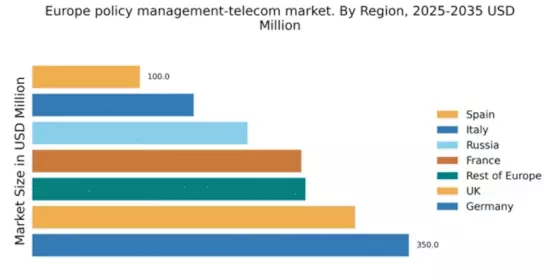
Europe Policy Management Telecom Market Regional Image

Key Players and Competitive Insights

The policy management-telecom market in Europe is characterized by a dynamic competitive landscape, driven by rapid technological advancements and increasing demand for efficient service delivery. Key players such as Amdocs (IL), Oracle (US), and Ericsson (SE) are at the forefront, each adopting distinct strategies to enhance their market positioning. Amdocs (IL) focuses on digital transformation initiatives, aiming to streamline operations for telecom providers through innovative software solutions. Oracle (US) emphasizes cloud-based services, leveraging its extensive database capabilities to offer scalable policy management solutions. Meanwhile, Ericsson (SE) is heavily investing in 5G technology, positioning itself as a leader in next-generation network solutions, which is crucial for policy management in an increasingly connected world. Collectively, these strategies contribute to a competitive environment that is both collaborative and competitive, as companies seek to differentiate themselves through technological innovation and service excellence.

In terms of business tactics, companies are increasingly localizing their operations to better serve regional markets, which appears to enhance responsiveness to customer needs. The market structure is moderately fragmented, with several players vying for market share, yet dominated by a few key firms that wield considerable influence. This competitive structure fosters an environment where innovation is paramount, as companies strive to maintain their competitive edge through unique offerings and strategic partnerships.

In October 2025, Amdocs (IL) announced a strategic partnership with a leading European telecom operator to enhance its customer experience management capabilities. This collaboration is expected to leverage Amdocs' advanced analytics and AI-driven insights, allowing the operator to deliver personalized services to its subscribers. Such partnerships are indicative of a broader trend where companies are aligning with telecom operators to co-create value and enhance service delivery.

In September 2025, Oracle (US) launched a new cloud-based policy management solution tailored for European telecom operators. This initiative is significant as it aligns with the growing demand for flexible and scalable solutions that can adapt to the rapidly changing telecom landscape. By offering a robust cloud platform, Oracle (US) positions itself to capture a larger share of the market, particularly among operators looking to modernize their infrastructure.

In November 2025, Ericsson (SE) unveiled its latest 5G policy management framework, designed to optimize network performance and enhance user experience. This development is crucial as it not only reinforces Ericsson's commitment to 5G technology but also addresses the increasing complexity of managing policies in a multi-service environment. The introduction of such frameworks is likely to set new standards in the industry, pushing competitors to innovate further.

As of November 2025, the competitive trends in the policy management-telecom market are increasingly defined by digitalization, sustainability, and the integration of AI technologies. Strategic alliances are becoming more prevalent, as companies recognize the value of collaboration in navigating the complexities of the market. Looking ahead, competitive differentiation is expected to evolve, with a notable shift from price-based competition to a focus on innovation, technological advancements, and supply chain reliability. This transition underscores the importance of agility and responsiveness in meeting the demands of a rapidly changing telecom landscape.

Key Companies in the Europe Policy Management Telecom Market market include

Industry Developments

In October 2023, Oracle disclosed a partnership with numerous prominent European telecommunications providers to optimize policy enforcement and advance monetization frameworks. This partnership highlights the increasing dependence on sophisticated policy solutions to address the complexity of network ecosystems.Ericsson previously acquired a specialized software provider in March 2023 to broaden its policy management portfolio.

This acquisition expanded Ericsson's service offerings and underscored the significance of mergers and acquisitions in the European sector for the purpose of consolidating market positions.At the same time, organizations like Netcracker Technology, Comarch, and Amdocs are continuing to allocate significant resources to cloud-native and AI-driven policy management solutions. 

Their primary objective is to enhance operational efficiency and adaptability to changing telecommunications needs.The market has also experienced substantial valuation increases in SAP and Nokia, which have been driven by the widespread adoption of 5G and the integration of policy management frameworks throughout the region. In response to the increasing demand for real-time network optimization and flexible service models, these organizations are increasingly utilizing technological innovation to fortify their position.

Future Outlook

Europe Policy Management Telecom Market Future Outlook

The Policy Management Telecom Market is projected to grow at a 9.9% CAGR from 2024 to 2035, driven by technological advancements, regulatory changes, and increasing demand for efficient service delivery.

New opportunities lie in:

  • Development of AI-driven policy automation tools for enhanced operational efficiency.
  • Expansion of cloud-based policy management solutions to improve scalability and flexibility.
  • Integration of IoT technologies for real-time policy enforcement and monitoring.

By 2035, the market is expected to achieve substantial growth, driven by innovation and strategic investments.

Market Segmentation

Europe Policy Management Telecom Market End User Outlook

  • Telecom Operators
  • Mobile Network Operators
  • Internet Service Providers

Europe Policy Management Telecom Market Component Outlook

  • Solutions
  • Services
  • Software

Europe Policy Management Telecom Market Application Outlook

  • Data Management
  • Billing and Charging
  • Regulatory Compliance

Europe Policy Management Telecom Market Deployment Model Outlook

  • On-Premises
  • Cloud-Based
  • Hybrid

Report Scope

MARKET SIZE 20241303.9(USD Million)
MARKET SIZE 20251432.99(USD Million)
MARKET SIZE 20353682.0(USD Million)
COMPOUND ANNUAL GROWTH RATE (CAGR)9.9% (2024 - 2035)
REPORT COVERAGERevenue Forecast, Competitive Landscape, Growth Factors, and Trends
BASE YEAR2024
Market Forecast Period2025 - 2035
Historical Data2019 - 2024
Market Forecast UnitsUSD Million
Key Companies Profiled["Amdocs (IL)", "Oracle (US)", "Ericsson (SE)", "Nokia (FI)", "CSG International (US)", "Netcracker Technology (US)", "Huawei (CN)", "ZTE Corporation (CN)", "Comptel (FI)"]
Segments CoveredDeployment Model, Component, End User, Application
Key Market OpportunitiesIntegration of artificial intelligence for enhanced policy automation and compliance in the policy management-telecom market.
Key Market DynamicsRegulatory changes drive innovation in policy management systems, enhancing telecom service delivery and compliance in Europe.
Countries CoveredGermany, UK, France, Russia, Italy, Spain, Rest of Europe

Leave a Comment

FAQs

What is the expected market size of the Europe Policy Management Telecom Market in 2024?

The Europe Policy Management Telecom Market is expected to be valued at 1.56 USD Billion in 2024.

What is the projected market size for the Europe Policy Management Telecom Market by 2035?

By 2035, the Europe Policy Management Telecom Market is projected to reach a value of 4.92 USD Billion.

What is the expected CAGR for the Europe Policy Management Telecom Market from 2025 to 2035?

The expected CAGR for the Europe Policy Management Telecom Market between 2025 and 2035 is 10.986 %.

Which region is expected to dominate the Europe Policy Management Telecom Market in 2024?

Germany is expected to dominate the Europe Policy Management Telecom Market in 2024, valued at 0.4 USD Billion.

What will be the market size for the Cloud-Based deployment model in 2035?

The Cloud-Based deployment model of the Europe Policy Management Telecom Market is expected to be valued at 2.27 USD Billion in 2035.

Who are the key players in the Europe Policy Management Telecom Market?

Key players in the Europe Policy Management Telecom Market include Netcracker Technology, Oracle, SAP, and Ericsson.

How much is the UK segment of the Europe Policy Management Telecom Market expected to grow by 2035?

The UK segment is expected to grow to 1.05 USD Billion by 2035.

What is the expected market size for Hybrid deployment in 2024?

The Hybrid deployment model is expected to be valued at 0.36 USD Billion in 2024.

What challenges could impact the growth of the Europe Policy Management Telecom Market?

Challenges such as regulatory changes and competition could impact the growth of the Europe Policy Management Telecom Market.

What is the expected market size for the France segment by 2035?

The France segment of the Europe Policy Management Telecom Market is projected to reach 0.9 USD Billion by 2035.

Download Free Sample

Kindly complete the form below to receive a free sample of this Report

Compare Licence

×
Features License Type
Single User Multiuser License Enterprise User
Price $4,950 $5,950 $7,250
Maximum User Access Limit 1 User Upto 10 Users Unrestricted Access Throughout the Organization
Free Customization
Direct Access to Analyst
Deliverable Format
Platform Access
Discount on Next Purchase 10% 15% 15%
Printable Versions