×
Request Free Sample ×

Kindly complete the form below to receive a free sample of this Report

* Please use a valid business email

Leading companies partner with us for data-driven Insights

clients tt-cursor
Hero Background

Network Security Policy Management Market

ID: MRFR/ICT/5573-HCR
100 Pages
Ankit Gupta
October 2025

Network Security Policy Management Market Research Report: Information By Components (Solution and Services), By Organization Size (Medium Size Enterprise and Large Scale Enterprise), By Product Type (Change Management, Network Compliance Policy, Vulnerability Assessment and Network Policy Management), By End-User (IT and Telecom, Energy and Utilities, Retail, Manufacturing and Healthcare), And By Region (North America, Europe, Asia-Pacific, And Rest Of The World) –Market Forecast Till 2035.

Share:
Download PDF ×

We do not share your information with anyone. However, we may send you emails based on your report interest from time to time. You may contact us at any time to opt-out.

Network Security Policy Management Market Infographic
Purchase Options

Network Security Policy Management Market Summary

As per MRFR analysis, the Network Security Policy Management Market Size was estimated at 20.14 USD Billion in 2024. The Network Security Policy Management industry is projected to grow from 21.57 USD Billion in 2025 to 43.01 USD Billion by 2035, exhibiting a compound annual growth rate (CAGR) of 7.14 during the forecast period 2025 - 2035.

Key Market Trends & Highlights

The Network Security Policy Management Market is experiencing robust growth driven by technological advancements and increasing regulatory demands.

  • The integration of AI and automation is transforming how organizations manage their network security policies.
  • North America remains the largest market, while Asia-Pacific is emerging as the fastest-growing region in this sector.
  • The solution segment dominates the market, whereas services are witnessing the fastest growth due to evolving customer needs.
  • Rising cybersecurity threats and stringent regulatory compliance requirements are key drivers propelling market expansion.

Market Size & Forecast

2024 Market Size 20.14 (USD Billion)
2035 Market Size 43.01 (USD Billion)
CAGR (2025 - 2035) 7.14%

Major Players

Cisco Systems (US), Palo Alto Networks (US), Fortinet (US), Check Point Software Technologies (IL), IBM (US), McAfee (US), Trend Micro (JP), SonicWall (US), Barracuda Networks (US)

Network Security Policy Management Market Trends

The Network Security Policy Management Market is currently experiencing a transformative phase, driven by the increasing complexity of cyber threats and the growing need for organizations to safeguard their digital assets. As businesses expand their digital footprints, the demand for robust security frameworks becomes paramount. This market appears to be evolving rapidly, with organizations recognizing the necessity of comprehensive policy management solutions that not only address compliance requirements but also enhance overall security posture. The integration of advanced technologies, such as artificial intelligence and machine learning, is likely to play a pivotal role in shaping the future landscape of this market. Moreover, the emphasis on regulatory compliance is intensifying, compelling organizations to adopt more sophisticated policy management strategies. This trend suggests that companies are not merely reacting to threats but are proactively seeking to establish a culture of security awareness. The convergence of various security technologies and the increasing collaboration between IT and security teams indicate a shift towards a more holistic approach to network security. As the Network Security Policy Management Market continues to mature, it may witness further innovations aimed at streamlining policy enforcement and enhancing visibility across diverse network environments.

Integration of AI and Automation

The incorporation of artificial intelligence and automation tools is becoming increasingly prevalent in the Network Security Policy Management Market. These technologies facilitate real-time monitoring and rapid response to potential threats, thereby enhancing the efficiency of security operations. Organizations are likely to leverage these advancements to streamline policy enforcement and reduce the burden on security personnel.

Focus on Regulatory Compliance

There is a growing emphasis on regulatory compliance within the Network Security Policy Management Market. Organizations are compelled to adhere to various regulations, which necessitates the implementation of comprehensive policy management solutions. This trend indicates a shift towards proactive compliance strategies, where businesses prioritize security policies that align with legal and industry standards.

Collaboration Between IT and Security Teams

The collaboration between IT and security teams is increasingly recognized as a critical factor in the success of network security initiatives. This trend suggests that organizations are moving towards a unified approach, where both teams work together to develop and implement security policies. Such collaboration is likely to enhance the overall effectiveness of security measures and foster a culture of shared responsibility.

Network Security Policy Management Market Drivers

Rising Cybersecurity Threats

The increasing frequency and sophistication of cyber threats is a primary driver for the Network Security Policy Management Market. Organizations are compelled to adopt robust security measures to protect sensitive data and maintain operational integrity. According to recent data, cyberattacks have surged by over 30% in the past year, prompting businesses to reassess their security policies. This trend indicates a growing recognition of the need for comprehensive security frameworks, which in turn fuels demand for effective policy management solutions. As organizations strive to mitigate risks associated with data breaches and ransomware attacks, investments in network security policy management are likely to escalate, thereby enhancing the market's growth prospects.

Adoption of Cloud Technologies

The rapid adoption of cloud technologies is reshaping the Network Security Policy Management Market. As organizations migrate to cloud-based infrastructures, they face unique security challenges that necessitate the development of tailored security policies. The cloud environment introduces complexities in data management and access control, making effective policy management essential. Recent studies indicate that over 70% of enterprises are utilizing cloud services, which underscores the need for robust security frameworks. Consequently, the demand for network security policy management solutions is expected to rise as organizations seek to protect their cloud assets and ensure compliance with industry standards.

Increased Focus on Data Privacy

The heightened emphasis on data privacy is a crucial driver for the Network Security Policy Management Market. With consumers becoming more aware of their data rights, organizations are under pressure to implement stringent data protection measures. This shift has led to a surge in demand for security policies that prioritize data privacy and ensure compliance with relevant regulations. As businesses strive to build trust with their customers, investments in network security policy management are likely to increase. The market is expected to expand as organizations recognize the importance of safeguarding personal information and mitigating the risks associated with data breaches.

Regulatory Compliance Requirements

The evolving landscape of regulatory compliance is a significant driver for the Network Security Policy Management Market. Organizations are increasingly required to adhere to stringent regulations such as GDPR, HIPAA, and PCI DSS, which necessitate the implementation of comprehensive security policies. Failure to comply with these regulations can result in severe penalties and reputational damage. As a result, businesses are investing in policy management solutions to ensure compliance and streamline their security operations. The market for network security policy management is projected to grow as organizations seek to align their security practices with regulatory requirements, thereby fostering a culture of accountability and transparency in data handling.

Integration of Advanced Technologies

The integration of advanced technologies such as artificial intelligence and machine learning is transforming the Network Security Policy Management Market. These technologies enable organizations to automate policy enforcement and enhance threat detection capabilities. By leveraging AI-driven insights, businesses can proactively identify vulnerabilities and respond to security incidents more effectively. The market is witnessing a shift towards solutions that incorporate these advanced technologies, as they offer improved efficiency and accuracy in policy management. As organizations seek to stay ahead of evolving threats, the demand for innovative network security policy management solutions is likely to grow, driving market expansion.

Market Segment Insights

Network Security Policy Management Market Components Insights

The global network security policy management market segmentation, based on components includes Solution and Services. The solution segment dominated the market. The chance of data loss, theft, and damage is decreased with a strong network security policy management. The introduction of virtualization technology and the growth of web-based applications are two factors that support the development of the market for network security policy management. Enterprise communications are safeguarded by network security from unauthorized access and data exploitation.

Network Security Policy Management Market Organization Size Insights

The global network security policy management market segmentation, based on organization size, includes Medium size enterprise and Large scale enterprise. The medium size enterprise category generated the most income. Medium-sized enterprise have lower budgets for security analyses, demonstrating the need for all-encompassing security solutions to monitor system architecture and fend off significant attacks. The market for network security policy management is growing as a result of increased cyber risks at the network edge and BYOD (bring your own device) policies.

Network Security Policy Management Market Product Type Insights

The global network security policy management market segmentation, based on product type includes Change Management, Network Compliance Policy, Vulnerability Assessment and Network Policy Management. The network policy management segment dominated the market due to an increase in networking and cross-industry connections. The rise of hackers in recent years has made network policy management more crucial. Network security policy management market services are essential for security upkeep and service upgrades, bolstering defense, and preventing cyberattacks.

Figure 2: Global Network Security Policy Management Market, by Product Type, 2022 & 2032 (USD Billion)

Source: Secondary Research, Primary Research, Market Research Future Database and Analyst Review

Network Security Policy Management Market End-User Insights

The global network security policy management market segmentation, based on end-user includes IT and Telecom, Energy and utilities, Retail, Manufacturing and Healthcare. The IT and telecom segment dominated the market. Cyber communication security is the detection, analysis, and mitigation of potential cyber threats in the telecommunications industry using tools and processes. Sensitive data makes the telecom industry more susceptible than ever to security dangers and assaults. The majority of these companies maintain sensitive infrastructure that tracks the addresses and financial data of their customers.

Get more detailed insights about Network Security Policy Management Market

Regional Insights

North America : Leading Innovation and Adoption

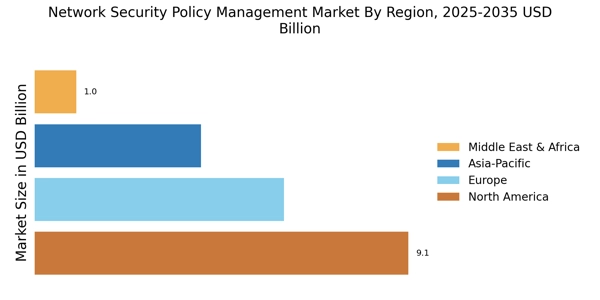
North America is the largest market for Network Security Policy Management Market, holding approximately 45% of the global share. The region's growth is driven by increasing cyber threats, stringent regulatory requirements, and a strong focus on digital transformation. The demand for advanced security solutions is further fueled by the rise of remote work and cloud computing, prompting organizations to enhance their security postures. The United States and Canada are the leading countries in this market, with major players like Cisco Systems, Palo Alto Networks, and Fortinet headquartered in the region. The competitive landscape is characterized by continuous innovation and strategic partnerships among key players, ensuring robust offerings in network security solutions. The presence of advanced technology infrastructure further supports market growth.

Europe : Regulatory Compliance and Growth

Europe is witnessing significant growth in the Network Security Policy Management Market, accounting for approximately 30% of the global share. The region's expansion is driven by stringent data protection regulations such as GDPR, which compel organizations to adopt comprehensive security measures. Additionally, the increasing frequency of cyberattacks has heightened awareness and demand for robust security solutions across various sectors. Leading countries in this market include the United Kingdom, Germany, and France, where companies are investing heavily in cybersecurity. The competitive landscape features key players like Check Point Software Technologies and IBM, who are actively enhancing their product offerings to meet regulatory requirements. The focus on compliance and security innovation is shaping the market dynamics in Europe.

Asia-Pacific : Emerging Market Potential

Asia-Pacific is emerging as a significant player in the Network Security Policy Management Market, holding around 20% of the global share. The region's growth is propelled by rapid digitalization, increasing internet penetration, and a surge in cyber threats. Governments are also implementing supportive regulations to enhance cybersecurity frameworks, which further drives demand for effective security solutions across various industries. Countries like China, India, and Japan are at the forefront of this market, with a growing number of local and international players. Companies such as Trend Micro and SonicWall are expanding their presence, focusing on tailored solutions for diverse business needs. The competitive landscape is evolving, with an emphasis on innovation and strategic collaborations to address the unique challenges faced by organizations in the region.

Middle East and Africa : Growing Awareness and Investment

The Middle East and Africa region is gradually developing its Network Security Policy Management Market, currently holding about 5% of the global share. The growth is driven by increasing awareness of cybersecurity threats and the need for robust security measures across various sectors, including finance and government. Additionally, regional governments are investing in cybersecurity initiatives to protect critical infrastructure and sensitive data. Countries like the United Arab Emirates and South Africa are leading the charge, with a growing number of local and international cybersecurity firms entering the market. The competitive landscape is characterized by partnerships and collaborations aimed at enhancing security capabilities. As organizations prioritize cybersecurity, the market is expected to witness steady growth in the coming years.

Network Security Policy Management Market Regional Image

Key Players and Competitive Insights

The Network Security Policy Management Market is currently characterized by a dynamic competitive landscape, driven by the increasing complexity of cyber threats and the growing need for robust security frameworks. Major players such as Cisco Systems (US), Palo Alto Networks (US), and Fortinet (US) are at the forefront, each adopting distinct strategies to enhance their market positioning. Cisco Systems (US) emphasizes innovation through continuous development of its security solutions, while Palo Alto Networks (US) focuses on integrating artificial intelligence into its offerings to improve threat detection and response times. Fortinet (US), on the other hand, is expanding its global footprint through strategic partnerships and acquisitions, thereby enhancing its service capabilities and market reach. Collectively, these strategies not only bolster individual company profiles but also intensify the competitive dynamics within the market, as firms vie for leadership in a rapidly evolving landscape.

In terms of business tactics, companies are increasingly localizing their operations to better serve regional markets, which appears to be a response to the diverse regulatory environments and customer needs across different geographies. The market structure is moderately fragmented, with a mix of established players and emerging startups. This fragmentation allows for a variety of solutions and innovations, but it also means that key players must continuously adapt to maintain their competitive edge. The influence of major companies is significant, as they set industry standards and drive technological advancements that smaller firms often follow.

In August 2025, Cisco Systems (US) announced a strategic partnership with a leading cloud service provider to enhance its security offerings in cloud environments. This move is likely to position Cisco favorably in the growing cloud security segment, as organizations increasingly migrate to cloud-based infrastructures. By leveraging the cloud provider's capabilities, Cisco aims to deliver integrated security solutions that address the unique challenges posed by cloud environments, thereby reinforcing its market leadership.

In September 2025, Palo Alto Networks (US) launched a new AI-driven security platform designed to automate threat detection and response. This initiative reflects a broader trend towards automation in cybersecurity, as organizations seek to reduce response times and improve overall security posture. The introduction of this platform not only enhances Palo Alto's product portfolio but also aligns with the industry's shift towards leveraging AI technologies to combat sophisticated cyber threats.

In July 2025, Fortinet (US) completed the acquisition of a cybersecurity startup specializing in advanced threat intelligence. This acquisition is indicative of Fortinet's strategy to bolster its capabilities in threat detection and response, particularly in the face of evolving cyber threats. By integrating the startup's technology, Fortinet aims to enhance its existing solutions and provide customers with more comprehensive security measures, thereby solidifying its competitive position in the market.

As of October 2025, the competitive trends within the Network Security Policy Management Market are increasingly defined by digitalization, sustainability, and the integration of artificial intelligence. Strategic alliances are becoming more prevalent, as companies recognize the value of collaboration in addressing complex security challenges. Looking ahead, it is anticipated that competitive differentiation will increasingly hinge on innovation and technological advancements rather than solely on price. Firms that prioritize R&D and supply chain reliability are likely to emerge as leaders in this evolving landscape.

Key Companies in the Network Security Policy Management Market market include

Industry Developments

March 2023: Cisco, a provider of cybersecurity and cloud solutions, intends to buy Valtix, a pioneer in the area of cloud network security, from Silicon Valley. Cisco's objectives in the area of multi-cloud network security and the benefit of having tools for monitoring traffic through business apps are two factors that led to the acquisition. The Valtix platform includes capabilities including application defence, secure deployment, and automated cloud application discovery.

January 2022: Trellix was introduced by Symphony Technology Group (STG), which offers businesses enhanced detection and response (XDR). Furthermore, the launch will speed up technological innovation through automation and machine learning.

June 2019: AD Bridge 1.0 was released by Micro Focus. Utilising their current Active Directory investments, customers of this product may manage and secure Linux resources more effectively.

Future Outlook

Network Security Policy Management Market Future Outlook

The Network Security Policy Management Market is projected to grow at a 7.14% CAGR from 2024 to 2035, driven by increasing cyber threats, regulatory compliance, and the need for streamlined security management.

New opportunities lie in:

  • Development of AI-driven policy automation tools for enhanced compliance efficiency.
  • Expansion into emerging markets with tailored security solutions for local businesses.
  • Integration of IoT security frameworks into existing policy management systems.

By 2035, the market is expected to be robust, reflecting substantial growth and innovation.

Market Segmentation

Network Security Policy Management Market End-User Outlook

  • IT and Telecom
  • Energy and Utilities
  • Retail
  • Manufacturing
  • Healthcare

Network Security Policy Management Market Components Outlook

  • Solution
  • Services

Network Security Policy Management Market Product Type Outlook

  • Change Management
  • Network Compliance Policy
  • Vulnerability Assessment
  • Network Policy Management

Network Security Policy Management Market Organization Size Outlook

  • Medium Size Enterprise
  • Large Scale Enterprise

Report Scope

MARKET SIZE 2024 20.14(USD Billion)
MARKET SIZE 2025 21.57(USD Billion)
MARKET SIZE 2035 43.01(USD Billion)
COMPOUND ANNUAL GROWTH RATE (CAGR) 7.14% (2024 - 2035)
REPORT COVERAGE Revenue Forecast, Competitive Landscape, Growth Factors, and Trends
BASE YEAR 2024
Market Forecast Period 2025 - 2035
Historical Data 2019 - 2024
Market Forecast Units USD Billion
Key Companies Profiled Market analysis in progress
Segments Covered Market segmentation analysis in progress
Key Market Opportunities Integration of artificial intelligence in Network Security Policy Management enhances threat detection and response capabilities.
Key Market Dynamics Rising regulatory compliance requirements drive demand for advanced network security policy management solutions across various industries.
Countries Covered North America, Europe, APAC, South America, MEA

Market Highlights

Author
Ankit Gupta
Senior Research Analyst

Ankit Gupta is an analyst in market research industry in ICT and SEMI industry. With post-graduation in "Telecom and Marketing Management" and graduation in "Electronics and Telecommunication" vertical he is well versed with recent development in ICT industry as a whole. Having worked on more than 150+ reports including consultation for fortune 500 companies such as Microsoft and Rio Tinto in identifying solutions with respect to business problems his opinions are inclined towards mixture of technical and managerial aspects.

Leave a Comment

FAQs

What is the projected market valuation of the Network Security Policy Management Market by 2035?

The projected market valuation is expected to reach 43.01 USD Billion by 2035.

What was the market valuation of the Network Security Policy Management Market in 2024?

The overall market valuation was 20.14 USD Billion in 2024.

What is the expected CAGR for the Network Security Policy Management Market during the forecast period 2025 - 2035?

The expected CAGR for the market during this period is 7.14%.

Which companies are considered key players in the Network Security Policy Management Market?

Key players include Cisco Systems, Palo Alto Networks, Fortinet, Check Point Software Technologies, IBM, McAfee, Trend Micro, SonicWall, and Barracuda Networks.

What are the projected valuations for the Network Policy Management segment by 2035?

The projected valuation for the Network Policy Management segment is expected to reach 17.51 USD Billion by 2035.

How does the market size for Large Scale Enterprises compare to Medium Size Enterprises in 2035?

By 2035, the market size for Large Scale Enterprises is projected to be 30.1 USD Billion, compared to 12.91 USD Billion for Medium Size Enterprises.

Download Free Sample

Kindly complete the form below to receive a free sample of this Report

Compare Licence

×
Features License Type
Single User Multiuser License Enterprise User
Price $4,950 $5,950 $7,250
Maximum User Access Limit 1 User Upto 10 Users Unrestricted Access Throughout the Organization
Free Customization
Direct Access to Analyst
Deliverable Format
Platform Access
Discount on Next Purchase 10% 15% 15%
Printable Versions