Download Free Sample
Kindly complete the form below to receive a free sample of this Report
Event Marketing Services Market Research Report By End Use (B2B, B2C, Non-Profit, Government, Educational Institutions), By Application (Corporate Events, Trade Shows, Conferences, Product Launches, Experiential Marketing), By Service Type (Event Planning, Event Promotion, Event Management, Event Technology, Event Logistics) And By Region (North America, Europe, Asia-Pacific, And Rest Of The World) – Market Forecast Till 2035.
As per MRFR analysis, the Event Marketing Services Market was estimated at 6.5 USD Billion in 2024. The Event Marketing Services industry is projected to grow from 6.77 USD Billion in 2025 to 10.2 USD Billion by 2035, exhibiting a compound annual growth rate (CAGR) of 4.18% during the forecast period 2025 - 2035.
The Event Marketing Services Market is experiencing a dynamic shift towards technological integration and personalized experiences.
| 2024 Market Size | 6.5 (USD Billion) |
| 2035 Market Size | 10.2 (USD Billion) |
| CAGR (2025 - 2035) | 4.18% |
Cvent (US), Eventbrite (US), Informa (GB), Freeman (US), Reed Exhibitions (GB), MCI Group (CH), GES (US), Bizzabo (US), Hubilo (IN)
Our Impact
Enabled $4.3B Revenue Impact for Fortune 500 and Leading Multinationals
Partnering with 2000+ Global Organizations Each Year
30K+ Citations by Top-Tier Firms in the Industry
The Event Marketing Services Market is currently experiencing a dynamic evolution, driven by the increasing integration of technology and the growing demand for personalized experiences. As organizations seek to engage their audiences more effectively, they are leveraging innovative tools and platforms to create immersive environments that resonate with attendees. This shift towards digitalization appears to be reshaping traditional marketing strategies, as brands explore new avenues for interaction and engagement. Furthermore, the emphasis on data analytics is becoming more pronounced, enabling marketers to tailor their approaches based on audience insights and preferences. In addition to technological advancements, sustainability is emerging as a pivotal consideration within the Event Marketing Services Market. Stakeholders are increasingly prioritizing eco-friendly practices, reflecting a broader societal shift towards environmental consciousness. This trend suggests that future events may incorporate sustainable materials, reduce waste, and promote responsible consumption. As the market continues to evolve, the interplay between technology, personalization, and sustainability will likely define the landscape of event marketing in the years to come.
The incorporation of advanced technologies is transforming the Event Marketing Services Market. Tools such as virtual reality, augmented reality, and artificial intelligence are enhancing attendee experiences, allowing for more interactive and engaging events. This trend indicates a shift towards creating memorable experiences that go beyond traditional formats.
There is a growing emphasis on tailoring events to meet the specific needs and preferences of attendees. Marketers are utilizing data analytics to gain insights into audience behavior, enabling them to craft personalized experiences that foster deeper connections. This trend highlights the importance of understanding the audience in order to drive engagement.
Sustainability is becoming a crucial focus within the Event Marketing Services Market. Organizations are increasingly adopting eco-friendly practices, such as using sustainable materials and minimizing waste. This trend reflects a broader commitment to environmental responsibility and suggests that future events will prioritize sustainability as a core value.
Experiential marketing is becoming a cornerstone of the Event Marketing Services Market, as brands increasingly focus on creating memorable experiences for their audiences. This approach emphasizes direct engagement and interaction, which can lead to higher brand loyalty and customer retention. Data suggests that 70 percent of consumers prefer experiences over products, indicating a shift in consumer behavior. As a result, event marketing services that offer innovative and immersive experiences are likely to thrive. The ability to craft unique, engaging events that resonate with target audiences may significantly enhance brand visibility and impact, positioning these services as essential in the current market landscape.
The Event Marketing Services Market is witnessing a notable shift towards hybrid events, which combine in-person and virtual experiences. This trend appears to be driven by the need for flexibility and broader audience reach. According to recent data, hybrid events can increase attendance by up to 30 percent compared to traditional formats. As organizations seek to engage diverse audiences, the demand for services that facilitate seamless integration of both formats is likely to grow. Event marketing services that specialize in hybrid solutions may find themselves at a competitive advantage, as they cater to the evolving preferences of attendees who value both physical presence and digital accessibility.
Data analytics is emerging as a critical driver in the Event Marketing Services Market, enabling organizations to make informed decisions based on attendee behavior and preferences. The integration of analytics tools allows marketers to measure event performance, optimize strategies, and enhance attendee engagement. Recent studies indicate that companies utilizing data-driven insights can improve their event ROI by up to 25 percent. As the demand for measurable outcomes increases, event marketing services that leverage data analytics to provide actionable insights are likely to gain a competitive edge. This trend underscores the necessity for service providers to adopt advanced analytics capabilities to meet client expectations.
Technological advancements are significantly shaping the Event Marketing Services Market, as innovations in event management tools and platforms enhance operational efficiency. The adoption of technologies such as virtual reality, augmented reality, and mobile applications is transforming how events are planned and executed. Data suggests that 75 percent of event planners believe technology improves attendee engagement. As organizations seek to leverage these advancements to create more interactive and engaging experiences, event marketing services that offer cutting-edge technological solutions are likely to see increased demand. This trend indicates a shift towards more sophisticated event management practices, positioning technology as a key driver in the industry.
Sustainability is becoming a pivotal concern within the Event Marketing Services Market, as stakeholders increasingly prioritize eco-friendly practices. Organizations are recognizing the importance of reducing their environmental footprint, leading to a rise in demand for sustainable event solutions. Research indicates that 60 percent of consumers are more likely to attend events that demonstrate a commitment to sustainability. Consequently, event marketing services that incorporate green practices, such as waste reduction and sustainable sourcing, may attract a more conscientious audience. This focus on sustainability not only enhances brand reputation but also aligns with the values of modern consumers, making it a vital consideration for service providers.
In the Event Marketing Services Market, the major application segments include Corporate Events, Trade Shows, Conferences, Product Launches, and Experiential Marketing. Among these, Corporate Events holds the largest market share due to the increasing need for companies to engage employees, stakeholders, and clients effectively. The significance of building brand identity and customer relationships through well-organized corporate events has seen substantial investments, driving this segment's dominance. On the other hand, Experiential Marketing is rapidly gaining traction, characterized by a focus on immersive brand experiences; it's becoming crucial for businesses seeking emotional connections with their audiences. This shift in consumer preferences is propelling its growth in the market.
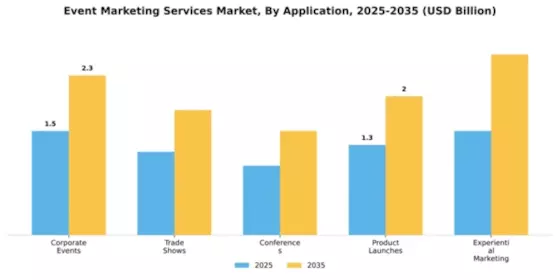
Corporate Events (Dominant) vs. Product Launches (Emerging)
Corporate Events remain the dominant application within the Event Marketing Services Market, primarily due to their role in facilitating meaningful interactions and strengthening corporate relationships. These events cover a wide range of activities, from annual meetings to executive retreats, emphasizing strategic objectives that align with corporate branding. In contrast, Product Launches represent an emerging segment that is evolving with innovative marketing techniques to attract audience attention. These events are essential for introducing new products, aimed at maximizing visibility and creating buzz. As companies increasingly embrace technology and digital platforms, Product Launches are incorporating interactive elements that enhance audience engagement, paving the way for sustained growth in this competitive landscape.
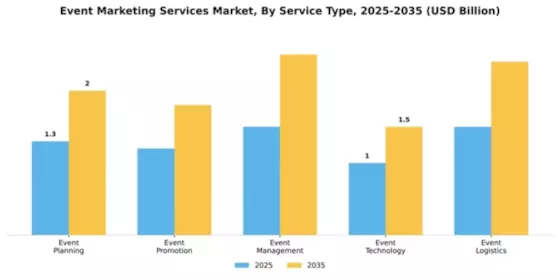
The Event Marketing Services Market is characterized by a diverse array of service types, each holding significant market share. Among these, Event Planning emerges as the largest segment, accounting for a substantial portion of the market. This is largely due to its essential role in orchestrating successful events, from conceptualization to execution. In contrast, Event Technology is rapidly gaining traction, attributed to the increasing reliance on digital solutions for event management, making it the fastest-growing segment in this space.
Event Planning (Dominant) vs. Event Technology (Emerging)
Event Planning remains the dominant force within the Event Marketing Services Market, as it encompasses a comprehensive suite of services required for successful event execution. This segment focuses on strategic planning, budgeting, and logistical coordination, making it indispensable for any event's success. On the other hand, Event Technology is emerging as a vital component, driven by innovations in mobile apps, virtual event platforms, and interactive attendee engagement tools. As organizations seek to enhance their event experiences through technology, Event Technology is positioned to reshape the landscape of event marketing, appealing particularly to tech-savvy audiences looking for seamless and engaging experiences.
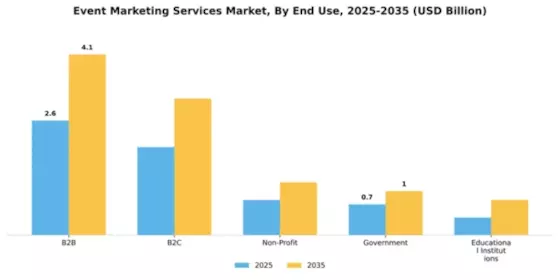
The Event Marketing Services Market is segmented primarily into B2B, B2C, Non-Profit, Government, and Educational Institutions. Among these, the B2B segment holds the largest market share, driven by the increasing demand for corporate events and trade shows that facilitate networking and business growth. Meanwhile, the B2C segment is witnessing rapid expansion, fueled by the rising consumer interest in experiential marketing and personal engagement events, indicating a growing trend towards tailored consumer experiences.
B2B (Dominant) vs. B2C (Emerging)
In the Event Marketing Services Market, the B2B segment is characterized by its focus on professional interactions and relationship building, often incorporating large-scale conferences, seminars, and exhibitions designed to promote business solutions and foster partnerships. Its dominance is attributed to the substantial investments businesses make in event marketing to enhance their visibility and brand reputation. Conversely, the B2C segment is rapidly emerging, characterized by increasingly interactive and immersive consumer experiences. This segment's growth is driven by the shift towards more engaging marketing strategies that resonate with consumers, leveraging social media platforms and experiential marketing techniques to capture audience attention.
Get more detailed insights about Event Marketing Services Market Request Free Sample
North America continues to lead the Event Marketing Services Market, holding a significant share of 3.25B in 2024. The region's growth is driven by a robust economy, increasing corporate spending on events, and a shift towards digital engagement strategies. Regulatory support for large gatherings and events has also catalyzed market expansion, with businesses adapting to hybrid models that blend in-person and virtual experiences. The competitive landscape is characterized by major players such as Cvent, Eventbrite, and Freeman, which dominate the market with innovative solutions. The U.S. remains the largest contributor, supported by a strong infrastructure for event management and marketing. Companies are increasingly leveraging technology to enhance attendee experiences, making North America a hub for event marketing innovation.
Europe's Event Marketing Services Market is valued at 2.0B, reflecting a growing demand for innovative event solutions. Factors such as increased investment in experiential marketing and a rise in international events are driving this growth. Regulatory frameworks across countries are evolving to support larger gatherings, enhancing the market's potential. The region is also witnessing a shift towards sustainability in event planning, aligning with broader environmental goals. Leading countries like the UK, Germany, and France are at the forefront, with key players such as Informa and Reed Exhibitions shaping the competitive landscape. The presence of diverse cultural events and trade shows further enriches the market. As companies adapt to changing consumer preferences, the focus on personalized experiences is becoming paramount, positioning Europe as a dynamic player in the global event marketing arena.
The Asia-Pacific region, valued at 1.75B, is experiencing rapid growth in the Event Marketing Services Market. Key drivers include a burgeoning middle class, increased disposable income, and a growing appetite for experiential events. Governments are also supporting the sector through favorable regulations and investments in infrastructure, which are crucial for hosting large-scale events. The region's diverse cultural landscape further fuels demand for unique and engaging event experiences. Countries like India and China are leading the charge, with local players such as Hubilo gaining traction alongside global giants. The competitive landscape is evolving, with a mix of traditional and digital marketing strategies being employed. As the region embraces technology, the integration of virtual and hybrid events is becoming increasingly common, positioning Asia-Pacific as a significant player in the global market.
The Middle East and Africa (MEA) region, with a market size of 0.5B, presents significant growth opportunities in the Event Marketing Services Market. Factors such as increasing investment in tourism and hospitality, along with government initiatives to promote events, are driving market expansion. The region is witnessing a rise in international conferences and exhibitions, supported by regulatory frameworks that encourage large gatherings and business events. Countries like the UAE and South Africa are leading the market, with key players such as MCI Group and GES establishing a strong presence. The competitive landscape is characterized by a mix of local and international firms, all vying for a share of the growing market. As the region continues to develop its infrastructure and event capabilities, the potential for growth in event marketing services remains substantial.
The Event Marketing Services Market is currently characterized by a dynamic competitive landscape, driven by technological advancements and evolving consumer preferences. Major players such as Cvent (US), Eventbrite (US), and Freeman (US) are strategically positioning themselves through innovation and digital transformation. Cvent (US) has focused on enhancing its event management software, integrating AI capabilities to streamline planning processes, which appears to resonate well with clients seeking efficiency. Meanwhile, Eventbrite (US) has emphasized community engagement and local event promotion, leveraging its platform to connect users with nearby events, thereby fostering a sense of localism in its offerings. Freeman (US) has adopted a comprehensive approach, integrating experiential marketing with data analytics to provide tailored solutions for clients, which seems to enhance their competitive edge in a crowded market.The business tactics employed by these companies reflect a moderately fragmented market structure, where localized strategies and supply chain optimization play crucial roles. The collective influence of these key players indicates a trend towards specialization, with companies focusing on niche markets and unique service offerings to differentiate themselves. This fragmentation allows for a diverse range of services, catering to various client needs, while also intensifying competition among established and emerging players.In November Cvent (US) announced a partnership with a leading AI firm to develop predictive analytics tools for event planners. This strategic move is likely to enhance Cvent's service offerings, enabling clients to make data-driven decisions that could optimize event outcomes. The integration of AI into their platform may not only improve user experience but also position Cvent as a thought leader in the event technology space.In October Eventbrite (US) launched a new initiative aimed at supporting small businesses by providing discounted event promotion services. This initiative appears to be a strategic response to the growing demand for affordable marketing solutions among local businesses. By aligning its services with the needs of small enterprises, Eventbrite is likely to strengthen its market presence and foster loyalty among a critical customer segment.In September Freeman (US) expanded its global footprint by acquiring a European event management company. This acquisition seems to reflect Freeman's strategy of enhancing its international capabilities and diversifying its service portfolio. By integrating local expertise with its existing operations, Freeman may be better positioned to cater to a broader range of clients and capitalize on emerging market opportunities.As of December the competitive trends in the Event Marketing Services Market are increasingly defined by digitalization, sustainability, and the integration of AI technologies. Strategic alliances are becoming more prevalent, as companies seek to leverage complementary strengths to enhance their service offerings. The shift from price-based competition to a focus on innovation and technology is evident, suggesting that future competitive differentiation will hinge on the ability to deliver unique, reliable, and technologically advanced solutions.



The Event Marketing Services Market is projected to grow at a 4.18% CAGR from 2025 to 2035, driven by technological advancements, increased digital engagement, and evolving consumer preferences.
New opportunities lie in:
By 2035, the market is expected to be robust, reflecting dynamic growth and innovation.
| MARKET SIZE 2024 | 6.5(USD Billion) |
| MARKET SIZE 2025 | 6.77(USD Billion) |
| MARKET SIZE 2035 | 10.2(USD Billion) |
| COMPOUND ANNUAL GROWTH RATE (CAGR) | 4.18% (2025 - 2035) |
| REPORT COVERAGE | Revenue Forecast, Competitive Landscape, Growth Factors, and Trends |
| BASE YEAR | 2024 |
| Market Forecast Period | 2025 - 2035 |
| Historical Data | 2019 - 2024 |
| Market Forecast Units | USD Billion |
| Key Companies Profiled | Cvent (US), Eventbrite (US), Informa (GB), Freeman (US), Reed Exhibitions (GB), MCI Group (CH), GES (US), Bizzabo (US), Hubilo (IN) |
| Segments Covered | Application, Service Type, End Use |
| Key Market Opportunities | Integration of advanced analytics and artificial intelligence in the Event Marketing Services Market. |
| Key Market Dynamics | Rising demand for personalized experiences drives innovation and competition in the Event Marketing Services Market. |
| Countries Covered | North America, Europe, APAC, South America, MEA |
The Event Marketing Services Market was valued at 6.5 USD Billion in 2024.
The market is projected to reach 10.2 USD Billion by 2035.
The expected CAGR for the market during the forecast period 2025 - 2035 is 4.18%.
The market segments by application include Corporate Events, Trade Shows, Conferences, Product Launches, and Experiential Marketing.
Corporate Events were valued at 1.5 USD Billion in 2024 and are projected to reach 2.3 USD Billion by 2035.
The Event Management segment was valued at 1.5 USD Billion in 2024 and is expected to grow to 2.5 USD Billion by 2035.
Key players in the market include Cvent, Eventbrite, Informa, Freeman, Reed Exhibitions, MCI Group, GES, Bizzabo, and Hubilo.
The B2B segment is projected to reach 4.1 USD Billion by 2035.
Event Promotion was valued at 1.2 USD Billion in 2024 and is expected to grow to 1.8 USD Billion by 2035.
The Non-Profit segment was valued at 0.8 USD Billion in 2024 and is projected to reach 1.2 USD Billion by 2035.


Kindly complete the form below to receive a free sample of this Report

“This is really good guys. Excellent work on a tight deadline. I will continue to use you going forward and recommend you to others. Nice job”


“Thanks. It’s been a pleasure working with you, please use me as reference with any other Intel employees.”


“Thanks for sending the report it gives us a good global view of the Betaïne market.”


“Thank you, this will be very helpful for OQS.”


“We found the report very insightful! we found your research firm very helpful. I'm sending this email to secure our future business.”


“I am very pleased with how market segments have been defined in a relevant way for my purposes (such as "Portable Freezers & refrigerators" and "last-mile"). In general the report is well structured. Thanks very much for your efforts.”


“I have been reading the first document or the study, ,the Global HVAC and FP market report 2021 till 2026. Must say, good info! I have not gone in depth at all parts, but got a good indication of the data inside!”


“We got the report in time, we really thank you for your support in this process. I also thank to all of your team as they did a great job.”


“The Automotive 48V ECU Components Procurement Intelligence Study” was a complex project, but the Market Research Future (MRFR) team handled it with quality, agility, and customer-centricity. They delivered all requested data on time and within the agreed scope. The team, including Shubhendra Anand and Rahul Gotadki, was always readily available to clarify questions and swiftly implement necessary adjustments, driving the project to a successful conclusion within a very demanding timeframe.
I would also like to specifically commend Akshay Agarwal for his responsiveness and support at every stage—from our initial inquiry on May 6th through to final delivery on June 18th. His dedication made the entire process seamless.”



