Event Management Software Market (2026 - 2035)

Event Management Software Market Size, Share and Research Report: By Solution (Software and Services), by Deployment (On-Premise and Cloud), by Application (Corporate, Government, Education, Event Organizers & Planners and others), and By Region (Asia-Pacific, North America, Europe, and Rest of the World) - Forecast till 2035
ID: MRFR/ICT/0890-CR
110 Pages
Apoorva Priyadarshi, Shubham Munde
Last Updated: July 20, 2026
Event Management Software Market
Market Size
Forecast Period2026-2035
CAGR (2026-2035)10.62%
2025 Market SizeUSD 14.18 Billion
2035 Market SizeUSD 35.29 Billion
Key Players
Cvent
Eventbrite
Bizzabo
Hopin
Aventri
Splash
Opportunities
  • AI-Powered Revenue Attribution Platforms
  • Emerging-Market MICE Infrastructure Buildout
  • Drone-as-a-Service and Event Data Monetization

Event Management Software Market Summary

The Event Management Software Market reached an estimated USD 14.18 billion in 2025, with the forecast period opening at USD 16.22 billion in 2026 and climbing to USD 35.29 billion by 2035 at a CAGR of 10.62%. This expansion is anchored in two converging forces: enterprise-wide digital transformation mandates that are funneling IT budgets toward unified event platforms, and a post-pandemic regulatory push — led by the EU's Corporate Sustainability Reporting Directive (CSRD) — requiring organizations to track and disclose the carbon footprint of conferences and corporate gatherings [2]. Both catalysts are converting what was once discretionary spending into a compliance-driven line item.

Legacy on-premise event coordination systems built around spreadsheets, email chains, and siloed registration portals are rapidly giving way to cloud-native suites that bundle online event registration software, attendee engagement analytics, and real-time venue management into a single dashboard. Global enterprise SaaS spending surpassed USD 232 billion in 2024, and event planning platforms captured a growing slice of that total as CFOs demanded tighter integration between event ROI data and CRM pipelines. AI-driven personalization engines now power session recommendations, matchmaking algorithms, and post-event sentiment scoring across the Event Management Software Market.

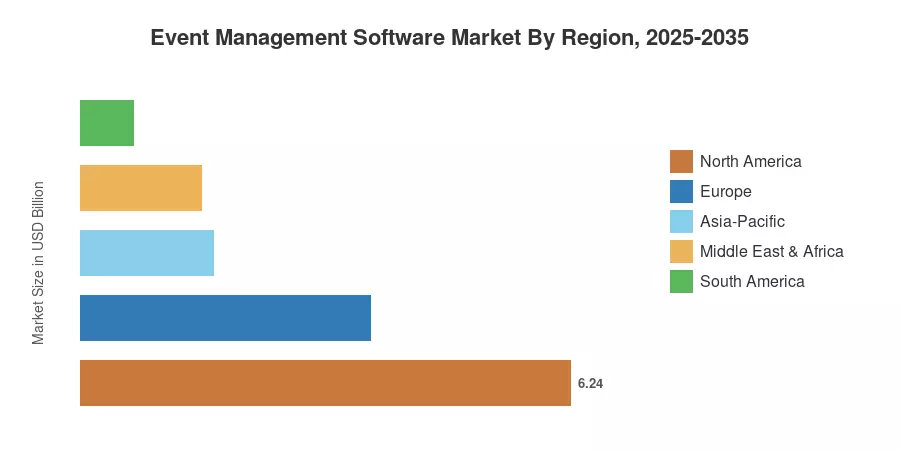
North America commands roughly 44% of global revenue, buoyed by a mature MICE (Meetings, Incentives, Conferences, Exhibitions) ecosystem and high corporate event density. Asia-Pacific is the fastest-growing region at approximately 11.93% CAGR, propelled by government-backed convention infrastructure in India, China, and the Gulf states Europe holds the second-largest share, near 26%, driven by strict data-privacy frameworks that favor GDPR-compliant conference management tools. The decade ahead will reward vendors who can deliver seamless hybrid experiences while satisfying increasingly granular sustainability reporting requirements.


Key Report Takeaways

• By Software Type

  • Event Planning held the dominant revenue share in 2025, accounting for roughly 41% of the Event Management Software Market
  • Analytics and Reporting is forecast to expand at an 11.14% CAGR through 2035, reflecting enterprise demand for revenue-attribution dashboards
  • Venue and Ticket Management generated approximately USD 2.27 billion in 2025 as self-service event ticketing solutions gained traction among mid-sized venues

• By Deployment


Cloud deployment captured about 76% of the Event Management Software Market share in 2025, advancing at a 11.89% CAGR through 2035

  • Organization Size
  • Small and Medium Enterprises represented approximately 60% of total demand in 2025, driven by affordable SaaS-based event planning platforms

• By End-User Vertical

  • Corporate events accounted for roughly 46% of end-user revenue in the Event Management Software Market during 2025
  • Education is projected to register the fastest vertical CAGR at 11.79% through 2035


  • Region


  • Asia-Pacific is set to grow at an 11.93% CAGR, the highest among all regions


Market Size and Forecast (2021–2035)

MRFR's market sizing integrates bottom-up revenue tracking across 120+ software vendors, validated against top-down enterprise IT spend benchmarks from Gartner and IDC. Historical figures (2021–2024) reflect audited annual reports and verified SaaS subscription data; forecast projections (2026–2035) apply a calibrated compound growth model adjusted for macroeconomic scenarios and regional adoption curves.
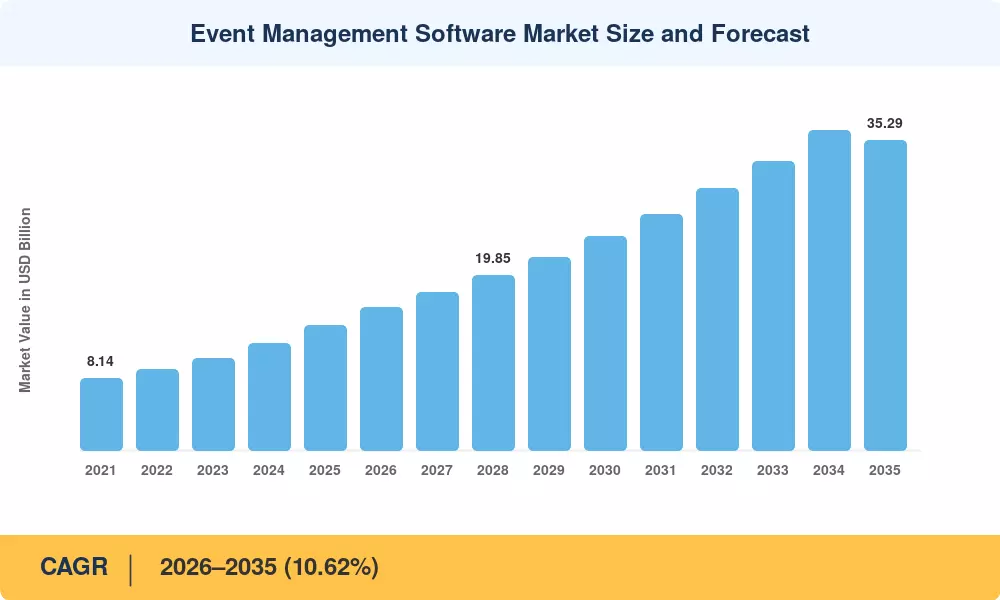
Event Management Software Market Size and Forecast
Our Impact
Enabled $4.3B Revenue Impact for Fortune 500 and Leading Multinationals
Partnering with 2000+ Global Organizations Each Year
30K+ Citations by Top-Tier Firms in the Industry

Driver Impact Analysis

Driver ~% Impact on CAGR Geographic Relevance Impact Timeline
AI-Driven Personalization & Engagement ~18% Global Medium-term (2–4 yr)
Mandatory Sustainability / ESG Reporting ~16% Europe, North America Short-term (≤2 yr)
5G Infrastructure Roll-out ~14% Asia-Pacific, North America Medium-term (2–4 yr)
Cloud-First Enterprise IT Mandates ~13% Global Short-term (≤2 yr)
SME Democratization via Self-Service Platforms ~12% Global Long-term (≥4 yr)
Government MICE Infrastructure Investment ~10% Middle East, Asia-Pacific Long-term (≥4 yr)
Revenue Attribution & CRM Integration ~9% North America, Europe Medium-term (2–4 yr)


AI-Driven Personalization and Attendee Engagement

Artificial intelligence is reshaping how organizers design, deliver, and measure events. Machine-learning recommendation engines now curate personalized agendas for attendees, while natural-language processing powers real-time sentiment analysis during live sessions. According to a 2024 Bizzabo benchmark, events deploying AI-driven matchmaking saw a 34% increase in attendee satisfaction scores and a 22% lift in sponsor lead quality [5]. These capabilities are rapidly becoming table stakes in the Event Management Software Market, pushing vendors to embed generative-AI co-pilots for session-content creation and post-event reporting.

Mandatory Sustainability and Carbon-Analytics Modules

The EU's CSRD, effective January 2024 for large companies and expanding to mid-caps by 2026, requires disclosure of Scope 3 emissions — a category that explicitly includes business travel and corporate events [2]. This regulatory mandate has catalyzed demand for carbon analytics modules within conference management tools, enabling organizers to calculate per-attendee emissions, offset procurement, and generate audit-ready sustainability reports. MRFR estimates that sustainability-linked features will represent 8–10% of total platform revenue by 2028.

5G-Enabled Hybrid and Virtual Experiences

The global 5G subscriber base is projected to surpass 5.5 billion by 2030 [6], and low-latency connectivity directly benefits virtual event management by enabling lag-free streaming of interactive sessions, AR product demonstrations, and real-time polling across distributed audiences. South Korea and Japan are early proving grounds where 5G-powered event venues report 40% higher virtual attendee retention compared to 4G-streamed equivalents. This infrastructure buildout is a structural tailwind for the Event Management Software Market through the forecast period.

Cloud-First Enterprise IT Consolidation

Enterprise CIOs are consolidating SaaS stacks to reduce vendor sprawl, and cloud-deployed event planning platforms that integrate natively with Microsoft 365, Salesforce, and ServiceNow are winning procurement battles over on-premise incumbents. Gartner's 2024 CIO Survey found that 78% of enterprises plan to retire at least one on-premise event tool by 2027, redirecting those budgets toward unified cloud suites that bundle online event registration software with marketing automation.


Restraints Impact Analysis

The restraint estimates below follow the same directional methodology as Section 4. Negative percentages indicate the degree to which each factor tempers the Event Management Software Market's headline growth rate.

Restraint ~% Impact on CAGR Geographic Relevance Impact Timeline
Data-Residency and Privacy Regulations ~−6% Europe, Asia-Pacific Short-term (≤2 yr)
SaaS Subscription Fatigue ~−5% North America, Europe Medium-term (2–4 yr)
Integration Complexity with Legacy Systems ~−4% Global Long-term (≥4 yr)
Cybersecurity & Data-Breach Liability ~−3% Global Medium-term (2–4 yr)
Price Sensitivity Among SMEs ~−3% South America, MEA Long-term (≥4 yr)


Data-Residency and Cross-Border Privacy Rules

GDPR in Europe, China's PIPL, and India's DPDP Act each impose distinct data-localization requirements on attendee information — names, payment details, dietary preferences, and biometric check-in data [12]. For global conference management tools, compliance means maintaining region-specific data centers and localized consent workflows, which increases infrastructure costs by an estimated 12–18% for vendors operating across three or more jurisdictions. Smaller vendors without multi-region cloud footprints face a structural disadvantage.

SaaS Subscription Fatigue and Budget Rationalization

The average enterprise now manages over 370 SaaS subscriptions [13], and procurement teams are pushing back on net-new platform additions — including event ticketing solutions — unless vendors demonstrate clear ROI and consolidation value. This dynamic creates longer sales cycles and downward pricing pressure in the Event Management Software Market, particularly for point solutions that lack broader workflow integration.

Legacy System Integration Friction

Large enterprises with entrenched ERP, HRIS, and CRM ecosystems often require 6–12 months of custom integration work before a new event platform goes live [14]. The cost and timeline of API development, SSO configuration, and data-migration projects act as adoption brakes, especially in regulated industries like financial services and healthcare, where change-management cycles are inherently conservative.


Event Management Software Market Opportunities

AI-Powered Revenue Attribution Platforms

Vendors who can directly connect attendee interactions to pipeline revenue and concluded sales will command higher prices as CFOs scrutinize event spending. By 2030, the event management software market could grow by USD 1.4 billion thanks to revenue-attribution analytics, which integrates event data with CRM opportunity phases [11]


Emerging-Market MICE Infrastructure Buildout

India's National Convention Centre in Delhi is expected to become Asia's largest facility when it is finished in 2028, while Saudi Arabia's Vision 2030 has set aside more than USD 7.2 billion for convention center development [10]. These government-funded initiatives generate new demand for venue management suites designed for high-volume, multilingual settings, online event registration software, and event planning platforms


Drone-as-a-Service and Event Data Monetization

Sponsors and exhibitors can purchase anonymized attendee behavioral data, like as session dwell times, booth traffic heatmaps, and networking interaction graphs, as actionable information. Vendors who incorporate data-monetization tiers into their conference management systems can increase ARPU by 15–20% and diversify income sources beyond subscription costs


Micro-Event and Creator-Economy Platforms

Lightweight event ticketing solutions and self-service virtual event management are seeing an increase in demand due to the growth of creator-led workshops, paid webinars, and niche community events. Between 2023 and 2025, platforms like Luma and Lu.ma increased registrations by 280% [9], indicating that long-tail organizers rather than enterprise-only consumers will drive the next wave of growth in the event management software market


Accessibility and Inclusive Event Technology

Regulatory frameworks like the European Accessibility Act (EAA), effective June 2025, mandate that digital services — including online event registration software — meet WCAG 2.1 AA standards [16]. Vendors investing early in automated captioning, sign-language avatar overlays, and adaptive UI earn both compliance advantages and brand differentiation in an increasingly regulation-dense market.


Event Management Software Market Future Outlook

AI-Autonomous Event Operations

By 2030, generative AI and agentic workflows will automate up to 60% of event-operations tasks — from venue sourcing and vendor negotiations to real-time schedule optimization and post-event reporting [5]. The Event Management Software Market will shift from tool-centric to outcome-centric pricing, with vendors charging based on attendee engagement scores and pipeline influence rather than per-seat licenses. Early movers like Cvent and Bizzabo are already piloting autonomous event-planning copilots.

Platform Economics and Ecosystem Consolidation

The next decade will see the Event Management Software Market consolidate around 3–4 dominant platform ecosystems, each integrating event planning platforms, CRM, marketing automation, and financial reconciliation into unified super-apps. Salesforce's acquisition strategy and Microsoft's Viva Events integration signal that horizontal SaaS giants view event technology as a strategic adjacency, not a standalone category [11]. Mid-tier vendors will either specialize in vertical niches or face acquisition.

Sustainability-as-a-Service in Event Technology

Carbon analytics modules will evolve from compliance checklists into full sustainability-as-a-service offerings, bundling carbon offsetting procurement, sustainable catering marketplaces, and circular-economy venue certifications [2]. The IEA estimates that business travel and events account for 2.5% of global CO₂ emissions [19], creating a durable regulatory tailwind for conference management tools with embedded environmental reporting.

Immersive and Spatial Event Experiences

Apple Vision Pro, Meta Quest, and emerging spatial-computing platforms will unlock a new category of immersive virtual event management experiences by 2028–2030 [9]. Spatial events — where attendees navigate 3D exhibition halls, interact with holographic product demos, and network via avatar-based lounges — will command premium pricing and require fundamentally new software architectures. The Event Management Software Market will bifurcate between traditional 2D-streaming platforms and next-generation spatial-event suites.


Event Management Software Market Segmentation

By Software Type

Segment Key Metric Primary Demand Driver
Event Planning ~41% share (2025) End-to-end workflow automation
Event Marketing 10.38% CAGR Omnichannel campaign integration
Venue and Ticket Management USD 2.27 Billion (2025) Self-service event ticketing solutions for SMEs
Analytics and Reporting 11.14% CAGR Revenue attribution and ROI dashboards
Other Software Types USD 0.89 Billion (2025) Niche compliance and accessibility tools


Event Planning remains the backbone of the Event Management Software Market, encompassing agenda builders, speaker management, attendee communication, and logistics coordination. This segment's dominance reflects the fact that planning functionality is the minimum viable feature set for any event platform purchase decision. Analytics and Reporting is the fastest-growing software category, fueled by C-suite demand for quantifiable event ROI. Vendors embedding predictive analytics and AI-generated post-event insights are capturing premium subscription tiers and displacing legacy spreadsheet-based reporting workflows.

By Deployment

Segment Key Metric Primary Demand Driver
Cloud ~76% share (2025) SaaS consolidation, instant scalability
On-Premise USD 3.40 Billion (2025) Data-sovereignty requirements in regulated industries


Cloud deployment dominates the Event Management Software Market as enterprises prioritize API-first architectures and real-time collaboration across distributed teams. On-premise solutions retain a foothold in government, defense, and financial-services verticals where data-residency regulations prohibit the transfer of attendee information to third-party cloud environments [12]. The gap will widen as cloud-native conference management tools add FedRAMP and ISO 27701 certifications.

By Organization Size

Segment Key Metric Primary Demand Driver
Small and Medium Enterprises ~60% share (2025) Affordable self-service event planning platforms
Large Enterprises 9.87% CAGR Complex multi-event portfolio management


SMEs drive the majority of license volume in the Event Management Software Market, attracted by freemium tiers and pay-per-event pricing models that eliminate upfront capital expenditure. Large enterprises, while fewer in number, generate higher average contract values through multi-year platform commitments that bundle online event registration software, analytics, and dedicated customer success teams.

By End-User Vertical

Segment Key Metric Primary Demand Driver
Corporate ~46% share (2025) Sales kickoffs, partner summits, product launches
Government USD 1.56 Billion (2025) Digital-first public consultation mandates
Education 11.79% CAGR Virtual campus events, alumni engagement
Other Verticals 10.14% CAGR Healthcare CME, nonprofit fundraising


Corporate events remain the largest vertical in the Event Management Software Market, spanning internal town halls, external product launches, and multi-day partner conferences that require sophisticated event planning platforms with CRM integration. Education is the fastest-growing vertical, driven by universities deploying virtual event management for admissions open days, hybrid lecture series, and global alumni fundraising galas. The pandemic permanently shifted higher education's comfort level with digital engagement tools.


Regional Market Share Analysis

Region Key Metric Primary Investment Themes
North America ~44% share (2025) CRM integration, AI personalization, corporate event density
Europe ~26% share (2025) GDPR compliance, sustainability analytics, hybrid conferencing
Asia-Pacific 11.93% CAGR (2026–2035) Government MICE projects, 5G rollout, SME adoption
South America USD 0.68 Billion (2025) Digital government events, startup ecosystem
Middle East & Africa 10.84% CAGR (2026–2035) Vision 2030, mega-event hosting, convention buildout
Total USD 14.18 Billion (2025)

The Event Management Software Market exhibits distinct regional dynamics shaped by digital maturity, regulatory environments, and MICE ecosystem density. North America leads in absolute spend, while Asia-Pacific is the fastest-growing region as governments and corporations invest heavily in event planning platforms and hybrid infrastructure.


North America

Country Key Metric Key Driver
US ~78% of regional share Enterprise SaaS dominance, Fortune 500 event budgets
Canada 10.48% CAGR Federal digital government initiative
Mexico USD 0.19 Billion (2025) Nearshoring-driven corporate event growth


The US accounts for the lion's share of North American demand, with Silicon Valley and New York acting as primary hubs for both vendor headquarters and enterprise event spend. Canada's federal government earmarked CAD 540 million for digital service modernization in Budget 2024, a portion of which flows into virtual event management for public consultations and citizen engagement [17]. Mexico's nearshoring boom is generating new corporate event volumes in Monterrey and Guadalajara.

Europe

Country Key Metric Key Driver
Germany ~22% of regional share Trade-fair tradition (Messe ecosystem)
UK 10.71% CAGR Fintech and tech-conference density
France USD 0.52 Billion (2025) Luxury brand event circuit, Paris 2024 legacy
Italy 9.82% CAGR Fashion and design event sector
Spain USD 0.31 Billion (2025) Tourism-linked MICE growth
Nordic Countries 10.45% CAGR Sustainability-first event mandates
Russia USD 0.14 Billion (2025) Domestic platform development
Rest of Europe 9.91% CAGR EU Digital Services Act compliance


Germany's deeply rooted trade-fair ecosystem — anchored by Messe Frankfurt, Messe München, and Hannover Messe — makes it Europe's single largest consumer of conference management tools. The UK's vibrant tech-conference circuit and early adoption of AI-powered event planning platforms position it as the fastest-growing major European market. CSRD compliance is accelerating sustainability module adoption across the continent [2].

Asia-Pacific

Country Key Metric Key Driver
China ~31% of regional share Alibaba/Tencent event ecosystems, government conventions
India 12.56% CAGR National Convention Centre, startup event boom
Japan USD 0.39 Billion (2025) 5G-powered hybrid events, corporate compliance culture
South Korea 12.18% CAGR K-culture export events, 5G infrastructure
ASEAN USD 0.27 Billion (2025) Tourism-driven MICE investment
Rest of Asia-Pacific 11.42% CAGR Digital infrastructure expansion


Asia-Pacific's growth trajectory in the Event Management Software Market is underpinned by a combination of massive government infrastructure projects and rapid SME digitization. India's event technology startup ecosystem raised over USD 380 million in 2023–2024 [10], and domestic platforms are capturing market share from global incumbents by offering localized-language online event registration software and UPI-integrated payment flows. China's enterprise event market is increasingly self-contained, with domestic platforms offering end-to-end virtual event management within WeChat and DingTalk ecosystems.

South America

Country Key Metric Key Driver
Brazil ~58% of regional share Corporate event culture, Carnival-adjacent MICE
Argentina 9.74% CAGR Tech startup conference scene
Rest of South America USD 0.11 Billion (2025) Government digitization programs


Brazil dominates South American demand for event planning platforms, driven by São Paulo's status as Latin America's corporate event capital. The country's digital government strategy (Estratégia de Governo Digital 2024–2027) includes provisions for digital-first public consultations that require compliant online event registration software [18].

Middle East & Africa

Country Key Metric Key Driver
Saudi Arabia ~34% of regional share Vision 2030 mega-events, NEOM conferences
UAE 10.92% CAGR Dubai Expo legacy, free-zone event hubs
South Africa USD 0.08 Billion (2025) Pan-African corporate events
Egypt 10.21% CAGR New Administrative Capital conference infrastructure
Rest of MEA USD 0.09 Billion (2025) Government-led digitization


The Gulf states are rapidly emerging as a high-growth corridor for the Event Management Software Market, with Saudi Arabia's Riyadh Season attracting over 15 million visitors annually and driving demand for scalable event ticketing solutions. UAE's post-Expo 2020 infrastructure — including the Dubai Exhibition Center — continues to generate recurring demand for enterprise-grade conference management tools [10].


Event Management Software Market By Region, 2025-2035

Competitive Benchmarking

The Event Management Software Market exhibits medium concentration, with the top five vendors collectively holding an estimated 32–38% of global revenue. The HHI index sits below 1,000, indicating a fragmented competitive environment where no single player exceeds 10% share. Competition centers on platform breadth, AI capabilities, vertical specialization, and ecosystem partnerships with CRM and marketing-automation providers.

Company Est. Revenue Share Range Key Offerings Strategic Positioning
Cvent ~7–9% End-to-end event management suite, venue sourcing, attendee hub Enterprise-grade full-stack platform leader
Eventbrite ~5–7% Self-service ticketing, creator tools, consumer marketplace SME and creator-economy focus
Bizzabo ~3–5% AI-powered engagement, hybrid event OS, analytics Mid-market challenger with AI-first positioning
Hopin ~2–4% Virtual and hybrid event studio, networking tools Virtual-native platform transitioning to hybrid
Aventri (Stova) ~3–5% Corporate meeting management, strategic meetings platform Enterprise meetings and compliance focus
Splash ~2–3% Event marketing, branded experiences, design-first UX Marketing-led event teams and brand activations
Whova ~2–3% Mobile event app, attendee networking, agenda management Mid-tier conferences and academic events
Swapcard ~2–3% AI matchmaking, exhibitor lead generation, hybrid platform Exhibition and trade-show vertical specialist
RainFocus ~2–4% Enterprise event data platform, content personalization Large-scale tech-conference optimization
Bevy ~1–2% Community-led events, chapter management, integrations Developer and community event networks


Recent News & Developments

  • Cvent (September 2024): Launched Cvent Studio 2.0 with generative-AI session-content creation and automated speaker-brief generation, targeting a 40% reduction in pre-event planning time [5].
  • Bizzabo (November 2024): Acquired SmartSessions, a London-based analytics startup, to integrate predictive attendance modeling and revenue-attribution scoring into its core platform [11].
  • Eventbrite (January 2025): Introduced Eventbrite Ads Manager, allowing organizers to run paid promotion campaigns directly within the marketplace — the company's first advertising-revenue product [8].
  • European Commission (March 2024): Published CSRD implementation guidance explicitly requiring Scope 3 event-related emissions reporting for companies above 250 employees, accelerating demand for sustainability-enabled conference management tools [2].
  • RainFocus (June 2024): Secured a USD 95 million Series C funding round led by JMI Equity to expand its enterprise event data platform into Asia-Pacific markets [10].
  • Stova (formerly Aventri + MeetingPlay) (April 2025): Completed its unified rebrand and launched a single-platform strategic meetings management module for Fortune 500 clients [14].
  • Hopin (August 2024): Pivoted from virtual-only to a hybrid-first positioning, releasing Hopin Venue — a physical-event check-in and badge-printing integration layer [9].


Event Management Software Market Report Scope

Parameter Details
Market Scope Global Event Management Software Market across software type, deployment, organization size, end-user vertical, and geography
Study Period 2021–2035
CAGR Window 2026–2035 (10.62%)
Market Size (2025) USD 14.18 Billion
Market Size (2035) USD 35.29 Billion
Fastest Growing Segment Analytics and Reporting (by software type); Education (by end-user); Asia-Pacific (by region)
Companies Profiled Cvent, Eventbrite, Bizzabo, Hopin, Aventri (Stova), Splash, Whova, Swapcard, RainFocus, Bevy
Valuation Currency USD Billion


FAQs

How do procurement teams evaluate build-versus-buy decisions for event technology?
Most enterprises find that buying a commercial event planning platform delivers ROI 3–5x faster than building in-house, primarily because commercial tools include pre-built integrations with CRM and marketing stacks [21]. Build options only make sense for organizations running 500+ proprietary events annually with unique workflow requirements.
What role does API extensibility play in selecting conference management tools?
API-first platforms allow organizers to connect event data with BI dashboards, HR systems, and finance tools without custom middleware [7]. Buyers should prioritize vendors offering RESTful APIs with documented webhook support and pre-built connectors for Salesforce, HubSpot, and Marketo.
How are event ticketing solutions adapting to dynamic pricing models?
Leading event ticketing solutions now offer algorithmic pricing that adjusts ticket costs based on demand signals, time-to-event, and historical conversion rates [8]. Dynamic pricing can lift revenue per event by 12–18% compared to fixed-tier models.
What cybersecurity certifications should buyers require from Event Management Software Market vendors?
Minimum requirements include SOC 2 Type II, ISO 27001, and GDPR compliance attestations [15]. For government or healthcare events, FedRAMP authorization or HIPAA-compliant hosting adds a critical layer of audit readiness.
How does the Event Management Software Market address accessibility compliance for hybrid events?
Vendors are embedding WCAG 2.1 AA-compliant interfaces, automated captioning in 30+ languages, and screen-reader-optimized attendee portals [16]. The European Accessibility Act makes these features regulatory requirements for EU-hosted events starting June 2025.
What integration challenges arise when deploying virtual event management alongside existing martech stacks?
The primary friction points are data-schema mismatches between event platforms and CRM systems, SSO configuration across identity providers, and real-time data-sync latency [14]. Pilot deployments of 60–90 days with a dedicated integration team reduce go-live risk significantly.
How are online event registration software platforms handling multi-currency and multi-language requirements for global events?
Top-tier platforms support 25+ currencies with real-time FX conversion and localized registration flows in 40+ languages [1]. Buyers running events across three or more regions should verify that the vendor offers in-country payment-gateway partnerships and locale-specific tax-ID collection.    
Author
Author
Author Profile
Apoorva Priyadarshi LinkedIn
Research Analyst
With 4+ years of experience in Market Intelligence and Strategic Research, Apoorv specializes in ICT, Semiconductor, and BFSI markets. Combining strong analytical capabilities with a deep understanding of technology-driven industries, he focuses on delivering data-driven insights that support strategic decision-making. With a background in technology and business research, Apoorv has contributed to numerous global market studies, competitive landscape analyses, and opportunity assessments across sectors such as semiconductors, digital banking, cybersecurity, and telecommunications.
Co-Author
Co-Author Profile
Shubham Munde LinkedIn
Team Lead - Research
Shubham brings over 7 years of expertise in Market Intelligence and Strategic Consulting, with a strong focus on the Automotive, Aerospace, and Defense sectors. Backed by a solid foundation in semiconductors, electronics, and software, he has successfully delivered high-impact syndicated and custom research on a global scale. His core strengths include market sizing, forecasting, competitive intelligence, consumer insights, and supply chain mapping. Widely recognized for developing scalable growth strategies, Shubham empowers clients to navigate complex markets and achieve a lasting competitive edge. Trusted by start-ups and Fortune 500 companies alike, he consistently converts challenges into strategic opportunities that drive sustainable growth.

Research Approach


Secondary Research

The secondary research process involved comprehensive analysis of industry databases, technology publications, government IT reports, and authoritative software industry organizations. Key sources included the US Bureau of Labor Statistics (BLS), International Data Corporation (IDC), Gartner Research, National Institute of Standards and Technology (NIST), European Commission's Digital Economy and Society Index (DESI), Software & Information Industry Association (SIIA), TechUK, National Association of Broadcasters (NAB), International Congress and Convention Association (ICCA), Events Industry Council (EIC), Meeting Professionals International (MPI), World Tourism Organization (UNWTO), International Monetary Fund (IMF) World Economic Outlook, US Census Bureau Business Patterns, EU Eurostat Digital Economy Statistics, and national IT ministry reports from key markets.

Digital adoption metrics, event industry statistics, cloud infrastructure data, corporate event spending trends, regulatory frameworks for data privacy (GDPR, CCPA), and competitive landscape analysis for event management platforms, virtual event solutions, and hybrid event technologies were all gathered from these sources.


Primary Research

In order to gather both qualitative and quantitative insights, supply-side and demand-side stakeholders were interviewed during the primary research process. CEOs, CTOs, VPs of Product Development, Chief Revenue Officers, and heads of Partnerships from SaaS technology firms, virtual event platform providers, and event management software suppliers were examples of supply-side sources. Chief marketing officers, corporate events directors, global meeting planners, IT directors from Fortune 1000 companies, procurement leaders from expert conference organizers, and venue technology managers from hotels and convention centers were among the demand-side sources. Primary research obtained information on procurement decision-making procedures, pricing models, and security compliance criteria; verified product roadmaps and AI integration timetables; and validated market segmentation across software vs. services, deployment models, and application verticals.

Primary Respondent Breakdown:

By Designation: C-level Primaries (40%), Director Level (32%), Others (28%)

By Region: North America (42%), Europe (25%), Asia-Pacific (23%), Rest of World (10%)


Market Size Estimation

Enterprise adoption analysis and revenue mapping were used to determine the global market valuation. The methodology comprised:

Finding more than fifty major software suppliers and service providers in North America, Europe, Asia-Pacific, and Latin America

Solution mapping between venue management software, virtual event platforms, registration and ticketing systems, analytics and engagement tools, and event management software

Examination of stated and projected yearly income for event technology portfolios

coverage of suppliers accounting for 75–80% of the world market in 2024

Extrapolation of segment-specific valuations across corporate, government, education, and third-party event organizer verticals utilizing top-down (vendor revenue validation) and bottom-up (number of events × average software spend by organization size) methods

Download Free Sample

Kindly complete the form below to receive a free sample of this Report

Download PDF ×

We do not share your information with anyone. However, we may send you emails based on your report interest from time to time. You may contact us at any time to opt-out.
















