Download Free Sample
Kindly complete the form below to receive a free sample of this Report
Executive Search and Recruitment Services Market Research Report By Industry (Information Technology, Healthcare, Finance, Manufacturing, Retail), By Client Size (Small Enterprises, Medium Enterprises, Large Enterprises), By Service Type (Executive Search, Recruitment Process Outsourcing, Contingency Recruitment, Talent Mapping, Market Intelligence), By Candidate Type (Permanent Placement, Temporary Placement, Contract Placement, Executive Placement), By Engagement Model (Retained Search, Contingency Search, Exclusive Search, Project-Based Search) And By Region (North America, Europe, Asia-Pacific, And Rest Of The World) – Market Forecast Till 2035.
As per MRFR analysis, the Executive Search and Recruitment Services Market was estimated at 22.0 USD Billion in 2024. The Executive Search and Recruitment Services industry is projected to grow from 22.76 USD Billion in 2025 to 32.0 USD Billion by 2035, exhibiting a compound annual growth rate (CAGR) of 3.46% during the forecast period 2025 - 2035.
The Executive Search and Recruitment Services Market is experiencing a transformative shift towards technology integration and diversity initiatives.
| 2024 Market Size | 22.0 (USD Billion) |
| 2035 Market Size | 32.0 (USD Billion) |
| CAGR (2025 - 2035) | 3.46% |
Korn Ferry (US), Heidrick & Struggles (US), Russell Reynolds Associates (US), Spencer Stuart (US), Egon Zehnder (CH), Odgers Berndtson (GB), Boyden (US), Michael Page (GB), Robert Walters (GB), Hays (GB)
Our Impact
Enabled $4.3B Revenue Impact for Fortune 500 and Leading Multinationals
Partnering with 2000+ Global Organizations Each Year
30K+ Citations by Top-Tier Firms in the Industry
The Executive Search and Recruitment Services Market is currently experiencing a transformative phase, driven by evolving workforce dynamics and technological advancements. Organizations are increasingly recognizing the necessity of specialized recruitment services to secure top-tier talent in a competitive landscape. This market appears to be adapting to the demands of a diverse workforce, emphasizing inclusivity and cultural fit alongside traditional qualifications. As companies strive to enhance their employer branding, the role of executive search firms is becoming more pivotal in aligning organizational goals with candidate aspirations. Moreover, the integration of artificial intelligence and data analytics into recruitment processes is reshaping how firms identify and engage potential candidates. This technological shift not only streamlines operations but also enhances the precision of candidate selection. The Executive Search and Recruitment Services Market seems poised for further growth as businesses continue to prioritize strategic talent acquisition. The focus on personalized candidate experiences and the need for agility in recruitment strategies indicate a promising future for this sector, as it evolves to meet the complexities of modern employment landscapes.
The Executive Search and Recruitment Services Market is witnessing a pronounced emphasis on diversity and inclusion initiatives. Organizations are actively seeking to build diverse teams that reflect a variety of perspectives and backgrounds. This trend suggests that recruitment firms are adapting their strategies to attract candidates from underrepresented groups, thereby fostering a more inclusive workplace culture.
The incorporation of advanced technologies, such as artificial intelligence and machine learning, is transforming the Executive Search and Recruitment Services Market. These tools enable firms to enhance candidate sourcing, streamline application processes, and improve overall efficiency. This technological integration appears to be a key driver in optimizing recruitment strategies and ensuring better alignment between candidates and organizational needs.
In the current landscape, there is a growing recognition of the importance of employer branding within the Executive Search and Recruitment Services Market. Companies are increasingly investing in their brand image to attract top talent. This trend indicates that recruitment firms are not only focusing on filling positions but also on promoting the unique value propositions of their clients to prospective candidates.
The Executive Search and Recruitment Services Market is witnessing significant growth due to the expansion of emerging markets. As companies venture into new geographical territories, the need for local expertise and leadership becomes critical. This trend is particularly evident in regions such as Asia-Pacific and Latin America, where economic growth is fostering the establishment of new enterprises. The recruitment landscape is evolving, with firms increasingly relying on executive search services to navigate local talent pools and cultural nuances. Data indicates that the recruitment services market in these regions is projected to grow at a compound annual growth rate (CAGR) of around 10 percent over the next five years. This expansion presents opportunities for executive search firms to enhance their service offerings and cater to the unique demands of diverse markets.
The Executive Search and Recruitment Services Market is experiencing a notable increase in demand for specialized talent across various sectors. Organizations are increasingly seeking candidates with niche skills and expertise, particularly in technology, healthcare, and finance. This trend is driven by the rapid evolution of industries that require highly skilled professionals to navigate complex challenges. According to recent data, the demand for specialized roles has surged by approximately 30 percent over the past few years, compelling companies to engage executive search firms that can efficiently identify and attract top-tier talent. As businesses strive to maintain competitive advantages, the role of executive search firms becomes paramount in sourcing candidates who not only possess the requisite skills but also align with organizational culture and values.
The Executive Search and Recruitment Services Market is significantly influenced by technological advancements that are reshaping recruitment processes. The integration of artificial intelligence, data analytics, and machine learning is enhancing the efficiency and effectiveness of talent acquisition. These technologies enable executive search firms to streamline candidate sourcing, improve matching algorithms, and provide data-driven insights to clients. As organizations increasingly adopt these technologies, the demand for tech-savvy recruitment services is likely to rise. Reports indicate that firms utilizing advanced recruitment technologies experience a 25 percent reduction in time-to-hire, which is a compelling advantage in a competitive job market. This trend suggests that executive search firms must continuously innovate to remain relevant and meet the evolving needs of their clients.
The Executive Search and Recruitment Services Market is benefiting from increased investment in talent acquisition strategies. Organizations are recognizing that attracting and retaining top talent is essential for long-term success. As a result, many companies are allocating larger budgets to recruitment efforts, including the engagement of executive search firms. Recent statistics suggest that organizations are increasing their recruitment budgets by an average of 15 percent annually, reflecting a shift in priorities towards human capital. This trend underscores the importance of strategic hiring and the role of executive search firms in identifying candidates who can drive organizational growth. The emphasis on talent acquisition is likely to continue, further solidifying the position of executive search services as a critical component of business strategy.
The Executive Search and Recruitment Services Market is increasingly characterized by a focus on employer branding and candidate experience. Organizations are recognizing that a strong employer brand is essential for attracting top talent, particularly in competitive industries. Executive search firms are playing a crucial role in helping companies articulate their value propositions and enhance their reputations as employers of choice. Additionally, the candidate experience during the recruitment process is becoming a key differentiator. Data indicates that companies with positive candidate experiences see a 20 percent increase in acceptance rates. As businesses strive to create compelling narratives and engaging recruitment processes, the demand for executive search services that prioritize employer branding and candidate experience is likely to grow, shaping the future of talent acquisition.
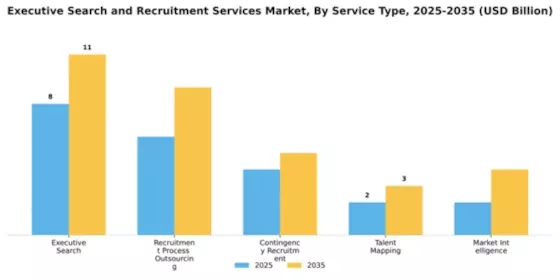
In the Executive Search and Recruitment Services Market, Executive Search holds the largest market share due to its specialized focus on sourcing high-level executives. This service is preferred by organizations seeking to fill critical leadership positions. Following this, Recruitment Process Outsourcing (RPO) is emerging prominently, driven by businesses looking to enhance efficiency by outsourcing their recruitment processes.
Executive Search (Dominant) vs. Talent Mapping (Emerging)
Executive Search is recognized for its deep industry knowledge and personalized approach, making it a dominant player in high-level talent acquisition. It enables companies to access a wider network of executive candidates. In contrast, Talent Mapping is gaining traction as an emerging service, helping organizations understand their talent landscape and identify key positions. While Executive Search provides targeted recruitment for specific roles, Talent Mapping offers insights for long-term strategic workforce planning, appealing to companies aiming for sustained growth and competitive advantage in talent sourcing.
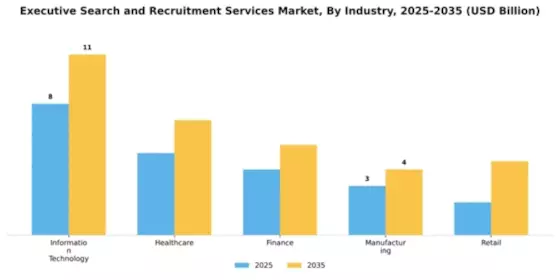
The Executive Search and Recruitment Services Market shows a clear distribution among various industries. The Information Technology segment stands out as the largest, reflecting the sector's rapid expansion and increasing demand for skilled talent. Following closely are Healthcare and Finance, demonstrating significant market presence due to evolving regulatory demands and the need for specialized roles. Meanwhile, both Manufacturing and Retail hold a smaller proportion of the market share, yet they are crucial sectors, particularly as they adapt to changing consumer behaviors and technological advancements.
Information Technology: IT Services (Dominant) vs. Healthcare Recruitment (Emerging)
The Information Technology sector, characterized by its diverse range of services and ongoing innovation, remains a dominant player in the Executive Search and Recruitment Services Market. Companies within this segment thrive on the need for specialized skills in software development, cybersecurity, and data analytics. Conversely, Healthcare Recruitment is an emerging field that has gained momentum due to a heightened focus on health services, driven by an aging population and advances in medical technology. This segment is actively seeking talent capable of adapting to new healthcare challenges, thereby creating fertile ground for recruitment firms to innovate and expand their services.
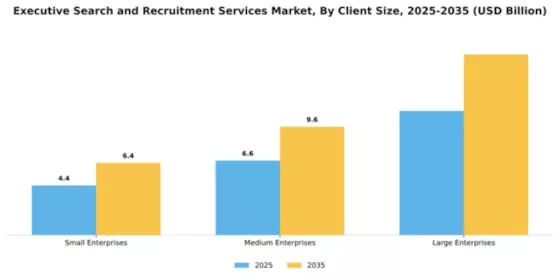
In the Executive Search and Recruitment Services Market, small enterprises currently represent the largest share of the client base, capitalizing on their flexibility and personalized services. They thrive on niche markets, offering specialized recruitment solutions that cater to specific industries. In contrast, large enterprises, while smaller in client numbers, show rapid growth, driven by their extensive resources and established market positioning, making them a formidable presence in executive recruitment.
Small Enterprises: Dominant vs. Large Enterprises: Emerging
Small enterprises dominate the Executive Search and Recruitment Services Market by leveraging bespoke services that create personalized experiences for their clients. Their agility allows them to adapt quickly to market trends and client needs, which fosters strong client relationships and repeat business. Meanwhile, large enterprises are emerging as vital players in this segment, driven by their vast networks and sophisticated recruitment technologies. They attract clients seeking comprehensive solutions, showcasing their capabilities in handling complex searches across diverse sectors, thus gaining ground rapidly.
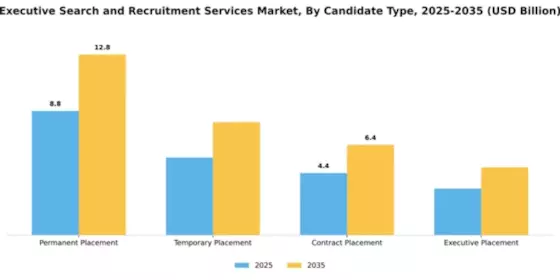
In the Executive Search and Recruitment Services Market, the Candidate Type segment is composed of Permanent Placement, Temporary Placement, Contract Placement, and Executive Placement. Among these, Permanent Placement holds the largest market share due to its long-term commitment to filling key positions in organizations. Companies increasingly prioritize stability and continuity, making Permanent Placement a favored choice for businesses looking to attract top talent. Meanwhile, Temporary and Contract Placements serve unique needs but do not compete with the dominance of Permanent roles. The market is witnessing significant growth in Executive Placement, which is recognized as the fastest-growing segment. This trend is driven by the increasing complexity of leadership roles and the demand for high-caliber executives who can lead organizations through strategic transformations. Firms seek specialized recruitment services that cater specifically to this elevated need, resulting in a surge in Executive Placement offerings. The rise of industries requiring specialized skill sets prominently influences this trend, as businesses look for expertise in navigating complex market environments.
Permanent Placement (Dominant) vs. Executive Placement (Emerging)
The Permanent Placement segment remains the cornerstone of the Executive Search and Recruitment Services Market, characterized by its focus on securing long-term employment solutions for companies. It typically involves extensive candidate assessments and aligns closely with the strategic goals of organizations, emphasizing cultural fit and long-term potential. Companies value Permanent Placement for the stability it provides, forging lasting relationships between employees and employers. Conversely, Executive Placement is burgeoning as a dynamic segment that responds to the increasing demand for executive talent in transformative business environments. This segment specializes in sourcing top-tier executives, catering to the nuanced needs of organizations in flux. As businesses seek leaders with specific skill sets, Executive Placement is increasingly regarded as an essential service, positioning itself as an attractive solution to meet evolving industry challenges.
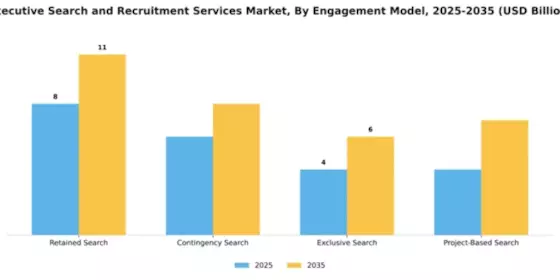
In the Executive Search and Recruitment Services Market, the Engagement Model segment is diversified into retained search, contingency search, exclusive search, and project-based search. Among these, retained search commands the largest share due to its reputation for delivering top-level executives and strategic hires for organizations. Businesses often prefer retained search for roles that require a comprehensive approach, ensuring that candidates are thoroughly vetted and aligned with company values. Meanwhile, contingency search is emerging as the fastest-growing segment, driven by industries that prioritize agility and rapid hiring processes. This model allows firms to share candidate profiles from multiple agencies, thus expanding their talent pool without restrictive commitments. As organizations seek to fill roles quickly and efficiently, the appeal of contingency search continues to rise.
Retained Search (Dominant) vs. Project-Based Search (Emerging)
Retained search is widely recognized as the dominant engagement model within the executive search and recruitment services market. It offers a high level of service, with recruiters dedicating their resources to find candidates that are the best fit for senior-level roles. This model ensures confidentiality and a thorough search process, appealing significantly to large enterprises. On the other hand, project-based search is an emerging model that caters to specific hiring projects within a set timeframe. It enables organizations to engage recruiters for short-term engagements, providing flexibility and a targeted approach to fulfilling immediate staffing needs. While retained search focuses on long-term leadership placements, project-based search appeals to businesses looking for quick, efficient hiring solutions.
Get more detailed insights about Executive Search and Recruitment Services Market Request Free Sample
North America continues to lead the Executive Search and Recruitment Services Market, holding a significant market share of 10.5 in 2024. The region's growth is driven by a robust economy, increasing demand for specialized talent, and a focus on diversity and inclusion in hiring practices. Regulatory support for workforce development and talent acquisition further catalyzes this growth, making it a prime location for recruitment services. The competitive landscape is characterized by major players such as Korn Ferry, Heidrick & Struggles, and Russell Reynolds Associates, all of which have established a strong presence in the region. The U.S. remains the largest market, with Canada and Mexico also contributing to the growth. The emphasis on technology and data analytics in recruitment processes is reshaping the industry, allowing firms to better match candidates with client needs.
Europe's Executive Search and Recruitment Services Market is valued at 6.5, reflecting a growing demand for talent acquisition across various sectors. The region benefits from a diverse labor market and increasing cross-border recruitment, driven by globalization and the need for specialized skills. Regulatory frameworks supporting labor mobility and employment rights are also key growth drivers, enhancing the attractiveness of the European market for recruitment services. Leading countries such as the UK, Germany, and France dominate the landscape, with firms like Michael Page and Hays playing pivotal roles. The competitive environment is marked by a mix of local and international players, fostering innovation and adaptability. The focus on digital transformation in recruitment processes is reshaping how firms operate, making them more efficient and responsive to client needs.
The Asia-Pacific region, with a market size of 4.5, is witnessing rapid growth in Executive Search and Recruitment Services. This growth is fueled by economic development, urbanization, and a rising middle class seeking better employment opportunities. Countries like China, India, and Japan are at the forefront, with increasing investments in human capital and a focus on skill development. Regulatory initiatives aimed at enhancing workforce participation are also contributing to market expansion. The competitive landscape features both local and international players, with firms like Spencer Stuart and Egon Zehnder establishing a strong foothold. The demand for specialized talent in technology, healthcare, and finance sectors is driving recruitment strategies. As companies adapt to changing market dynamics, the emphasis on digital tools and analytics is becoming increasingly important in recruitment processes.
The Middle East and Africa region, with a market size of 0.5, presents emerging opportunities in the Executive Search and Recruitment Services Market. The growth is driven by economic diversification efforts, particularly in Gulf Cooperation Council (GCC) countries, and an increasing focus on local talent development. Regulatory frameworks aimed at enhancing employment opportunities and attracting foreign investment are also pivotal in shaping the market landscape. Countries like the UAE and South Africa are leading the charge, with a growing number of recruitment firms entering the market. The competitive landscape is evolving, with both local and international players vying for market share. The emphasis on technology and digital platforms is reshaping recruitment strategies, making them more efficient and aligned with global standards.
The Executive Search and Recruitment Services Market is characterized by a dynamic competitive landscape, driven by the increasing demand for specialized talent across various sectors. Key players are actively refining their strategies to enhance operational efficiency and market reach. For instance, Korn Ferry (US) has been focusing on digital transformation, leveraging advanced analytics to improve candidate matching processes. Similarly, Heidrick & Struggles (US) emphasizes innovation through the integration of AI technologies, which aids in streamlining recruitment processes and enhancing client engagement. These strategic initiatives collectively contribute to a more competitive environment, as firms strive to differentiate themselves through technology and service quality.In terms of business tactics, companies are increasingly localizing their operations to better cater to regional market needs. This approach not only optimizes supply chains but also enhances client relationships by providing tailored services. The market appears moderately fragmented, with several key players exerting influence over their respective niches. The collective actions of these firms suggest a trend towards consolidation, as companies seek to expand their service offerings and geographic presence.In November Russell Reynolds Associates (US) announced a strategic partnership with a leading technology firm to develop a new platform aimed at enhancing executive search capabilities. This collaboration is expected to leverage cutting-edge technology to improve candidate sourcing and assessment, thereby positioning Russell Reynolds as a frontrunner in the market. The strategic importance of this move lies in its potential to redefine how executive searches are conducted, emphasizing the role of technology in enhancing efficiency and effectiveness.In October Spencer Stuart (US) launched a new initiative focused on diversity and inclusion within executive recruitment. This program aims to address the growing demand for diverse leadership teams across industries. By prioritizing diversity in their search processes, Spencer Stuart not only aligns with current market expectations but also enhances its reputation as a forward-thinking firm. This initiative reflects a broader trend within the industry, where diversity is increasingly viewed as a critical component of organizational success.In September Egon Zehnder (CH) expanded its global footprint by opening new offices in emerging markets, particularly in Asia and Africa. This strategic expansion is indicative of the firm’s commitment to tapping into new talent pools and catering to the evolving needs of clients in these regions. The significance of this move lies in its potential to enhance Egon Zehnder's competitive positioning, allowing it to offer localized expertise while capitalizing on the growth opportunities presented by these markets.As of December the competitive trends within the Executive Search and Recruitment Services Market are increasingly defined by digitalization, sustainability, and AI integration. Strategic alliances are becoming more prevalent, as firms recognize the value of collaboration in enhancing service offerings and operational capabilities. Looking ahead, it appears that competitive differentiation will increasingly hinge on innovation and technology, rather than traditional price-based competition. Companies that successfully integrate advanced technologies and maintain reliable supply chains are likely to emerge as leaders in this evolving landscape.






The Executive Search and Recruitment Services Market is projected to grow at a 3.46% CAGR from 2025 to 2035, driven by technological advancements and evolving workforce needs.
New opportunities lie in:
By 2035, the market is expected to be robust, reflecting adaptive strategies and innovative service offerings.
| MARKET SIZE 2024 | 22.0(USD Billion) |
| MARKET SIZE 2025 | 22.76(USD Billion) |
| MARKET SIZE 2035 | 32.0(USD Billion) |
| COMPOUND ANNUAL GROWTH RATE (CAGR) | 3.46% (2025 - 2035) |
| REPORT COVERAGE | Revenue Forecast, Competitive Landscape, Growth Factors, and Trends |
| BASE YEAR | 2024 |
| Market Forecast Period | 2025 - 2035 |
| Historical Data | 2019 - 2024 |
| Market Forecast Units | USD Billion |
| Key Companies Profiled | Korn Ferry (US), Heidrick & Struggles (US), Russell Reynolds Associates (US), Spencer Stuart (US), Egon Zehnder (CH), Odgers Berndtson (GB), Boyden (US), Michael Page (GB), Robert Walters (GB), Hays (GB) |
| Segments Covered | Service Type, Industry, Client Size, Candidate Type, Engagement Model |
| Key Market Opportunities | Integration of artificial intelligence in candidate sourcing enhances efficiency in the Executive Search and Recruitment Services Market. |
| Key Market Dynamics | Rising demand for specialized talent drives competition among executive search firms, influencing recruitment strategies and service offerings. |
| Countries Covered | North America, Europe, APAC, South America, MEA |
The market valuation reached 22.0 USD Billion in 2024.
The market is expected to grow to 32.0 USD Billion by 2035.
The market is projected to experience a CAGR of 3.46% from 2025 to 2035.
The Executive Search segment is likely to reach between 11.0 and 12.8 USD Billion by 2035.
Recruitment Process Outsourcing is projected to grow to between 9.0 and 12.8 USD Billion by 2035, indicating strong demand.
The Information Technology and Healthcare sectors are expected to lead, with valuations of 11.0 and 7.0 USD Billion respectively by 2035.
Large Enterprises are projected to dominate with a valuation between 11.0 and 16.0 USD Billion by 2035.
The Temporary Placement segment is anticipated to grow to between 8.0 and 10.0 USD Billion by 2035.
The Retained Search model is likely to reach a valuation of 11.0 USD Billion by 2035.
Key players include Korn Ferry, Heidrick & Struggles, and Russell Reynolds Associates, among others.


Kindly complete the form below to receive a free sample of this Report

“This is really good guys. Excellent work on a tight deadline. I will continue to use you going forward and recommend you to others. Nice job”


“Thanks. It’s been a pleasure working with you, please use me as reference with any other Intel employees.”


“Thanks for sending the report it gives us a good global view of the Betaïne market.”


“Thank you, this will be very helpful for OQS.”


“We found the report very insightful! we found your research firm very helpful. I'm sending this email to secure our future business.”


“I am very pleased with how market segments have been defined in a relevant way for my purposes (such as "Portable Freezers & refrigerators" and "last-mile"). In general the report is well structured. Thanks very much for your efforts.”


“I have been reading the first document or the study, ,the Global HVAC and FP market report 2021 till 2026. Must say, good info! I have not gone in depth at all parts, but got a good indication of the data inside!”


“We got the report in time, we really thank you for your support in this process. I also thank to all of your team as they did a great job.”


“The Automotive 48V ECU Components Procurement Intelligence Study” was a complex project, but the Market Research Future (MRFR) team handled it with quality, agility, and customer-centricity. They delivered all requested data on time and within the agreed scope. The team, including Shubhendra Anand and Rahul Gotadki, was always readily available to clarify questions and swiftly implement necessary adjustments, driving the project to a successful conclusion within a very demanding timeframe.
I would also like to specifically commend Akshay Agarwal for his responsiveness and support at every stage—from our initial inquiry on May 6th through to final delivery on June 18th. His dedication made the entire process seamless.”



