Download Free Sample
Kindly complete the form below to receive a free sample of this Report
Recruitment Process Outsourcing (RPO) Services Market Research Report: Size, Share, Trend Analysis By Industry Outlook (Information Technology, Healthcare, Manufacturing, Retail, Financial Services) By Company Size Outlook (Small Enterprises, Medium Enterprises, Large Enterprises, Startups) By Service Type Outlook (End-to-End Recruitment, Recruitment Marketing, On-Demand Recruitment, Talent Mapping, Employer Branding) By Candidate Type Outlook (Permanent Placement, Temporary Placement, Contract Staffing, Executive Search) By Recruitment Model Outlook (Contingent Recruitment, Retained Recruitment, Hybrid Recruitment) By Region (North America, Europe, APAC, South America, MEA) – Growth Outlook & Industry Forecast To 2035
As per MRFR analysis, the Recruitment Process Outsourcing (RPO) Services Market was estimated at 28.0 USD Billion in 2024. The RPO industry is projected to grow from 29.23 USD Billion in 2025 to 45.0 USD Billion by 2035, exhibiting a compound annual growth rate (CAGR) of 4.41% during the forecast period 2025 - 2035.
The Recruitment Process Outsourcing (RPO) Services Market is experiencing a dynamic shift towards technological integration and enhanced employer branding.
| 2024 Market Size | 28.0 (USD Billion) |
| 2035 Market Size | 45.0 (USD Billion) |
| CAGR (2025 - 2035) | 4.41% |
Allegis Group (US), Randstad (NL), ManpowerGroup (US), Adecco (CH), Hays (GB), Kelly Services (US), Cognizant (US), Tata Consultancy Services (IN), IBM (US)
Our Impact
Enabled $4.3B Revenue Impact for Fortune 500 and Leading Multinationals
Partnering with 2000+ Global Organizations Each Year
30K+ Citations by Top-Tier Firms in the Industry
The Recruitment Process Outsourcing (RPO) Services Market is currently experiencing a transformative phase, driven by evolving workforce dynamics and technological advancements. Organizations are increasingly recognizing the value of outsourcing their recruitment processes to specialized providers, which allows them to focus on core business functions while enhancing the efficiency of talent acquisition. This shift appears to be influenced by the need for agility in hiring practices, as companies strive to adapt to changing market conditions and workforce expectations. Furthermore, the integration of artificial intelligence and data analytics into recruitment strategies is reshaping how organizations identify and engage potential candidates, suggesting a future where technology plays a pivotal role in recruitment. In addition, the emphasis on diversity and inclusion within the workplace is prompting organizations to seek RPO services that can help them attract a broader range of candidates. This trend indicates a growing awareness of the importance of varied perspectives in driving innovation and business success. As the Recruitment Process Outsourcing (RPO) Services Market continues to evolve, it is likely that providers will enhance their offerings to meet the diverse needs of clients, ultimately leading to more tailored and effective recruitment solutions.
The incorporation of advanced technologies, such as artificial intelligence and machine learning, is revolutionizing the Recruitment Process Outsourcing (RPO) Services Market. These innovations facilitate more efficient candidate sourcing, screening, and engagement, allowing organizations to streamline their hiring processes.
There is a notable trend towards prioritizing diversity and inclusion in recruitment strategies. Organizations are increasingly seeking RPO services that can assist in attracting a diverse talent pool, reflecting a commitment to fostering inclusive workplaces.
Companies are recognizing the significance of employer branding in attracting top talent. RPO providers are adapting their strategies to enhance clients' brand presence in the job market, thereby improving their ability to attract high-quality candidates.
The emphasis on employer branding is becoming a crucial driver in the Recruitment Process Outsourcing (RPO) Services Market. Organizations are increasingly aware that a strong employer brand can significantly influence their ability to attract and retain top talent. RPO providers are now tasked with not only filling positions but also enhancing the employer's brand image in the job market. Data indicates that companies with a well-defined employer brand can experience a 50 percent reduction in turnover rates. This focus on branding is prompting organizations to collaborate with RPO providers to develop compelling narratives that resonate with potential candidates. As the importance of employer branding continues to grow, the demand for RPO services that incorporate branding strategies is expected to rise.
The Recruitment Process Outsourcing (RPO) Services Market is experiencing a surge in demand for talent acquisition services. Organizations are increasingly recognizing the need for specialized recruitment strategies to attract top talent. This trend is driven by the competitive landscape where companies strive to secure skilled professionals. According to recent data, the demand for RPO services has grown by approximately 25 percent over the past year, indicating a robust market. Companies are seeking to streamline their hiring processes, reduce time-to-fill positions, and enhance the quality of hires. This heightened demand for talent acquisition services is likely to propel the growth of the RPO services market, as businesses prioritize effective recruitment solutions to meet their workforce needs.
Cost efficiency remains a pivotal driver in the Recruitment Process Outsourcing (RPO) Services Market. Organizations are increasingly turning to RPO providers to optimize their recruitment budgets and reduce overhead costs associated with in-house hiring. By outsourcing recruitment processes, companies can leverage the expertise of RPO providers, which often results in lower cost-per-hire metrics. Data suggests that businesses utilizing RPO services can achieve cost savings of up to 30 percent compared to traditional recruitment methods. This financial incentive encourages organizations to adopt RPO solutions, thereby contributing to the overall growth of the RPO services market. As companies continue to seek ways to enhance operational efficiency, the demand for cost-effective recruitment solutions is expected to rise.
Regulatory compliance and risk management are increasingly recognized as vital drivers in the Recruitment Process Outsourcing (RPO) Services Market. Organizations face a myriad of regulations related to hiring practices, data protection, and equal employment opportunities. RPO providers play a crucial role in ensuring that recruitment processes adhere to these regulations, thereby mitigating potential legal risks. The complexity of compliance requirements has led many companies to seek the expertise of RPO providers to navigate these challenges effectively. Data suggests that organizations utilizing RPO services experience a 40 percent reduction in compliance-related issues. As regulatory landscapes evolve, the demand for RPO services that prioritize compliance and risk management is likely to grow, further propelling the market.
Technological advancements are significantly influencing the Recruitment Process Outsourcing (RPO) Services Market. The integration of artificial intelligence, machine learning, and data analytics into recruitment processes is transforming how organizations identify and engage candidates. RPO providers are increasingly adopting these technologies to enhance their service offerings, streamline candidate sourcing, and improve the overall recruitment experience. For instance, the use of AI-driven tools can reduce the time spent on resume screening by up to 70 percent, allowing recruiters to focus on strategic decision-making. This technological evolution not only enhances efficiency but also improves the quality of hires, making RPO services more attractive to businesses. As technology continues to evolve, its impact on the RPO services market is likely to expand.
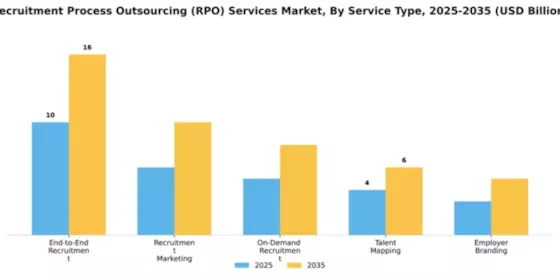
The Recruitment Process Outsourcing (RPO) Services Market is segmented primarily into five service types: End-to-End Recruitment, Recruitment Marketing, On-Demand Recruitment, Talent Mapping, and Employer Branding. Among these, End-to-End Recruitment commands the largest share, offering comprehensive recruitment services from job requisition to onboarding. In contrast, Talent Mapping is gaining traction as more organizations recognize the need for strategic workforce planning and insights into talent availability. Its growth is fueled by an increasing emphasis on proactive recruitment strategies.
End-to-End Recruitment (Dominant) vs. Talent Mapping (Emerging)
End-to-End Recruitment is recognized as the dominant force in the RPO services market, providing a fully integrated recruitment solution that meets various client needs. This service covers the entire recruitment lifecycle and is preferred by large organizations requiring cohesive talent acquisition strategies. On the other hand, Talent Mapping is emerging as a vital service, particularly for businesses focused on long-term workforce planning. It enables companies to assess their talent pipeline and align it with future demands, making it essential for organizations striving for agility and a competitive edge in the market.
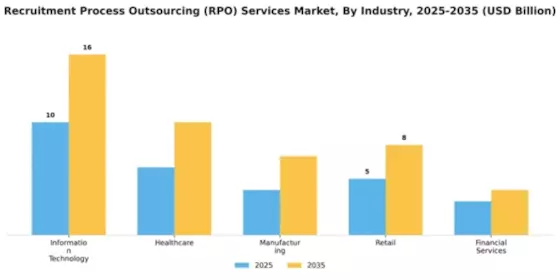
The Recruitment Process Outsourcing (RPO) Services Market showcases a diverse landscape across various industries. Information Technology remains the largest sector, characterized by a significant demand for skilled professionals capable of keeping pace with rapid technological advancements. In contrast, Healthcare is gaining momentum as one of the fastest-growing segments due to an increased need for specialized talent in the wake of rising health concerns and a focus on quality patient care. Initiatives aimed at enhancing workforce efficiency and filling critical positions are propelling growth in this sector. Growth trends in the RPO market are heavily influenced by the digital transformation wave sweeping through all industries. The demand for IT talent is primarily fueled by the ongoing developments in artificial intelligence, cloud computing, and cybersecurity. Similarly, the Healthcare sector is witnessing expansion driven by an aging population, rising healthcare demands, and the shift toward personalized healthcare services. Organizations are increasingly adopting RPO solutions to mitigate recruitment challenges and ensure access to top talent, making it essential for RPO providers to adapt their strategies accordingly.
Information Technology (Dominant) vs. Healthcare (Emerging)
The Information Technology sector dominates the Recruitment Process Outsourcing (RPO) Services Market, reflecting its crucial role in business operations across sectors. Companies within this space require a steady influx of tech-savvy professionals to thrive amidst fierce competition. The emphasis on digital skills, software development, and data analytics not only defines the talent requirements but also makes IT the go-to industry for recruitment outsourcing. In contrast, the Healthcare sector is emerging rapidly in the RPO landscape, propelled by the need for specialized healthcare professionals. Factors such as an increasing regulatory environment and the rising importance of patient-centric care are pushing healthcare organizations to seek RPO solutions. This emerging trend highlights the dynamic nature of the RPO market, where adaptability and specialization are becoming essential for success.
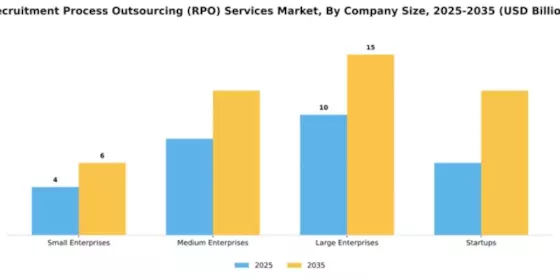
In the Recruitment Process Outsourcing (RPO) Services Market, the distribution of market share reveals that large enterprises hold the majority stake, capitalizing on their established structures and resources. Their comprehensive recruitment needs often lead them to seek RPO services, providing them with the advantage of scalability and expertise. On the other hand, small enterprises are witnessing a significant rise in their market share, as they increasingly turn to RPO to streamline hiring processes, reduce overheads, and compete for talent against larger firms. The growth trends in this segment are driven primarily by the increasing need for efficiency in recruitment and the agility offered by RPO services. As the labor market evolves, small enterprises are discovering the benefits of leveraging RPO to enhance their recruitment strategies, thus becoming a rapidly emerging segment. Large enterprises continue to invest heavily in RPO services to maintain their competitive edge and optimize their hiring practices, leading to a dynamic interplay between these segments that shapes the overall market landscape.
Large Enterprises (Dominant) vs. Small Enterprises (Emerging)
Large enterprises are characterized by their extensive resources, well-defined recruitment processes, and a need for scalable solutions in hiring. Their dominant market position allows them to negotiate better terms with RPO providers, ensuring they receive tailored services that meet their complex needs. They tend to focus on specialized roles and long-term workforce planning, thus requiring RPO partners to be adaptive and integrated into their overall business strategy. In contrast, small enterprises represent an emerging segment that is rapidly adopting RPO services due to the need for cost-effective solutions and agility. These companies are motivated by the desire to enhance their recruitment capabilities without the burden of overhead costs associated with full-time HR departments. They often seek flexible RPO solutions that can quickly adapt to their changing requirements, allowing them to attract and retain top talent.
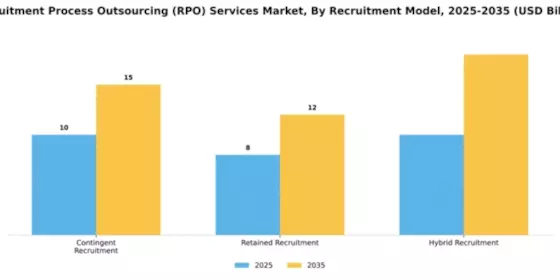
In the Recruitment Process Outsourcing (RPO) Services Market, Contingent Recruitment holds the largest share, primarily driven by its flexibility and ability to quickly fill temporary roles. This model appeals to organizations requiring agile workforce solutions, allowing companies to adapt to changing business environments without long-term commitments. Retained Recruitment, while smaller in market share, is noted for its strategic approach to hiring, particularly in high-demand positions. It emphasizes the depth of candidate evaluation and engagement, catering to clients looking for dedicated talent acquisition solutions.
Contingent Recruitment (Dominant) vs. Retained Recruitment (Emerging)
Contingent Recruitment has established itself as the dominant model in the RPO market, primarily due to its ability to meet the immediate staffing needs of businesses across various sectors. It is characterized by sourcing external candidates for short-term assignments or project-based roles, thus allowing organizations to maintain operational efficiency. On the other hand, Retained Recruitment is emerging, focusing on long-term placements and specialized hiring processes, typically for senior or executive positions. This model involves a more consultative approach and a commitment from clients, ensuring thorough vetting and a strong fit between candidates and company culture.
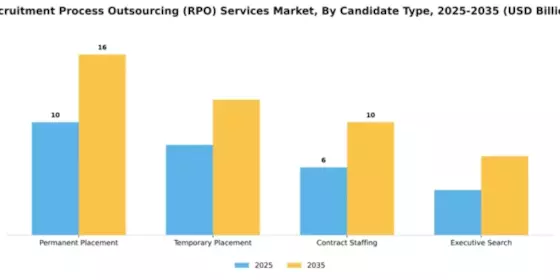
The Recruitment Process Outsourcing (RPO) Services Market features a diverse range of candidate types, with Permanent Placement leading in market share. This segment appeals to organizations seeking to fill long-term roles and build a stable workforce, thus dominating the landscape. Temporary Placement and Contract Staffing follow, while Executive Search emerges as a more specialized service that caters to top-tier talent acquisition, reflecting its growing significance in a competitive environment. Rapid changes in workforce dynamics and the increasing necessity for specialized skill sets drive the growth of the Executive Search segment. As businesses recognize the importance of attracting high-caliber executives to steer their operations, demand for RPO services geared towards executive searches continues to surge. Conversely, while Permanent Placement remains crucial for consistent staffing needs, there is a noticeable shift towards flexibility and agility, further fueling interest in alternative models like Temporary Placement and Contract Staffing.
Permanent Placement (Dominant) vs. Executive Search (Emerging)
Permanent Placement stands as the dominant candidate type within the RPO Services Market, providing organizations with one of the most reliable methods to source talent for permanent roles. Its strength lies in its ability to align long-term employee capabilities with organizational goals, ensuring high retention rates and optimal cultural fit. Industries ranging from technology to healthcare benefit from this model, which emphasizes sustained relationships between companies and their workforce. On the other hand, Executive Search has emerged as a fast-growing segment, addressing the escalating demand for leadership talent and strategic hires. This method is characterized by its tailored, intensive search processes aimed at finding executives who possess unique skills and experiences that are vital for driving business growth. Together, these segments highlight the diverse approaches organizations are taking to meet varying staffing needs.
Get more detailed insights about Recruitment Process Outsourcing (RPO) Services Market Request Free Sample
North America continues to lead the Recruitment Process Outsourcing (RPO) services market, holding a significant share of 14.0 in 2024. The region's growth is driven by a robust demand for talent acquisition solutions, particularly in technology and healthcare sectors. Regulatory support for flexible workforce solutions further enhances market dynamics, making it an attractive landscape for RPO providers. The competitive landscape is characterized by major players such as Allegis Group, ManpowerGroup, and IBM, which dominate the market. The U.S. remains the largest contributor, with a strong emphasis on innovation and technology integration in recruitment processes. This competitive edge is bolstered by strategic partnerships and investments in AI-driven recruitment solutions, ensuring sustained growth in the region.
Europe's RPO services market is evolving, with a market size of 7.0 in 2024. The region is witnessing increased demand for outsourcing solutions driven by the need for efficiency and cost-effectiveness in recruitment processes. Regulatory frameworks promoting labor market flexibility are also contributing to this growth, making RPO an attractive option for businesses across various sectors. Leading countries such as the UK, Germany, and the Netherlands are at the forefront of this market, with key players like Randstad and Adecco establishing a strong presence. The competitive landscape is marked by a focus on digital transformation and innovative recruitment strategies, positioning Europe as a significant player in The Recruitment Process Outsourcing (RPO) Services. "The European labor market is increasingly embracing flexible recruitment solutions to adapt to changing workforce needs," European Commission report, European Commission.
The Asia-Pacific region is experiencing rapid growth in the RPO services market, with a size of 5.0 in 2024. This growth is fueled by the increasing demand for skilled labor and the rising trend of outsourcing recruitment functions to enhance operational efficiency. Countries like India and China are leading this trend, supported by favorable government policies that encourage foreign investment and talent acquisition. The competitive landscape features key players such as Tata Consultancy Services and Cognizant, which are leveraging technology to streamline recruitment processes. The region's diverse market dynamics and varying regulatory environments present both challenges and opportunities for RPO providers, making it a vibrant area for growth in the coming years.
The Middle East and Africa (MEA) region is gradually emerging in the RPO services market, with a market size of 2.0 in 2024. The growth is driven by increasing investments in human capital and a shift towards outsourcing recruitment to enhance efficiency. Regulatory initiatives aimed at improving labor market conditions are also fostering a conducive environment for RPO services to thrive. Countries like South Africa and the UAE are leading the charge, with a growing number of local and international players entering the market. The competitive landscape is characterized by a focus on localized solutions and partnerships, enabling RPO providers to cater to the unique needs of businesses in the region. "The MEA region is witnessing a transformation in recruitment practices, driven by the need for efficiency and effectiveness in talent acquisition," World Bank report, World Bank.
The Recruitment Process Outsourcing (RPO) Services Market is characterized by a dynamic competitive landscape, driven by the increasing demand for efficient talent acquisition solutions. Key players are actively engaging in strategies that emphasize innovation, digital transformation, and strategic partnerships to enhance their service offerings. Companies such as Allegis Group (US), Randstad (NL), and ManpowerGroup (US) are at the forefront, leveraging their extensive networks and technological capabilities to capture market share. Allegis Group (US) focuses on integrating advanced analytics into its recruitment processes, while Randstad (NL) emphasizes regional expansion and localized service delivery to meet diverse client needs. ManpowerGroup (US) is also notable for its commitment to sustainability and workforce development, which collectively shapes a competitive environment that prioritizes adaptability and responsiveness to market demands.The market structure appears moderately fragmented, with a mix of large multinational corporations and smaller specialized firms. Key players are employing various business tactics, such as optimizing their supply chains and localizing their service offerings to enhance operational efficiency. This competitive structure allows for a diverse range of services, catering to different client requirements and fostering innovation across the sector.In November Randstad (NL) announced a strategic partnership with a leading AI technology firm to enhance its recruitment automation capabilities. This move is significant as it positions Randstad to leverage AI-driven insights, potentially streamlining the hiring process and improving candidate matching. Such advancements may lead to increased client satisfaction and retention, reinforcing Randstad's competitive edge in the market.In October Allegis Group (US) launched a new digital platform aimed at improving candidate engagement through personalized experiences. This initiative reflects a growing trend towards digitalization in recruitment, suggesting that Allegis is keen on enhancing its technological infrastructure to attract top talent. The platform's success could redefine how candidates interact with recruitment services, thereby influencing industry standards.In September ManpowerGroup (US) expanded its global footprint by acquiring a regional RPO provider in Asia. This acquisition is likely to enhance ManpowerGroup's service delivery capabilities in emerging markets, aligning with its strategy to tap into high-growth regions. Such strategic moves indicate a broader trend of consolidation within the industry, as companies seek to bolster their market presence and operational efficiencies.As of December the competitive trends in the RPO Services Market are increasingly defined by digitalization, AI integration, and a focus on sustainability. Strategic alliances are becoming more prevalent, enabling companies to pool resources and expertise to address complex client needs. Looking ahead, competitive differentiation is expected to evolve, shifting from traditional price-based competition to a focus on innovation, technology, and supply chain reliability. This transition may redefine the competitive landscape, compelling firms to invest in cutting-edge solutions that enhance their value propositions.





The Recruitment Process Outsourcing (RPO) Services Market is projected to grow at a 4.41% CAGR from 2025 to 2035, driven by technological advancements and increasing demand for talent acquisition efficiency.
New opportunities lie in:
By 2035, the RPO Services Market is expected to be robust, reflecting sustained growth and innovation.
| MARKET SIZE 2024 | 28.0(USD Billion) |
| MARKET SIZE 2025 | 29.23(USD Billion) |
| MARKET SIZE 2035 | 45.0(USD Billion) |
| COMPOUND ANNUAL GROWTH RATE (CAGR) | 4.41% (2025 - 2035) |
| REPORT COVERAGE | Revenue Forecast, Competitive Landscape, Growth Factors, and Trends |
| BASE YEAR | 2024 |
| Market Forecast Period | 2025 - 2035 |
| Historical Data | 2019 - 2024 |
| Market Forecast Units | USD Billion |
| Key Companies Profiled | Allegis Group (US), Randstad (NL), ManpowerGroup (US), Adecco (CH), Hays (GB), Kelly Services (US), Cognizant (US), Tata Consultancy Services (IN), IBM (US) |
| Segments Covered | Service Type, Industry, Company Size, Recruitment Model, Candidate Type |
| Key Market Opportunities | Integration of artificial intelligence in Recruitment Process Outsourcing (RPO) Services enhances efficiency and candidate matching. |
| Key Market Dynamics | Growing demand for flexible talent solutions drives innovation and competition in the Recruitment Process Outsourcing Services Market. |
| Countries Covered | North America, Europe, APAC, South America, MEA |
The projected market valuation for the Recruitment Process Outsourcing (RPO) Services Market is expected to reach 45.0 USD Billion by 2035.
The overall market valuation of the Recruitment Process Outsourcing (RPO) Services Market was 28.0 USD Billion in 2024.
The expected CAGR for the Recruitment Process Outsourcing (RPO) Services Market during the forecast period 2025 - 2035 is 4.41%.
The End-to-End Recruitment service type segment is projected to reach a valuation of 16.0 USD Billion by 2035.
By 2035, the On-Demand Recruitment segment is expected to achieve a valuation of 8.0 USD Billion, indicating robust growth compared to other service types.
The Healthcare industry segment is anticipated to reach a market size of 10.0 USD Billion by 2035.
The Large Enterprises segment is expected to dominate the RPO Services Market with a projected valuation of 15.0 USD Billion by 2035.
The Hybrid Recruitment model is projected to reach a valuation of 18.0 USD Billion by 2035.
Key players in the RPO Services Market include Allegis Group, Randstad, ManpowerGroup, and Adecco, among others.
The Temporary Placement candidate type segment is expected to grow to a valuation of 12.0 USD Billion by 2035.


Kindly complete the form below to receive a free sample of this Report

“This is really good guys. Excellent work on a tight deadline. I will continue to use you going forward and recommend you to others. Nice job”


“Thanks. It’s been a pleasure working with you, please use me as reference with any other Intel employees.”


“Thanks for sending the report it gives us a good global view of the Betaïne market.”


“Thank you, this will be very helpful for OQS.”


“We found the report very insightful! we found your research firm very helpful. I'm sending this email to secure our future business.”


“I am very pleased with how market segments have been defined in a relevant way for my purposes (such as "Portable Freezers & refrigerators" and "last-mile"). In general the report is well structured. Thanks very much for your efforts.”


“I have been reading the first document or the study, ,the Global HVAC and FP market report 2021 till 2026. Must say, good info! I have not gone in depth at all parts, but got a good indication of the data inside!”


“We got the report in time, we really thank you for your support in this process. I also thank to all of your team as they did a great job.”


“The Automotive 48V ECU Components Procurement Intelligence Study” was a complex project, but the Market Research Future (MRFR) team handled it with quality, agility, and customer-centricity. They delivered all requested data on time and within the agreed scope. The team, including Shubhendra Anand and Rahul Gotadki, was always readily available to clarify questions and swiftly implement necessary adjustments, driving the project to a successful conclusion within a very demanding timeframe.
I would also like to specifically commend Akshay Agarwal for his responsiveness and support at every stage—from our initial inquiry on May 6th through to final delivery on June 18th. His dedication made the entire process seamless.”



