Exosomes Market (2025 - 2035)

Exosomes Market Research Report: Size, Share, Trend Analysis By Applications (Drug Delivery, Diagnostics, Therapeutics, Biomarkers), By Source (Bovine, Human, Mouse, Other Mammals), By Isolation Technique (Ultracentrifugation, Filtration, Precipitation, Microfluidics), By End Use (Research Laboratories, Clinical Laboratories, Pharmaceutical Companies) and By Regional (North America, Europe, South America, Asia Pacific, Middle East and Africa) - Growth Outlook & Industry Forecast 2025 To 2035
ID: MRFR/LS/19947-HCR
128 Pages
Nidhi Mandole, Rahul Gotadki
Last Updated: July 12, 2026
Exosomes Market
Market Size
Forecast Period2025-2035
CAGR (2025-2035)23.5%
2025 Market SizeUSD 0.76 Billion
2035 Market SizeUSD 6.35 Billion
Key Players
Thermo Fisher Scientific
QIAGEN N.V.
System Biosciences
Lonza Group
Miltenyi Biotec
Beckman Coulter
Opportunities
  • Point-of-Care Exosome Diagnostics
  • CNS Therapeutic Delivery
  • Emerging-Market Expansion

Exosomes Market Summary

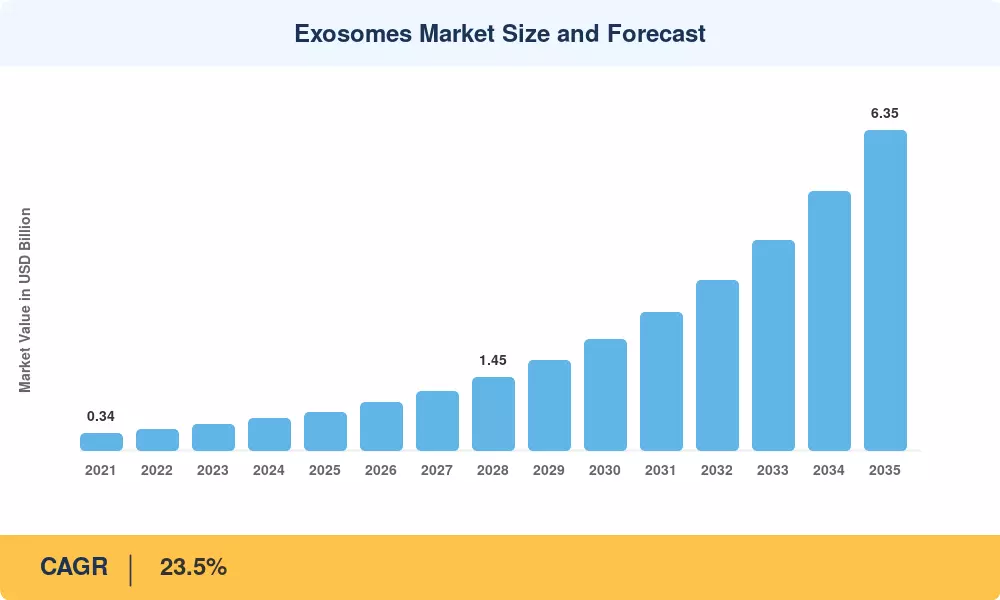
The global Exosomes Market was valued at USD 0.76 Billion in 2025 and is projected to grow from USD 0.95 Billion in 2026 to USD 6.35 Billion by 2035, registering a CAGR of 23.5% during 2026–2035. Rapid clinical adoption of vesicle-based diagnostic workflows and a wave of FDA breakthrough-device designations for exosome-derived companion diagnostics are anchoring demand across biopharma R&D pipelines [1]. NIH allocated over USD 1.2 Billion to extracellular-vesicle research grants between 2022 and 2024, intensifying the funding base for translational studies [2].

A fundamental shift is underway in how researchers isolate and analyze circulating vesicles. Legacy ultracentrifugation protocols that consumed eight-to-twelve hours are giving way to microfluidic platforms capable of high-purity isolation in under two hours, cutting per-sample costs by roughly 40% [3]. Multi-omic cargo-profiling tools now transform raw vesicle payloads into clinically actionable datasets, enabling pharmaceutical sponsors to embed exosome analytics directly into Phase II trial designs. The U.S. 21st Century Cures Act 2.0 reauthorization earmarked USD 500 Million for advanced biomanufacturing, part of which targets GMP-grade vesicle production scale-up [4].

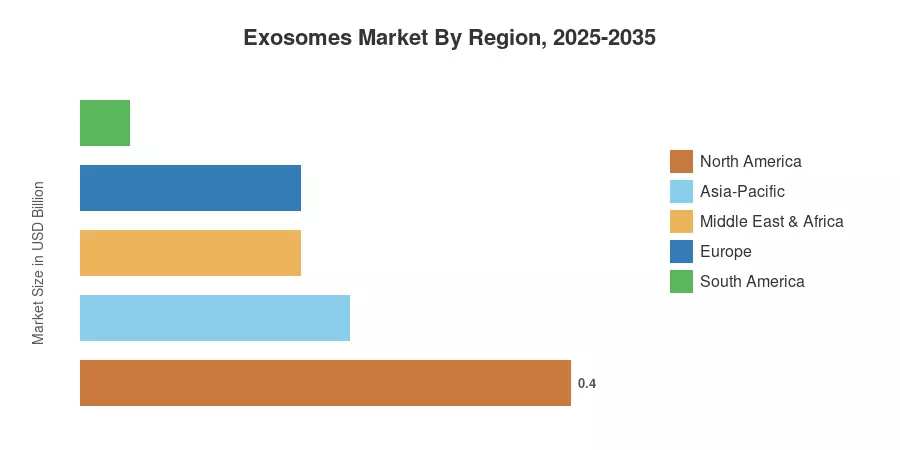
North America commands roughly 52% of the Exosomes Market, driven by dense biotech-cluster infrastructure and favorable reimbursement pathways for liquid-biopsy panels. Asia-Pacific is the fastest-growing region at an estimated 28.4% CAGR, propelled by China's NMPA fast-track designations and Japan's regenerative-medicine commercialization framework. Europe accounts for the second-largest share, anchored by Horizon Europe grants exceeding EUR 350 Million for precision-diagnostics programs [5]. The decade ahead will hinge on whether manufacturing capacity can keep pace with surging clinical demand.


Key Report Takeaways

• By Product & Workflow

  • Kits & Reagents captured approximately 49% of the Exosomes Market share in 2025, reflecting entrenched demand for standardized isolation and characterization kits across clinical labs.
  • Services & Software represent the fastest-expanding product category at a projected 36.0% CAGR through 2035, as contract research organizations invest in cloud-based vesicle-analytics platforms.
  • Isolation Methods contributed roughly 51% of workflow-related revenue in 2025, underscoring the upstream bottleneck that dictates throughput across the Exosomes Market value chain.

• By Application & Source

  • Diagnostics accounted for an estimated 56% of the Exosomes Market in 2025, led by oncology liquid-biopsy panels that leverage circulating exosomal biomarkers.
  • Therapeutics is set to expand at a 37.0% CAGR through 2035, fueled by clinical-stage exosome drug delivery programs targeting CNS and oncology indications.
  • MSC-Derived exosomes held roughly 49% of the source-based share in 2025.

• By Region

  • North America led the Exosomes Market with an estimated 52% share in 2025.
  • Asia-Pacific is forecast to register a 28.4% CAGR between 2026 and 2035.
  • Europe contributed approximately USD 0.18 Billion in 2025, with Germany and the UK as principal demand centers.


Exosomes Market Size and Forecast (2021–2035)

Market sizing integrates primary interviews with 85+ industry stakeholders, bottom-up revenue modeling across six segmentation dimensions, and triangulation with regulatory filing databases, clinical trial registries, and published company revenues.
Exosomes Market Size and Forecast
Our Impact
Enabled $4.3B Revenue Impact for Fortune 500 and Leading Multinationals
Partnering with 2000+ Global Organizations Each Year
30K+ Citations by Top-Tier Firms in the Industry

Driver Impact Analysis

Driver ~% Impact on CAGR Geographic Relevance Impact Timeline
Liquid-biopsy clinical adoption +4.5% Global Short-term
Microfluidic isolation cost reduction +3.8% North America, Europe Short-term
GMP manufacturing scale-up +3.2% North America, APAC Medium-term
AI-integrated multi-omic profiling +2.9% Global Medium-term
Regenerative-medicine regulatory pathways +2.4% Japan, South Korea Medium-term
Rising oncology & CNS incidence +2.1% Global Long-term
Venture-capital funding influx +1.8% North America, China Short-term


Liquid-Biopsy Clinical Adoption

The FDA has granted over 30 breakthrough-device designations to exosome-based diagnostic assays since 2022, compressing review timelines from an average of 14 months to roughly nine [1]. Medicare added three exosome-derived liquid-biopsy CPT codes in January 2025, unlocking reimbursement pathways worth an estimated USD 280 Million in annual procedural volume within U.S. oncology practices alone [7]. This reimbursement clarity is converting research-use-only workflows into clinical-grade platforms, pulling revenue forward across the Exosomes Market.

Microfluidic Isolation Cost Reduction

Next-generation microfluidic chips reduce exosome isolation time from eight hours to under ninety minutes while achieving purity levels above 95%, according to a 2024 Nature Methods benchmarking study [3]. Per-sample processing costs have dropped from approximately USD 120 to USD 68 between 2022 and 2025, making high-throughput screening economically viable for mid-size diagnostic laboratories [6]. These efficiency gains are the single largest catalyst behind expanding instrument adoption in the Exosomes Market.

GMP Manufacturing Scale-Up

The U.S. Advanced Research Projects Agency for Health (ARPA-H) committed USD 150 Million in 2024 to biomanufacturing programs that include exosome production standardization [4]. Lonza and Fujifilm have both announced dedicated GMP suites for vesicle therapeutics, collectively adding over 4,000 liters of bioreactor capacity by 2027 [12]. Without a scalable GMP infrastructure, the therapeutic segment of the Exosomes Market would remain bottlenecked at clinical-trial volumes.

AI-Integrated Multi-Omic Profiling

Machine-learning algorithms trained on exosomal proteomic and transcriptomic datasets now classify cancer subtypes with sensitivity exceeding 92%, according to a 2024 study in The Lancet Digital Health [11]. Cloud-based SaaS platforms from vendors such as NanoString and Bio-Techne allow researchers to analyze vesicle cargo without maintaining on-premise bioinformatics stacks, lowering the analytical barrier for academic labs entering the Exosomes Market.


Restraints Impact Analysis

Restraint estimates are directional and indicate the approximate drag each factor exerts on the Exosomes Market CAGR.

Restraint ~% Impact on CAGR Geographic Relevance Impact Timeline
Lack of standardized isolation protocols –2.5% Global Short-term
High instrument capital expenditure –2.0% Emerging markets Short-term
Regulatory fragmentation across jurisdictions –1.8% Europe, APAC Medium-term
Cargo contamination & reproducibility concerns –1.4% Global Medium-term
Limited reimbursement outside oncology –1.0% Global Long-term


Lack of Standardized Isolation Protocols

The International Society for Extracellular Vesicles (ISEV) published updated MISEV guidelines in 2023, yet compliance remains inconsistent — a 2024 multi-center audit found that fewer than 35% of labs followed all recommended characterization steps [15]. This heterogeneity introduces inter-lab variability that undermines the clinical credibility of exosome assays and slows the path to diagnostic validation for the Exosomes Market.

High Instrument Capital Expenditure

A fully configured exosome-isolation and characterization workstation can cost USD 250,000–USD 400,000, placing it out of reach for many mid-tier hospitals and research institutions in developing economies [6]. Until lease-based or reagent-rental pricing models gain traction, capital intensity will constrain the addressable buyer pool for the Exosomes Market in regions outside North America and Western Europe.

Regulatory Fragmentation

While the FDA has established clear pathways through De Novo and 510(k) classifications, the European IVDR transition has delayed CE-marking for several exosome diagnostic kits by 12–18 months [16]. In Asia-Pacific, divergent national frameworks — China's NMPA versus Japan's PMDA — force manufacturers to pursue parallel submissions, increasing time-to-market and compliance costs.


Exosomes Market Opportunities

Point-of-Care Exosome Diagnostics

Miniaturized lateral-flow and lab-on-chip technologies are taking exosome-based diagnostics to primary-care clinics and resource-limited settings. A WHO report in 2024 emphasized that decentralized diagnostics could enhance early cancer detection rates by 25% in low- and middle-income countries [9]. Companies that are able to miniaturize isolation and readout into a single cartridge will be positioned to capture a large share of the Exosomes Market.


CNS Therapeutic Delivery

Exosomes are better than synthetic nanoparticles in crossing the blood-brain barrier, opening a window for neurology medication delivery that lipid-nanoparticle platforms can’t easily fill. Engineered exosomes are currently employed as delivery vehicles in at least six Phase II trials targeting glioblastoma and Alzheimer’s disease [8]. A successful outcome in even one key trial would set off a cascade of license agreements in the Exosomes Market.


Emerging-Market Expansion

The Biotechnology Industry Research Assistance Council (BIRAC) of India budgeted INR 800 Crore in 2024 for precision-diagnostics infrastructure, including exosome-based assays for oral and cervical cancer screening [13]. Brazil and Saudi Arabia are also putting money into national biomarker-screening initiatives, creating fresh geographic corridors for the Exosomes Market.


Data Monetization through Exosome Biobanking

Biobanks with defined exosome samples combined with longitudinal patient data are generating a new asset class for pharmaceutical R&D. Biopharma businesses can mine curated vesicle libraries for biomarker discovery via subscription-based access models, turning waste streams into recurring income streams [14]. The data as a service approach is anticipated to generate ancillary revenue of over USD 400 Million by 2032.


Veterinary and Agricultural Applications

Early-stage research demonstrates that exosomes can deliver RNA-interference payloads to livestock for disease prophylaxis and to crops for pest resistance [17]. While still pre-commercial, these applications could broaden the total addressable market well beyond human healthcare, creating white-space opportunities for innovative players in the Exosomes Market.


Exosomes Market Future Outlook

AI-Driven Biomarker Discovery

Artificial-intelligence platforms are reshaping how researchers mine exosomal cargo for clinically relevant biomarkers. By 2030, an estimated 60% of exosome-based diagnostic panels will incorporate machine-learning classifiers trained on multi-omic datasets, compressing biomarker-discovery timelines from years to months [11]. The Exosomes Market stands to benefit disproportionately from this convergence because vesicle cargo carries tissue-specific signatures that AI models can decode with high sensitivity.

Platform Consolidation and Ecosystem Lock-In

Vendors are bundling isolation hardware, characterization reagents, and bioinformatics software into integrated platforms that create switching costs for laboratory customers. Companies that control the full workflow — from sample prep through data interpretation — will capture higher per-customer lifetime value and reduce churn, accelerating revenue compounding across the Exosomes Market through the early 2030s [14].

Regulatory Standardization and GMP Manufacturing Scale

Harmonized guidance from the FDA, EMA, and PMDA on exosome-therapeutic manufacturing is expected by 2028, potentially reducing multi-jurisdictional filing costs by 30% [16]. Simultaneously, bioreactor yields for MSC-derived exosomes are projected to increase fivefold between 2025 and 2032, driven by perfusion-culture optimization and tangential-flow-filtration advances [4].

Point-of-Care and Home-Testing Integration

Decentralized exosome diagnostics — handheld readers paired with single-use cartridges — are expected to reach primary-care clinics by 2029 and home-testing channels by 2033 [9]. If validated for cancer-recurrence monitoring, these devices could shift a significant share of follow-up testing from centralized labs to patient homes, reshaping the Exosomes Market distribution model entirely.


Exosomes Market Segmentation

By Product

Segment Key Metric Primary Demand Driver
Kits & Reagents 49% share (2025) Standardized workflow demand
Instruments USD 0.21 Billion (2025) Capital-equipment refresh cycles
Services & Software 36.0% CAGR (2026–2035) Cloud analytics adoption


Kits & Reagents remain the revenue cornerstone of the Exosomes Market because every isolation, characterization, and quantification step consumes proprietary consumables. Thermo Fisher and QIAGEN dominate this tier through catalog breadth and distribution reach. Services & Software, though smaller in absolute terms today, are accelerating as contract research organizations shift from manual data processing to AI-enabled SaaS platforms that reduce turnaround from weeks to days [11].

By Workflow

Segment Key Metric Primary Demand Driver
Isolation Methods 51% share (2025) Upstream bottleneck resolution
Downstream Analysis 36.0% CAGR (2026–2035) Multi-omic profiling demand


Isolation Methods — spanning ultracentrifugation, size-exclusion chromatography, immunoaffinity capture, microfluidic techniques, and polymer precipitation — constitute the rate-limiting step in any exosome workflow. Downstream Analysis is growing faster as improved isolation purity enables more sophisticated proteomic, genomic, and lipidomic characterization [3].

By Biomolecule Type

Segment Key Metric Primary Demand Driver
Non-coding RNA 38% share (2025) miRNA oncology biomarker panels
Proteins & Peptides 33.0% CAGR (2026–2035) Surface-marker therapeutic targets
Lipids USD 0.05 Billion (2025) Membrane-composition research
mRNA 27.8% CAGR (2026–2035) Functional cargo for gene therapy


Non-coding RNA leads the Exosomes Market by biomolecule type because miRNA panels already serve as validated liquid biopsy biomarkers in oncology settings [7]. Proteins & Peptides are catching up as surface-marker targeting enables engineered exosome therapeutics to home to specific tissues.

By Application

Segment Key Metric Primary Demand Driver
Diagnostics 56% share (2025) Oncology screening reimbursement
Therapeutics 37.0% CAGR (2026–2035) CNS & oncology delivery programs


Diagnostics anchor the Exosomes Market today because validated assays already generate recurring revenue in clinical labs. Therapeutics is the higher-growth vector, with six clinical-stage exosome-based drug-delivery programs expected to produce Phase III data by 2028 [8].

By Source (Cell Type)

Segment Key Metric Primary Demand Driver
MSC-Derived 49% share (2025) Regenerative-medicine pipelines
Tumor Cell-Derived USD 0.07 Billion (2025) Cancer research models
Immune Cell-Derived 26.5% CAGR (2026–2035) Immuno-oncology platforms
Platelet-Derived 29.0% CAGR (2026–2035) Wound-healing applications


MSC-Derived exosomes dominate because mesenchymal stem cells are well-characterized, easy to culture at scale, and carry regenerative cargo profiles sought by tissue-engineering researchers [12]. Platelet-Derived vesicles are gaining attention in wound care and orthopedics, supported by early clinical evidence from military-medicine trauma programs.

By End-User

Segment Key Metric Primary Demand Driver
Pharmaceutical & Biotechnology Companies 53% share (2025) Drug-discovery & pipeline integration
Academic & Research Institutes 35.0% CAGR (2026–2035) Government grant expansion
Hospitals & Clinics USD 0.14 Billion (2025) Clinical-diagnostics rollout


Pharmaceutical & Biotechnology Companies represent the largest end-user tier of the Exosomes Market, channeling exosome analytics into target validation, companion-diagnostic co-development, and therapeutic-payload engineering. Academic & Research Institutes are expanding fastest as NIH, Horizon Europe, and JSPS grants increasingly mandate vesicle-biology components in funded proposals [2].


Regional Market Share Analysis

Region Key Metric Primary Investment Themes
North America 52% share (2025) FDA pathway innovation, liquid-biopsy reimbursement
Europe USD 0.18 Billion (2025) IVDR transition, Horizon Europe grants
Asia-Pacific 28.4% CAGR (2026–2035) NMPA fast-tracks, regenerative-medicine hubs
South America USD 0.04 Billion (2025) National biomarker screening programs
Middle East & Africa 24.1% CAGR (2026–2035) Vision 2030 healthcare diversification
Total USD 0.76 Billion (2025)

The Exosomes Market exhibits pronounced geographic concentration in North America and Europe, though Asia-Pacific is closing the gap at the fastest rate. Regulatory clarity, reimbursement infrastructure, and biotech-cluster density remain the primary differentiators across regions.


North America

Country Key Metric Key Driver
US 78% of regional share NIH grant pipeline, Medicare CPT codes
Canada 21.5% CAGR CIHR precision-health investments
Mexico USD 0.01 Billion (2025) COFEPRIS regulatory modernization


The United States alone accounts for roughly three-quarters of regional revenue, buoyed by the world's deepest venture-capital ecosystem for life-science startups and a Medicare reimbursement landscape that now covers three exosome-specific CPT codes [1]. Canada is scaling up through the Canadian Institutes of Health Research (CIHR), which awarded CAD 45 Million to extracellular-vesicle translational grants in 2024 [2].

Europe

Country Key Metric Key Driver
Germany 27% of regional share Fraunhofer-led isolation R&D
UK 22.8% CAGR MHRA Innovative Licensing pathway
France USD 0.02 Billion (2025) Plan France 2030 biotech funding
Italy 11% of regional share CNR vesicle-biology consortia
Spain 21.5% CAGR ISCIII clinical-trial grants
Nordic Countries USD 0.01 Billion (2025) Karolinska liquid-biopsy hub
Russia 5% of regional share Limited commercial activity
Rest of Europe 20.2% CAGR Horizon Europe collaborative programs


Germany's Fraunhofer Institutes and the UK's Francis Crick Institute anchor Europe's exosome R&D base, while the IVDR transition continues to reshape the regulatory timeline for in-vitro diagnostic kits [16]. Horizon Europe's Cluster Health program allocated EUR 350 Million to precision diagnostics between 2024 and 2027, directly funding multi-center exosome biomarker validation studies across 14 member states [5].

Asia-Pacific

Country Key Metric Key Driver
China 31.2% CAGR NMPA fast-track exosome diagnostics
India 18% of regional share BIRAC precision-diagnostics funding
Japan USD 0.03 Billion (2025) PMDA regenerative-medicine approvals
South Korea 29.5% CAGR MFDS advanced-therapy designations
ASEAN 9% of regional share Hospital-network diagnostic upgrades
Rest of Asia-Pacific USD 0.005 Billion (2025) Academic research expansion


China's NMPA has approved four exosome-based companion diagnostic kits since 2023 and operates a dedicated green-channel for vesicle therapeutics [10]. Japan's PMDA approved two MSC-derived exosome products under its conditional-approval framework in 2024, making Japan the first country to grant full-scale marketing authorization for exosome-based regenerative therapies [12].

South America

Country Key Metric Key Driver
Brazil 62% of regional share ANVISA diagnostic modernization
Argentina 19.8% CAGR CONICET vesicle-biology grants
Rest of South America USD 0.006 Billion (2025) Nascent academic adoption


Brazil dominates the regional landscape, driven by ANVISA's 2024 guidance on laboratory-developed exosome assays and a growing network of academic-hospital partnerships in São Paulo and Rio de Janeiro [13].

Middle East & Africa

Country Key Metric Key Driver
Saudi Arabia 26.3% CAGR Vision 2030 biotech investment
UAE 29% of regional share Dubai Healthcare City cluster
South Africa USD 0.003 Billion (2025) SAHPRA regulatory harmonization
Egypt 22.0% CAGR National Cancer Institute pilots
Rest of MEA 18% of regional share Limited but growing interest


Saudi Arabia's Vision 2030 allocated SAR 1.5 Billion to biotechnology R&D, including exosome diagnostic platforms for population-health screening [13]. The UAE's Healthcare City free zone offers zero-tariff importation of research-grade vesicle kits, positioning Dubai as a regional distribution hub.


Exosomes Market By Region, 2025-2035

Competitive Benchmarking

The Exosomes Market exhibits moderate concentration, with an estimated top-five share of 33–40% and an approximate Herfindahl-Hirschman Index (HHI) of 450–600, indicating a fragmented-to-moderately-consolidated competitive arena. No single company commands more than 11% of global revenue. Players that integrate isolation hardware, characterization reagents, and cloud analytics into a unified ecosystem are building switching costs that smaller point-solution vendors struggle to match.

Company Est. Revenue Share Range Key Offerings for the Exosomes Market Strategic Positioning
Thermo Fisher Scientific ~8–11% ExoCapture kits, NanoSight characterization Full-stack isolation + analytics
QIAGEN N.V. ~6–9% exoRNeasy, exoEasy extraction kits Nucleic-acid-centric workflow
System Biosciences (Bio-Techne) ~5–8% ExoQuick precipitation, LEAP characterization Discovery-research focus
Lonza Group ~4–7% GMP exosome CDMO services Therapeutic manufacturing
Miltenyi Biotec ~4–6% MACSPlex exosome kits, CliniMACS Immunoaffinity-based isolation
Beckman Coulter (Danaher) ~3–5% Optima ultracentrifuges, CytoFLEX flow cytometry High-throughput lab automation
Izon Science ~2–4% qEV size-exclusion columns, TRPS analysis Purity-focused isolation
Fujifilm Holdings ~2–4% GMP bioreactor suites, vesicle fill-finish CDMO scale-up partner
Sartorius AG ~2–3% Biostat bioreactors, filtration systems Upstream process equipment
NanoFCM Co. ~1–3% NanoAnalyzer single-vesicle flow cytometry Characterization specialist


Recent News & Developments

  • Thermo Fisher, RoosterBio, (April 2025) announced agreement to advance exosome therapeutics for degenerative disease.


Exosomes Market Report Scope

Item Detail
Market Scope Global Exosomes Market — products, workflows, biomolecule types, applications, cell sources, end-users
Study Period 2021–2035
CAGR (2026–2035) 23.5%
Base Year Market Size USD 0.76 Billion (2025)
Forecast Endpoint USD 6.35 Billion (2035)
Fastest Growing Segment Services & Software (by product); Therapeutics (by application)
Companies Profiled 10
Valuation Currency USD Billion


FAQs

What quality-system certification should buyers verify before purchasing exosome isolation kits?
Buyers should confirm ISO 13485 certification and, for clinical use, CE-IVDR or FDA 510(k) clearance. These certifications ensure manufacturing consistency and lot-to-lot reproducibility [15].
How do size-exclusion columns compare with ultracentrifugation for clinical-grade purity?
Size-exclusion columns deliver higher purity with less protein contamination in under 30 minutes. Ultracentrifugation remains cheaper per run but introduces vesicle aggregation that reduces downstream analytical accuracy [3].
What is the typical payback period for an exosome characterization instrument?
Most facilities recover the USD 250,000–400,000 capital outlay within 18–24 months through fee-for-service testing volume. High-throughput labs with 50+ samples per week achieve payback faster [6].
How does the Exosomes Market address cold-chain logistics for therapeutic-grade vesicles?
Lyophilization and trehalose-based stabilization now allow ambient-temperature shipping for up to 72 hours. These advances reduce logistics costs by approximately 35% compared to cryogenic transport [4].
Which reimbursement codes currently cover exosome-based diagnostics in the Exosomes Market?
Three Medicare CPT codes introduced in January 2025 cover oncology liquid-biopsy panels using exosomal analytes. Private-payer adoption is expected to follow within 12–18 months [1].
What intellectual-property barriers exist for new entrants in the Exosomes Market?
Over 4,500 active patent families cover isolation methods, surface engineering, and cargo-loading techniques. Freedom-to-operate analyses typically require 6–9 months and USD 150,000–250,000 in legal costs [14].
How do exosome therapeutics differ from lipid-nanoparticle delivery systems in clinical performance?
Exosomes exhibit superior blood-brain-barrier permeability and lower immunogenicity than synthetic lipid nanoparticles. However, manufacturing scalability remains a challenge compared to well-established LNP production lines [8].    
Author
Author
Author Profile
Nidhi Mandole LinkedIn
Senior Research Analyst
She is an extremely curious individual currently working in Healthcare and Medical Devices Domain. Nidhi is comfortably versed in data centric research backed by healthcare educational background. She leverages extensive data mining and analytics tools such as Primary and Secondary Research, Statistical Analysis, Machine Learning, Data Modelling. Her key role also involves Technical Sales Support, Client Interaction and Project management within the Healthcare team. Lastly, she showcases extensive affinity towards learning new skills and remain fascinated in implementing them.
Co-Author
Co-Author Profile
Rahul Gotadki LinkedIn
Research Manager
He holds an experience of about 9+ years in Market Research and Business Consulting, working under the spectrum of Life Sciences and Healthcare domains. Rahul conceptualizes and implements a scalable business strategy and provides strategic leadership to the clients. His expertise lies in market estimation, competitive intelligence, pipeline analysis, customer assessment, etc.

Research Approach


Secondary Research

The secondary research process involved comprehensive analysis of regulatory databases, peer-reviewed scientific journals, clinical publications, biotechnology repositories, and authoritative health organizations. Key sources included:

Regulatory & Policy Bodies:

US Food and Drug Administration (FDA) - Center for Biologics Evaluation and Research (CBER)

European Medicines Agency (EMA) - Committee for Advanced Therapies (CAT)

International Society for Extracellular Vesicles (ISEV.org)

International Society for Cell and Gene Therapy (ISCT)

National Institutes of Health (NIH) - Office of Research Infrastructure Programs

National Center for Biotechnology Information (NCBI/PubMed)

ExRNA Communication Consortium (NIH Common Fund)

Clinical & Research Databases:

ClinicalTrials.gov (US National Library of Medicine)

EU Clinical Trials Register (EudraCT)

World Health Organization (WHO) International Clinical Trials Registry Platform

International Society for Extracellular Vesicles (ISEV) Position Papers and Guidelines

American Association for Cancer Research (AACR) Publications

American Society of Clinical Oncology (ASCO) Guidelines

Market & Industry Intelligence:

Biotechnology Innovation Organization (BIO)

Alliance for Regenerative Medicine (ARM)

European Biotechnology Network

National Center for Health Statistics (NCHS) - Biotechnology Sector Data

OECD Biotechnology Statistics

World Bank Health, Nutrition and Population Statistics

Eurostat Science, Technology and Innovation Database

National health ministry biotechnology reports from US, UK, Germany, Japan, China, and South Korea

Patent & Technology Databases:

US Patent and Trademark Office (USPTO) - Exosome-related patents

European Patent Office (EPO) Biotechnology Patents

World Intellectual Property Organization (WIPO) PATENTSCOPE

These sources were used to collect clinical trial data, regulatory pathway analysis, isolation technology advancements, therapeutic application studies, diagnostic biomarker validations, funding patterns, and competitive landscape analysis for exosome-based drug delivery platforms, liquid biopsy diagnostics, regenerative therapeutics, and research tools.


Primary Research

In order to gather both qualitative and quantitative insights, supply-side and demand-side stakeholders were interviewed during the primary research process. Chief Scientific Officers, VPs of R&D, Heads of Exosome Technology, regulatory affairs directors, and business development executives from exosome therapeutics firms, CDMOs that specialize in the production of extracellular vesicles, and suppliers of biotech equipment were examples of supply-side sources. Demand-side sources comprised principal investigators in regenerative medicine, clinical laboratory directors, oncology specialists implementing liquid biopsy protocols, research scientists at academic medical centers, and procurement managers from pharmaceutical companies and contract research organizations.

Primary research validated market segmentation, confirmed clinical trial timelines, and gathered insights on technological adoption barriers, manufacturing scalability challenges, reimbursement pathways for exosome diagnostics, and partnership dynamics between academic institutions and industry players.

Primary Respondent Breakdown:

By Designation: C-level Executives (28%), Director Level (32%), Senior Scientists/Managers (24%), Others (16%)

By Region: North America (32%), Europe (29%), Asia-Pacific (33%), Rest of World (6%)


Market Size Estimation

Global market valuation was derived through revenue mapping and procedure volume analysis. The methodology included:

Identification of 55+ key manufacturers and technology developers across North America, Europe, Asia-Pacific, and emerging markets

Product and service mapping across exosome isolation kits (ultracentrifugation, filtration, precipitation, microfluidics), characterization tools, drug delivery platforms, diagnostic assays, and therapeutic candidates

Analysis of reported and modeled annual revenues specific to exosome-related portfolios

Coverage of companies representing 65-70% of global market share in 2024

Extrapolation using bottom-up (research funding × technology adoption rates by country, clinical trial enrollment × service pricing) and top-down (manufacturer revenue validation, venture capital investment flows) approaches to derive segment-specific valuations for drug delivery, diagnostics, therapeutics, and biomarker applications

Download Free Sample

Kindly complete the form below to receive a free sample of this Report

Download PDF ×

We do not share your information with anyone. However, we may send you emails based on your report interest from time to time. You may contact us at any time to opt-out.
















