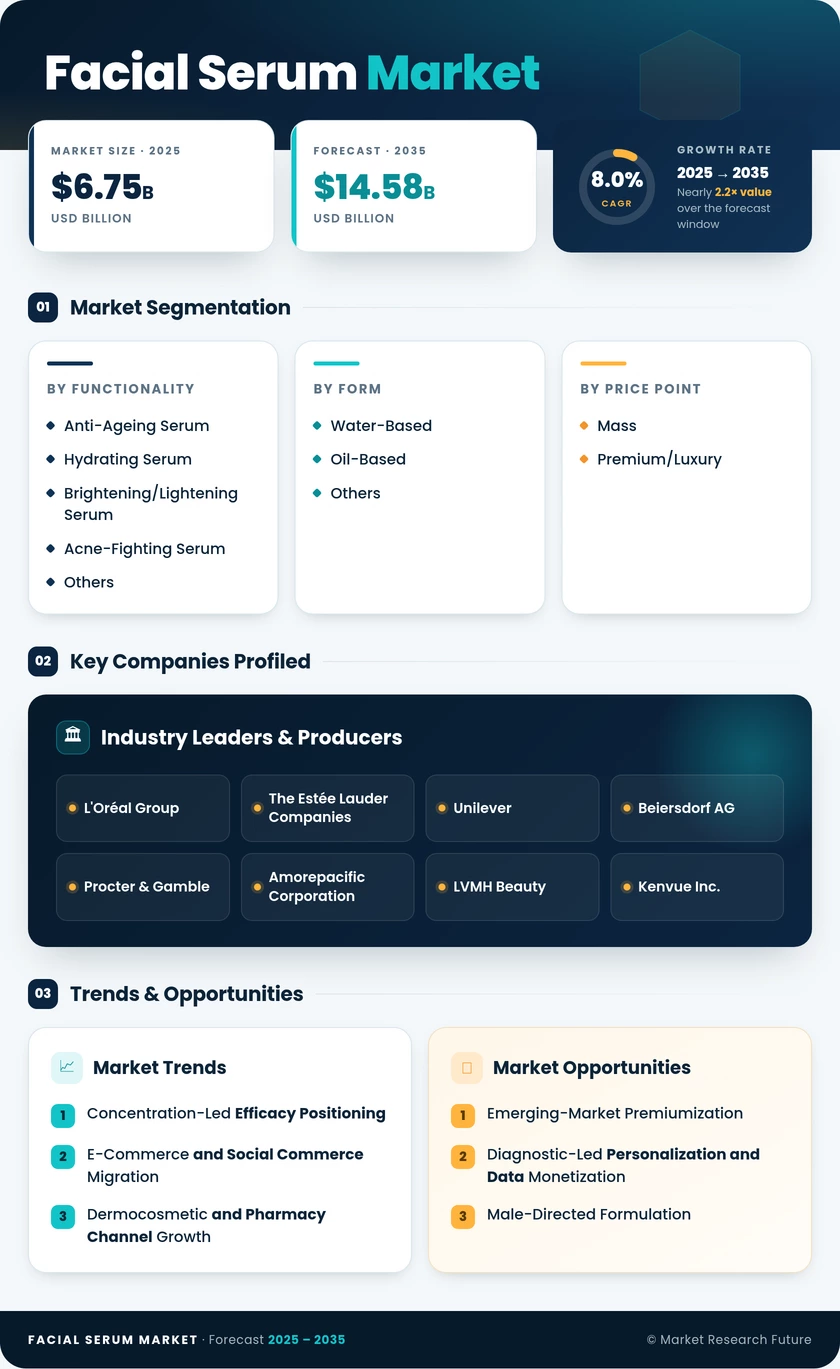
Facial Serum Market (2026 - 2035)

Facial Serum Market Size, Share, Industry Trend & Analysis Research Report Information By Functionality (Hydrating Serum, Anti-Ageing Serum, Brightening/Lightening Serum, Acne-Fighting Serum, Others), By Form (Oil-Based, Water-Based, Others), By Price Point (Mass, Premium/Luxury), By Distribution Channel (Hypermarkets/Supermarkets, Health and Beauty Stores, Online Retail Stores, Others), By Geography (North America, Europe, Asia-Pacific, South America, Middle East & Africa) – Forecast Till 2035

Forecast Period
2026-2035
CAGR
8.0%
2025 Market Size
USD 6.75 Billion
2035 Market Size
USD 14.58 Billion
Consumer and Retail ● Updated August 2026 Report ID: MRFR/CG/20325-HCR | Pages: 128 | Author: Sakshi Gupta
  1. 1 Market Summary |
    1. 1.1 Study Assumptions & Market Definition |
    2. 1.2 Scope of the Study |
    3. 1.3 Research Methodology
  2. 2 Key Report Takeaways |
    1. 2.1 By Functionality |
    2. 2.2 By Form and Price Point |
    3. 2.3 By Geography
  3. 3 Market Size & Forecast (2021–2035) |
    1. 3.1 Historical Market Size (2021–2024) |
    2. 3.2 Base Year Assessment (2025) |
    3. 3.3 Forecast Market Size (2026–2035) |
    4. 3.4 Year-over-Year Growth Analysis
  4. 4 Driver Impact Analysis |
    1. 4.1 Concentration-Led Efficacy Positioning |
    2. 4.2 E-Commerce and Social Commerce Migration |
    3. 4.3 Dermocosmetic and Pharmacy Channel Growth |
    4. 4.4 Regulatory Clarity Post-MoCRA
  5. 5 Restraints Impact Analysis |
    1. 5.1 Active Ingredient Cost Volatility |
    2. 5.2 Claim Substantiation Scrutiny |
    3. 5.3 Category Saturation
  6. 6 Opportunity Analysis |
    1. 6.1 Emerging-Market Premiumization |
    2. 6.2 Diagnostic-Led Personalization and Data Monetization |
    3. 6.3 Male-Directed Formulation |
    4. 6.4 Refill and Concentrate Architecture |
    5. 6.5 Clinical Channel Crossover
  7. 7 Regional Market Share & Country-Level Analysis |
    1. 7.1 North America | |
      1. 7.1.1 US | |
      2. 7.1.2 Canada | |
      3. 7.1.3 Mexico |
    2. 7.2 Europe | |
      1. 7.2.1 Germany | |
      2. 7.2.2 UK | |
      3. 7.2.3 France | |
      4. 7.2.4 Italy | |
      5. 7.2.5 Spain | |
      6. 7.2.6 Nordic Countries | |
      7. 7.2.7 Russia | |
      8. 7.2.8 Rest of Europe |
    3. 7.3 Asia-Pacific | |
      1. 7.3.1 China | |
      2. 7.3.2 India | |
      3. 7.3.3 Japan | |
      4. 7.3.4 South Korea | |
      5. 7.3.5 ASEAN | |
      6. 7.3.6 Rest of Asia-Pacific |
    4. 7.4 South America | |
      1. 7.4.1 Brazil | |
      2. 7.4.2 Argentina | |
      3. 7.4.3 Rest of South America |
    5. 7.5 Middle East & Africa | |
      1. 7.5.1 Saudi Arabia | |
      2. 7.5.2 UAE | |
      3. 7.5.3 South Africa | |
      4. 7.5.4 Egypt | |
      5. 7.5.5 Rest of Middle East & Africa
  8. 8 Future Outlook (2026–2035) |
    1. 8.1 Algorithmic Formulation and Diagnostic Personalization |
    2. 8.2 Channel Economics and the Subscription Turn |
    3. 8.3 Ingredient Supply Chain Localization |
    4. 8.4 Sustainability Disclosure and Packaging Reform
  9. 9 Market Segmentation Analysis |
    1. 9.1 By Functionality | |
      1. 9.1.1 Hydrating Serum | |
      2. 9.1.2 Anti-Ageing Serum | |
      3. 9.1.3 Brightening/Lightening Serum | |
      4. 9.1.4 Acne-Fighting Serum | |
      5. 9.1.5 Others |
    2. 9.2 By Form | |
      1. 9.2.1 Oil-Based | |
      2. 9.2.2 Water-Based | |
      3. 9.2.3 Others |
    3. 9.3 By Price Point | |
      1. 9.3.1 Mass | |
      2. 9.3.2 Premium/Luxury |
    4. 9.4 By Distribution Channel | |
      1. 9.4.1 Hypermarkets/Supermarkets | |
      2. 9.4.2 Health and Beauty Stores | |
      3. 9.4.3 Online Retail Stores | |
      4. 9.4.4 Others
  10. 10 Competitive Landscape |
    1. 10.1 Market Concentration Analysis |
    2. 10.2 Competitive Benchmarking Matrix |
    3. 10.3 Company Profiles | |
      1. 10.3.1 L'Oréal Group | |
      2. 10.3.2 The Estée Lauder Companies | |
      3. 10.3.3 Unilever | |
      4. 10.3.4 Beiersdorf AG | |
      5. 10.3.5 Shiseido Company | |
      6. 10.3.6 Procter & Gamble | |
      7. 10.3.7 Amorepacific Corporation | |
      8. 10.3.8 LVMH Beauty | |
      9. 10.3.9 Kenvue Inc. | |
      10. 10.3.10 Natura &Co | |
      11. 10.3.11 Clarins Group | |
      12. 10.3.12 Coty Inc.
  11. 11 Recent News & Developments
  12. 12 Report Scope & Methodology |
    1. 12.1 Study Period & Base Year |
    2. 12.2 Data Sources & Triangulation |
    3. 12.3 Abbreviations
  13. 13 Detailed Sources & Citations
  14. 14 Frequently Asked Questions
  15. 15 LIST OF TABLES
  16. 16 LIST OF FIGURES
Share::
Request Free Sample

Segmentation Quick Reference

DimensionSub-SegmentsDominant SegmentFastest Growing Segment
By FunctionalityHydrating Serum, Anti-Ageing Serum, Brightening/Lightening Serum, Acne-Fighting Serum, OthersAnti-Ageing SerumAcne-Fighting Serum
By FormOil-Based, Water-Based, OthersWater-BasedOil-Based
By Price PointMass, Premium/LuxuryMassPremium/Luxury
By Distribution ChannelHypermarkets/Supermarkets, Health and Beauty Stores, Online Retail Stores, OthersHealth and Beauty StoresOnline Retail Stores
By GeographyNorth America, Europe, Asia-Pacific, South America, Middle East & AfricaAsia-PacificMiddle East & Africa


Market Segmentation Overview

By Functionality

Sub-SegmentKey Trend
Hydrating SerumMulti-molecular-weight humectant blends replacing single-ingredient claims
Anti-Ageing SerumEncapsulated retinoid systems reducing irritation while raising tolerated dosage
Brightening/Lightening SerumMigration away from restricted agents toward tranexamic and azelaic derivatives
Acne-Fighting SerumDermatologist-endorsed mass brands compressing the price of clinical positioning
OthersScalp, neck and eye-adjacent serums extending the format beyond the face


Functionality remains the primary purchase filter for shoppers, and it dictates shelf architecture in both pharmacy and specialty beauty. Anti-ageing anchors profitability; acne-fighting drives incremental unit growth from younger cohorts.

By Form

Sub-SegmentKey Trend
Oil-BasedBarrier-support narratives and facial-oil crossover lifting acceptance in humid markets
Water-BasedLayering compatibility and lightweight finish sustaining mass-market dominance
OthersBiphasic and gel-cream hybrids blurring the serum-moisturizer boundary


Form preference tracks climate and routine complexity more than income. Water-based systems dominate where multi-step layering is habitual, while oil-based formats grow fastest in drier and cooler geographies.

By Price Point

Sub-SegmentKey Trend
MassValue-active brands delivering credible concentrations below the USD 20 threshold
Premium/LuxuryRitual, packaging and diagnostic services justifying triple-digit price points


Price architecture is polarizing. Mid-tier propositions are losing share to both ends of the ladder as shoppers either optimize for cost-per-active or trade up for experience.

By Distribution Channel

Sub-SegmentKey Trend
Hypermarkets/SupermarketsBasket attachment strategies pairing serums with cleansers and sunscreen
Health and Beauty StoresAdvisory selling and sampling driving conversion on higher-ticket items
Online Retail StoresSocial commerce, subscription replenishment and creator-led discovery
OthersClinics, salons and direct-selling networks reaching underserved catchments


Channel mix is the sharpest regional differentiator. Advisory retail retains share where sampling matters, while online continues to compound fastest across every geography tracked in this study.




Share::
Request Free Sample
Download PDF ×

We do not share your information with anyone. However, we may send you emails based on your report interest from time to time. You may contact us at any time to opt-out.