×
Request Free Sample ×

Kindly complete the form below to receive a free sample of this Report

* Please use a valid business email

Leading companies partner with us for data-driven Insights

clients tt-cursor
Hero Background

Fast Charge Lithium Ion Battery Market

ID: MRFR/EnP/17703-HCR
128 Pages
Priya Nagrale
October 2025

Fast Charge Lithium Ion Battery Market Research Report Information By Type (2C-Rate, 3C-Rate, 4C-Rate, and 6C-Rate), By Application (Automobile, Energy Storage, and Other) And By Region (North America, Europe, Asia-Pacific, And Rest Of The World) –Market Forecast Till 2035

Share:
Download PDF ×

We do not share your information with anyone. However, we may send you emails based on your report interest from time to time. You may contact us at any time to opt-out.

Fast Charge Lithium Ion Battery Market Infographic
Purchase Options

Fast Charge Lithium Ion Battery Market Summary

As per MRFR analysis, the Fast Charge Lithium Ion Battery Market Size was estimated at 17.25 USD Billion in 2024. The Fast Charge Lithium Ion Battery industry is projected to grow from 18.98 USD Billion in 2025 to 49.42 USD Billion by 2035, exhibiting a compound annual growth rate (CAGR) of 10.04 during the forecast period 2025 - 2035.

Key Market Trends & Highlights

The Fast Charge Lithium Ion Battery Market is poised for substantial growth driven by technological advancements and increasing demand across various sectors.

  • Technological advancements in battery chemistry are enhancing the efficiency and speed of fast charging solutions.
  • North America remains the largest market, while the Asia-Pacific region is experiencing the fastest growth in fast charge lithium ion batteries.
  • The consumer electronics segment continues to dominate, whereas the electric vehicle segment is rapidly expanding due to rising adoption rates.
  • Key market drivers include the rising demand for electric vehicles and increased consumer awareness regarding fast charging capabilities.

Market Size & Forecast

2024 Market Size 17.25 (USD Billion)
2035 Market Size 49.42 (USD Billion)
CAGR (2025 - 2035) 10.04%

Major Players

Tesla (US), Panasonic (JP), LG Energy Solution (KR), Samsung SDI (KR), CATL (CN), BYD (CN), A123 Systems (US), SK Innovation (KR), Northvolt (SE)

Fast Charge Lithium Ion Battery Market Trends

The Fast Charge Lithium Ion Battery Market is currently experiencing a notable transformation, driven by advancements in technology and increasing demand for efficient energy storage solutions. As electric vehicles gain traction and portable electronic devices proliferate, the need for rapid charging capabilities has become paramount. This market appears to be characterized by a growing emphasis on enhancing battery performance, safety, and longevity, which are critical factors for consumer acceptance and widespread adoption. Manufacturers are investing in research and development to create batteries that not only charge quickly but also maintain their efficiency over time, thereby addressing concerns related to battery degradation. Moreover, the competitive landscape of the Fast Charge Lithium Ion Battery Market is evolving, with numerous players striving to differentiate their offerings through innovative designs and sustainable practices. Collaborations between technology firms and automotive manufacturers seem to be on the rise, as they seek to integrate advanced battery technologies into their products. This trend indicates a shift towards more environmentally friendly solutions, as stakeholders recognize the importance of sustainability in the energy sector. Overall, the Fast Charge Lithium Ion Battery Market is poised for growth, with potential opportunities emerging from the intersection of technological innovation and consumer demand for faster, more reliable energy storage options.

Technological Advancements in Battery Chemistry

Recent innovations in battery chemistry are likely to enhance the performance of fast charge lithium ion batteries. Research into new materials and formulations may lead to batteries that charge more rapidly while maintaining safety and longevity. This trend suggests a continuous evolution in battery technology, which could redefine energy storage capabilities.

Integration with Renewable Energy Sources

The Fast Charge Lithium Ion Battery Market appears to be increasingly aligned with the integration of renewable energy sources. As solar and wind energy become more prevalent, the demand for efficient energy storage solutions is likely to rise. This trend indicates a growing synergy between fast charging technologies and sustainable energy practices.

Expansion in Electric Vehicle Applications

The expansion of electric vehicles is a significant driver for the Fast Charge Lithium Ion Battery Market. As more consumers opt for electric transportation, the need for rapid charging solutions is becoming more pronounced. This trend suggests that advancements in battery technology will play a crucial role in the future of mobility.

Fast Charge Lithium Ion Battery Market Drivers

Government Initiatives and Policies

Government initiatives aimed at promoting clean energy and sustainable technologies are pivotal for the Global Fast Charge Lithium Ion Battery Market Industry. Various countries are implementing policies that encourage the development and adoption of fast-charging battery technologies. These initiatives often include funding for research, tax incentives for manufacturers, and regulations that promote the use of electric vehicles. Such supportive measures are likely to create a conducive environment for market growth, as stakeholders align their strategies with governmental objectives. The anticipated market value of 75 USD Billion by 2035 underscores the potential impact of these initiatives.

Rising Demand for Electric Vehicles

The increasing adoption of electric vehicles (EVs) is a primary driver for the Global Fast Charge Lithium Ion Battery Market Industry. As governments worldwide implement stricter emissions regulations and provide incentives for EV purchases, the demand for fast-charging batteries is expected to surge. In 2024, the market is projected to reach 25 USD Billion, reflecting the growing consumer preference for EVs that require efficient charging solutions. This trend is likely to continue, with the market anticipated to expand significantly as more manufacturers invest in fast-charging technologies to meet consumer expectations.

Growing Renewable Energy Integration

The integration of renewable energy sources into the grid is driving the Global Fast Charge Lithium Ion Battery Market Industry. As solar and wind energy become more prevalent, the need for efficient energy storage solutions is paramount. Fast charge lithium-ion batteries play a crucial role in storing excess energy generated during peak production times, enabling a more stable energy supply. This trend is expected to bolster market growth, as energy storage systems become increasingly essential for balancing supply and demand. The market's expansion is anticipated to align with the broader shift towards sustainable energy practices.

Consumer Electronics Market Expansion

The rapid growth of the consumer electronics sector is significantly influencing the Global Fast Charge Lithium Ion Battery Market Industry. With the proliferation of smartphones, tablets, and wearable devices, the demand for batteries that support quick charging capabilities is on the rise. Manufacturers are increasingly prioritizing fast-charging technology to enhance user experience and meet consumer expectations. This trend is expected to contribute to the market's growth, as the consumer electronics industry continues to expand. The synergy between fast charge batteries and consumer electronics is likely to create new opportunities for innovation and market penetration.

Technological Advancements in Battery Chemistry

Innovations in battery chemistry are propelling the Global Fast Charge Lithium Ion Battery Market Industry forward. Research and development efforts are focusing on enhancing energy density, reducing charging times, and improving overall battery lifespan. For instance, advancements in solid-state batteries and lithium-silicon anodes may lead to faster charging capabilities and increased safety. These technological breakthroughs not only enhance performance but also attract investments, contributing to the market's growth. As a result, the industry is likely to witness a compound annual growth rate (CAGR) of 10.5% from 2025 to 2035, indicating a robust future.
Market Segment Insights

By Application: Consumer Electronics (Largest) vs. Electric Vehicles (Fastest-Growing)

In the Fast Charge Lithium Ion Battery Market, the application sectors demonstrate diverse market share distributions. Consumer Electronics hold a significant portion of the market, primarily driven by the ubiquity of smartphones, laptops, and other portable devices that require efficient battery solutions. Meanwhile, Electric Vehicles, though currently a smaller segment, are rapidly gaining traction in terms of market share due to an increasing consumer shift towards sustainable transportation options.

Electric Vehicles: Dominant vs. Energy Storage Systems: Emerging

Electric Vehicles have emerged as a dominant force in the Fast Charge Lithium Ion Battery Market, characterized by their requirement for high-capacity, long-lasting battery solutions that can withstand frequent charging cycles. This segment is supported by government incentives and a growing consumer demand for electric vehicles as an eco-friendly alternative. In contrast, Energy Storage Systems represent an emerging segment, poised for growth due to advancements in renewable energy technologies and the increasing need for efficient energy management systems, particularly in residential and commercial applications. Both segments contribute significantly to advancing battery technology, aiming at enhanced performance and sustainability.

By End Use: Automotive (Largest) vs. Aerospace (Fastest-Growing)

The Fast Charge Lithium Ion Battery Market showcases a diverse distribution across various end-use segments. The automotive sector leads the market, driven by the rising demand for electric vehicles (EVs) and the need for quick charging solutions to enhance vehicle performance. The telecommunications segment also holds a significant market share due to the increasing reliance on mobile devices and infrastructure upgrades to accommodate 5G technology. However, as the market evolves, emerging sectors such as aerospace and renewable energy are gaining traction and reshaping market dynamics. In recent years, growth trends within the Fast Charge Lithium Ion Battery Market have been primarily influenced by advancements in battery technology and increasing consumer awareness of sustainability. The aerospace sector, with its push for more efficient energy sources in aircraft, is emerging as the fastest-growing segment, while the consumer goods sector, including electronics, is also adapting to new charging solutions. As industries strive for efficiency and environmental responsibility, the demand for fast-charging batteries is expected to soar, creating new opportunities for innovation in various end-use applications.

Automotive: EV (Dominant) vs. Telecommunications (Emerging)

In the Fast Charge Lithium Ion Battery Market, the automotive sector, particularly electric vehicles (EVs), represents a dominant force due to substantial investments in electric mobility and the growing consumer preference for sustainable transportation. EVs require high-performance batteries capable of delivering rapid charge times, which aligns with the capabilities of fast charge lithium-ion technology. In contrast, the telecommunications sector is an emerging player, leveraging fast-charging solutions to meet the escalating demands for power efficiency in mobile networks and devices. As the 5G rollout continues to expand, the need for reliable battery solutions in telecom infrastructure is becoming increasingly pertinent. Both sectors, while distinct, are pushing the envelope of battery technology, presenting unique challenges and opportunities for manufacturers.

By Battery Type: Lithium Nickel Manganese Cobalt Oxide (Largest) vs. Lithium Iron Phosphate (Fastest-Growing)

In the Fast Charge Lithium Ion Battery Market, Lithium Nickel Manganese Cobalt Oxide (NMC) stands as the largest segment, gaining traction due to its efficient energy density and robust performance. Following closely is Lithium Iron Phosphate (LFP), which has emerged as a crucial alternative, especially in applications requiring safety and longevity. Other notable segments like Lithium Cobalt Oxide (LCO), Lithium Polymer (Li-Po), and Lithium Titanate also contribute to the overall landscape but are largely overshadowed by the dominance of NMC and LFP. As the market evolves, the growth of Lithium Iron Phosphate can be attributed to its increasing adoption in electric vehicles and renewable energy storage solutions. NMC continues to benefit from advancements in technology that enhance its performance, making it favorable for high-drain applications. The push for sustainable and efficient battery solutions is fostering a competitive environment, promoting innovation and new entrants into the market, ensuring that different battery types cater to diverse consumer needs.

Battery Technology: NMC (Dominant) vs. LFP (Emerging)

Lithium Nickel Manganese Cobalt Oxide (NMC) is recognized as the dominant technology in the Fast Charge Lithium Ion Battery Market, offering superior energy density and thermal stability, making it a preferred choice for high-performance applications like electric vehicles and portable electronics. By contrast, Lithium Iron Phosphate (LFP) has emerged as an attractive alternative, particularly favored for its thermal stability, safety, and lower costs, making it suitable for large-scale energy storage and electric vehicles. The distinct characteristics of NMC, such as its ability to handle high charge and discharge rates, paired with LFP's emphasis on safety and longevity, illustrate the varied landscape of battery technologies, driven by differing consumer demands and market dynamics.

By Charging Technology: Fast Charging (Largest) vs. Ultra-Fast Charging (Fastest-Growing)

In the Fast Charge Lithium Ion Battery Market, Fast Charging is the largest segment, dominating the market due to its widespread adoption in consumer electronics and electric vehicles (EVs). This technology significantly reduces the time needed to charge batteries, making it a preferred choice among users. Ultra-Fast Charging is emerging rapidly, driven by growing demand for faster charging solutions and advancements in battery technology. The competition among manufacturers to deliver quicker charging options is further enhancing its market presence.

Charging Technology: Fast Charging (Dominant) vs. Ultra-Fast Charging (Emerging)

Fast Charging has established itself as the dominant technology in the Fast Charge Lithium Ion Battery Market due to its ability to deliver a substantial amount of power in a short timeframe. It caters to the needs of a wide range of applications including smartphones, laptops, and electric vehicles, combining convenience with efficiency. On the other hand, Ultra-Fast Charging represents an emerging technology that is gaining traction, particularly in the EV sector. With advancements in charging infrastructure and battery design, Ultra-Fast Charging aims to reduce charge times to mere minutes, making it increasingly attractive to consumers. This growing trend highlights the industry's commitment to enhancing user experience and addressing the challenges of charging times.

By Form Factor: Cylindrical (Largest) vs. Prismatic (Fastest-Growing)

In the Fast Charge Lithium Ion Battery Market, the prismatic segment has established itself as the largest share, driven by its efficient design and versatility in various applications. Cylindrical batteries, however, are emerging as the fastest-growing segment, favored for their energy density and compactness. The growing demand for electric vehicles and consumer electronics is fueling competition among these form factors, each catering to different consumer needs and technological advancements. Both prismatic and cylindrical batteries are experiencing significant growth as the market evolves. The demand for lighter and more efficient batteries is boosting the prismatic design, which excels in maximizing space. On the other hand, cylindrical batteries are rapidly gaining traction in electric vehicles due to their high thermal stability and charge rates, providing a balanced solution in fast charging technologies.

Cylindrical (Dominant) vs. Pouch (Emerging)

Cylindrical batteries are currently the dominant form factor in the Fast Charge Lithium Ion Battery Market, known for their robust construction and impressive energy capacity. Their cylindrical shape allows for efficient heat dissipation and high-performance output, making them ideal for high-power applications and electric vehicles. Conversely, pouch batteries are an emerging segment, gaining attention for their lightweight and thin profile that offers versatile design options. Pouch batteries are suitable for applications that prioritize space and weight, such as portable devices and wearables. While cylindrical batteries continue to lead the market, pouch batteries are rapidly evolving with technological innovations, catering to a growing segment of consumers looking for lightweight, high-density power solutions.

Get more detailed insights about Fast Charge Lithium Ion Battery Market

Regional Insights

North America : Innovation and Sustainability Focus

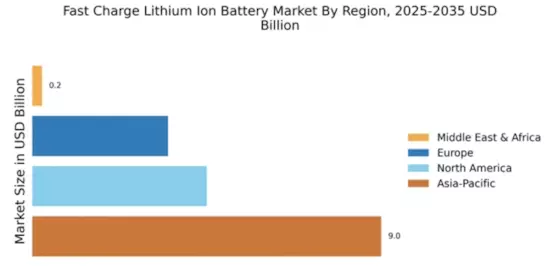
The North American fast charge lithium ion battery market is projected to reach $4.5 billion by December 2025, driven by increasing demand for electric vehicles (EVs) and renewable energy storage solutions. Regulatory support, such as tax incentives for EV purchases and investments in clean energy infrastructure, is catalyzing market growth. The region's focus on sustainability and innovation is further enhancing the adoption of advanced battery technologies. Leading countries like the US and Canada are at the forefront of this market, with key players such as Tesla and A123 Systems driving innovation. The competitive landscape is characterized by significant investments in R&D and partnerships aimed at enhancing battery performance and reducing costs. As the market evolves, the presence of established manufacturers and emerging startups will shape the future of fast charge battery technology.

Europe : Regulatory Support and Innovation

Europe's fast charge lithium ion battery market is expected to reach $3.5 billion by December 2025, fueled by stringent environmental regulations and a strong push for electric mobility. The European Union's Green Deal and initiatives to reduce carbon emissions are key drivers of this market. The region's commitment to sustainability is leading to increased investments in battery technology and infrastructure, enhancing market growth. Countries like Germany, France, and Sweden are leading the charge, with major players such as Northvolt and LG Energy Solution establishing a strong presence. The competitive landscape is marked by collaborations between automotive manufacturers and battery producers, aiming to innovate and meet the growing demand for efficient energy storage solutions. This synergy is crucial for achieving Europe's ambitious climate goals.

Asia-Pacific : Dominance in Battery Production

The Asia-Pacific region dominates the fast charge lithium ion battery market, projected to reach $9 billion by December 2025. This growth is driven by the rapid adoption of electric vehicles and the increasing demand for energy storage solutions across various sectors. Government initiatives promoting clean energy and technological advancements are significant catalysts for market expansion, contributing to the region's substantial market share. China, Japan, and South Korea are the leading countries in this market, with key players like CATL, Panasonic, and Samsung SDI driving innovation and production capacity. The competitive landscape is characterized by aggressive investments in R&D and strategic partnerships aimed at enhancing battery efficiency and reducing costs. As the region continues to lead in battery technology, it plays a crucial role in shaping global market trends.

Middle East and Africa : Emerging Market Potential

The Middle East and Africa (MEA) fast charge lithium ion battery market is projected to reach $0.25 billion by December 2025, reflecting emerging opportunities in renewable energy and electric mobility. The region's growth is supported by increasing investments in infrastructure and government initiatives aimed at promoting sustainable energy solutions. As countries seek to diversify their energy sources, the demand for advanced battery technologies is expected to rise. Leading countries in this region include South Africa and the UAE, where initiatives to enhance energy storage capabilities are gaining traction. The competitive landscape is still developing, with a mix of local and international players entering the market. As the region focuses on sustainability and innovation, the fast charge battery market is poised for gradual growth, driven by evolving consumer preferences and regulatory support.

Key Players and Competitive Insights

The Fast Charge Lithium Ion Battery Market is currently characterized by intense competition and rapid innovation, driven by the increasing demand for electric vehicles (EVs) and renewable energy storage solutions. Key players such as Tesla (US), Panasonic (JP), and CATL (CN) are strategically positioned to leverage their technological advancements and manufacturing capabilities. Tesla (US) continues to focus on vertical integration, enhancing its battery production through the Gigafactory model, which allows for significant cost reductions and efficiency improvements. Meanwhile, Panasonic (JP) emphasizes partnerships with automotive manufacturers to expand its market reach, particularly in the EV sector, while CATL (CN) is rapidly scaling its production capacity to meet global demand, indicating a collective push towards innovation and operational excellence among these leaders.

The market structure appears moderately fragmented, with a mix of established players and emerging companies vying for market share. Key tactics such as localizing manufacturing and optimizing supply chains are prevalent, as companies seek to mitigate risks and enhance responsiveness to market fluctuations. This competitive landscape is shaped by the collective influence of major players, who are increasingly adopting strategies that prioritize sustainability and technological advancement.

In November 2025, Tesla (US) announced a groundbreaking partnership with a leading renewable energy firm to develop a new battery technology that promises to reduce charging times by 50%. This strategic move not only reinforces Tesla's commitment to innovation but also positions the company to capture a larger share of the growing EV market, where fast charging capabilities are becoming a critical differentiator.

In October 2025, Panasonic (JP) unveiled its latest battery cell technology, which reportedly increases energy density by 20% compared to previous models. This advancement is crucial for enhancing the performance of EVs and could potentially lead to longer driving ranges, thereby addressing one of the primary consumer concerns regarding electric vehicles. Such innovations are likely to strengthen Panasonic's competitive edge in the market.

In September 2025, CATL (CN) expanded its production facility in Germany, aiming to double its output of fast charge lithium-ion batteries. This expansion is indicative of CATL's strategy to solidify its presence in the European market, which is experiencing a surge in demand for high-performance batteries. By increasing production capacity, CATL is well-positioned to meet the needs of European automakers and further establish itself as a global leader in battery technology.

As of December 2025, the competitive trends in the Fast Charge Lithium Ion Battery Market are increasingly defined by digitalization, sustainability, and the integration of artificial intelligence (AI) in manufacturing processes. Strategic alliances among key players are shaping the landscape, fostering innovation and enhancing supply chain reliability. The shift from price-based competition to a focus on technological differentiation and sustainable practices is evident, suggesting that future competitive advantages will hinge on the ability to innovate and adapt to evolving market demands.

Key Companies in the Fast Charge Lithium Ion Battery Market market include

Industry Developments

March 2023: Samsung SDI will be presenting BMW i7 and Volvo FM Electric vehicles at InterBattery 2023 in addition to showcasing its unique battery technology, which includes all-solid-state batteries and high-efficiency fast charging. The company wants to communicate its technological prowess and dedication to a sustainable battery sector future. Along with showcasing Samsung SDI's currently developing solid-state battery pilot line, the booth will showcase a variety of battery applications.

February 2022: The Energy Company of Panasonic Corporation has announced that it will set up a production facility at its Wakayama Factory in western Japan to produce new, huge 4680 cylindrical lithium-ion batteries for electric vehicles (EVs), measuring 46 millimeters wide by 80 millimeters tall.

Future Outlook

Fast Charge Lithium Ion Battery Market Future Outlook

The Fast Charge Lithium Ion Battery Market is projected to grow at a 10.04% CAGR from 2024 to 2035, driven by increasing demand for electric vehicles, renewable energy storage, and consumer electronics.

New opportunities lie in:

  • Development of ultra-fast charging infrastructure for urban areas.
  • Partnerships with automotive manufacturers for integrated battery solutions.
  • Expansion into emerging markets with tailored battery technologies.

By 2035, the market is expected to be robust, driven by innovation and strategic partnerships.

Market Segmentation

Fast Charge Lithium Ion Battery Market End Use Outlook

  • Automotive
  • Aerospace
  • Telecommunications
  • Renewable Energy
  • Consumer Goods

Fast Charge Lithium Ion Battery Market Application Outlook

  • Consumer Electronics
  • Electric Vehicles
  • Energy Storage Systems
  • Industrial Equipment
  • Medical Devices

Fast Charge Lithium Ion Battery Market Form Factor Outlook

  • Prismatic
  • Cylindrical
  • Pouch
  • Stacked
  • Modular

Fast Charge Lithium Ion Battery Market Battery Type Outlook

  • Lithium Nickel Manganese Cobalt Oxide
  • Lithium Iron Phosphate
  • Lithium Cobalt Oxide
  • Lithium Polymer
  • Lithium Titanate

Fast Charge Lithium Ion Battery Market Charging Technology Outlook

  • Standard Charging
  • Fast Charging
  • Ultra-Fast Charging
  • Wireless Charging
  • Smart Charging

Report Scope

MARKET SIZE 202417.25(USD Billion)
MARKET SIZE 202518.98(USD Billion)
MARKET SIZE 203549.42(USD Billion)
COMPOUND ANNUAL GROWTH RATE (CAGR)10.04% (2024 - 2035)
REPORT COVERAGERevenue Forecast, Competitive Landscape, Growth Factors, and Trends
BASE YEAR2024
Market Forecast Period2025 - 2035
Historical Data2019 - 2024
Market Forecast UnitsUSD Billion
Key Companies ProfiledTesla (US), Panasonic (JP), LG Energy Solution (KR), Samsung SDI (KR), CATL (CN), BYD (CN), A123 Systems (US), SK Innovation (KR), Northvolt (SE)
Segments CoveredApplication, End Use, Battery Type, Charging Technology, Form Factor
Key Market OpportunitiesGrowing demand for rapid charging solutions in electric vehicles drives innovation in the Fast Charge Lithium Ion Battery Market.
Key Market DynamicsRising demand for electric vehicles drives innovation and competition in the fast charge lithium ion battery market.
Countries CoveredNorth America, Europe, APAC, South America, MEA

Leave a Comment

FAQs

How much is the fast-charge lithium-ion battery market?

The global fast-charge lithium-ion battery market size was valued at Significant Value in 2022.

What is the growth rate of the fast-charge lithium-ion battery market?

The global market is projected to grow at a CAGR of 16.80% during the forecast period, 2025-2035.

Which region held the largest market share in the fast-charge lithium-ion battery market?

North America had the largest share of the global market

Who are the key players in the fast-charge lithium-ion battery market?

The key players in the market are CATL, Samsung SDI, CALB, Gotion High-tech, Tesla, BYD, LG Energy Solution, Panasonic, Guangzhou Greater, Bay Technology, SVOLT Energy Technology, Sunwoda Electronic, GAC Aian, EVE Energy., and others.

Which type led to the fast-charge lithium-ion battery market?

The 4C-rate category dominated the market in 2022.

Which application had the largest market share in the fast-charge lithium-ion battery market?

The automobile had the largest share of the global market.

Download Free Sample

Kindly complete the form below to receive a free sample of this Report

Compare Licence

×
Features License Type
Single User Multiuser License Enterprise User
Price $4,950 $5,950 $7,250
Maximum User Access Limit 1 User Upto 10 Users Unrestricted Access Throughout the Organization
Free Customization
Direct Access to Analyst
Deliverable Format
Platform Access
Discount on Next Purchase 10% 15% 15%
Printable Versions