Lithium-Ion Battery Market Summary
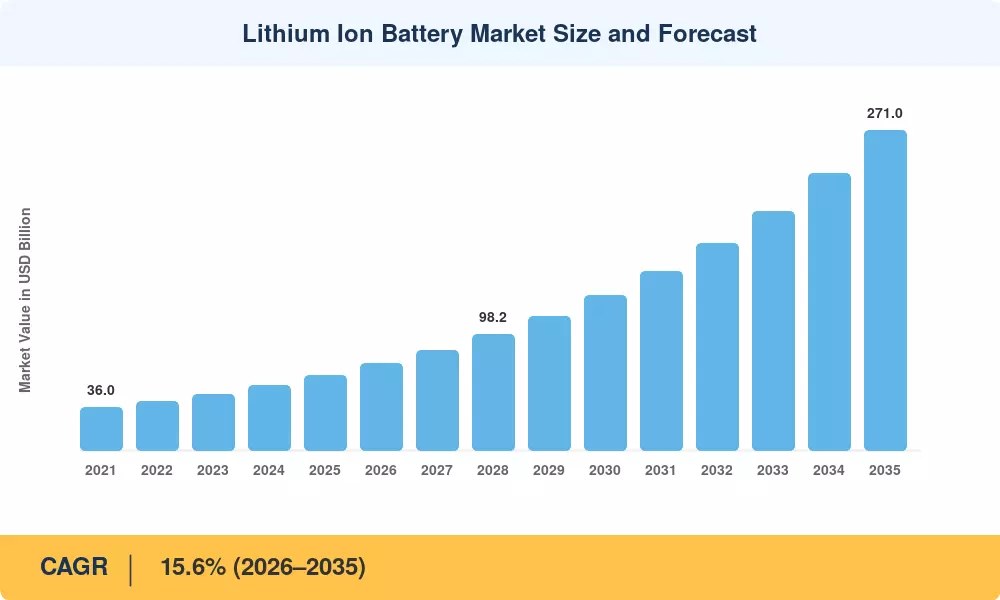
The Lithium-Ion Battery Market reached an estimated USD 63.5 billion in 2025 and is projected to grow from USD 73.5 billion in 2026 to USD 271.0 billion by 2035, registering a CAGR of 15.6% during the forecast period (2026–2035). Government mandates accelerating vehicle electrification — including the EU's 2035 combustion engine phase-out and the U.S. Inflation Reduction Act's USD 7,500 EV tax credit — have turned battery procurement into a strategic priority for automakers and grid operators alike [1][2]. The Lithium-Ion Battery Market sits at the intersection of transportation decarbonization, grid modernization, and portable electronics innovation, making it one of the most capital-intensive segments of the global energy transition.
A technology transformation is reshaping the industry. Legacy cylindrical NMC cells that dominated a decade ago are now competing with prismatic LFP architectures that eliminate cobalt dependency and cut pack-level costs below USD 100/kWh in leading Chinese facilities [3]. Concurrently, global investment in gigafactory capacity surpassed USD 150 billion between 2022 and 2025, with CATL, LG Energy Solution, and Panasonic each committing to multi-continent manufacturing footprints [4].
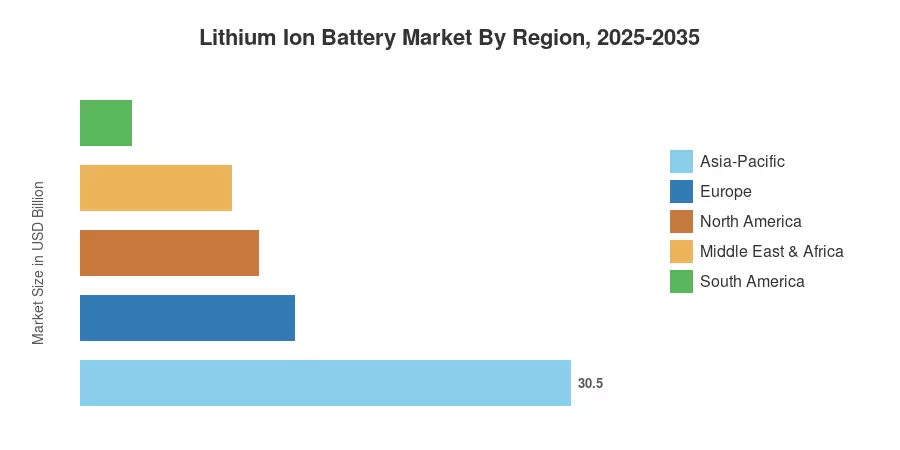
Asia-Pacific commands the dominant position in the Lithium-Ion Battery Market with approximately 48% revenue share in 2025, driven by China's integrated cell-to-pack supply chain. North America represents the fastest-growing corridor at an estimated 17.4% CAGR, fueled by IRA-linked domestic content incentives. Europe holds the second-largest share at roughly 21%, anchored by the EU Battery Regulation's sustainability passport requirements [5]. As raw material supply chains localize and recycling infrastructure scales, the Lithium-Ion Battery Market is entering its most competitive decade.
Key Report Takeaways
• By Product Type
- NMC chemistry held the largest technology share in the Lithium-Ion Battery Market at approximately 38% in 2025, sustained by high energy density requirements in premium EV platforms.
- LFP cells represent the fastest-growing chemistry segment at an estimated 18.3% CAGR (2026–2035), driven by cost advantages and improved cold-weather performance.
- LCO chemistry contributed roughly USD 8.9 billion in 2025, anchored by smartphone and laptop demand.
• By End-User
- The automotive/EV application segment accounted for approximately 52% of the Lithium-Ion Battery Market in 2025, reflecting accelerating fleet electrification.
- Energy storage systems registered the highest application CAGR at an estimated 19.1%, propelled by grid-scale deployment mandates.
• By Region
- Asia-Pacific generated the largest regional revenue at roughly USD 30.5 billion in 2025.
- North America's Lithium-Ion Battery Market is forecast to expand at an estimated 17.4% CAGR through 2035, led by U.S. gigafactory buildouts.
- Europe accounted for approximately 21% of global revenue, supported by the EU Battery Regulation.
Lithium-Ion Battery Market Size and Forecast (2021–2035)
Market sizing draws on a combination of cell manufacturer revenue disclosures, trade-flow databases, downstream OEM procurement filings, and verified third-party forecasts from BloombergNEF and. Historical figures (2021–2024) reflect actual shipment data, while forecast values (2026–2035) apply a compound annual growth rate calibrated against announced gigafactory capacity, policy-driven demand models, and raw material cost trajectories [6][7].






















.webp?v=1787579595)
