Feminine Hygiene Market

Key Players: Procter & Gamble (Always, Tampax), Kimberly-Clark (Kotex), Unicharm Corporation, Essity (Libresse/Bodyform), Johnson & Johnson (Stayfree, Carefree), Hengan International, Edgewell Personal Care (Playtex), Diva International (DivaCup)

Feminine Hygiene Market

Global Feminine Hygiene Market Size, Share, Industry Trend & Analysis Research Report: By Product Type (Sanitary Pads/Napkins, Tampons, Menstrual Cups, Period Panties, Other), By Product Category (Disposable Products, Reusable Products), By Nature (Conventional, Natural/Organic), By Distribution Channel (Supermarkets/Hypermarkets, Pharmacies/Drug Stores, Online Retail, Other), By Region (North America, Europe, Asia-Pacific, South America, Middle East & Africa) - Forecast to 2035
ID: MRFR/CG/6514-HCR
128 Pages
Kinjoll Dey
Last Updated: June 05, 2026
 

Feminine Hygiene Market Summary

The Feminine Hygiene Market was valued at USD 35.19 billion in 2025 and is projected to reach USD 36.58 billion in 2026 before climbing to USD 55.82 billion by 2035, registering a CAGR of 5.27% during the forecast period (2026–2035). Government-backed menstrual equity legislation — including Scotland's Period Products Act and similar mandates across 14 U.S. states — has transformed period care products from discretionary purchases into institutionally procured essentials, accelerating category-wide demand [2]. Parallel growth in e-commerce subscriptions and direct-to-consumer channels is reshaping how consumers access sanitary pads and tampons, compressing traditional retail cycles and lifting average order values.

A material shift is underway from conventional single-use disposables toward organic cotton feminine products and reusable alternatives such as menstrual cups and discs. Brands investing in plant-based absorbent cores, compostable packaging, and medical-grade silicone have captured consumer trust, with organic period care products growing at roughly twice the pace of their conventional counterparts [3]. The USDA BioPreferred Program and EU Single-Use Plastics Directive are supplying additional regulatory tailwinds that reward sustainable product design.

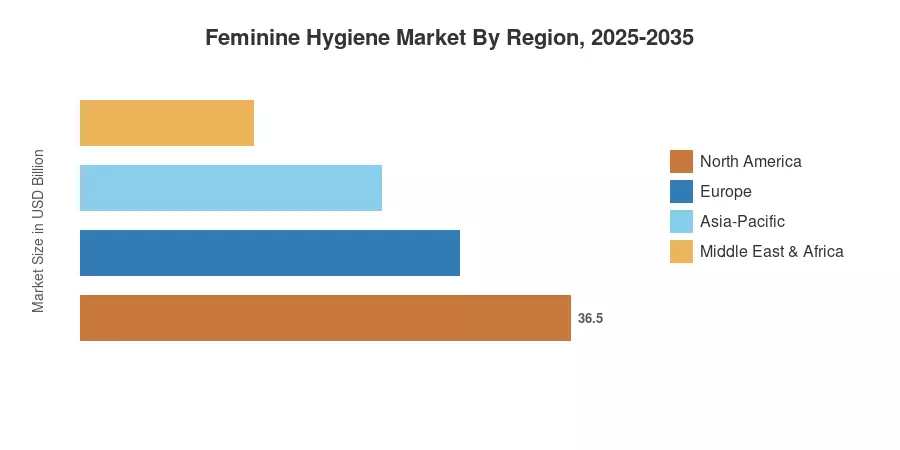
North America leads the Feminine Hygiene Market with approximately 33.8% of 2025 revenue, driven by high per-capita spending and strong retail infrastructure. Asia-Pacific delivers the fastest growth at a projected CAGR of 7.10%, fueled by rising disposable incomes and expanding menstrual hygiene management awareness campaigns across India, Indonesia, and the Philippines [4]. Europe holds the second-largest share at roughly 27%, buoyed by Nordic sustainability mandates and France's zero-VAT policy on period care products. As institutional procurement scales and digital distribution deepens, the Feminine Hygiene Market is set for sustained broadening through 2035.


Key Report Takeaways

• By Product Type

  • Sanitary pads and tampons together command over 68% of the Feminine Hygiene Market revenue, with pads alone accounting for a 42.7% share in 2025
  • Menstrual cups and discs are forecast to expand at a 7.65% CAGR through 2035, driven by eco-conscious consumers switching

• By Product Category

  • Disposable period care products captured 72.4% of the Feminine Hygiene Market in 2025, though reusable alternatives are closing the gap at a 7.98% CAGR


• By Nature

  • Disposable period care products captured 72.4% of the Feminine Hygiene Market in 2025, though reusable alternatives are closing the gap at a 7.98% CAGR
  • Natural and organic cotton feminine products are advancing at a 8.2% CAGR as clean-label preferences penetrate menstrual hygiene management

• By Distribution Channel

  • Pharmacy and drug stores held 35.4% channel share in 2025, while online retail posted the highest growth trajectory in the Feminine Hygiene Market

• By Region

  • North America contributed USD 11.89 billion in 2025
  • Asia-Pacific is projected to register a 7.10% CAGR through 2035, adding the largest incremental volume


Market Size and Forecast (2021–2035)

MRFR's sizing methodology triangulates top-down revenue estimates from manufacturer filings, distributor sell-through data, and bottom-up demand models benchmarked against national health statistics and retail panel datasets.
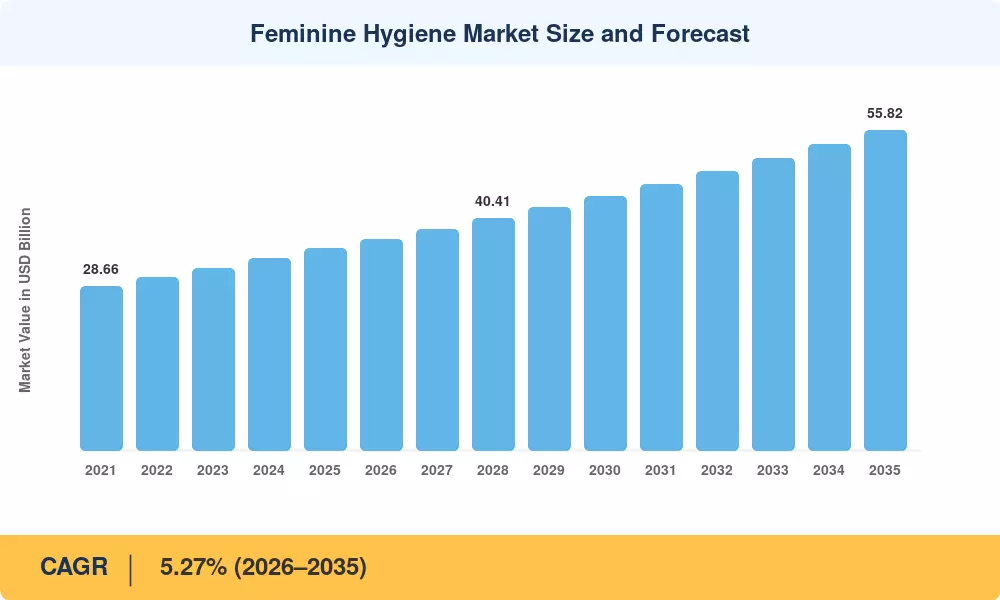
Feminine Hygiene Market Size and Forecast
Our Impact
Enabled $4.3B Revenue Impact for Fortune 500 and Leading Multinationals
Partnering with 2000+ Global Organizations Each Year
30K+ Citations by Top-Tier Firms in the Industry
 

Driver Impact Analysis

Driver ~% Impact on CAGR Geographic Relevance Impact Timeline
Menstrual equity legislation & institutional procurement ~18% North America, Europe Short-term (≤2 yr)
Rising e-commerce & subscription models ~16% Global Short-term (≤2 yr)
Organic & sustainable product innovation ~15% Europe, North America Medium-term (2–4 yr)
Expanding menstrual hygiene management awareness in emerging economies ~14% Asia-Pacific, Africa Long-term (≥4 yr)
Premiumization & wellness-oriented branding ~12% North America, Europe Medium-term (2–4 yr)
Retail pharmacy chain expansion in developing markets ~10% Asia-Pacific, South America Long-term (≥4 yr)
Period-tech integration (smart wearables, tracking apps) ~8% Global Long-term (≥4 yr)


Menstrual Equity Legislation and Institutional Procurement

Government mandates are redefining period care products as essential goods. Scotland's Period Products Act (2022) requires free provision in public buildings, while 14 U.S. states have eliminated sales tax on sanitary pads and tampons [2]. India's GST reduction on sanitary napkins from 12% to 0% added an estimated 45 million new consumers in 2018. These policies create recurring, budget-backed demand channels that insulate the Feminine Hygiene Market from consumer discretionary spending swings.

E-Commerce and Subscription Acceleration

Online retail's share of feminine hygiene sales grew from 11% in 2020 to approximately 22% by 2025, with subscription replenishment models accounting for nearly a third of digital revenue. Platforms like Amazon Subscribe & Save, and DTC brands such as Cora and Lola deliver period care products on predictable cadences. Discreet doorstep delivery and algorithm-driven restocking remove friction from menstrual hygiene management.


Expanding Access in Emerging Economies

According to UNICEF and WHO, 500 million women worldwide do not have proper menstrual hygiene management facilities [4]. Government efforts – India’s Rashtriya Kishor Swasthya Karyakram, Kenya’s free-pad school distribution scheme – are bridging the gap. The addressable consumer base for the Feminine Hygiene Market is growing at an estimated 60-80 million users per year across Asia-Pacific and Sub-Saharan Africa, as cultural stigma declines and local manufacture increases (Saathi in India, AFRIpads in Uganda).


Restraints Impact Analysis

Restraint impact percentages represent estimated drags on CAGR growth and are directional, not algebraically linked to the headline rate.

Restraint ~% Impact on CAGR Geographic Relevance Impact Timeline
Price sensitivity in low-income markets ~–20% Asia-Pacific, Africa Long-term (≥4 yr)
Cultural taboos and limited menstrual hygiene management education ~–18% South Asia, Sub-Saharan Africa Long-term (≥4 yr)
Raw material cost volatility (cotton, SAP, fluff pulp) ~–15% Global Medium-term (2–4 yr)
Regulatory fragmentation on product safety standards ~–12% Global Medium-term (2–4 yr)
Competition from unbranded/counterfeit products ~–10% Asia-Pacific, South America Short-term (≤2 yr)


Cultural Stigma and Education Deficits

Pervasive social taboos, inadequate school sanitation, and persistent education deficits continue to cause thousands of adolescent girls across low-income regions to skip classes during menstruation. Until comprehensive hygiene literacy and infrastructure improve significantly, localized consumer product trial rates will lag far behind regional supply capacity.

Raw Material Cost Volatility

Cotton spot prices jumped 38% between 2022 and 2024, while super-absorbent polymer costs grew 14% in the face of petrochemical constraints [13]. Manufacturers of organic cotton feminine goods are faced with an extra premium of 25–30% on certified raw inputs, putting pressure on margins and constraining how quickly brands may reduce shelf pricing for sanitary pads and tampons.


Feminine Hygiene Market Opportunities

Reusable and Long-Life Product Expansion

Menstrual cups and discs offer a cost-per-cycle savings of 60–80% over disposables after six months of use, positioning them as the fastest-growing sub-segment in the Feminine Hygiene Market Brands that pair cups with educational content and starter kits are reporting 50%+ first-year retention rates. Scaling direct-to-consumer distribution in Asia-Pacific could unlock USD 2–3 billion in incremental revenue by 2032.

Organic Certification as a Competitive Moat

The EU Ecodesign Regulation and USDA BioPreferred criteria are being tightened, and first movers in organic cotton feminine goods are able to build supply chain advantages that cannot easily be replicated by latecomers Vertical integration along organic supply chains from farm-level cotton to completed period care products can attract a 15-20% price premium and lock in consumer loyalty.


Emerging-Market Institutional Distribution

Government-to-school and government-to-community distribution channels for sanitary pads and tampons in India, Kenya, and Rwanda represent procurement pipelines worth an estimated USD 1.2 billion annually by 2030 Companies that secure institutional tenders build brand awareness at scale before these consumers transition to retail purchasing.

Period-Tech and Connected Health Integration

Smart menstrual cups with Bluetooth-enabled flow tracking and companion apps are creating a new data layer in menstrual hygiene management. These devices transform the Feminine Hygiene Market from a consumable category into a health-platform opportunity, enabling cross-sell into fertility tracking, telehealth, and wellness subscriptions

Subscription Commerce and Personalized Bundles

Curated monthly boxes combining sanitary pads and tampons with pain-relief supplements, organic cotton feminine products, and wellness items are lifting basket sizesabove standalone product orders. This model deepens consumer engagement and generates predictable recurring revenue for brands operating in the Feminine Hygiene Market.


Feminine Hygiene Market Future Outlook


Inclusive Design and Expanded Demographics

The Feminine Hygiene Market is expanding its target base as product development moves beyond traditional demographics to include transgender males, non-binary individuals, and postpartum consumers. Brands such as August and Aunt Flow have been at the forefront of inclusive branding and gender-neutral packaging for period care products, which represent a societal shift and open up new consumer cohorts.


Supply-Chain Localization and Emerging-Market Manufacturing

Manufacturers are moving production closer to high-growth demand centers. New sanitary pad operations in Vietnam, Bangladesh, and Ethiopia are cutting landed costs by 20-30% while providing local employment [11]. This localization trend secures the supply chain of the Feminine Hygiene Market against logistics interruptions and helps government goals of self-sufficiency in menstrual hygiene management.


Feminine Hygiene Market Segmentation

By Product Type

Segment Key Metric Primary Demand Driver
Sanitary Pads/Napkins 42.7% share (2025) Universal adoption; institutional procurement
Tampons USD 6.85 Billion (2025) Convenience and active-lifestyle preference
Menstrual Cups 7.65% CAGR (2026–2035) Cost savings and eco-conscious switching
Period Panties 6.92% CAGR (2026–2035) Comfort-driven innovation
Other Products USD 1.22 Billion (2025) Niche formats (discs, sponges, liners)


Sanitary pads and tampons remain the backbone of the Feminine Hygiene Market, together representing the vast majority of unit sales. Pads benefit from near-universal consumer familiarity and remain the default product distributed through government menstrual hygiene management programs. Tampons hold strong in North America and Western Europe, where active-lifestyle positioning and compact form factors sustain loyalty among younger consumers. Innovation in organic cotton feminine products within both categories — chlorine-free bleaching, plant-derived wrappers — is driving premiumization without sacrificing mass appeal.

Menstrual cups and discs are rewriting category economics. A single medical-grade silicone cup lasts up to ten years, delivering lifetime savings exceeding USD 1,200 compared to disposable sanitary pads and tampons [9]. Period panties occupy a fast-growing but still niche position in the Feminine Hygiene Market, appealing to consumers seeking leak-proof backup or standalone protection with the feel of regular underwear. As period care products diversify, the traditional disposable-dominated category structure is gradually shifting toward a multi-format landscape.

By Product Category

Segment Key Metric Primary Demand Driver
Disposable Products 72.4% share (2025) Convenience; mass retail availability
Reusable Products 7.98% CAGR (2026–2035) Sustainability and long-term cost savings


Disposable products dominate the Feminine Hygiene Market through sheer convenience and deeply embedded consumer habits. Reusable alternatives — including menstrual cups and discs, period panties, and cloth pads — are gaining share as environmental awareness intensifies. The reusable segment's 7.98% CAGR reflects a structural consumer pivot, supported by growing retail shelf space for organic cotton feminine products and dedicated reusable-product sections on major e-commerce platforms.

By Nature

Segment Key Metric Primary Demand Driver
Conventional USD 28.98 Billion (2025) Established supply chains; competitive pricing
Natural/Organic 8.20% CAGR (2026–2035) Clean-label demand; regulatory incentives


Conventional products retain volume leadership across the Feminine Hygiene Market, but organic cotton feminine products are the clear growth story. A 2024 consumer survey found that 38% of Gen Z consumers in the U.S. and EU consider ingredient transparency a top-three purchase criterion for period care products [3]. Brands certifying under GOTS (Global Organic Textile Standard) are converting this preference into shelf-space gains, particularly in pharmacy and natural-specialty channels.

By Distribution Channel

Segment Key Metric Primary Demand Driver
Supermarkets/Hypermarkets 27.8% share (2025) One-stop shopping convenience
Pharmacies/Drug Stores USD 12.46 Billion (2025) Trusted health-adjacent retail environment
Online Retail 7.35% CAGR (2026–2035) Subscription models; discreet delivery
Other Channels 12.5% share (2025) Convenience stores, vending, institutional


Pharmacy and drug stores remain the dominant distribution channel for sanitary pads and tampons, leveraging their health-credentialed positioning to influence purchase decisions. Online retail is the fastest-growing channel in the Feminine Hygiene Market, powered by subscription replenishment and personalized period care product bundles. Supermarkets compete on breadth and promotional pricing, while institutional channels — school vending, workplace restroom dispensers — represent an emerging route for menstrual hygiene management product placement.


Regional Market Share Analysis

Region Key Metric Primary Investment Themes
North America 33.8% share (2025) Menstrual equity laws; premium organic cotton feminine products
Europe 27.0% share (2025) Sustainability regulation; zero-VAT policies on period care products
Asia-Pacific 7.10% CAGR (2026–2035) Government access programs; rural distribution of sanitary pads and tampons
South America USD 2.46 Billion (2025) Expanding retail pharmacy networks; growing brand awareness
Middle East & Africa 5.85% CAGR (2026–2035) NGO-led menstrual hygiene management campaigns; local manufacturing
Total USD 35.19 Billion (2025)

The Feminine Hygiene Market spans five major regions, each shaped by distinct regulatory, cultural, and economic dynamics. North America and Europe together account for over 60% of 2025 revenue, while Asia-Pacific closes the gap with the fastest incremental growth driven by expanding menstrual hygiene management programs.


North America

Country Key Metric Key Driver
US 78.5% of regional revenue State-level menstrual equity mandates [2]
Canada 5.42% CAGR (2026–2035) Federal GST exemption on period care products
Mexico USD 1.08 Billion (2025) Expanding pharmacy chains in tier-2 cities


The U.S. dominates North America's Feminine Hygiene Market, accounting for over three-quarters of regional revenue. Fourteen states now exempt sanitary pads and tampons from sales tax, while campus vending programs in California and New York create sticky institutional demand [2]. Canadian consumers increasingly favor organic cotton feminine products, with natural-segment penetration exceeding 18% in 2025. Mexico's growth is anchored by Farmacias del Ahorro and Similares chains, extending feminine hygiene shelf sets into secondary urban centers.

Europe

Country Key Metric Key Driver
Germany 21.3% of regional revenue Retailer private-label organic investment [3]
UK 5.18% CAGR (2026–2035) NHS free-provision pilot for period care products
France USD 1.52 Billion (2025) Zero-VAT policy since 2015
Italy 4.72% CAGR (2026–2035) Growing e-commerce adoption for sanitary pads and tampons
Spain 8.4% of regional revenue Rising awareness of menstrual cups and discs
Nordic Countries 5.55% CAGR (2026–2035) Sustainability-first consumer behavior
Russia USD 0.89 Billion (2025) Local manufacturing replacing imports
Rest of Europe 14.2% of regional revenue Eastern European market development


Europe's Feminine Hygiene Market benefits from regulatory leadership in sustainability. The EU's Single-Use Plastics Directive is prompting brands to accelerate compostable packaging and reusable period care products [6]. Nordic retailers have mainstreamed menstrual cups and discs, achieving household penetration rates above 12%. Germany's discount retailers (dm, Rossmann) are expanding organic cotton feminine products under private labels, driving price competition that benefits consumers across the Feminine Hygiene Market.

Asia-Pacific

Country Key Metric Key Driver
China 31.8% of regional revenue E-commerce dominance; Tmall/JD distribution
India 8.35% CAGR (2026–2035) Government menstrual hygiene management subsidies [4]
Japan USD 1.74 Billion (2025) Ultra-thin technology innovation
South Korea 6.92% CAGR (2026–2035) K-beauty crossover into period care products
ASEAN 7.45% CAGR (2026–2035) Institutional school-distribution programs
Rest of Asia-Pacific 12.6% of regional revenue Rising disposable incomes in emerging economies


Asia-Pacific is the growth engine of the Feminine Hygiene Market. India's Rashtriya Kishor Swasthya Karyakram has distributed over 120 million sanitary pads since 2018, while China's livestream commerce channels have made menstrual hygiene management products a mainstream social-commerce category [4]. South Korea's beauty-adjacent positioning of period care products — infused with centella and green tea extracts — is creating a premiumization path that lifts average selling prices. ASEAN nations, particularly Indonesia and the Philippines, are rapidly closing the access gap through school-based distribution of sanitary pads and tampons.

South America

Country Key Metric Key Driver
Brazil 58.3% of regional revenue Pharmacy expansion in northeastern cities
Argentina 5.15% CAGR (2026–2035) Policy advocacy for menstrual equity
Rest of South America USD 0.62 Billion (2025) NGO distribution partnerships


Brazil anchors South America's Feminine Hygiene Market, where pharmacy chains Raia Drogasil and Panvel continue shelf-space expansion for sanitary pads and tampons. Argentina's congress introduced menstrual equity legislation in 2023, catalyzing institutional procurement of period care products in public schools. Cultural destigmatization campaigns across Colombia and Chile are raising awareness of menstrual cups and discs, though price-point barriers remain significant in rural areas.

Middle East & Africa

Country Key Metric Key Driver
Saudi Arabia 28.4% of regional revenue Modernizing retail infrastructure
UAE 5.90% CAGR (2026–2035) Premium imported period care products
South Africa USD 0.38 Billion (2025) Government pad distribution programs
Egypt 6.25% CAGR (2026–2035) Local manufacturing incentives for sanitary pads and tampons
Rest of MEA 33.1% of regional revenue NGO-led menstrual hygiene management outreach


The Middle East & Africa region represents the Feminine Hygiene Market frontier. South Africa's government distributed 9 million free sanitary pads to schools in 2024, while Kenya eliminated import duties on raw materials for local pad manufacturing [4]. UAE consumers favor premium organic cotton feminine products imported from European brands, creating a high-value niche. Egypt's nascent local manufacturing base is reducing reliance on imports and bringing affordable sanitary pads and tampons within reach of lower-income consumers.


Feminine Hygiene Market By Region, 2025-2035
 

Competitive Benchmarking

The Feminine Hygiene Market displays moderate concentration, with the top five players commanding an estimated 45–55% of global revenue. The Herfindahl-Hirschman Index (HHI) sits in the low-to-moderate range (~1,200–1,500), reflecting a mix of multinational FMCG conglomerates and fast-scaling DTC challengers [10]. Innovation in organic cotton feminine products and menstrual cups and discs is lowering barriers for niche entrants, fragmenting the competitive fringe.

Company Est. Revenue Share Range Key Offerings for the Feminine Hygiene Market Strategic Positioning
Procter & Gamble (Always, Tampax) ~14–18% Sanitary pads, tampons, period panties Mass-market leader; global distribution
Kimberly-Clark (Kotex) ~10–14% Pads, liners, organic cotton feminine products Brand heritage; pharmacy-channel strength
Unicharm Corporation ~8–11% Ultra-thin pads, panty liners Asia-Pacific dominance; technology innovation
Essity (Libresse/Bodyform) ~6–9% Pads, period panties, menstrual cups Sustainability pioneer; European leader
Johnson & Johnson (Stayfree, Carefree) ~5–8% Pads, liners Health-credentialed positioning
Hengan International ~4–6% Sanitary pads and tampons China-focused; cost leadership
Edgewell Personal Care (Playtex) ~3–5% Tampons, pads North American retail partnerships
Diva International (DivaCup) ~2–4% Menstrual cups and discs Reusable-segment pioneer
Saathi ~1–2% Biodegradable banana-fiber pads Emerging-market organic innovation
The Honest Company ~1–3% Organic cotton feminine products DTC premium; wellness branding


Recent News & Developments


  • Essity (January 2025): Finalized multi-million-dollar consumer market integrations to heavily grow its personal care portfolio in North America, capped by its late 2025 deal to acquire Edgewell's cycle care brands.
  • Unicharm (November 2024): Opened a USD 120 million sanitary pad manufacturing plant in Gujarat, India, doubling its South Asian production capacity for the Feminine Hygiene Market [11].


  • Government of Kenya (January 2024): Retained standard East African Community Common External Tariff schedules governing importing textile variables and non-woven inputs.
  • Diva International (October 2023): Introduced DivaCup Model 3 for postpartum consumers, extending the addressable market for menstrual cups and discs [9].


Feminine Hygiene Market Report Scope

Parameter Detail
Market Scope Global Feminine Hygiene Market covering sanitary pads and tampons, menstrual cups and discs, period panties, and related period care products
Study Period 2021–2035
CAGR 5.27% (2026–2035)
Base Year Market Size USD 35.19 Billion (2025)
Forecast End-Year Market Size USD 55.82 Billion (2035)
Fastest Growing Segment Menstrual Cups (by product type); Natural/Organic (by nature)
Companies Profiled 10 (Procter & Gamble, Kimberly-Clark, Unicharm, Essity, Johnson & Johnson, Hengan, Edgewell, Diva International, Saathi, The Honest Company)
Valuation Currency USD Billion


FAQs

How do menstrual cups compare to tampons in terms of total cost of ownership over five years?

A medical-grade silicone cup costs USD 25–40 and lasts up to ten years, bringing the five-year cost to under USD 40. Disposable tampons average USD 70–100 annually, totaling USD 350–500 over the same period [9].

What regulatory certifications should institutional buyers verify before bulk-procuring organic period care products?

Buyers should confirm GOTS certification for organic cotton and FDA 510(k) clearance for tampons. These certifications validate raw-material purity and product safety for school or workplace distribution [14].


How are biodegradable materials reshaping the environmental footprint of sanitary pads?

Banana-fiber and bamboo-based cores decompose within 6–18 months versus 500+ years for conventional plastic pads. Brands like Saathi and NatraCare lead this shift with certified compostable lines [3].


How does the competitive dynamic differ between FMCG incumbents and DTC challengers in this category?

Incumbents leverage pharmacy-channel dominance and mass advertising budgets, while DTC brands compete on ingredient transparency and community engagement. The gap narrows as incumbents acquire DTC players for portfolio diversification [10].


FAQs

What is the current valuation of the Feminine Hygiene Market as of 2024?

The Feminine Hygiene Market was valued at 37.55 USD Billion in 2024.

What is the projected market size for the Feminine Hygiene Market in 2035?

The market is projected to reach 63.76 USD Billion by 2035.

What is the expected CAGR for the Feminine Hygiene Market during the forecast period 2025 - 2035?

The expected CAGR for the Feminine Hygiene Market during 2025 - 2035 is 4.93%.

Which segment of the Feminine Hygiene Market had the highest valuation in 2024?

In 2024, the Sanitary Napkins segment had the highest valuation at 12.5 USD Billion.

How do online stores compare to other distribution channels in the Feminine Hygiene Market?

Online stores are projected to grow from 9.0 USD Billion in 2024 to 18.0 USD Billion by 2035.

What materials are predominantly used in the Feminine Hygiene products?

The market segments by material include Cotton, Synthetic, and Biodegradable, with Cotton valued at 15.0 USD Billion in 2024.

Which demographic segment is expected to show significant growth in the Feminine Hygiene Market?

The Adults demographic is projected to grow from 20.0 USD Billion in 2024 to 32.0 USD Billion by 2035.

Who are the key players in the Feminine Hygiene Market?

Key players include Procter & Gamble, Kimberly-Clark, Unicharm, and Johnson & Johnson.

What is the projected growth for the Tampons segment in the Feminine Hygiene Market?

The Tampons segment is expected to grow from 10.0 USD Billion in 2024 to 16.0 USD Billion by 2035.

How does the market for biodegradable materials in Feminine Hygiene products appear to be evolving?

The Biodegradable materials segment is projected to increase from 10.55 USD Billion in 2024 to 18.76 USD Billion by 2035.

Author
Author
Author Profile
Kinjoll Dey LinkedIn
Senior Research Analyst
He is an extremely curious individual currently working in Healthcare and Medical Devices Domain. Kinjoll is comfortably versed in data centric research backed by healthcare educational background. He leverages extensive data mining and analytics tools such as Primary and Secondary Research, Statistical Analysis, Machine Learning, Data Modelling. His key role also involves Technical Sales Support, Client Interaction and Project management within the Healthcare team. Lastly, he showcases extensive affinity towards learning new skills and remain fascinated in implementing them.

Research Approach


Secondary Research

The secondary research process involved comprehensive analysis of regulatory filings, peer-reviewed public health journals, clinical epidemiological studies, and authoritative international health databases. Key sources included the US Food & Drug Administration (FDA) Center for Devices and Radiological Health, US Environmental Protection Agency (EPA) Safer Choice Standards, European Commission Medical Device Regulation (MDR) and General Product Safety Directive, World Health Organization (WHO) Department of Sexual and Reproductive Health and Research, UNICEF WASH (Water, Sanitation and Hygiene) Programme, UNFPA (United Nations Population Fund) Sexual and Reproductive Health Division, US Centers for Disease Control and Prevention (CDC) Reproductive Health Division, National Institutes of Health (NIH) Eunice Kennedy Shriver National Institute of Child Health and Human Development (NICHD), PubMed Central reproductive health archives, World Bank Health, Nutrition and Population Statistics, UN Statistics Division Gender Data Hub, Eurostat Population and Social Conditions Database, Indian Ministry of Health and Family Welfare (MHFW) National Health Mission, China National Health Commission (NHC) reproductive health statistics, and national hygiene product safety standards from ISO (International Organization for Standardization) Technical Committee 224 (WC Hygiene). These sources were utilized to collect menstrual health prevalence data, regulatory classification frameworks for menstrual cups and tampons as medical devices, environmental impact assessments of disposable vs. reusable products, demographic menstrual cycle statistics, and policy landscape analysis for product accessibility initiatives.


Primary Research

To gather both qualitative and quantitative insights, supply-side and demand-side stakeholders were interviewed during the primary research phase. Chief Executive Officers, Chief Marketing Officers, Heads of Sustainability, and Vice Presidents of Innovation from regional private-label manufacturers, biodegradable material suppliers, and multinational feminine hygiene manufacturers were examples of supply-side sources. Board-certified obstetricians and gynecologists, retail category managers from supermarkets and pharmacy chains, health and personal care directors from e-commerce platforms, procurement leads from hospital and institutional supply chains, program directors from menstrual health non-governmental organizations, and school health coordinators overseeing menstrual hygiene management (MHM) programs were among the demand-side sources. Primary research established sustainability roadmap deadlines, validated product segmentation across disposable and reusable categories, and collected viewpoints on pricing elasticity, the mechanics of channel shifts toward digital commerce, and cultural barriers to product uptake in emerging regions.

Primary Respondent Breakdown:

By Designation: C-level Primaries (40%), Director Level (32%), Others (28%)

By Region: North America (32%), Europe (30%), Asia-Pacific (28%), Rest of World (10%)


Market Size Estimation

Global market valuation was derived through revenue mapping and consumption unit analysis. The methodology included:

Identification of 35+ key manufacturers across North America, Europe, Asia-Pacific, Latin America, and Middle East & Africa

Product mapping across sanitary napkins, tampons, menstrual cups, and panty liners, with sub-segmentation by material type (cotton/organic, synthetic/polymer-based, biodegradable/bamboo fiber)

Analysis of reported and modeled annual revenues specific to feminine hygiene portfolios, including private-label and direct-to-consumer subscription brands

Coverage of manufacturers representing 75-80% of global market share in 2024 (including Procter & Gamble, Kimberly-Clark, Unicharm Corporation, Essity, Hengan International, Reckitt Benckiser, Edgewell Personal Care, and emerging sustainable brands)

Extrapolation using bottom-up (unit sales volume × Average Selling Price by country, adjusted for retail markup and distribution channel margins) and top-down (manufacturer revenue validation against retail scanner data and import/export statistics) approaches to derive segment-specific valuations across product categories, distribution channels, and regional markets

Download Free Sample

Kindly complete the form below to receive a free sample of this Report

Download PDF ×

We do not share your information with anyone. However, we may send you emails based on your report interest from time to time. You may contact us at any time to opt-out.
















