×
Request Free Sample ×

Kindly complete the form below to receive a free sample of this Report

* Please use a valid business email

Leading companies partner with us for data-driven Insights

clients tt-cursor
Hero Background

Flight Data Monitoring Market

ID: MRFR/AD/8680-CR
153 Pages
Sejal Akre
February 2021

Flight Data Monitoring Market Research Report Information By Solution (Onboard and On Ground), End User (Fleet Operators, Drone Operators, FDM Service Providers, and Investigation Agencies), Component (FDM Services, FDM Software and FDM Systems) and Region (North America, Europe, Asia-Pacific and the Rest of the World) - Forecast till 2035

Share:
Download PDF ×

We do not share your information with anyone. However, we may send you emails based on your report interest from time to time. You may contact us at any time to opt-out.

Flight Data Monitoring Market Infographic
Purchase Options

Flight Data Monitoring Market Summary

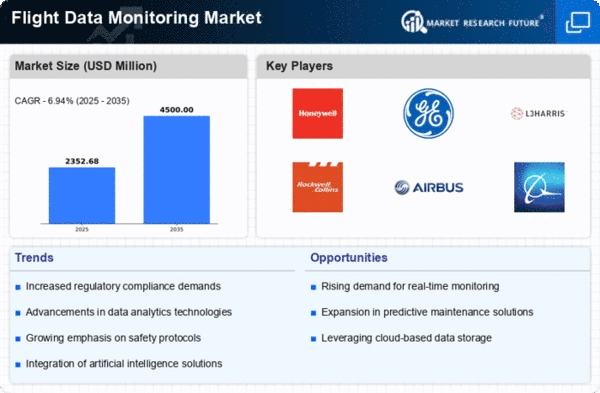
As per MRFR analysis, the Flight Data Monitoring Market Size was estimated at 2200.0 USD Million in 2024. The Flight Data Monitoring industry is projected to grow from 2300.0 in 2025 to 4500.0 by 2035, exhibiting a compound annual growth rate (CAGR) of 6.94 during the forecast period 2025 - 2035.

Key Market Trends & Highlights

The Flight Data Monitoring Market is poised for substantial growth driven by technological advancements and regulatory compliance.

  • Technological advancements are reshaping the Flight Data Monitoring Market, enhancing data accuracy and operational efficiency.
  • Cloud-based solutions are increasingly adopted, facilitating real-time data access and analysis across various aviation sectors.
  • North America remains the largest market, while the Asia-Pacific region is recognized as the fastest-growing area for flight data monitoring solutions.
  • The rising demand for safety and efficiency, alongside regulatory pressures, significantly drives the market, particularly in the commercial aviation and performance monitoring segments.

Market Size & Forecast

2024 Market Size 2200.0 (USD Million)
2035 Market Size 4500.0 (USD Million)
CAGR (2025 - 2035) 6.94%

Major Players

Honeywell (US), General Electric (US), L3Harris Technologies (US), Rockwell Collins (US), Airbus (FR), Boeing (US), Thales Group (FR), Safran (FR), Curtiss-Wright (US)

Flight Data Monitoring Market Trends

The Flight Data Monitoring Market is currently experiencing a notable evolution, driven by advancements in technology and increasing regulatory requirements. The integration of sophisticated data analytics tools and artificial intelligence is enhancing the ability to monitor flight data in real-time, thereby improving safety and operational efficiency. As airlines and aviation authorities prioritize safety, the demand for comprehensive flight data monitoring solutions is likely to rise. Furthermore, the growing emphasis on predictive maintenance and operational optimization suggests that stakeholders are increasingly recognizing the value of data-driven insights in enhancing performance and reducing costs. In addition, the Flight Data Monitoring Market appears to be influenced by the rising adoption of cloud-based solutions. These platforms facilitate seamless data sharing and collaboration among various stakeholders, including airlines, manufacturers, and regulatory bodies. This shift towards cloud technology may enhance the accessibility and scalability of flight data monitoring systems, allowing for more efficient data management. As the aviation industry continues to evolve, the Flight Data Monitoring Market is poised for further growth, with innovations likely to shape its future landscape.

Technological Advancements

The Flight Data Monitoring Market is witnessing a surge in technological innovations, particularly in data analytics and artificial intelligence. These advancements enable real-time monitoring and analysis of flight data, enhancing safety and operational efficiency.

Cloud-Based Solutions

The increasing adoption of cloud technology is transforming the Flight Data Monitoring Market. Cloud-based platforms facilitate better data sharing and collaboration among stakeholders, improving accessibility and scalability of monitoring systems.

Regulatory Compliance

Growing regulatory requirements are driving the demand for robust flight data monitoring solutions. Airlines and aviation authorities are prioritizing compliance, which is likely to boost the market for comprehensive monitoring systems.

Flight Data Monitoring Market Drivers

Market Growth Projections

The Global Flight Data Monitoring Market Industry is poised for substantial growth, with projections indicating a market size of 2.9 USD Billion in 2024 and an anticipated increase to 3.78 USD Billion by 2035. This growth trajectory reflects a CAGR of 2.43% from 2025 to 2035, driven by various factors such as technological advancements, regulatory compliance, and the increasing focus on safety and operational efficiency. The market's expansion is indicative of the aviation industry's commitment to leveraging data monitoring solutions to enhance flight safety and operational performance.

Growing Focus on Operational Efficiency

A growing focus on operational efficiency is a key driver in the Global Flight Data Monitoring Market Industry. Airlines are under constant pressure to reduce operational costs while maintaining high safety standards. Flight data monitoring systems provide insights into fuel consumption, flight paths, and maintenance needs, allowing operators to optimize their operations. This trend is particularly relevant as airlines seek to enhance profitability in a competitive landscape. By leveraging data-driven insights, airlines can make informed decisions that lead to improved efficiency and cost savings, thereby driving the demand for advanced monitoring solutions.

Increasing Demand for Safety and Compliance

The Global Flight Data Monitoring Market Industry experiences heightened demand for safety and compliance measures in aviation. Regulatory bodies worldwide, such as the Federal Aviation Administration (FAA) and the European Union Aviation Safety Agency (EASA), emphasize the importance of data monitoring to enhance flight safety. This trend is driven by the need to analyze flight data for incident prevention and operational efficiency. As a result, the market is projected to reach 2.9 USD Billion in 2024, reflecting the industry's commitment to adopting advanced monitoring systems that ensure adherence to safety regulations and improve overall flight operations.

Integration of Real-Time Monitoring Systems

The integration of real-time monitoring systems significantly influences the Global Flight Data Monitoring Market Industry. Airlines and operators are increasingly adopting real-time data monitoring solutions to enhance situational awareness and decision-making during flights. These systems provide immediate access to critical flight parameters, enabling timely interventions in case of anomalies. As the industry evolves, the demand for such systems is likely to rise, contributing to the overall market growth. The ability to monitor flights in real-time not only improves safety but also optimizes operational efficiency, making it a crucial driver in the market.

Technological Advancements in Data Analytics

Technological advancements in data analytics play a pivotal role in shaping the Global Flight Data Monitoring Market Industry. Innovations in artificial intelligence and machine learning enable airlines to process vast amounts of flight data efficiently. These technologies facilitate predictive maintenance, allowing operators to anticipate potential issues before they escalate. Consequently, the market is expected to grow at a CAGR of 2.43% from 2025 to 2035, reaching an estimated 3.78 USD Billion by 2035. This growth underscores the increasing reliance on sophisticated data analytics tools that enhance operational efficiency and safety in aviation.

Expansion of Aviation Industry in Emerging Markets

The expansion of the aviation industry in emerging markets significantly impacts the Global Flight Data Monitoring Market Industry. Countries in regions such as Asia-Pacific and Latin America are witnessing rapid growth in air travel, leading to increased investments in aviation infrastructure and technology. As new airlines enter the market, the demand for flight data monitoring solutions rises to ensure compliance with international safety standards. This trend is expected to drive market growth as emerging economies prioritize safety and operational efficiency in their expanding aviation sectors.

Market Segment Insights

By Application: Flight Operations Monitoring (Largest) vs. Performance Monitoring (Fastest-Growing)

In the Flight Data Monitoring Market, the application segment comprises four crucial areas: Flight Operations Monitoring, Maintenance Monitoring, Safety Monitoring, and Performance Monitoring. Among these, Flight Operations Monitoring stands out as the largest segment, capturing a significant share of overall market activities. This segment plays an integral role in ensuring that flight operations are optimized and streamlined, driving operational efficiencies across various airline and flight service organizations. On the other hand, Performance Monitoring is recognized as the fastest-growing segment in this market. This growth can be attributed to the increasing emphasis on efficiency, fuel management, and aircraft performance assessment, as airlines seek to enhance their operations and reduce costs. The rise of advanced data analytics and real-time monitoring technologies is further propelling this segment, allowing for proactive decisions and operational improvements.

Flight Operations Monitoring (Dominant) vs. Safety Monitoring (Emerging)

Flight Operations Monitoring remains the dominant application in the Flight Data Monitoring Market, providing critical oversight for managing and optimizing flight operations. This segment employs advanced technologies to monitor flight paths, fuel consumption, and operational delays, ensuring safe and efficient flight experiences. The insights derived from flight operations data enable airlines to make informed decisions and enhance performance. Conversely, Safety Monitoring, while still emerging, is gaining traction due to its focus on risk assessment and compliance with safety regulations. This segment utilizes sophisticated monitoring systems to track safety metrics and incidents, thus fostering a culture of safety within aviation operations. As regulatory standards tighten and safety becomes paramount, Safety Monitoring is expected to see robust growth.

By End Use: Commercial Aviation (Largest) vs. Military Aviation (Fastest-Growing)

In the Flight Data Monitoring Market, the distribution of market shares among the end-use segments reveals that Commercial Aviation holds the largest share, driven by increasing passenger traffic and regulatory requirements for flight safety. Military Aviation follows closely, benefiting from rising defense budgets and the need for operational efficiency in military operations. Business Aviation and General Aviation also contribute to the market, although their shares are comparatively smaller due to niche applications and varying regulatory environments.

Commercial Aviation (Dominant) vs. Military Aviation (Emerging)

Commercial Aviation is the dominant segment in the Flight Data Monitoring Market due to its extensive demand for data analysis and transparency in safety measures. Airlines globally are adopting sophisticated flight data monitoring systems to adhere to stringent aviation regulations and enhance operational efficiency. Conversely, Military Aviation is emerging as a key growth area, fueled by advancements in technology and increased military spending. This segment emphasizes real-time data capture and analysis to improve tactical decision-making. As such, Military Aviation represents a rapidly expanding market with significant investments in flight data monitoring solutions.

By Component: Flight Data Recorder (Largest) vs. Data Acquisition Unit (Fastest-Growing)

The Flight Data Monitoring Market is characterized by diverse components, with the Flight Data Recorder holding the largest market share. This device collects and stores flight data, ensuring compliance with safety regulations and facilitating accident investigations. In contrast, the Data Acquisition Unit is experiencing rapid growth as it integrates with advanced technologies, enhancing data collection capabilities in real-time. These component values together shape the competitive landscape of the market.

Flight Data Recorder (Dominant) vs. Data Acquisition Unit (Emerging)

The Flight Data Recorder stands as a dominant force in the Flight Data Monitoring Market due to its critical role in aviation safety and regulatory compliance. With its robust ability to capture and store vital flight information, it appeals to airlines and manufacturers alike. Conversely, the Data Acquisition Unit is emerging as a key player, driven by the increasing demand for real-time data analytics and improved efficiency in data gathering. This unit channels cutting-edge technologies like IoT and AI, fostering rapid advancements that cater to modern aviation challenges, ultimately reshaping the operational paradigms of airlines.

By Deployment Type: Cloud-Based (Largest) vs. On-Premises (Fastest-Growing)

In the Flight Data Monitoring Market, the deployment type segment is significantly shaped by the competition between cloud-based and on-premises solutions. Currently, cloud-based systems are leading the market, claiming a substantial share due to their scalability, flexibility, and ease of integration with other data management tools. Meanwhile, on-premises solutions, while losing some ground, still maintain a loyal customer base that values data control and security inherent in their deployment. The hybrid deployment model is carving out its niche, appealing to organizations wanting the reliability of on-premises systems coupled with the advantages of cloud technology. As trends evolve, the cloud-based segment is poised to continue its dominance due to increasing reliance on remote operations and the growing adoption of AI and big data analytics. On-premises solutions are witnessing a resurgence as aviation companies prioritize security, prompting growth in this segment. The hybrid deployment model is gaining traction as organizations recognize the need for a flexible approach that incorporates both solutions, meeting diverse operational needs and ensuring data safety while leveraging the benefits of cloud capabilities.

Cloud-Based (Dominant) vs. On-Premises (Emerging)

The cloud-based deployment model in the Flight Data Monitoring Market has emerged as a dominant force, characterized by real-time data analysis, reduced maintenance costs, and unparalleled scalability. This model allows companies to access flight data from anywhere, facilitating quicker operational decision-making and data integration. The hybrid model is also gaining importance, serving those firms that seek to tap into the benefits of both cloud and on-premises setups. Conversely, on-premises deployment is seen as an emerging alternative, appealing particularly to organizations with stringent data security requirements. This model offers robust data governance and control, making it a viable choice for critical operations where data sensitivity is paramount. The dual preference for both deployment types highlights a market adaptive to various operational priorities.

By Technology: Data Analytics (Largest) vs. Artificial Intelligence (Fastest-Growing)

In the Flight Data Monitoring Market, the segment values reveal a diverse landscape, with Data Analytics having the largest share. This segment plays a pivotal role in processing and interpreting vast amounts of flight data, ensuring airlines can maintain operational efficiency and safety. Artificial Intelligence, emerging with rapid growth, is becoming increasingly integral for predictive maintenance and optimizing flight operations, showcasing the market's shift towards advanced technological solutions.

Technology: Data Analytics (Dominant) vs. Artificial Intelligence (Emerging)

Data Analytics serves as the backbone of the Flight Data Monitoring Market, enabling stakeholders to convert raw data into actionable insights essential for enhancing operational performance. Meanwhile, Artificial Intelligence, characterized by its learning capabilities, is rapidly transforming the industry by enabling advanced predictive models and decision-making tools. Airlines utilizing AI technologies gain a competitive edge through improved safety protocols and efficiency. The synergy between both segments is increasingly prominent, as data turns more intelligent through AI-driven analytics, signaling a shift towards data-driven decision environments.

Get more detailed insights about Flight Data Monitoring Market

Regional Insights

North America : Market Leader in Flight Data

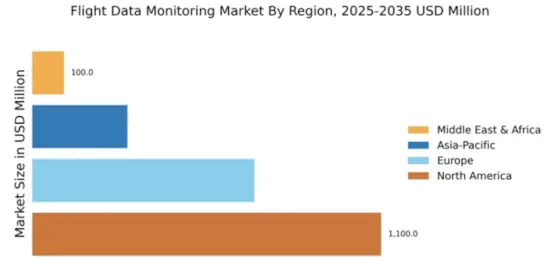
North America is poised to maintain its leadership in the Flight Data Monitoring market, holding a significant share of 1100.0M in 2025. The region's growth is driven by increasing air traffic, stringent safety regulations, and advancements in technology. Regulatory bodies are emphasizing the importance of data analytics for enhancing flight safety, which further fuels demand for monitoring solutions. The presence of major players like Honeywell and Boeing also contributes to the region's robust market dynamics. The competitive landscape in North America is characterized by a concentration of key players, including General Electric and L3Harris Technologies. These companies are investing heavily in R&D to innovate and improve their offerings. The U.S. is the leading country in this region, supported by a strong aviation infrastructure and a growing focus on safety and efficiency. This competitive environment ensures that North America remains at the forefront of flight data monitoring solutions.

Europe : Emerging Market with Growth Potential

Europe is witnessing a significant rise in the Flight Data Monitoring market, projected to reach 700.0M by 2025. The growth is driven by increasing regulatory requirements for safety and efficiency in aviation. The European Union Aviation Safety Agency (EASA) has been proactive in establishing regulations that mandate the use of advanced monitoring systems, thereby enhancing market demand. The focus on sustainability and reducing carbon emissions is also pushing airlines to adopt more efficient monitoring solutions. Leading countries in Europe include France, Germany, and the UK, where major players like Airbus and Thales Group are based. The competitive landscape is marked by collaborations and partnerships aimed at enhancing technological capabilities. The presence of established companies alongside emerging startups fosters innovation, making Europe a dynamic market for flight data monitoring solutions.

Asia-Pacific : Rapidly Growing Aviation Sector

The Asia-Pacific region is experiencing rapid growth in the Flight Data Monitoring market, expected to reach 300.0M by 2025. This growth is fueled by increasing air travel demand, expanding airline fleets, and a focus on safety regulations. Countries like China and India are investing heavily in aviation infrastructure, which is driving the need for advanced monitoring systems. Regulatory bodies are also emphasizing the importance of data analytics in improving operational efficiency and safety standards. China is the leading country in this region, with significant investments in aviation technology. The competitive landscape features both global players and local companies, creating a diverse market environment. Key players such as Boeing and Curtiss-Wright are actively participating in this growth, ensuring that the region remains competitive in flight data monitoring solutions.

Middle East and Africa : Emerging Market with Untapped Potential

The Middle East and Africa region is on the cusp of growth in the Flight Data Monitoring market, projected to reach 100.0M by 2025. The aviation sector in this region is expanding rapidly, driven by increasing air travel and investments in airport infrastructure. Regulatory bodies are beginning to implement safety standards that necessitate the adoption of flight data monitoring systems, which is expected to boost market demand. The focus on enhancing operational efficiency is also a key driver for this growth. Leading countries in this region include the UAE and South Africa, where there is a growing presence of both international and local players. The competitive landscape is evolving, with companies looking to establish partnerships to enhance their technological capabilities. This emerging market presents significant opportunities for growth in flight data monitoring solutions, as the region seeks to improve its aviation safety standards.

Key Players and Competitive Insights

The Flight Data Monitoring Market is currently characterized by a dynamic competitive landscape, driven by technological advancements and an increasing emphasis on safety and efficiency in aviation operations. Key players such as Honeywell (US), General Electric (US), and Airbus (FR) are strategically positioned to leverage their extensive expertise in aerospace technologies. Honeywell (US) focuses on innovation in data analytics and predictive maintenance, while General Electric (US) emphasizes digital transformation through its digital twin technology. Airbus (FR) is actively pursuing partnerships to enhance its data monitoring capabilities, thereby shaping a competitive environment that prioritizes technological integration and operational efficiency.

The market structure appears moderately fragmented, with several players vying for market share through various business tactics. Companies are increasingly localizing manufacturing to reduce costs and optimize supply chains, which is crucial in a market where timely data access is paramount. The collective influence of these key players fosters a competitive atmosphere that encourages continuous improvement and innovation, ultimately benefiting end-users through enhanced safety and operational performance.

In November 2025, Honeywell (US) announced a strategic partnership with a leading airline to implement its advanced flight data monitoring system, which is expected to enhance operational efficiency and reduce maintenance costs. This collaboration underscores Honeywell's commitment to integrating cutting-edge technology into aviation operations, potentially setting a new standard for data-driven decision-making in the industry. The partnership is likely to bolster Honeywell's market position by showcasing its innovative capabilities and reinforcing its reputation as a leader in flight data solutions.

In October 2025, General Electric (US) unveiled a new suite of digital tools designed to optimize flight data analysis and improve predictive maintenance capabilities. This launch reflects GE's ongoing investment in digital transformation, aiming to provide airlines with actionable insights that can lead to significant cost savings and improved safety outcomes. The introduction of these tools may enhance GE's competitive edge by positioning it as a frontrunner in the integration of AI and machine learning within flight data monitoring.

In September 2025, Airbus (FR) expanded its collaboration with a prominent technology firm to develop a next-generation flight data monitoring platform that incorporates real-time analytics and machine learning algorithms. This initiative is indicative of Airbus's strategic focus on innovation and its commitment to enhancing the safety and efficiency of flight operations. By investing in advanced technologies, Airbus aims to differentiate itself in a competitive market, potentially attracting new customers seeking state-of-the-art solutions.

As of December 2025, the Flight Data Monitoring Market is witnessing trends that emphasize digitalization, sustainability, and AI integration. Strategic alliances among key players are increasingly shaping the competitive landscape, fostering innovation and collaboration. The shift from price-based competition to a focus on technological advancement and supply chain reliability is evident, suggesting that future competitive differentiation will hinge on the ability to innovate and adapt to evolving market demands. Companies that prioritize these aspects are likely to thrive in an increasingly complex and competitive environment.

Key Companies in the Flight Data Monitoring Market market include

Industry Developments

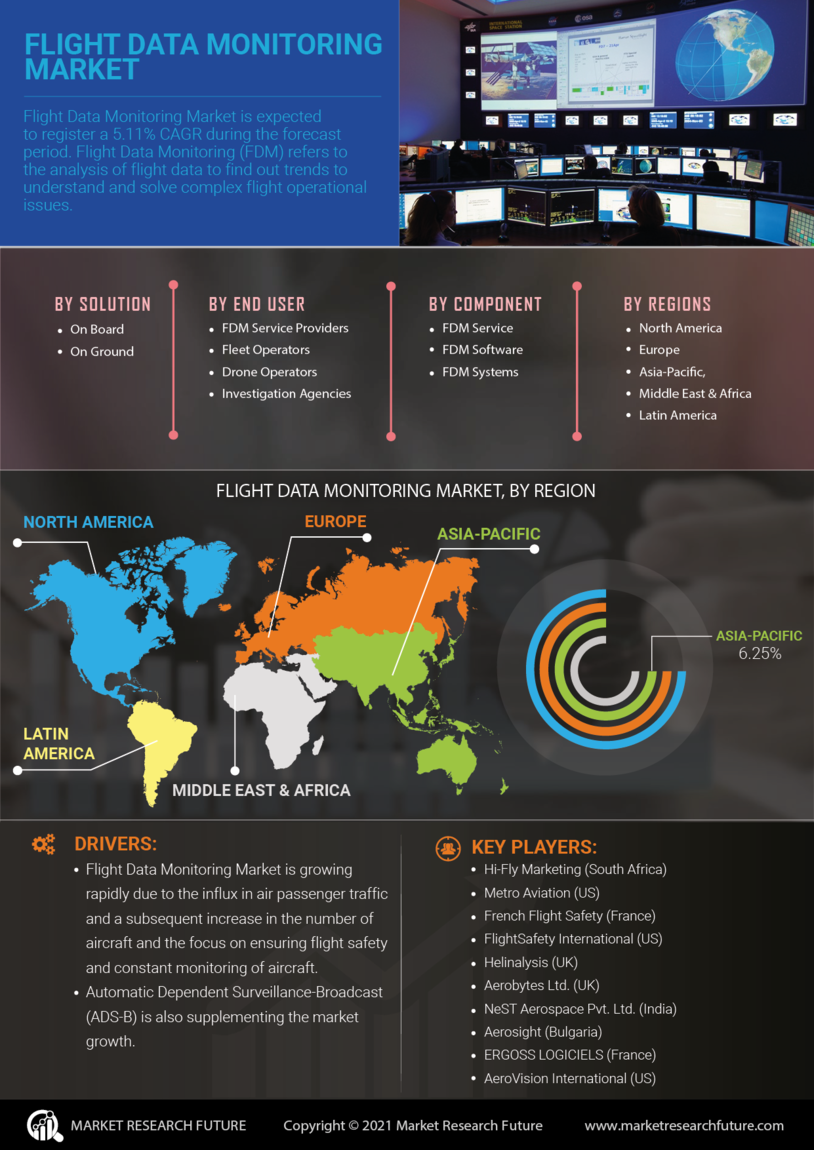
The on-board segment of the market is currently dominating the market trends. The market segment is expected to continue its dominance during the forecast period that will be ending in 2028. This is majorly due to the increased degree of procurement of new aircraft in both the commercial and military sectors.

The rising demand is helping the market to fill in the loopholes related to the lack of investment to provide the best portfolio and market products for catering to the demand of the target audience that is spread in various locations amid the global flight data monitoring market premises especially in the ongoing forecast period of 2021-2028. 

As of April 2020, Airbus, as one of the prominent market parts, is known to have as many as 7,645 aircraft on the backlog. This is available with more than 80% of these prevailing orders for one of the market products - A320 Family aircraft. A350XWBs alongside A220s are accounting for approximately 14% of the order backlog. The planned aircraft deliveries of new aircraft programs like Boeing 777X, COMAC C919, and MC-21, as a part of the upcoming years, are anticipated to propel the demand for the prevalent commercial aircraft flight data monitoring systems.

There has been an increasing demand for commercial helicopters across various applications like search and rescue operations alongside private transports among others are generating a huge degree of demand for rotary-wing FDM systems. Military aircraft including Eurofighter Typhoon, Lockheed Martin F-35 Lightning II, and A-400M, amongst others, have planned their deliveries in major market countries Europe, Asia-Pacific, and Middle-East and Africa regions in the forecast period ending in 2028.


Future Outlook

Flight Data Monitoring Market Future Outlook

The Flight Data Monitoring Market is projected to grow at a 6.94% CAGR from 2024 to 2035, driven by technological advancements, regulatory compliance, and increasing safety concerns.

New opportunities lie in:

  • Integration of AI-driven analytics for predictive maintenance solutions.
  • Development of cloud-based data storage for real-time monitoring.
  • Expansion into emerging markets with tailored compliance solutions.

By 2035, the Flight Data Monitoring Market is expected to be robust, reflecting substantial growth and innovation.

Market Segmentation

Flight Data Monitoring Market End Use Outlook

  • Commercial Aviation
  • Military Aviation
  • Business Aviation
  • General Aviation

Flight Data Monitoring Market Component Outlook

  • Flight Data Recorder
  • Data Acquisition Unit
  • Communication System
  • Software Solutions

Flight Data Monitoring Market Technology Outlook

  • Data Analytics
  • Artificial Intelligence
  • Machine Learning
  • Real-Time Monitoring

Flight Data Monitoring Market Application Outlook

  • Flight Operations Monitoring
  • Maintenance Monitoring
  • Safety Monitoring
  • Performance Monitoring

Flight Data Monitoring Market Deployment Type Outlook

  • On-Premises
  • Cloud-Based
  • Hybrid

Report Scope

MARKET SIZE 20242200.0(USD Million)
MARKET SIZE 20252300.0(USD Million)
MARKET SIZE 20354500.0(USD Million)
COMPOUND ANNUAL GROWTH RATE (CAGR)6.94% (2024 - 2035)
REPORT COVERAGERevenue Forecast, Competitive Landscape, Growth Factors, and Trends
BASE YEAR2024
Market Forecast Period2025 - 2035
Historical Data2019 - 2024
Market Forecast UnitsUSD Million
Key Companies ProfiledHoneywell (US), General Electric (US), L3Harris Technologies (US), Rockwell Collins (US), Airbus (FR), Boeing (US), Thales Group (FR), Safran (FR), Curtiss-Wright (US)
Segments CoveredApplication, End Use, Component, Deployment Type, Technology
Key Market OpportunitiesIntegration of artificial intelligence for enhanced predictive analytics in the Flight Data Monitoring Market.
Key Market DynamicsRising demand for real-time data analytics drives innovation in flight data monitoring technologies and regulatory compliance.
Countries CoveredNorth America, Europe, APAC, South America, MEA

Market Highlights

Author
Sejal Akre
Senior Research Analyst

She has over 5 years of rich experience, in market research and consulting providing valuable market insights to client. Hands on expertise in management consulting, and extensive knowledge in domain including ICT, Automotive & Transportation and Aerospace & Defense. She is skilled in Go-to market strategy, industry analysis, market sizing, in depth company profiling, competitive intelligence & benchmarking and value chain amongst others.

Leave a Comment

FAQs

What is the estimated market value of the global flight data monitoring market?

Flight data monitoring market is expected to record a substantial market valuation of USD 9.2 billion by 2030.

What is the projected growth rate of the global flight data monitoring market?

Global flight data monitoring market is projected to register a moderate 2.8% CAGR in the forecast period.

Which solution is touted to witness the highest growth?

The onboard segment is expected to observe substantial demand over the review period.

What is the end-users segment of the global flight data monitoring market expected to witness the highest growth?

The fleet operators segment is slated to expand as the fastest-growing segment.

Who are the significant players operative in the global flight data monitoring market?

A few eminent market players functioning in the global flight data monitoring market are Teledyne Controls LLC (US), Safran (France), Guardian Mobility (Canada), among others.

Download Free Sample

Kindly complete the form below to receive a free sample of this Report

Compare Licence

×
Features License Type
Single User Multiuser License Enterprise User
Price $4,950 $5,950 $7,250
Maximum User Access Limit 1 User Upto 10 Users Unrestricted Access Throughout the Organization
Free Customization
Direct Access to Analyst
Deliverable Format
Platform Access
Discount on Next Purchase 10% 15% 15%
Printable Versions