×
Request Free Sample ×

Kindly complete the form below to receive a free sample of this Report

* Please use a valid business email

Leading companies partner with us for data-driven Insights

clients tt-cursor
Hero Background

Flow Battery Market

ID: MRFR/EnP/5157-HCR
111 Pages
Snehal Singh
October 2025

Flow Battery Market Research Report Information By Product Type (Redox, Hybrid), By Material Type (Vanadium, Zinc-Bromine), By Storage Type (Compact, Large Scale), By Application (Industrial & Commercial, Defense, Utilities And Others) And By Region (North America, Europe, Asia-Pacific, And Rest Of The World) –Market Forecast Till 2035

Share:
Download PDF ×

We do not share your information with anyone. However, we may send you emails based on your report interest from time to time. You may contact us at any time to opt-out.

Flow Battery Market Infographic
Purchase Options

Flow Battery Market Summary

As per MRFR analysis, the Flow Battery Market Size was estimated at 446.35 USD Million in 2024. The Flow Battery industry is projected to grow from 583.3 in 2025 to 8473.29 by 2035, exhibiting a compound annual growth rate (CAGR) of 30.68 during the forecast period 2025 - 2035.

Key Market Trends & Highlights

The Flow Battery Market is poised for substantial growth driven by technological advancements and increasing demand for energy storage solutions.

  • North America remains the largest market for flow batteries, driven by a robust demand for renewable energy storage.
  • Asia-Pacific is emerging as the fastest-growing region, reflecting a surge in investments and technological innovations.
  • The Grid Energy Storage segment continues to dominate the market, while the Uninterruptible Power Supply segment is witnessing rapid growth.
  • Key market drivers include rising demand for energy storage solutions and supportive government policies that incentivize technological advancements.

Market Size & Forecast

2024 Market Size 446.35 (USD Million)
2035 Market Size 8473.29 (USD Million)
CAGR (2025 - 2035) 30.68%

Major Players

Redflow (AU), Vionx Energy (US), ESS Inc. (US), Gildemeister (DE), Sungrow Power Supply Co. (CN), Primus Power (US), Invinity Energy Systems (GB), Flow Battery Systems (US), Ceres Media (US)

Flow Battery Market Trends

The Flow Battery Market is currently experiencing a notable transformation, driven by the increasing demand for energy storage solutions. This shift is largely attributed to the growing emphasis on renewable energy sources, which necessitate efficient storage systems to manage intermittent supply. Flow batteries, with their unique ability to provide long-duration energy storage, are emerging as a viable alternative to traditional battery technologies. Their scalability and flexibility make them particularly appealing for large-scale applications, such as grid storage and renewable integration. As the world moves towards a more sustainable energy future, the Flow Battery Market is poised for substantial growth, reflecting a broader trend towards decarbonization and energy resilience. In addition to the push for renewable energy, advancements in flow battery technology are enhancing performance and reducing costs. Innovations in materials and design are likely to improve energy density and cycle life, making these systems more competitive against lithium-ion batteries. Furthermore, the increasing interest from various sectors, including commercial, industrial, and utility-scale applications, suggests a diversification of the market. As stakeholders recognize the potential of flow batteries to support energy transition goals, investment and research in this area are expected to intensify, further solidifying the Flow Battery Market's position in the energy landscape.

Rising Demand for Renewable Energy Storage

The Flow Battery Market is witnessing a surge in interest due to the escalating need for effective energy storage solutions. As renewable energy sources become more prevalent, the ability to store energy efficiently is crucial for maintaining grid stability and reliability. Flow batteries offer a promising solution, enabling the integration of solar and wind power into existing energy systems.

Technological Advancements in Flow Battery Systems

Recent innovations in flow battery technology are enhancing their performance characteristics. Improvements in materials and design are likely to lead to higher energy densities and longer cycle lives. These advancements may position flow batteries as a more competitive option compared to conventional battery technologies, particularly in large-scale applications.

Increased Investment and Research Initiatives

The Flow Battery Market is experiencing heightened investment and research activities as stakeholders recognize the potential of these systems. Various sectors, including utilities and commercial enterprises, are exploring flow batteries to meet energy transition goals. This trend indicates a growing commitment to developing sustainable energy storage solutions.

Flow Battery Market Drivers

Market Charts and Projections

The Flow Battery Market is characterized by dynamic growth projections and evolving trends. The market is expected to expand from a valuation of 0.45 USD Billion in 2024 to an impressive 8.47 USD Billion by 2035. This growth trajectory indicates a robust compound annual growth rate (CAGR) of 30.58% from 2025 to 2035. The charts illustrate the anticipated market expansion, highlighting key drivers such as technological advancements, government policies, and increasing demand for renewable energy storage. These visual representations provide a comprehensive overview of the market's potential, underscoring the importance of flow batteries in the global energy landscape.

Government Incentives and Policies

Government initiatives and policies significantly influence the Flow Battery Market, as many countries implement supportive measures to promote energy storage technologies. Incentives such as tax credits, grants, and subsidies encourage the adoption of flow batteries, particularly in renewable energy projects. For example, various governments are establishing frameworks that prioritize energy storage solutions to enhance grid stability and reliability. These policies not only stimulate market growth but also foster innovation within the industry. As governments recognize the importance of energy storage in achieving climate goals, the flow battery market is likely to benefit from increased funding and support, further driving its expansion.

Growing Applications in Electric Vehicles

The Flow Battery Industry is witnessing a notable increase in applications within the electric vehicle sector. Flow batteries offer several advantages, including longer cycle life and faster charging capabilities, making them an attractive option for electric vehicle manufacturers. As the demand for electric vehicles continues to rise, driven by environmental concerns and regulatory pressures, flow batteries are positioned to play a significant role in this market. Their scalability and ability to provide high energy output align well with the needs of electric vehicle technology. This trend suggests a promising future for flow batteries, potentially contributing to the market's growth trajectory through 2035.

Increasing Demand for Renewable Energy Storage

The Flow Battery Market experiences a surge in demand for energy storage solutions, driven by the global transition towards renewable energy sources. As countries aim to reduce carbon emissions, the need for efficient energy storage systems becomes paramount. Flow batteries, with their ability to store large amounts of energy for extended periods, are well-suited for this purpose. In 2024, the market is valued at 0.45 USD Billion, indicating a growing recognition of flow batteries as a viable option for integrating renewable energy into the grid. This trend is expected to continue, with projections suggesting a market growth to 8.47 USD Billion by 2035.

Technological Advancements in Flow Battery Systems

Technological innovations play a crucial role in the Flow Battery Market, enhancing the efficiency and performance of flow battery systems. Recent advancements in materials and designs have led to improved energy density and cycle life, making flow batteries more competitive against traditional energy storage technologies. For instance, developments in vanadium redox flow batteries have demonstrated increased efficiency and lower costs. These innovations not only attract investments but also expand the application range of flow batteries in various sectors, including grid storage and electric vehicles. As technology continues to evolve, the market is poised for significant growth, with a projected CAGR of 30.58% from 2025 to 2035.
Market Segment Insights

By Application: Grid Energy Storage (Largest) vs. Uninterruptible Power Supply (Fastest-Growing)

In the Flow Battery Market, the application segment shows a diverse range of utilities, with Grid Energy Storage leading as the largest segment. The utilization of flow batteries in grid applications allows for enhanced stability and energy management, capturing a significant market share. Uninterruptible Power Supply is rapidly gaining traction due to the increasing demand for reliable power solutions in critical infrastructure and data centers, making it the fastest-growing segment in this market.

Grid Energy Storage (Dominant) vs. Uninterruptible Power Supply (Emerging)

Grid Energy Storage represents the dominant application within the Flow Battery Market due to its essential role in supporting renewable energy integration and load balancing. This application leverages flow batteries' ability to store significant amounts of energy for extended periods, making them key players in stabilizing grid operations. Meanwhile, Uninterruptible Power Supply is emerging rapidly as organizations seek reliable and uninterrupted power sources. This growth is driven by increased reliance on technology and the rise of sensitive equipment, highlighting the need for robust energy solutions that flow batteries can uniquely provide.

By End Use: Utility (Largest) vs. Commercial (Fastest-Growing)

The Flow Battery Market demonstrates a diverse landscape across its end-use segments, with the utility segment holding the largest share. This segment is primarily driven by the increasing demand for energy storage solutions that support renewable energy integration and grid stability. Following closely, the commercial segment shows substantial growth, fueled by businesses seeking reliable energy storage options to manage peak demand and minimize electricity costs. Growth trends indicate that as renewable energy sources expand, particularly solar and wind, utility-scale flow batteries are gaining preference for large-scale energy storage needs. Concurrently, the commercial sector is rapidly adopting flow battery technology due to its efficiency and long operational life, further accelerated by government incentives and advancements in battery technologies.

Utility (Dominant) vs. Commercial (Emerging)

The utility sector represents the dominant force in the Flow Battery Market, primarily due to extensive investments in renewable energy projects and the necessity for energy storage systems that can balance supply and demand. Utility-scale flow batteries offer high capacity and longevity, making them ideal for grid applications and large-scale energy storage. In contrast, the commercial segment is emerging quickly as businesses increasingly recognize the benefits of energy resilience and cost savings through energy storage solutions. The adoption of flow batteries in commercial applications is driven by technological advancements, environmental sustainability goals, and the growing necessity to stabilize energy supply amid fluctuating energy prices.

By Technology Type: Vanadium Flow Battery (Largest) vs. Zinc-Bromine Flow Battery (Fastest-Growing)

In the Flow Battery Market, the Vanadium Flow Battery dominates due to its high energy density and long cycle life, accounting for a significant portion of the market share. This technology is widely adopted in large-scale energy storage applications, offering reliability and efficiency, which attracts both commercial and utility sectors. In contrast, the Zinc-Bromine Flow Battery, while smaller in market share, is gaining traction rapidly, thanks to its cost-effective nature and lower environmental impact. As companies seek alternatives to traditional battery technologies, Zinc-Bromine is positioned to gain a larger foothold. Growth trends in the Flow Battery Market are influenced by the increasing demand for renewable energy integration and grid stability. Vanadium Flow Batteries are preferred for their durability and ability to discharge energy for extended periods, which is crucial as energy storage demands rise. Conversely, the Zinc-Bromine Flow Battery is recognized for its emerging technology that promises shorter payback periods and scalability, making it appealing for smaller installations. These trends indicate a shift towards both established and innovative technologies within the sector, bolstering market evolution.

Technology: Vanadium Flow Battery (Dominant) vs. Zinc-Bromine Flow Battery (Emerging)

The Vanadium Flow Battery stands out in the Flow Battery Market as a dominant technology known for its long cycle life, safety, and ability to handle large-scale energy requirements. Its electrochemical properties allow for efficient energy storage and retrieval, making it suitable for applications such as grid energy storage and renewable energy support. On the other hand, the Zinc-Bromine Flow Battery is emerging rapidly, characterized by its cost-effectiveness and reduced environmental footprint. This technology is ideal for various applications, from commercial energy storage to electric vehicle support. As the market progresses, both technologies are expected to coexist, addressing different customer needs while contributing to a greener energy landscape.

By Storage Duration: Medium Duration (Largest) vs. Long Duration (Fastest-Growing)

In the flow battery market, the storage duration segment is categorized into short, medium, and long durations. The medium duration segment currently holds the largest market share, driven by applications in renewable energy integration and peak shaving. In contrast, while the short duration segment captures interest, it primarily serves niche applications, leading to a smaller share. Long duration flow batteries, although smaller in current market share, display a significant potential for growth as they cater to bulk energy storage needs, particularly in supporting grid stability and renewable energy sources.

Storage Duration: Medium (Dominant) vs. Long (Emerging)

The medium duration storage segment is the current leader in the flow battery market due to its versatility and suitability for a wide range of applications, including industrial energy management and large-scale renewable projects. It provides a balance between power output and storage duration, making it highly appealing for grid services. On the other hand, long duration batteries are emerging as a key player, especially for applications demanding extensive energy storage over prolonged periods. Innovations are driving this segment’s growth, as technological advancements enhance efficiency and reduce costs, paving the way for their integration in renewable energy systems and long-term energy planning.

By Power Rating: Medium Power (Largest) vs. High Power (Fastest-Growing)

The Flow Battery Market showcases distinct segments across power ratings, with Medium Power batteries commanding the largest share due to their versatile applications in renewable energy systems and grid stabilization. Low Power batteries are also present, primarily catering to smaller-scale applications, while High Power batteries are gaining attention for their rapid deployment in large-scale energy storage projects. As the demand for efficient energy storage solutions grows, these segments continue to evolve, with Medium Power leading the market.

Medium Power: Dominant vs. High Power: Emerging

Medium Power flow batteries are currently dominating the Flow Battery Market, largely attributed to their adaptability in various settings, including industrial and commercial energy management. This segment supports a wide range of applications, enabling it to effectively meet increasing energy demands. In contrast, High Power flow batteries are emerging as a key player, driven by their ability to deliver rapid energy delivery, making them ideal for applications that require quick bursts of power. The rapid advancements in technology are fostering innovations in the High Power segment, positioning it for significant growth as energy storage needs diversify, especially in grid management and stabilization.

Get more detailed insights about Flow Battery Market

Regional Insights

North America : Market Leader in Flow Batteries

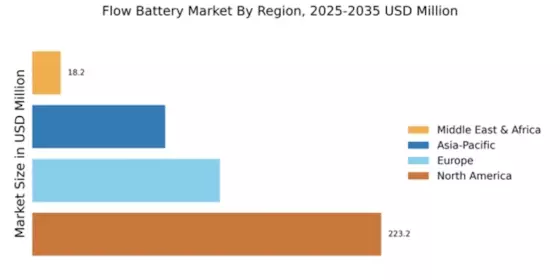
North America is poised to maintain its leadership in the flow battery market, holding a significant share of 223.18 million in 2024. The region's growth is driven by increasing demand for renewable energy storage solutions, supported by favorable government policies and incentives aimed at reducing carbon emissions. The push for energy independence and sustainability is further catalyzing investments in flow battery technologies. The United States stands out as the leading country in this sector, with key players like Vionx Energy, ESS Inc., and Primus Power driving innovation and market expansion. The competitive landscape is characterized by a mix of established companies and emerging startups, all vying for a share of the growing market. The presence of advanced research institutions also fosters collaboration and technological advancements in flow battery systems.

Europe : Emerging Market for Energy Storage

Europe is rapidly emerging as a significant player in the flow battery market, with a market size of 120.0 million. The region's growth is fueled by stringent regulations aimed at reducing greenhouse gas emissions and increasing the share of renewable energy in the energy mix. Initiatives like the European Green Deal are catalyzing investments in energy storage technologies, including flow batteries, to enhance grid stability and energy security. Germany and the UK are leading countries in this market, with companies like Gildemeister and Invinity Energy Systems making notable contributions. The competitive landscape is marked by a focus on innovation and sustainability, with numerous collaborations between industry players and research institutions. This synergy is expected to drive further advancements in flow battery technology, positioning Europe as a key market in the global landscape.

Asia-Pacific : Growing Demand for Energy Solutions

The Asia-Pacific region is witnessing a growing demand for flow battery solutions, with a market size of 85.0 million. This growth is primarily driven by the increasing adoption of renewable energy sources and the need for efficient energy storage systems. Countries in this region are focusing on enhancing their energy infrastructure to support sustainable development goals, which is creating a favorable environment for flow battery technologies. China and Australia are at the forefront of this market, with companies like Sungrow Power Supply Co. and Redflow leading the charge. The competitive landscape is characterized by a mix of local and international players, all striving to capture market share. The region's commitment to reducing carbon emissions and improving energy efficiency is expected to further propel the growth of flow battery systems in the coming years.

Middle East and Africa : Emerging Energy Storage Solutions

The Middle East and Africa (MEA) region is gradually recognizing the potential of flow batteries, with a market size of 18.17 million. The growth in this region is driven by the increasing need for reliable energy storage solutions, particularly in countries with high renewable energy potential. Government initiatives aimed at diversifying energy sources and enhancing energy security are also contributing to the market's development. Countries like South Africa and the UAE are leading the charge in adopting flow battery technologies. The competitive landscape is still in its nascent stages, with a few key players beginning to establish their presence. As investments in renewable energy projects increase, the demand for flow batteries is expected to rise, paving the way for future growth in the MEA region.

Key Players and Competitive Insights

The Flow Battery Market is currently characterized by a dynamic competitive landscape, driven by the increasing demand for energy storage solutions and the transition towards renewable energy sources. Key players are actively engaging in strategic initiatives to enhance their market positioning. For instance, Redflow (AU) focuses on innovation in zinc-bromine flow battery technology, which appears to be gaining traction due to its sustainability and efficiency. Similarly, ESS Inc. (US) emphasizes the development of iron-based flow batteries, which are perceived as a cost-effective alternative for large-scale energy storage applications. These strategies collectively contribute to a competitive environment that is increasingly centered around technological advancements and sustainability.

In terms of business tactics, companies are localizing manufacturing and optimizing supply chains to enhance operational efficiency. The market structure is moderately fragmented, with several players vying for market share. This fragmentation allows for diverse approaches to product development and customer engagement, as companies leverage their unique strengths to capture specific segments of the market. The collective influence of these key players shapes the competitive dynamics, fostering an environment where innovation and strategic partnerships are paramount.

In November 2025, Vionx Energy (US) announced a partnership with a leading renewable energy provider to deploy its vanadium flow battery systems in multiple utility-scale projects. This collaboration is strategically significant as it not only expands Vionx's market reach but also aligns with the growing trend of integrating energy storage solutions with renewable energy generation. Such partnerships are likely to enhance the company's visibility and credibility in the market, potentially leading to increased adoption of its technology.

In October 2025, Invinity Energy Systems (GB) secured a contract to supply its flow battery systems for a large-scale solar project in Europe. This development underscores the company's commitment to expanding its footprint in the European market, which is witnessing a surge in demand for energy storage solutions. The strategic importance of this contract lies in its potential to position Invinity as a key player in the European energy transition, thereby enhancing its competitive edge.

As of December 2025, the Flow Battery Market is witnessing trends that emphasize digitalization, sustainability, and the integration of AI technologies. Companies are increasingly forming strategic alliances to leverage complementary strengths, which is reshaping the competitive landscape. The shift from price-based competition to a focus on innovation, technology, and supply chain reliability is becoming evident. This evolution suggests that future competitive differentiation will hinge on the ability to deliver advanced, reliable, and sustainable energy storage solutions.

Key Companies in the Flow Battery Market market include

Industry Developments

  • Q2 2024: Sumitomo Electric launches world's largest vanadium flow battery in China Sumitomo Electric Industries announced the commissioning of a 100MW/400MWh vanadium redox flow battery system in Dalian, China, marking the world's largest operational flow battery installation for grid-scale energy storage.
  • Q2 2024: Invinity Energy Systems secures $20M contract for flow battery deployment in California Invinity Energy Systems signed a $20 million contract to supply vanadium flow batteries for a major renewable energy project in California, supporting long-duration energy storage for solar and wind integration.
  • Q3 2024: VFlow Tech raises $15M Series B to expand flow battery manufacturing in Singapore Singapore-based VFlow Tech completed a $15 million Series B funding round to scale up its flow battery production capacity and accelerate commercialization in Southeast Asia.
  • Q3 2024: Redflow wins contract to supply flow batteries for Australian government microgrid project Redflow Ltd. announced it will provide zinc-bromine flow batteries for a government-backed microgrid initiative in Queensland, Australia, aimed at improving energy resilience in remote communities.
  • Q4 2024: Lockheed Martin partners with Nel ASA for flow battery pilot in Norway Lockheed Martin and Nel ASA entered a strategic partnership to deploy a pilot flow battery system in Norway, targeting renewable energy storage and grid balancing applications.
  • Q4 2024: Invinity Energy Systems opens new flow battery manufacturing facility in Scotland Invinity Energy Systems inaugurated a new manufacturing plant in Scotland dedicated to producing vanadium flow batteries for European energy storage markets.
  • Q1 2025: Elestor BV secures €12M grant from Dutch government for flow battery R&D Elestor BV received a €12 million grant from the Netherlands government to advance research and development of hydrogen-bromine flow battery technology for grid-scale storage.
  • Q1 2025: Primus Power announces executive appointment to lead global expansion Primus Power appointed a new Chief Commercial Officer to spearhead its international growth strategy for flow battery deployments in emerging markets.
  • Q1 2025: Sumitomo Electric signs MoU with Indian utility for flow battery pilot project Sumitomo Electric Industries signed a Memorandum of Understanding with a major Indian utility to launch a pilot vanadium flow battery project supporting renewable energy integration.
  • Q2 2025: VoltStorage GmbH announces new iron-salt flow battery product launch VoltStorage GmbH unveiled its latest iron-salt flow battery product, targeting commercial and industrial energy storage applications with improved cost efficiency and sustainability.
  • Q2 2025: Redflow opens new assembly facility in South Africa for zinc-bromine flow batteries Redflow Ltd. launched a new assembly plant in South Africa to meet growing demand for zinc-bromine flow batteries in the African energy storage market.
  • Q2 2025: StorEn Technologies secures $10M Series A funding for US flow battery commercialization StorEn Technologies completed a $10 million Series A funding round to accelerate commercialization of its vanadium flow battery systems in the United States.

Future Outlook

Flow Battery Market Future Outlook

The Flow Battery Market is poised for robust growth, driven by renewable energy integration and energy storage needs, with a projected 30.68% CAGR from 2024 to 2035.

New opportunities lie in:

  • Development of modular flow battery systems for residential applications.
  • Partnerships with renewable energy firms for integrated storage solutions.
  • Expansion into emerging markets with tailored financing options.

By 2035, the Flow Battery Market is expected to achieve substantial growth, solidifying its role in global energy storage.

Market Segmentation

Flow Battery Market End Use Outlook

  • Utility
  • Commercial
  • Industrial
  • Residential

Flow Battery Market Application Outlook

  • Grid Energy Storage
  • Renewable Energy Integration
  • Uninterruptible Power Supply
  • Electric Vehicle Charging
  • Microgrid Systems

Flow Battery Market Power Rating Outlook

  • Low Power
  • Medium Power
  • High Power

Flow Battery Market Technology Type Outlook

  • Vanadium Flow Battery
  • Zinc-Bromine Flow Battery
  • Iron-Chromium Flow Battery
  • Organic Flow Battery

Flow Battery Market Storage Duration Outlook

  • Short Duration
  • Medium Duration
  • Long Duration

Report Scope

MARKET SIZE 2024446.35(USD Million)
MARKET SIZE 2025583.3(USD Million)
MARKET SIZE 20358473.29(USD Million)
COMPOUND ANNUAL GROWTH RATE (CAGR)30.68% (2024 - 2035)
REPORT COVERAGERevenue Forecast, Competitive Landscape, Growth Factors, and Trends
BASE YEAR2024
Market Forecast Period2025 - 2035
Historical Data2019 - 2024
Market Forecast UnitsUSD Million
Key Companies ProfiledRedflow (AU), Vionx Energy (US), ESS Inc. (US), Gildemeister (DE), Sungrow Power Supply Co. (CN), Primus Power (US), Invinity Energy Systems (GB), Flow Battery Systems (US), Ceres Media (US)
Segments CoveredApplication, End Use, Technology Type, Storage Duration, Power Rating
Key Market OpportunitiesGrowing demand for renewable energy storage solutions drives innovation in the Flow Battery Market.
Key Market DynamicsRising demand for renewable energy storage drives innovation and competition in the flow battery market.
Countries CoveredNorth America, Europe, APAC, South America, MEA

Market Highlights

Author
Snehal Singh
Assistant Manager - Research

High acumen in analyzing complex macro & micro markets with more than 6 years of work experience in the field of market research. By implementing her analytical skills in forecasting and estimation into market research reports, she has expertise in Packaging, Construction, and Equipment domains. She handles a team size of 20-25 resources and ensures smooth running of the projects, associated marketing activities, and client servicing.

Leave a Comment

FAQs

How much is the Flow Battery Market?

The global Flow Battery Market size was valued at USD 0.45 Billion in 2024.

What is the growth rate of the Flow Battery Market?

The global market is projected to grow at a CAGR of 30.68% during the forecast period, 2025-2035.

Which region held the largest market share in the Flow Battery Market?

North America had the largest share in the global market

Who are the key players in the Flow Battery Market?

The key players in the market are Sumitomo Electric Industries, Ltd. (Japan), ViZn Energy Systems. (US), EnSync Energy Systems (US), Schmid (Germany), and Elestor (Europe).

Which Product Type led the Flow Battery Market?

The redox category dominated the market in 2022.

Which application had the largest market share in the Flow Battery Market?

The utilities had the largest share in the global market.

Download Free Sample

Kindly complete the form below to receive a free sample of this Report

Compare Licence

×
Features License Type
Single User Multiuser License Enterprise User
Price $4,950 $5,950 $7,250
Maximum User Access Limit 1 User Upto 10 Users Unrestricted Access Throughout the Organization
Free Customization
Direct Access to Analyst
Deliverable Format
Platform Access
Discount on Next Purchase 10% 15% 15%
Printable Versions