×
Request Free Sample ×

Kindly complete the form below to receive a free sample of this Report

* Please use a valid business email

Leading companies partner with us for data-driven Insights

clients tt-cursor
Hero Background

Flow Cytometer Reagents Market

ID: MRFR/LS/2805-HCR
90 Pages
Kinjoll Dey
October 2025

Flow Cytometer Reagents Market Research Report Information By Type (Calibration and Validation Reagents, Specificity Reagents, Supporting Reagents, Secondary Reagents, Isotype Controls, and Buffers), By Application (Diagnostics and Drug Discovery), By End-Users (Pharmaceuticals & Biotechnology Industry, Academic & Research Centers, and Diagnostic Centers), And By Region (North America, Europe, Asia-Pacific, And Rest Of The World) –Market Forecast Till 2035

Share:
Download PDF ×

We do not share your information with anyone. However, we may send you emails based on your report interest from time to time. You may contact us at any time to opt-out.

Flow Cytometer Reagents Market Infographic
Purchase Options

Flow Cytometer Reagents Market Summary

As per MRFR analysis, the Flow Cytometer Reagents Market Size was estimated at 3330.66 USD Million in 2024. The Flow Cytometer Reagents industry is projected to grow from 3637.15 USD Million in 2025 to 8771.38 USD Million by 2035, exhibiting a compound annual growth rate (CAGR) of 9.2 during the forecast period 2025 - 2035.

Key Market Trends & Highlights

The Flow Cytometer Reagents Market is experiencing robust growth driven by technological advancements and increasing demand for personalized medicine.

  • Technological advancements are enhancing the capabilities of flow cytometry, leading to more precise and efficient analyses.
  • North America remains the largest market for flow cytometer reagents, while the Asia-Pacific region is recognized as the fastest-growing market.

  • Cell analysis continues to dominate the market, whereas immunophenotyping is emerging as the fastest-growing segment.
  • Rising demand for diagnostic applications and increased focus on cell-based therapies are key drivers propelling market expansion.

Market Size & Forecast

2024 Market Size 3330.66 (USD Million)
2035 Market Size 8771.38 (USD Million)
CAGR (2025 - 2035) 9.2%

Major Players

BD Biosciences (US), Beckman Coulter (US), Thermo Fisher Scientific (US), Merck KGaA (DE), Bio-Rad Laboratories (US), Miltenyi Biotec (DE), Abcam (GB), Stemcell Technologies (CA), PeproTech (US)

Flow Cytometer Reagents Market Trends

The Flow Cytometer Reagents Market is currently experiencing a dynamic evolution, driven by advancements in technology and increasing applications in various fields such as clinical diagnostics, research, and drug development. The demand for high-quality reagents is on the rise, as researchers and healthcare professionals seek to enhance the accuracy and efficiency of their analyses. This market appears to be influenced by the growing emphasis on personalized medicine, which necessitates precise cellular analysis. Furthermore, the integration of automation and artificial intelligence in flow cytometry is likely to streamline workflows, thereby expanding the market's potential. In addition, the Flow Cytometer Reagents Market seems to be benefiting from a surge in research funding and initiatives aimed at understanding complex diseases. This trend indicates a shift towards more sophisticated methodologies that require specialized reagents. As the market continues to evolve, it may witness increased collaboration between manufacturers and research institutions, fostering innovation and the development of novel products. Overall, the future of this market appears promising, with numerous opportunities for growth and advancement in the coming years.

Technological Advancements

The Flow Cytometer Reagents Market is witnessing a notable impact from technological innovations. Enhanced detection methods and improved reagent formulations are enabling more accurate and efficient cellular analysis. This trend suggests that manufacturers are focusing on developing reagents that can provide higher sensitivity and specificity, thereby meeting the evolving needs of researchers.

Personalized Medicine

The increasing focus on personalized medicine is shaping the Flow Cytometer Reagents Market. As healthcare moves towards tailored treatment approaches, the demand for reagents that facilitate detailed cellular profiling is likely to grow. This trend indicates a shift in research priorities, emphasizing the need for reagents that can support complex analyses.

Collaborative Research Initiatives

There appears to be a growing trend of collaboration between reagent manufacturers and research institutions within the Flow Cytometer Reagents Market. Such partnerships are fostering innovation and the development of new products that cater to specific research needs. This collaborative approach may enhance the overall quality and diversity of reagents available in the market.

Flow Cytometer Reagents Market Drivers

Emerging Markets and Global Expansion

Emerging markets present a significant opportunity for the Global Flow Cytometer Reagents Market Industry. As countries invest in healthcare infrastructure and research capabilities, the demand for flow cytometry reagents is expected to rise. Regions such as Asia-Pacific and Latin America are becoming increasingly important as they adopt advanced technologies and methodologies in clinical and research environments. This global expansion is likely to contribute to the overall growth of the market, as companies seek to establish a presence in these burgeoning markets, thereby enhancing accessibility to flow cytometry solutions and reagents.

Technological Advancements in Flow Cytometry

Technological advancements play a crucial role in shaping the Global Flow Cytometer Reagents Market Industry. Innovations such as multi-parameter analysis and improved fluorescent labeling techniques enhance the capabilities of flow cytometers, allowing for more detailed cellular characterization. These advancements not only improve the efficiency of research and clinical applications but also expand the range of potential applications in immunology, oncology, and stem cell research. As a result, the market is anticipated to grow at a CAGR of 9.2% from 2025 to 2035, indicating a strong trajectory fueled by continuous innovation and the introduction of novel reagents.

Rising Investment in Research and Development

The Global Flow Cytometer Reagents Market Industry benefits from increasing investments in research and development across various sectors, including pharmaceuticals and biotechnology. As organizations prioritize the development of new therapies and diagnostic tools, the demand for flow cytometry reagents rises correspondingly. This trend is particularly evident in the context of personalized medicine, where precise cellular analysis is essential for tailoring treatments to individual patients. The influx of funding into R&D initiatives is expected to bolster the market, contributing to its growth and expansion in the coming years, as stakeholders recognize the value of flow cytometry in advancing scientific discovery.

Increasing Demand for Advanced Diagnostic Tools

The Global Flow Cytometer Reagents Market Industry experiences a surge in demand for advanced diagnostic tools, driven by the growing prevalence of chronic diseases and the need for precise cellular analysis. As healthcare providers seek to enhance diagnostic accuracy, flow cytometry emerges as a pivotal technology. The market is projected to reach 3.33 USD Billion in 2024, reflecting a robust interest in innovative reagents that facilitate complex analyses. This trend is likely to continue as the industry adapts to evolving healthcare needs, potentially leading to a more significant market presence by 2035, when it is expected to reach 8.77 USD Billion.

Growing Applications in Clinical and Research Settings

The Global Flow Cytometer Reagents Market Industry is witnessing an expansion in applications across clinical and research settings. Flow cytometry is increasingly utilized in various fields, including immunology, hematology, and cancer research, due to its ability to provide rapid and accurate analysis of cell populations. This growing versatility enhances the appeal of flow cytometry, leading to a broader adoption of reagents tailored for specific applications. As the market evolves, it is likely to see a diversification of products that cater to these expanding applications, further driving growth and innovation within the industry.

Market Segment Insights

By Application: Cell Analysis (Largest) vs. Immunophenotyping (Fastest-Growing)

In the Flow Cytometer Reagents Market, Cell Analysis continues to dominate as the largest application segment, capturing a significant share of the market. This segment is highly utilized in various research and clinical settings for its capability to provide detailed insights into cellular properties. In contrast, Immunophenotyping, while currently smaller in market share, is rapidly gaining traction due to its increasing application in personalized medicine and cancer treatments, highlighting its potential for future growth.

Cell Analysis (Dominant) vs. Immunophenotyping (Emerging)

Cell Analysis emerges as the dominant force in the Flow Cytometer Reagents Market, being integral to both research laboratories and clinical diagnostics. Its extensive use in analyzing cellular parameters makes it crucial for applications ranging from basic research to complex clinical trials. On the other hand, Immunophenotyping is classified as an emerging segment, primarily driven by advancements in immunology and the need for targeted therapeutic strategies. This application enables detailed characterization of cell populations, leading to improved diagnostic accuracy and treatment options, positioning it as a vital area for future innovation in flow cytometry.

By End Use: Research Laboratories (Largest) vs. Pharmaceutical Companies (Fastest-Growing)

The Flow Cytometer Reagents Market is primarily driven by the presence of research laboratories, which hold the largest share of the market. These laboratories utilize flow cytometry techniques extensively for cell analysis and sorting, contributing significantly to overall reagent consumption. In contrasting, pharmaceutical companies represent a vital segment, leveraging flow cytometry for drug development processes. This segment is experiencing notable growth due to a surge in demand for precision medicine and personalized therapeutics.

End Use: Research Laboratories (Dominant) vs. Biotechnology Companies (Emerging)

Research laboratories have established a dominant presence in the Flow Cytometer Reagents Market due to their integral role in scientific research and development. These labs often require a diverse range of reagents for complex experiments, leading to substantial consumption. On the other hand, biotechnology companies are emerging as a significant force, utilizing flow cytometry for innovative solutions in areas like gene therapy and cellular engineering. As biotechnological advancements accelerate, these companies are projected to increase their market footprint, signaling a shift in demand and opportunity within the sector.

By Product Type: Fluorescent Dyes (Largest) vs. Antibodies (Fastest-Growing)

In the Flow Cytometer Reagents Market, the product type segment is primarily dominated by Fluorescent Dyes, which capture a significant portion of the market share due to their extensive application in various cytometric assays. Antibodies, while having a smaller share currently, are gaining traction due to advances in specificity and sensitivity, catering to an increasing demand for precise immunological studies. These reagents are vital for enhancing the accuracy of flow cytometry results, thus driving their adoption across research and clinical settings. The growth trends indicate a rising interest in Antibodies as researchers seek innovative solutions for personalized medicine and targeted therapies. This trend is bolstered by a wider range of available antibody options, which introduces a varied portfolio catering to specific research needs. Furthermore, partnerships among manufacturers and research institutions are enhancing the development of cutting-edge antibody formulations, thus speeding up their integration into standard flow cytometric practices.

Fluorescent Dyes (Dominant) vs. Beads (Emerging)

Fluorescent Dyes remain the dominant player in the Flow Cytometer Reagents Market, primarily due to their versatile applications and effectiveness in multi-parametric analysis. They are indispensable in numerous assays, allowing for the simultaneous detection of multiple targets, which is critical in complex biological studies. On the other hand, Beads are emerging as a noteworthy segment, particularly for applications requiring high-throughput analysis and precise particle manipulation. These beads can be functionalized for targeted interactions, making them attractive for specific assays and enhancing the accuracy of flow cytometry results. The growing trend towards multiplexing and the need for high sensitivity in assays favor the development and adoption of bead-based reagents, thereby positioning them as a potential substitute for traditional methods. Together, these segments highlight the evolving landscape of flow cytometry, with innovative applications paving the way for growth.

Get more detailed insights about Flow Cytometer Reagents Market

Regional Insights

North America : Market Leader in Innovation

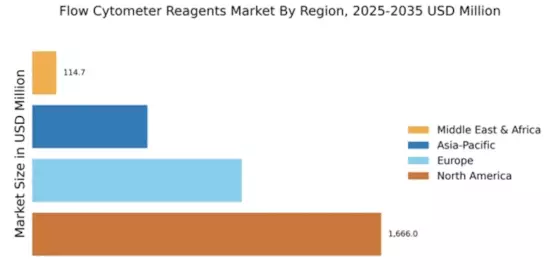
North America continues to lead the Flow Cytometer Reagents Market, holding a significant share of 1666.0. The region's growth is driven by advanced research facilities, increasing investments in biotechnology, and a robust healthcare infrastructure. Regulatory support from agencies like the FDA further catalyzes market expansion, ensuring high-quality standards and safety in reagent production. The United States stands out as the primary market, with key players such as BD Biosciences, Thermo Fisher Scientific, and Bio-Rad Laboratories dominating the landscape. The competitive environment is characterized by continuous innovation and strategic partnerships, enhancing product offerings. As research in immunology and oncology grows, the demand for flow cytometry reagents is expected to rise, solidifying North America's market position.

Europe : Emerging Market with Growth Potential

Europe's Flow Cytometer Reagents Market is valued at 800.0, reflecting a growing demand driven by advancements in medical research and diagnostics. The region benefits from strong regulatory frameworks that promote innovation and ensure safety. Initiatives by the European Medicines Agency (EMA) are pivotal in fostering a conducive environment for market growth, particularly in the life sciences sector. Germany, the UK, and France are leading countries in this market, with a concentration of key players like Merck KGaA and Miltenyi Biotec. The competitive landscape is marked by collaborations between academic institutions and industry leaders, enhancing research capabilities. As Europe focuses on personalized medicine, the demand for flow cytometry reagents is anticipated to increase, positioning the region for significant growth.

Asia-Pacific : Rapidly Growing Market Segment

The Asia-Pacific region, with a market size of 700.0, is rapidly emerging as a significant player in the Flow Cytometer Reagents Market. The growth is fueled by increasing investments in healthcare infrastructure, rising prevalence of chronic diseases, and a growing focus on research and development. Government initiatives aimed at enhancing healthcare access and quality are also contributing to market expansion. Countries like China, Japan, and India are at the forefront of this growth, with a rising number of research institutions and biotechnology firms. The competitive landscape features both local and international players, including Stemcell Technologies and PeproTech. As the region continues to invest in advanced technologies, the demand for flow cytometry reagents is expected to soar, making Asia-Pacific a key market to watch.

Middle East and Africa : Emerging Market with Challenges

The Middle East and Africa (MEA) region, with a market size of 164.66, is gradually developing in the Flow Cytometer Reagents Market. The growth is primarily driven by increasing healthcare investments and a rising focus on research in biotechnology. However, regulatory challenges and varying healthcare standards across countries pose significant hurdles to market expansion. Countries like South Africa and the UAE are leading the market, with a growing number of research institutions and healthcare facilities. The competitive landscape is characterized by a mix of local and international players, striving to meet the unique needs of the region. As governments prioritize healthcare improvements, the demand for flow cytometry reagents is expected to grow, albeit at a slower pace compared to other regions.

Key Players and Competitive Insights

The Flow Cytometer Reagents Market is characterized by a dynamic competitive landscape, driven by innovation, strategic partnerships, and a growing demand for advanced diagnostic tools. Key players such as BD Biosciences (US), Thermo Fisher Scientific (US), and Merck KGaA (DE) are at the forefront, each adopting distinct strategies to enhance their market presence. BD Biosciences (US) focuses on expanding its product portfolio through continuous innovation, while Thermo Fisher Scientific (US) emphasizes strategic acquisitions to bolster its capabilities in flow cytometry. Merck KGaA (DE) appears to be concentrating on regional expansion, particularly in emerging markets, thereby diversifying its customer base and enhancing its competitive edge.

The market structure is moderately fragmented, with several players vying for market share. Key business tactics include localizing manufacturing to reduce costs and optimize supply chains, which is crucial in maintaining competitive pricing. The collective influence of these major companies shapes the market dynamics, as they leverage their strengths to navigate challenges and capitalize on growth opportunities.

In November 2025, BD Biosciences (US) announced the launch of a new line of flow cytometry reagents designed to enhance the accuracy of cell analysis. This strategic move is significant as it not only reinforces BD's commitment to innovation but also addresses the increasing demand for precise diagnostic tools in clinical and research settings. The introduction of these reagents is likely to strengthen BD's market position and attract new customers.

In October 2025, Thermo Fisher Scientific (US) completed the acquisition of a leading biotechnology firm specializing in flow cytometry technologies. This acquisition is pivotal as it expands Thermo Fisher's technological capabilities and enhances its product offerings, positioning the company to better meet the evolving needs of researchers and clinicians. The integration of advanced technologies is expected to drive growth and improve customer satisfaction.

In September 2025, Merck KGaA (DE) entered into a strategic partnership with a prominent research institution to develop next-generation flow cytometry reagents. This collaboration is indicative of Merck's strategy to leverage external expertise and accelerate innovation. By aligning with academic leaders, Merck aims to enhance its research capabilities and bring cutting-edge solutions to market more rapidly.

As of December 2025, the Flow Cytometer Reagents Market is witnessing trends such as digitalization, sustainability, and the integration of AI technologies. These trends are reshaping competitive dynamics, with companies increasingly focusing on strategic alliances to enhance their innovation capabilities. The shift from price-based competition to a focus on technological advancement and supply chain reliability is evident, suggesting that future competitive differentiation will hinge on the ability to innovate and deliver high-quality, reliable products.

Key Companies in the Flow Cytometer Reagents Market market include

Industry Developments

June 2022 BD (US) launched BD FACS Discover S8 Cell Sorter with high-speed imaging technology that sorts cells based on visual characteristics.

April 2020 Merck, a leading science and technology company, launched its new Cell Stream TM benchtop flow cytometry system, a customizable that uses a camera for detection, and its unique optics system and design provide researchers unparalleled sensitivity and flexibility when analyzing cells and submicron particles.

Future Outlook

Flow Cytometer Reagents Market Future Outlook

The Flow Cytometer Reagents Market is projected to grow at a 9.2% CAGR from 2024 to 2035, driven by advancements in biotechnology, increasing research funding, and rising demand for personalized medicine.

New opportunities lie in:

  • Development of novel fluorescent dyes for enhanced detection sensitivity.
  • Expansion into emerging markets with tailored reagent kits.
  • Partnerships with diagnostic labs for custom reagent solutions.

By 2035, the market is expected to achieve substantial growth, solidifying its position as a leader in biotechnological advancements.

Market Segmentation

Flow Cytometer Reagents Market End Use Outlook

  • Research Laboratories
  • Clinical Laboratories
  • Pharmaceutical Companies
  • Biotechnology Companies
  • Academic Institutions

Flow Cytometer Reagents Market Application Outlook

  • Cell Analysis
  • Cell Sorting
  • Apoptosis Detection
  • Immunophenotyping
  • Stem Cell Research

Flow Cytometer Reagents Market Product Type Outlook

  • Fluorescent Dyes
  • Antibodies
  • Beads
  • Buffers
  • Stains

Report Scope

MARKET SIZE 20243330.66(USD Million)
MARKET SIZE 20253637.15(USD Million)
MARKET SIZE 20358771.38(USD Million)
COMPOUND ANNUAL GROWTH RATE (CAGR)9.2% (2024 - 2035)
REPORT COVERAGERevenue Forecast, Competitive Landscape, Growth Factors, and Trends
BASE YEAR2024
Market Forecast Period2025 - 2035
Historical Data2019 - 2024
Market Forecast UnitsUSD Million
Key Companies ProfiledBD Biosciences (US), Beckman Coulter (US), Thermo Fisher Scientific (US), Merck KGaA (DE), Bio-Rad Laboratories (US), Miltenyi Biotec (DE), Abcam (GB), Stemcell Technologies (CA), PeproTech (US)
Segments CoveredApplication, End Use, Product Type
Key Market OpportunitiesAdvancements in personalized medicine drive demand for innovative Flow Cytometer Reagents Market solutions.
Key Market DynamicsRising demand for advanced flow cytometry applications drives innovation in reagents and enhances competitive market dynamics.
Countries CoveredNorth America, Europe, APAC, South America, MEA

Market Highlights

Author
Kinjoll Dey
Research Analyst Level I

He is an extremely curious individual currently working in Healthcare and Medical Devices Domain. Kinjoll is comfortably versed in data centric research backed by healthcare educational background. He leverages extensive data mining and analytics tools such as Primary and Secondary Research, Statistical Analysis, Machine Learning, Data Modelling. His key role also involves Technical Sales Support, Client Interaction and Project management within the Healthcare team. Lastly, he showcases extensive affinity towards learning new skills and remain fascinated in implementing them.

Leave a Comment

FAQs

What is the projected growth of the Flow Cytometer Reagents market?

The Flow Cytometer Reagents market is the expected increase in total market value of 8.77 USD billion over a defined forecast period 2025–2035. It is driven by factors such as demand trends, technological advances, regulatory changes, and geographic expansion.

What is the size of the Flow Cytometer Reagents market?

Flow Cytometer Reagents market size was valued at approximately 3.33 billion USD in 2024. This figure will reach 8.77 billion USD covering all regions (America, Europe, Asia, MEA and ROW), focusing its segments / services / distribution channels till 2035.

What is the CAGR of the Flow Cytometer Reagents market?

Flow Cytometer Reagents market is expected to grow at a CAGR of 9.2% between 2025 and 2035.

How much will the Flow Cytometer Reagents market be worth by 2035?

Flow Cytometer Reagents market is expected to be worth of 8.77 billion USD, reflecting growth driven by usage, technology and global demands by the end of 2035.

How will the Flow Cytometer Reagents market perform over the next 10 years?

Over the next 10 years the Flow Cytometer Reagents market is expected to shift from usd billion 3.33 to 8.77 billion USD, led by adoption of advanced tech, demographic trends, regulatory approvals, with potential headwinds from 2025 to 2035.

Which region held the largest market share in the Flow Cytometer Reagents market?

North America had the largest share of the market.

Who are the key players in the Flow Cytometer Reagents market?

The key players in the market are Biocompare, Bio-Rad Laboratories, Inc., Miltenyi Biotec, Bio Legend, Inc., Becton, Dickinson and Company, Beckman Coulter, Inc., Merck KGaA, Immuno Reagents, Inc., Thermo Fisher Scientific.

Download Free Sample

Kindly complete the form below to receive a free sample of this Report

Compare Licence

×
Features License Type
Single User Multiuser License Enterprise User
Price $4,950 $5,950 $7,250
Maximum User Access Limit 1 User Upto 10 Users Unrestricted Access Throughout the Organization
Free Customization
Direct Access to Analyst
Deliverable Format
Platform Access
Discount on Next Purchase 10% 15% 15%
Printable Versions