×
Request Free Sample ×

Kindly complete the form below to receive a free sample of this Report

* Please use a valid business email

Leading companies partner with us for data-driven Insights

clients tt-cursor
Hero Background

Fluid Power Equipment Market

ID: MRFR/EnP/6463-HCR
111 Pages
Anshula Mandaokar
October 2025

Fluid Power Equipment Market Research Report Information By Type (Hydraulic and Pneumatic), By Component (Pumps, Motors, Valves, Cylinder, Steel Tube and Compression Fitting, Accumulators, and Accessories), By Application (Construction, Automotive, Oil & Gas, Food Processing, Packaging, Semiconductor, and Others) And By Region (North America, Europe, Asia-Pacific, And Rest Of The World) – Global Industry Size, Share, Growth, Trends and Forecast To 2035

Share:
Download PDF ×

We do not share your information with anyone. However, we may send you emails based on your report interest from time to time. You may contact us at any time to opt-out.

Fluid Power Equipment Market Infographic
Purchase Options

Fluid Power Equipment Market Summary

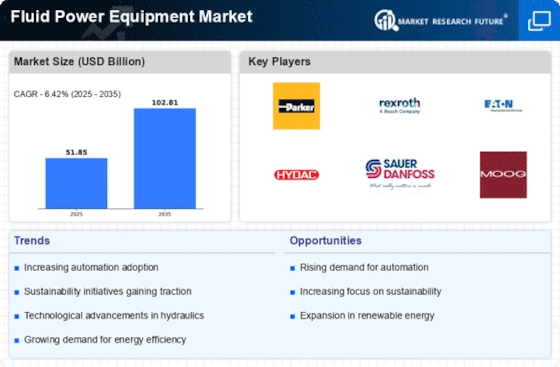
As per Market Research Future analysis, the Fluid Power Equipment Market Size was estimated at 51.85 USD Billion in 2024. The Fluid Power Equipment industry is projected to grow from 55.18 USD Billion in 2025 to 102.81 USD Billion by 2035, exhibiting a compound annual growth rate (CAGR) of 6.42% during the forecast period 2025 - 2035.

Key Market Trends & Highlights

The Fluid Power Equipment Market is poised for robust growth driven by technological advancements and increasing demand across various sectors.

  • Technological integration is reshaping the Fluid Power Equipment Market, enhancing efficiency and performance.
  • A strong sustainability focus is emerging, with companies prioritizing eco-friendly solutions in fluid power systems.
  • Customization and flexibility are becoming essential as industries seek tailored solutions to meet specific operational needs.
  • Rising demand in the construction sector and increased automation in manufacturing are key drivers propelling market expansion.

Market Size & Forecast

2024 Market Size 51.85 (USD Billion)
2035 Market Size 102.81 (USD Billion)
CAGR (2025 - 2035) 6.42%

Major Players

Parker Hannifin (US), Bosch Rexroth (DE), Eaton (US), Hydac (DE), Sauer-Danfoss (DK), Moog (US), Bucher Hydraulics (DE), Danfoss (DK), Kawasaki (JP)

Fluid Power Equipment Market Trends

The Fluid Power Equipment Market is currently experiencing a dynamic evolution, driven by advancements in technology and increasing demand across various sectors. The integration of automation and smart technologies appears to be reshaping the landscape, as industries seek to enhance efficiency and reduce operational costs. Furthermore, the growing emphasis on sustainability and energy efficiency is prompting manufacturers to innovate and develop more eco-friendly solutions. This shift not only aligns with global environmental goals but also caters to the rising consumer preference for sustainable products. In addition, the Fluid Power Equipment Market is witnessing a notable trend towards customization and flexibility in product offerings. Companies are increasingly focusing on tailored solutions to meet specific client needs, which may enhance customer satisfaction and loyalty. The competitive landscape is also evolving, with new entrants and established players alike striving to differentiate themselves through unique value propositions. Overall, the Fluid Power Equipment Market seems poised for continued growth, driven by technological advancements and a commitment to sustainability.

Technological Integration

The Fluid Power Equipment Market is increasingly influenced by the integration of advanced technologies. Automation and smart systems are becoming prevalent, allowing for enhanced operational efficiency and precision. This trend indicates a shift towards more intelligent fluid power solutions that can adapt to varying operational demands.

Sustainability Focus

There is a growing emphasis on sustainability within the Fluid Power Equipment Market. Manufacturers are exploring eco-friendly materials and energy-efficient designs to meet regulatory standards and consumer expectations. This focus on environmental responsibility suggests a long-term commitment to reducing the ecological footprint of fluid power systems.

Customization and Flexibility

The demand for customized solutions is rising in the Fluid Power Equipment Market. Companies are increasingly offering tailored products to address specific client requirements. This trend highlights the importance of flexibility in product design, which may enhance competitiveness and customer satisfaction.

Fluid Power Equipment Market Drivers

Growing Focus on Renewable Energy

The Fluid Power Equipment Market is increasingly influenced by the growing focus on renewable energy sources. As nations strive to reduce their carbon footprints and transition towards sustainable energy solutions, the demand for fluid power systems in renewable energy applications is expected to rise. In 2025, investments in renewable energy infrastructure are projected to exceed 1 trillion dollars, creating opportunities for fluid power equipment manufacturers. Hydraulic systems are essential in wind turbines and solar energy installations, providing the necessary force for operation and maintenance. This trend suggests that fluid power equipment will play a pivotal role in supporting the renewable energy sector, thereby driving market growth. Additionally, as technology evolves, fluid power solutions are likely to become more efficient and environmentally friendly, further enhancing their appeal in the renewable energy landscape.

Rising Demand in Construction Sector

The Fluid Power Equipment Market experiences a notable surge in demand driven by the construction sector. As urbanization accelerates, the need for heavy machinery and equipment that utilize fluid power systems becomes increasingly critical. In 2025, the construction industry is projected to grow at a compound annual growth rate of approximately 5.5%, which directly influences the fluid power equipment market. Hydraulic systems, in particular, are essential for cranes, excavators, and other construction machinery, enhancing efficiency and productivity. This trend indicates a robust market potential for fluid power equipment manufacturers, as they align their offerings with the evolving needs of the construction sector. Furthermore, the integration of advanced technologies in construction equipment is likely to further bolster the demand for fluid power solutions, making this sector a key driver for the industry.

Increased Automation in Manufacturing

The Fluid Power Equipment Market is significantly impacted by the ongoing trend of increased automation in manufacturing processes. As industries strive for higher efficiency and reduced operational costs, the adoption of automated systems that utilize fluid power technology is on the rise. In 2025, it is estimated that the automation market will reach a valuation of over 200 billion dollars, with fluid power systems playing a crucial role in this transformation. Pneumatic and hydraulic systems are integral to automated machinery, providing the necessary force and precision for various applications. This shift towards automation not only enhances productivity but also reduces labor costs, thereby driving the demand for fluid power equipment. Consequently, manufacturers are likely to invest in innovative fluid power solutions to meet the growing needs of automated manufacturing environments.

Advancements in Fluid Power Technology

The Fluid Power Equipment Market is witnessing substantial growth due to advancements in fluid power technology. Innovations such as smart hydraulic systems and energy-efficient pneumatic solutions are reshaping the landscape of fluid power applications. In 2025, the market for energy-efficient fluid power systems is expected to expand significantly, driven by the increasing emphasis on sustainability and operational efficiency. These technological advancements enable better control, reduced energy consumption, and enhanced performance of fluid power equipment. As industries seek to optimize their operations, the demand for cutting-edge fluid power solutions is likely to rise. Furthermore, the integration of IoT and data analytics into fluid power systems may provide manufacturers with valuable insights, allowing for predictive maintenance and improved system reliability, thus propelling the growth of the fluid power equipment market.

Expansion of Agricultural Mechanization

The Fluid Power Equipment Market is experiencing growth due to the expansion of agricultural mechanization. As the global population continues to rise, the demand for efficient agricultural practices is becoming increasingly critical. In 2025, the agricultural machinery market is anticipated to grow at a rate of approximately 6%, with fluid power systems being integral to modern farming equipment. Hydraulic systems are widely used in tractors, harvesters, and irrigation systems, enhancing productivity and reducing labor requirements. This trend indicates a strong potential for fluid power equipment manufacturers to cater to the evolving needs of the agricultural sector. Furthermore, the integration of advanced technologies such as precision farming and automated machinery is likely to further drive the demand for fluid power solutions, positioning the industry for sustained growth.

Market Segment Insights

Fluid Power Equipment Market Type Insights

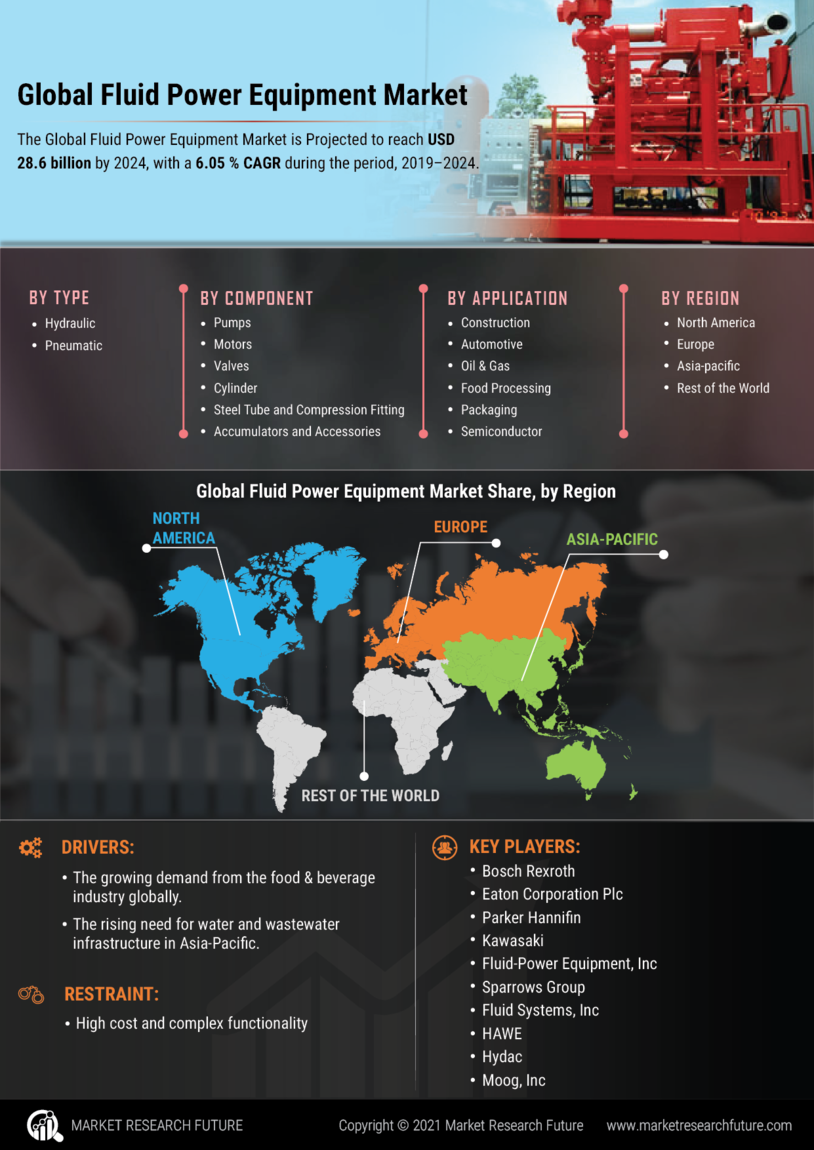
The market segmentation, based on Type, includes Hydraulic and Pneumatic. The Hydraulic segment holds the majority share in 2021 of the market. Due to its efficiency and cost-effectiveness.

Fluid Power Equipment Market Component Insights

Based on Components, the market segmentation includes Pumps, Motors, Valves, Cylinders, Steel tubes and Compression Fitting, Accumulators and Accessories. The Motors segment is estimated to account for the largest share of the market. These motors play an important role in a wide range of industries such as automotive, and industrial. 

With their ability to provide high torque and power output, they are increasingly being adopted in a variety of applications. Moreover, advancements in technology have further enhanced their performance and efficiency making them more cost-effective for companies looking for reliable solutions.

Fluid Power Equipment Market Application Insights

Based on Application, the market segmentation includes Construction, Automotive, Oil & Gas, Food Processing, Packaging, Semiconductors, and Others. The Construction segment dominated the market in 2021. By utilizing fluid power technology, construction companies can increase efficiency and accuracy, reduce costs, and improve safety on the job site. This equipment is used in a wide range of applications including material handling, excavation, demolition, and more.

Figure 2 : Fluid Power Equipment Market, by Application, 2021 & 2030 (USD Billion)

Source Secondary Research, Primary Research, Market Research Future Database, and Analyst Review

Get more detailed insights about Fluid Power Equipment Market

Regional Insights

North America : Innovation and Demand Surge

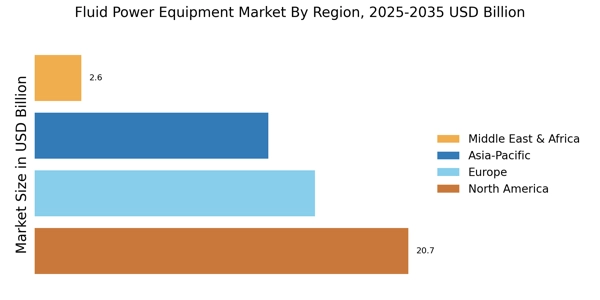
North America is the largest market for fluid power equipment, holding approximately 40% of the global market share. The growth is driven by increasing automation in manufacturing, stringent regulations on energy efficiency, and a rising demand for advanced hydraulic systems. The U.S. is the primary contributor, followed by Canada, which is experiencing a surge in demand for fluid power solutions in various sectors, including construction and agriculture. The competitive landscape in North America is robust, featuring key players like Parker Hannifin, Eaton, and Moog. These companies are investing heavily in R&D to innovate and enhance their product offerings. The presence of a well-established manufacturing base and a strong distribution network further solidifies the region's position. Additionally, government initiatives promoting sustainable practices are expected to bolster market growth.

Europe : Strong Manufacturing Backbone

Europe is the second-largest market for fluid power equipment, accounting for around 30% of the global market share. The region benefits from a strong manufacturing base, particularly in Germany and France, where demand for hydraulic and pneumatic systems is on the rise. Regulatory frameworks focusing on energy efficiency and sustainability are driving innovation and adoption of advanced fluid power technologies across various industries. Germany leads the European market, supported by key players like Bosch Rexroth and Hydac. The competitive landscape is characterized by a mix of established companies and innovative startups, fostering a dynamic environment for growth. The European Union's commitment to reducing carbon emissions is also pushing manufacturers to develop more efficient fluid power solutions, enhancing the region's market potential.

Asia-Pacific : Rapid Growth and Expansion

Asia-Pacific is witnessing rapid growth in the fluid power equipment market, holding approximately 25% of the global market share. The region's growth is fueled by industrialization, urbanization, and increasing investments in infrastructure projects. Countries like China and India are leading the charge, with significant demand for hydraulic systems in construction, manufacturing, and automotive sectors, driven by government initiatives to boost economic development. China is the largest market in the region, with a strong presence of local and international players. Companies like Kawasaki and Danfoss are expanding their operations to cater to the growing demand. The competitive landscape is evolving, with a focus on innovation and cost-effective solutions. As the region continues to industrialize, the demand for fluid power equipment is expected to rise significantly, making it a key area for future investments.

Middle East and Africa : Resource-Rich Opportunities

The Middle East and Africa region is gradually emerging as a significant market for fluid power equipment, accounting for about 5% of the global market share. The growth is primarily driven by increasing investments in oil and gas, mining, and construction sectors. Countries like the UAE and South Africa are leading the market, with a growing demand for hydraulic systems to support various industrial applications and infrastructure projects. The competitive landscape is characterized by a mix of local and international players, with companies focusing on providing tailored solutions to meet regional needs. The presence of abundant natural resources and ongoing infrastructure development projects are expected to drive further growth in the fluid power market. As the region continues to diversify its economy, the demand for advanced fluid power technologies is likely to increase, presenting new opportunities for market players.

Fluid Power Equipment Market Regional Image

Key Players and Competitive Insights

The Fluid Power Equipment Market is currently characterized by a dynamic competitive landscape, driven by technological advancements and increasing demand for automation across various industries. Key players such as Parker Hannifin (US), Bosch Rexroth (DE), and Eaton (US) are strategically positioned to leverage innovation and expand their market presence. Parker Hannifin (US) focuses on enhancing its product portfolio through continuous research and development, while Bosch Rexroth (DE) emphasizes digital transformation and smart manufacturing solutions. Eaton (US) is actively pursuing partnerships to bolster its capabilities in energy-efficient fluid power systems, collectively shaping a competitive environment that prioritizes technological leadership and operational excellence.

In terms of business tactics, companies are increasingly localizing manufacturing to reduce lead times and optimize supply chains. The Fluid Power Equipment Market appears moderately fragmented, with a mix of established players and emerging companies. This structure allows for competitive dynamics where key players can exert significant influence, particularly through strategic collaborations and innovations that enhance product offerings and customer service.

In August 2025, Parker Hannifin (US) announced the launch of a new line of energy-efficient hydraulic pumps designed to reduce energy consumption by up to 30%. This strategic move not only aligns with global sustainability trends but also positions Parker as a leader in eco-friendly fluid power solutions. The introduction of these pumps is likely to attract environmentally conscious customers and enhance Parker's competitive edge in the market.

In September 2025, Bosch Rexroth (DE) unveiled its latest IoT-enabled hydraulic systems, which integrate advanced data analytics for predictive maintenance. This initiative underscores Bosch's commitment to digitalization and reflects a broader industry trend towards smart technologies. By offering solutions that enhance operational efficiency and reduce downtime, Bosch Rexroth is poised to strengthen its market position and cater to the evolving needs of its customers.

In July 2025, Eaton (US) entered into a strategic partnership with a leading automation technology firm to develop integrated fluid power solutions for the manufacturing sector. This collaboration is expected to enhance Eaton's product offerings and provide customers with comprehensive solutions that combine fluid power with automation technologies. Such partnerships are indicative of a trend where companies seek to create synergies that drive innovation and improve customer value.

As of October 2025, the Fluid Power Equipment Market is witnessing significant trends such as digitalization, sustainability, and the integration of artificial intelligence. These trends are reshaping competitive dynamics, with companies increasingly focusing on strategic alliances to enhance their technological capabilities. The shift from price-based competition to a focus on innovation, technology, and supply chain reliability is becoming evident. Moving forward, competitive differentiation will likely hinge on the ability to deliver advanced, sustainable solutions that meet the complex demands of modern industries.

Key Companies in the Fluid Power Equipment Market market include

Industry Developments

In June 2022, Bosch Rexroth, a Germany-based engineering firm that provides hydraulic products partnered with AGILOX to open up the market for autonomous mobile robots. This partnership aimed to combine strong products and scale the presence.

In February 2022, AGILOX announced a partnership with Parker Hannifin Corporation. This partnership enables customers to receive real-time alerts and access diagnostic messages for Parker components and Cummins engines in a single dashboard. Cummins Inc. is a US-based company that manufactures filtration, engines, and power generation products.

March 2024, A global manufacturer of innovative, vastly designed power transmission and fluid power solutions, Gates, has disclosed its partnership and entry into the fast-mounting and evolving data center cooling market with CoolIT Systems.

CoolIT Systems is the global leader in accessible liquid cooling technology for the world's most demanding computing environments. To fulfill the escalating demand in the AI, enterprise, and high-performance computing (HPC) markets, CoolIT is operating with Gates to build the most efficient and reliable liquid cooling solutions available in the market at present.

The collaboration involves developing advanced solutions and strengthening the supply chain between Gates' intense North America-based operations and CoolIT's Calgary, Canada production hub. Gates is using its technical expertise in materials science, thermal management, and fluid conveyance to provide reliable and efficient solutions for the data center cooling market. 

Gates' solutions incorporate a wide variety of highly engineered products that manage the rigorous demands of high-performance computing environments where uptime and reliability are crucial.

September 2023, The parent company of Aerox Aviation Oxygen Systems, O2 Aero Acquisitions, announced the acquisition of Fluid Power Inc., a longtime producer of aviation oxygen systems and concerned components for military use. Aerox stated that the addition extends its range of aviation oxygen systems while growing its global customer base. 

The O2 Aero managing director and Aerox president, Scott Ashton, said that the acquisition of Fluid Power will produce a balanced military and civil aviation product range and will offer better manufacturing capacity and engineering expertise.

He further added that Fluid Power has a 75-year legacy of servicing the aviation industry, offering advanced oxygen equipment as far back as the Korean War, and at present offers several oxygen components for military applications. Aerox stated the two organizations' product ranges are complementary and will enable them to cater to more segments of the aviation oxygen market.

Future Outlook

Fluid Power Equipment Market Future Outlook

The Fluid Power Equipment Market is projected to grow at a 6.42% CAGR from 2024 to 2035, driven by automation, energy efficiency, and technological advancements.

New opportunities lie in:

  • Development of smart hydraulic systems for predictive maintenance.
  • Expansion into renewable energy applications for fluid power solutions.
  • Integration of IoT technologies in fluid power equipment for enhanced monitoring.

By 2035, the Fluid Power Equipment Market is expected to achieve robust growth and innovation.

Market Segmentation

Fluid Power Equipment Market Type Outlook

  • Hydraulic
  • Pneumatic

Fluid Power Equipment Market Component Outlook

  • Pumps
  • Motors
  • Valves
  • Cylinders
  • Steel tubes and Compression Fitting
  • Accumulators and Accessories

Fluid Power Equipment Market Application Outlook

  • Construction
  • Automotive
  • Oil & Gas
  • Food Processing
  • Packaging
  • Semiconductors
  • Others

Report Scope

MARKET SIZE 2024 51.85(USD Billion)
MARKET SIZE 2025 55.18(USD Billion)
MARKET SIZE 2035 102.81(USD Billion)
COMPOUND ANNUAL GROWTH RATE (CAGR) 6.42% (2024 - 2035)
REPORT COVERAGE Revenue Forecast, Competitive Landscape, Growth Factors, and Trends
BASE YEAR 2024
Market Forecast Period 2025 - 2035
Historical Data 2019 - 2024
Market Forecast Units USD Billion
Key Companies Profiled Market analysis in progress
Segments Covered Market segmentation analysis in progress
Key Market Opportunities Integration of smart technologies enhances efficiency in the Fluid Power Equipment Market.
Key Market Dynamics Technological advancements and regulatory changes drive innovation and competition in the Fluid Power Equipment Market.
Countries Covered North America, Europe, APAC, South America, MEA

Market Highlights

Author
Anshula Mandaokar
Team Lead - Research

Anshula Mandaokar holds an academic degree in Chemical Engineering and has been contributing to the field for more than 5 years. She has expertise in Market Research and Business Consulting and serves as a Team Lead for a reputed Market Research firm under the Chemicals and Materials domain spectrum. She has worked on multiple projects, generating explicit results in a quick turnaround time. Her understanding of data interpretation justifies her role as a leader.

Leave a Comment

FAQs

What is the current valuation of the Fluid Power Equipment Market as of 2024?

The Fluid Power Equipment Market was valued at 51.85 USD Billion in 2024.

What is the projected market size for the Fluid Power Equipment Market by 2035?

The market is projected to reach 102.81 USD Billion by 2035.

What is the expected CAGR for the Fluid Power Equipment Market during the forecast period 2025 - 2035?

The expected CAGR for the Fluid Power Equipment Market during 2025 - 2035 is 6.42%.

Which segments are included in the Fluid Power Equipment Market?

The market includes segments such as Type, Component, and Application.

What are the projected valuations for the Hydraulic and Pneumatic segments by 2035?

The Hydraulic segment is projected to reach between 30.0 and 60.0 USD Billion, while the Pneumatic segment is expected to reach between 21.85 and 42.81 USD Billion by 2035.

Which components are driving growth in the Fluid Power Equipment Market?

Key components driving growth include Pumps, Motors, Valves, and Cylinders, with projected valuations ranging from 5.0 to 26.81 USD Billion by 2035.

Download Free Sample

Kindly complete the form below to receive a free sample of this Report

Compare Licence

×
Features License Type
Single User Multiuser License Enterprise User
Price $4,950 $5,950 $7,250
Maximum User Access Limit 1 User Upto 10 Users Unrestricted Access Throughout the Organization
Free Customization
Direct Access to Analyst
Deliverable Format
Platform Access
Discount on Next Purchase 10% 15% 15%
Printable Versions