×
Request Free Sample ×

Kindly complete the form below to receive a free sample of this Report

* Please use a valid business email

Leading companies partner with us for data-driven Insights

clients tt-cursor
Hero Background

Food Pathogen Testing Market

ID: MRFR/FnB/20097-HCR
200 Pages
Snehal Singh
October 2025

Food Pathogen Testing Market Research Report By Technology (Polymerase Chain Reaction, Enzyme-Linked Immunosorbent Assay, Next Generation Sequencing, Isothermal Nucleic Acid Amplification Techniques), By Application (Meat and Poultry Testing, Dairy Testing, Seafood Testing, Fruits and Vegetables Testing), By End Use (Food Manufacturers, Food Retailers, Quality Control Laboratories, Government Agencies), By Pathogen Type (Bacteria, Viruses, Protozoa, Fungi) and By Regional (North America, Europe, South America, Asia Pacific, Middle East and A... read more

Share:
Download PDF ×

We do not share your information with anyone. However, we may send you emails based on your report interest from time to time. You may contact us at any time to opt-out.

Food Pathogen Testing Market Infographic
Purchase Options

Food Pathogen Testing Market Summary

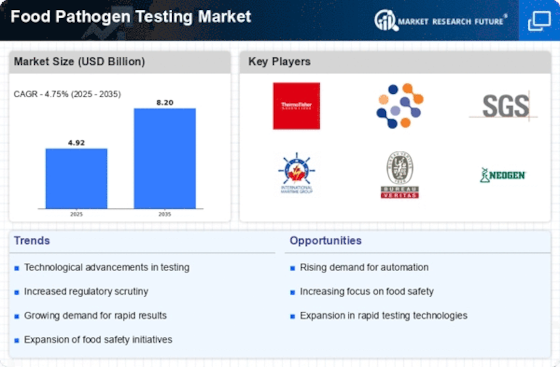
As per MRFR analysis, the Food Pathogen Testing Market was estimated at 4.923 USD Billion in 2024. The Food Pathogen Testing industry is projected to grow from 5.157 USD Billion in 2025 to 8.202 USD Billion by 2035, exhibiting a compound annual growth rate (CAGR) of 4.75 during the forecast period 2025 - 2035.

Key Market Trends & Highlights

The Food Pathogen Testing Market is experiencing robust growth driven by technological advancements and increasing regulatory compliance.

  • North America remains the largest market for food pathogen testing, driven by stringent food safety regulations.
  • Asia-Pacific is emerging as the fastest-growing region, fueled by rising consumer awareness and food safety concerns.
  • Polymerase Chain Reaction technology dominates the market, while Next Generation Sequencing is rapidly gaining traction due to its efficiency.
  • Key market drivers include rising incidences of foodborne illnesses and the expansion of food processing and distribution networks.

Market Size & Forecast

2024 Market Size 4.923 (USD Billion)
2035 Market Size 8.202 (USD Billion)
CAGR (2025 - 2035) 4.75%

Major Players

Thermo Fisher Scientific (US), Eurofins Scientific (LU), SGS SA (CH), Intertek Group (GB), Bureau Veritas (FR), Neogen Corporation (US), Bio-Rad Laboratories (US), Merck KGaA (DE), Romer Labs (AT)

Food Pathogen Testing Market Trends

The Food Pathogen Testing Market is currently experiencing a notable evolution, driven by increasing consumer awareness regarding food safety and the rising incidence of foodborne illnesses. Regulatory bodies are imposing stringent guidelines to ensure that food products meet safety standards, which in turn propels the demand for effective testing solutions. Technological advancements in testing methodologies, such as rapid testing kits and molecular techniques, are enhancing the efficiency and accuracy of pathogen detection. This shift towards more sophisticated testing approaches appears to be a response to the growing complexity of food supply chains and the need for real-time monitoring of food safety. Moreover, the market is likely to witness a surge in investments aimed at research and development, as stakeholders seek innovative solutions to combat emerging pathogens. The integration of automation and artificial intelligence in testing processes may further streamline operations, reduce human error, and improve turnaround times. As the Food Pathogen Testing Market continues to expand, collaboration among industry players, regulatory agencies, and research institutions seems essential to address the evolving challenges in food safety. This collaborative approach could foster the development of comprehensive testing frameworks that not only meet regulatory requirements but also enhance consumer confidence in food products.

Technological Advancements in Testing Methods

The Food Pathogen Testing Market is increasingly influenced by innovations in testing technologies. Rapid testing kits and molecular techniques are becoming more prevalent, allowing for quicker and more accurate detection of pathogens. These advancements are essential in addressing the complexities of modern food supply chains.

Regulatory Pressures and Compliance

Stringent regulations imposed by governmental bodies are shaping the landscape of the Food Pathogen Testing Market. Compliance with these regulations is crucial for food manufacturers, driving the demand for reliable testing solutions to ensure safety and quality in food products.

Growing Consumer Awareness

There is a noticeable increase in consumer awareness regarding food safety, which is impacting the Food Pathogen Testing Market. As consumers become more informed about foodborne illnesses, they are demanding higher safety standards, prompting manufacturers to invest in effective testing solutions.

Food Pathogen Testing Market Drivers

Growing Consumer Awareness

Consumer awareness regarding food safety is on the rise, significantly impacting the Food Pathogen Testing Market. As individuals become more informed about the risks associated with foodborne pathogens, they are demanding higher safety standards from food producers. This shift in consumer behavior is prompting manufacturers to invest in comprehensive testing programs to ensure the safety and quality of their products. Surveys indicate that over 70% of consumers are willing to pay a premium for food products that are certified safe from pathogens. This trend is likely to drive the market forward, as companies strive to meet consumer expectations and enhance their brand reputation. The increasing focus on transparency in food sourcing and production further amplifies the need for effective pathogen testing.

Regulatory Pressures and Compliance

The Food Pathogen Testing Market is heavily influenced by stringent regulatory frameworks aimed at ensuring food safety. Governments and regulatory bodies are implementing rigorous standards for pathogen testing in food products, which compels manufacturers to adopt advanced testing methods. Compliance with these regulations is not only essential for market access but also for maintaining consumer trust. The increasing number of foodborne illness outbreaks has led to heightened scrutiny and enforcement of testing protocols. Consequently, the market is witnessing a surge in demand for reliable testing solutions that meet regulatory requirements. It is estimated that the market could reach a valuation of USD 5 billion by 2027, driven by the need for compliance and the prevention of foodborne diseases.

Rising Incidence of Foodborne Illnesses

The Food Pathogen Testing Market is significantly impacted by the rising incidence of foodborne illnesses worldwide. Reports indicate that millions of cases of foodborne diseases occur annually, leading to severe health consequences and economic losses. This alarming trend has prompted governments and health organizations to prioritize food safety initiatives, thereby increasing the demand for pathogen testing. The economic burden associated with foodborne illnesses is estimated to exceed USD 15 billion annually, highlighting the critical need for effective testing solutions. As awareness of these issues grows, food manufacturers are compelled to implement rigorous testing protocols to mitigate risks and protect public health. This increasing focus on prevention is likely to drive market growth in the coming years.

Technological Advancements in Testing Methods

The Food Pathogen Testing Market is experiencing a notable transformation due to rapid technological advancements. Innovations such as PCR (Polymerase Chain Reaction) and next-generation sequencing are enhancing the speed and accuracy of pathogen detection. These methods allow for the identification of pathogens in food samples within hours, significantly reducing the time required for testing. Furthermore, the integration of automation and artificial intelligence in testing processes is streamlining operations, thereby increasing efficiency. As a result, the market is projected to grow at a compound annual growth rate (CAGR) of approximately 7% over the next five years. This growth is driven by the need for faster testing solutions to meet the demands of food safety regulations and consumer expectations.

Expansion of Food Processing and Distribution Networks

The Food Pathogen Testing Market is also influenced by the expansion of food processing and distribution networks. As the food supply chain becomes more complex, the potential for contamination increases, necessitating robust testing measures. The globalization of food trade has led to a greater variety of food products entering markets, which in turn raises the stakes for food safety. Companies are increasingly recognizing the importance of pathogen testing as a critical component of their quality assurance processes. The market is expected to benefit from this trend, as businesses invest in advanced testing technologies to ensure the safety of their products throughout the supply chain. This expansion is projected to contribute to a market growth rate of approximately 6% over the next few years.


Market Segment Insights

By Technology: Polymerase Chain Reaction (Largest) vs. Next Generation Sequencing (Fastest-Growing)

In the Food Pathogen Testing Market, the Polymerase Chain Reaction (PCR) technique holds the largest share, dominating the landscape with its efficiency and reliability. This method is widely used for detecting pathogens like bacteria and viruses, making it a go-to choice for laboratories seeking accuracy in food safety testing. On the other hand, Next Generation Sequencing (NGS) is gaining traction as a revolutionary approach, providing comprehensive insights into microbial communities and unidentified pathogens, although its market share is still growing compared to PCR.

Technology: PCR (Dominant) vs. NGS (Emerging)

Polymerase Chain Reaction (PCR) is recognized as the dominant technology in the Food Pathogen Testing Market due to its ability to amplify small segments of DNA, allowing for the detection of pathogens with high sensitivity and specificity. Its established protocols make PCR a preferred choice in clinical and food safety testing. In contrast, Next Generation Sequencing (NGS) is an emerging technology that offers a high-throughput approach, enabling the sequencing of entire genomes at once. This technology is particularly advantageous for identifying novel pathogens and understanding complex microbial ecosystems, making it a vital tool for the evolving food safety challenges.

By Application: Meat and Poultry Testing (Largest) vs. Dairy Testing (Fastest-Growing)

In the Food Pathogen Testing Market, Meat and Poultry Testing holds the largest market share among application segments, primarily driven by the significant consumption of these products and the stringent food safety regulations imposed by authorities. This segment accounts for a substantial portion of the market due to increasing awareness and compliance with safety standards in the meat processing industry. Meanwhile, Dairy Testing, while currently holding a smaller share, is rapidly gaining traction. The rising incidences of dairy-related foodborne illnesses and the shifting consumer preferences towards organic dairy products are contributing to its growth. The growth trends within this market segment reflect a broader focus on food safety and quality assurance. As foodborne pathogens continue to pose health risks, the food industry is innovating and adopting advanced testing technologies to ensure the safety of their products. The demand for Dairy Testing is being propelled by emerging markets, with an increased emphasis on monitoring and testing for pathogens in raw and processed dairy products. Concurrently, Meat and Poultry Testing remains critical due to regulatory pressures and consumer demands for transparency, ensuring that meat products are safe for consumption.

Meat and Poultry Testing (Dominant) vs. Seafood Testing (Emerging)

Meat and Poultry Testing is considered the dominant segment within the Food Pathogen Testing Market, largely because of the rigorous safety protocols required in the processing of these food categories. The robust regulatory framework surrounding meat safety necessitates regular testing for pathogens such as Salmonella and E. coli, making this segment highly essential for producers. On the other hand, Seafood Testing is emerging as a significant player in the market. With the rising global demand for seafood and increased awareness of contamination issues, this segment is beginning to witness a surge in testing requirements. Seafood is often associated with unique pathogens, which drives the need for specialized testing methods. Thus, while Meat and Poultry Testing continues to lead, the growth of Seafood Testing reflects changing consumer preferences and awareness regarding food safety.

By End Use: Food Manufacturers (Largest) vs. Food Retailers (Fastest-Growing)

The Food Pathogen Testing Market exhibits a diverse distribution among its end-use segments, with Food Manufacturers commanding the largest share. This is primarily due to the essential role these manufacturers play in ensuring the safety and quality of food products prior to reaching consumers. Meanwhile, Food Retailers are experiencing rapid growth as safety concerns become increasingly paramount among consumers, driving them to invest more in testing solutions to maintain trust and compliance with safety regulations.

Food Manufacturers (Dominant) vs. Food Retailers (Emerging)

Food Manufacturers represent the dominant force within the Food Pathogen Testing Market, often requiring comprehensive testing processes to ensure the safety of their products before distribution. They have established rigorous testing protocols and are focused on reducing the risk of foodborne illnesses. Conversely, Food Retailers, considered the emerging segment, are increasingly adopting testing solutions to assure customers of food safety. Retailers are leveraging advanced testing technologies not only to comply with regulations but also to enhance their brand reputation in an increasingly competitive market, thus becoming integral partners in the food safety chain.

By Pathogen Type: Bacteria (Largest) vs. Viruses (Fastest-Growing)

In the Food Pathogen Testing Market, Bacteria holds the largest share among the pathogen types, driven by the high incidence of foodborne illnesses linked to bacterial contamination. The global focus on food safety regulations and standards continually propels demand for reliable testing solutions for bacteria such as Salmonella, E. coli, and Listeria. Meanwhile, Viruses are emerging as the fastest-growing segment, spurred by increasing awareness of viral outbreaks within food supply chains, such as Norovirus and Hepatitis A.

Bacteria (Dominant) vs. Viruses (Emerging)

Bacteria represent the dominant pathogen type in food testing due to their substantial public health impact. With stringent food safety regulations and growing consumer awareness, the demand for bacterial testing is robust. On the other hand, Viruses are seen as an emerging segment, experiencing significant growth due to recent viral outbreaks affecting food safety. This segment has attracted considerable investment in innovative testing technologies and techniques, underscoring the need for rapid, accurate testing solutions. Companies are actively focusing on refining test methods and expanding their offerings to cover more viral pathogens, signaling a vital shift in market dynamics.

Get more detailed insights about Food Pathogen Testing Market

Regional Insights

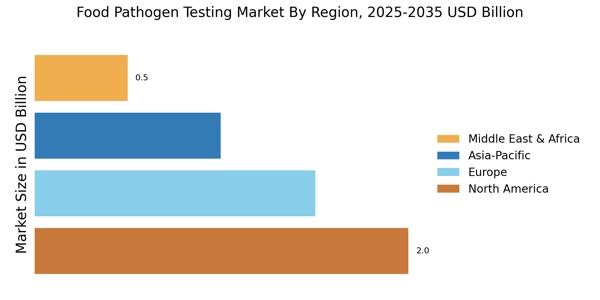
The Food Pathogen Testing Market is experiencing significant growth, with regional insights revealing varying market dynamics across different areas. North America stood as a major player, valued at 1.74 USD Billion in 2024, with projections of reaching 2.87 USD Billion by 2035, showcasing its dominant position attributed to stringent food safety regulations and advanced technology integration. Europe closely followed, valued at 1.42 USD Billion in 2024 and expected to reach 2.34 USD Billion by 2035, supported by robust food quality standards and consumer awareness.

The Asia-Pacific (APAC) region was valued at 1.02 USD Billion in 2024 and is projected to expand to 1.66 USD Billion by 2035; it is witnessing growth due to increasing population and food consumption patterns. South America, with a starting value of 0.45 USD Billion in 2024 and a forecasted 0.73 USD Billion in 2035, is gradually enhancing its food safety regulations, while the Middle East and Africa (MEA) represented the smallest yet growing segment, valued at 0.29 USD Billion in 2024 and 0.47 USD Billion by 2035.

The variance in regional representation underscores the importance of tailored regulatory approaches and technological advancements to address local demands effectively, constituting key factors influencing the overall Food Pathogen Testing Market statistics.

Food Pathogen Testing Market Regional Image

Key Players and Competitive Insights

The Food Pathogen Testing Market has emerged as a crucial segment within the food safety industry, driven by increasing consumer concerns about foodborne illnesses and the need for stringent regulatory compliance. As foodborne pathogens pose significant health risks, companies within this market are continuously innovating and investing in advanced testing technologies to enhance their product offerings. The competitive landscape is characterized by a mix of well-established players and emerging companies, all vying for market share through strategic partnerships and acquisitions, as well as enhancing their technological capabilities.

The landscape is further shaped by trends such as the rising adoption of automated systems, improving accuracy in testing methods, and the increasing demand for rapid testing solutions, all of which enhance the overall growth potential of this market.

Neogen Corporation is a prominent player in the Food Pathogen Testing Market, showcasing a strong commitment to providing high-quality solutions for food safety testing. They have established a robust market presence through their comprehensive portfolio, which includes a wide array of pathogen testing kits and equipment. Neogen’s strengths lie in its innovative research and development capabilities, allowing it to stay ahead of industry trends and address the evolving needs of its customers. Their strong customer relationships are bolstered by a reputation for reliability and accuracy, ensuring they remain a trusted partner for food safety professionals around the world. 

Moreover, Neogen’s global reach is enhanced by its effective distribution channels, making its testing solutions readily accessible in various regions.Thermo Fisher Scientific holds a significant position in the Food Pathogen Testing Market, recognized for its extensive range of key products and services catered to the food safety domain. The company’s offerings include advanced pathogen detection kits, laboratory equipment, and software solutions aimed at enhancing operational efficiencies for food laboratories. Thermo Fisher Scientific benefits from its strong market presence, which is supported by a global network that enables it to address diverse customer requirements effectively. 

The company’s strengths are further amplified by strategic mergers and acquisitions that have expanded its technological capabilities and service portfolio. Through these initiatives, Thermo Fisher Scientific continues to innovate and improve its testing processes, ensuring they deliver fast, accurate, and reliable results, thereby reinforcing its position in the competitive landscape of food pathogen testing on a global scale.

Key Companies in the Food Pathogen Testing Market market include

Industry Developments

  • Q2 2024: Clear Labs Launches Next-Generation NGS-Based Food Safety Platform for High-Volume Routine Pathogen Testing Clear Labs announced the launch of a next-generation sequencing (NGS)-based food safety platform designed for high-volume routine pathogen testing, combining NGS sequencing, robotic automation, data science, and software analytics to lower costs and improve accuracy.
  • Food Pathogen Testing Market Segmentation Insights
  • Food Pathogen Testing Market Technology Outlook
    • Polymerase Chain Reaction
    • Enzyme-Linked Immunosorbent Assay
    • Next Generation Sequencing
    • Isothermal Nucleic Acid Amplification Techniques
  • Food Pathogen Testing Market Application Outlook
    • Meat and Poultry Testing
    • Dairy Testing
    • Seafood Testing
    • Fruits and Vegetables Testing
  • Food Pathogen Testing Market End Use Outlook
    • Food Manufacturers
    • Food Retailers
    • Quality Control Laboratories
    • Government Agencies
  • Food Pathogen Testing Market Pathogen Type Outlook
    • Bacteria
    • Viruses
    • Protozoa
    • Fungi
  • Food Pathogen Testing Market Regional Outlook
    • North America
    • Europe
    • South America
    • Asia Pacific
    • Middle East and Africa

Future Outlook

Food Pathogen Testing Market Future Outlook

The Food Pathogen Testing Market is projected to grow at a 4.75% CAGR from 2024 to 2035, driven by increasing food safety regulations, technological advancements, and rising consumer awareness.

New opportunities lie in:

  • Development of rapid testing kits for foodborne pathogens
  • Integration of AI for predictive analytics in testing processes
  • Expansion of testing services in emerging markets and food sectors

By 2035, the market is expected to be robust, reflecting enhanced safety standards and technological integration.

Market Segmentation

Food Pathogen Testing Market End Use Outlook

  • Food Manufacturers
  • Food Retailers
  • Quality Control Laboratories
  • Government Agencies

Food Pathogen Testing Market Technology Outlook

  • Polymerase Chain Reaction
  • Enzyme-Linked Immunosorbent Assay
  • Next Generation Sequencing
  • Isothermal Nucleic Acid Amplification Techniques

Food Pathogen Testing Market Application Outlook

  • Meat and Poultry Testing
  • Dairy Testing
  • Seafood Testing
  • Fruits and Vegetables Testing

Food Pathogen Testing Market Pathogen Type Outlook

  • Bacteria
  • Viruses
  • Protozoa
  • Fungi

Report Scope

MARKET SIZE 20244.923(USD Billion)
MARKET SIZE 20255.157(USD Billion)
MARKET SIZE 20358.202(USD Billion)
COMPOUND ANNUAL GROWTH RATE (CAGR)4.75% (2024 - 2035)
REPORT COVERAGERevenue Forecast, Competitive Landscape, Growth Factors, and Trends
BASE YEAR2024
Market Forecast Period2025 - 2035
Historical Data2019 - 2024
Market Forecast UnitsUSD Billion
Key Companies ProfiledMarket analysis in progress
Segments CoveredMarket segmentation analysis in progress
Key Market OpportunitiesIntegration of rapid testing technologies enhances food safety and compliance in the Food Pathogen Testing Market.
Key Market DynamicsRising regulatory scrutiny and technological advancements drive innovation in food pathogen testing methodologies and solutions.
Countries CoveredNorth America, Europe, APAC, South America, MEA

Leave a Comment

FAQs

What is the current valuation of the Food Pathogen Testing Market?

The Food Pathogen Testing Market was valued at 4.923 USD Billion in 2024.

What is the projected market size for the Food Pathogen Testing Market by 2035?

The market is projected to reach 8.202 USD Billion by 2035.

What is the expected CAGR for the Food Pathogen Testing Market during the forecast period 2025 - 2035?

The expected CAGR for the Food Pathogen Testing Market during 2025 - 2035 is 4.75%.

Which technology segment is anticipated to show significant growth in the Food Pathogen Testing Market?

The Polymerase Chain Reaction segment is expected to grow from 1.5 USD Billion in 2024 to 2.5 USD Billion by 2035.

What are the key applications driving the Food Pathogen Testing Market?

Key applications include Meat and Poultry Testing, projected to grow from 1.5 USD Billion in 2024 to 2.5 USD Billion by 2035.

Who are the leading players in the Food Pathogen Testing Market?

Key players include Thermo Fisher Scientific, Eurofins Scientific, and SGS SA, among others.

What pathogen types are primarily tested in the Food Pathogen Testing Market?

The market focuses on testing for Bacteria, Viruses, Protozoa, and Fungi, with Bacteria expected to grow from 1.5 USD Billion in 2024 to 2.5 USD Billion by 2035.

How does the end-use segment of Food Pathogen Testing Market perform?

Food Manufacturers are projected to increase from 1.5 USD Billion in 2024 to 2.5 USD Billion by 2035.

What is the growth outlook for the Dairy Testing application in the Food Pathogen Testing Market?

Dairy Testing is expected to grow from 1.2 USD Billion in 2024 to 2.0 USD Billion by 2035.

What role do government agencies play in the Food Pathogen Testing Market?

Government Agencies are anticipated to grow from 1.2 USD Billion in 2024 to 2.2 USD Billion by 2035.

Download Free Sample

Kindly complete the form below to receive a free sample of this Report

Compare Licence

×
Features License Type
Single User Multiuser License Enterprise User
Price $4,950 $5,950 $7,250
Maximum User Access Limit 1 User Upto 10 Users Unrestricted Access Throughout the Organization
Free Customization
Direct Access to Analyst
Deliverable Format
Platform Access
Discount on Next Purchase 10% 15% 15%
Printable Versions