Food Traceability Market Summary
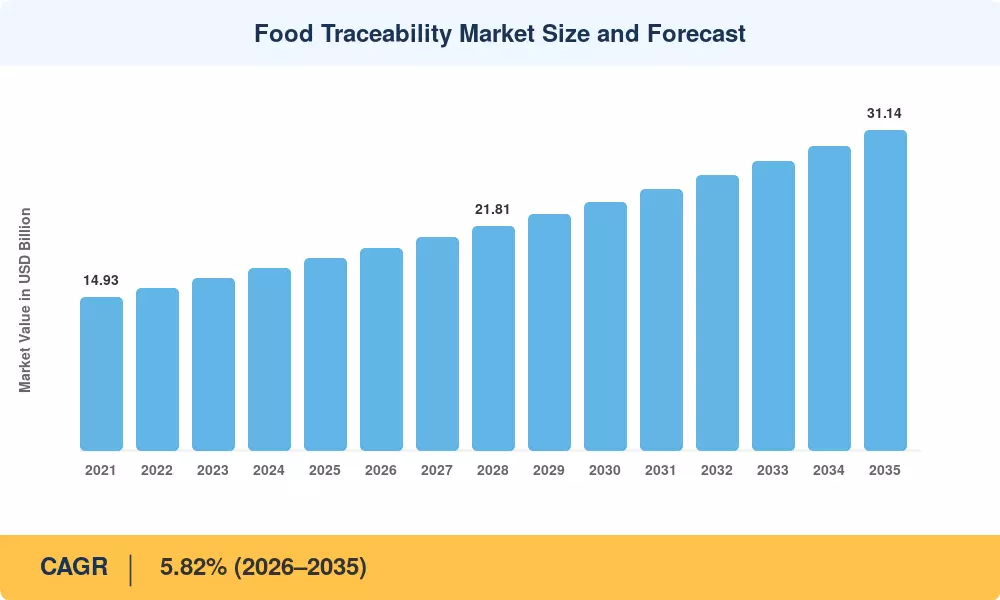
The food traceability market was valued at USD 18.72 billion in 2025 and is projected to reach USD 19.84 billion in 2026, expanding to USD 31.14 billion by 2035 at a CAGR of 5.82% over the 2026–2035 forecast period. Two catalysts are driving this acceleration: the U.S. FDA's Food Safety Modernization Act (FSMA) Section 204 traceability rule — which requires lot-level recordkeeping for high-risk foods by January 2026 — and the EU's General Food Law Regulation (EC 178/2002) enforcement tightening, both compelling manufacturers and retailers to invest in digital supply chain transparency technology. The food traceability market is no longer a compliance checkbox; it is a commercial differentiator
Legacy paper-based lot logs and standalone barcode scanners are being replaced by integrated technologies that blend RFID and barcode food tracking, cloud analytics and consumer-facing QR portals. The trend may be seen in IBM Food Trust’s blockchain-powered network that’s onboarding more than 300 food enterprises. Walmart and other retailers have required blockchain for food safety verification from their leafy greens suppliers, triggering an upstream investment cascade across the farm-to-fork supply chain tracking ecosystem. Buyers are expecting analytics, not just data acquisition, and the spend on software and services is outstripping hardware
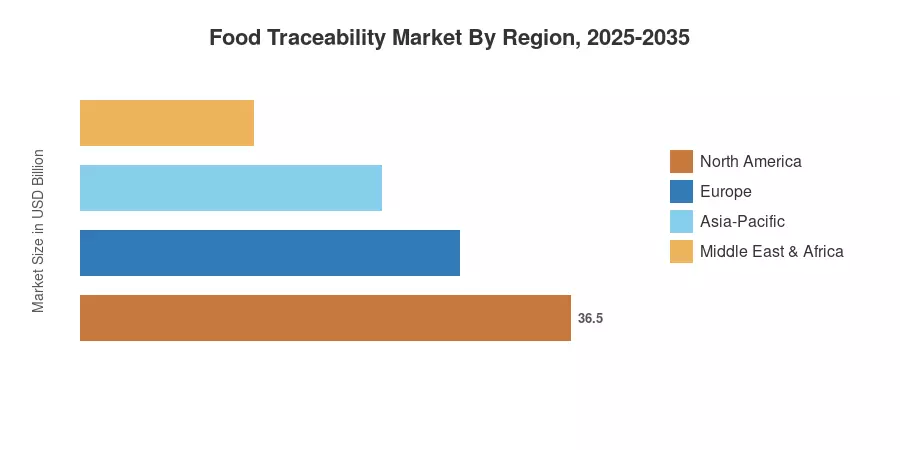
North America has the biggest regional share of around 29.6% of 2025 revenues, driven by robust regulatory infrastructure and mandates from major retailers. Asia Pacific is the fastest-growing market with a CAGR of 6.53% through 2035, owing to the maturing food safety law framework in China and the rising cold-chain logistics sector in India. Europe has the second greatest share at around 26.1%, due to the farm-to-fork supply chain tracking duties under the European Green Deal’s Farm to Fork Strategy. The food-traceability market is approaching a decade of platform convergence and AI-assisted recall management
Key Report Takeaways
• By Technology
- Barcodes and QR codes held approximately 31.8% revenue share of the food traceability market in 2025, retaining dominance due to low deployment cost and universal retail infrastructure.
- Blockchain in food safety is the fastest-growing technology segment, forecast at an 8.83% CAGR through 2035, as multi-stakeholder consortia demand tamper-proof audit trails.
- RFID and barcode food tracking collectively represent the workhorse infrastructure layer, with RFID gaining share in cold-chain and pharmaceutical-adjacent food applications.
• By Sector
- Fresh produce accounted for roughly 26.3% of food traceability market revenues in 2025, driven by high recall frequency and consumer sensitivity to contamination events.
- The seafood segment is set to grow at a 8.12% CAGR through 2035, underpinned by EU IUU fishing regulations and U.S. SIMP traceability mandates.
• By Geography
- North America contributed approximately 29.6% of the 2025 food traceability market revenues, anchored by FSMA compliance spend.
- Asia Pacific is the fastest-growing region at 6.53% CAGR (2026–2035), with China and India leading greenfield deployments.
- Europe's farm-to-fork supply chain tracking mandate under the Farm to Fork Strategy sustains steady mid-single-digit growth.
Market Size and Forecast (2021–2035)
Market Research Future (MRFR) projections are derived from a triangulation process that includes primary interviews with supply chain executives, secondary data from regulatory filing databases, and bottom-up segment modeling calibrated against publicly revealed technology procurement figures. Historical data are real documented periods. 2026-2035 values represent Market Research Future (MRFR)’s key scenario.