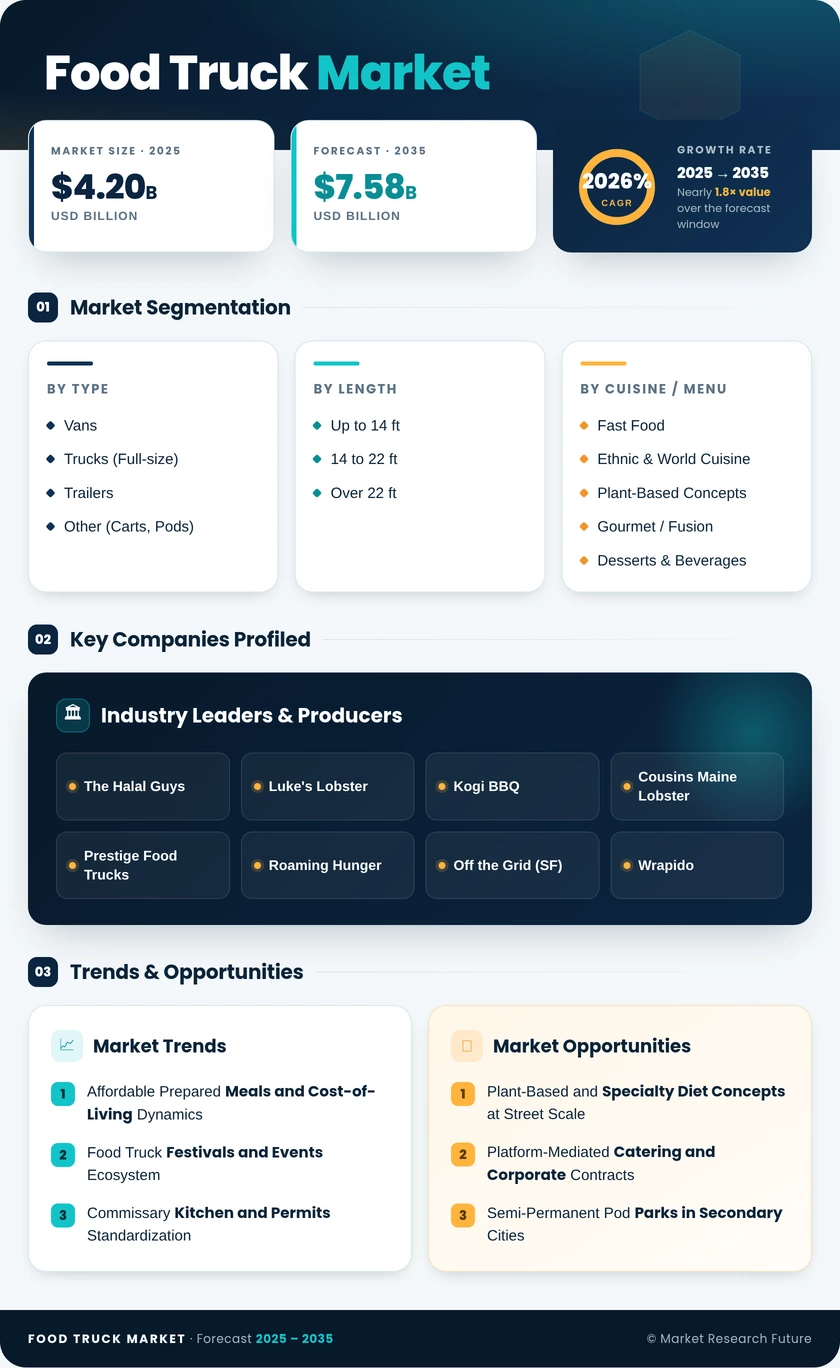
Segmentation Quick Reference
| Dimension | Sub-Segments | Dominant Segment | Fastest Growing Segment |
| Vehicle Type | Vans; Trucks (Full-Size); Trailers; Other (Carts, Pods) | Vans (~43.8% share) | Trucks – Full-Size (17.8% CAGR) |
| Length | Up to 14 Ft; 14 to 22 Ft; Over 22 Ft | 14 to 22 Ft (~50.9% share) | Over 22 Ft (9.90% CAGR) |
| Cuisine / Menu | Fast Food; Ethnic & World Cuisine; Plant-Based Concepts; Gourmet / Fusion; Desserts & Beverages; Other | Fast Food (~45.7% share) | Plant-Based Concepts (14.6% CAGR) |
| Ownership Model | Independent Operators; Franchise Chains; Corporate / Catering Fleet | Independent Operators (~58.8% share) | Franchise Chains (11.5% CAGR) |
| Powertrain | Internal Combustion Engine; Hybrid; All-Electric | Internal Combustion Engine (~82.9% share) | All-Electric (17.8% CAGR) |
| Food Truck Market Model | Roaming / Event-Based; Semi-Permanent Pods & Parks | Roaming / Event-Based (~57.7% share) | Semi-Permanent Pods & Parks (8.30% CAGR) |
Market Segmentation Overview
By Vehicle Type
| Sub-Segment | Key Trend |
| Vans | Dominant due to urban parking flexibility and lower acquisition cost; OEMs adding food-prep upfit packages |
| Trucks (Full-Size) | Fastest-growing; franchise chain standardization driving demand for commercial kitchen-grade prep space |
| Trailers | Stable niche for food truck festivals and events; low fixed-cost option for seasonal operators |
| Other (Carts, Pods) | Emerging segment linked to semi-permanent pod park development and EV micro-vehicle innovation |
Vehicle type is the most operationally consequential segmentation dimension in the food truck market. The van–truck dichotomy essentially maps the divide between solo independent operators and scaling franchise systems: vans are accessible and agile, while full-size trucks deliver the standardized commissary kitchen and permit-compliant environment that multi-unit operators require. The trailer sub-segment serves a distinct purpose—enabling operators to maximize revenue during food truck festivals and events season without carrying a full drivetrain year-round.
By Length
| Sub-Segment | Key Trend |
| Up to 14 Ft | Urban street-vending staple; solo operators; regulatory parking-limit compliance |
| 14 to 22 Ft | Industry workhorse; balances prep capacity with urban accessibility; dominant volume segment |
| Over 22 Ft | High-growth; franchise chain catering fleets; pod park anchors; full commercial kitchen capability |
Length is a proxy for operational complexity and the target use case. The 14–22 ft category has held its dominant position because it fits within standard parallel parking spaces while still accommodating enough equipment for a two-to-three-person crew. As the food truck market matures and semi-permanent pod locations reduce reliance on street parking, the over-22-ft segment is expected to grow its share meaningfully through 2035.
By Cuisine / Menu
| Sub-Segment | Key Trend |
| Fast Food | High throughput, repeatable recipes; proven at scale; under margin pressure from QSR convergence |
| Ethnic & World Cuisine | Social-media discovery driver; diaspora community anchoring; strong in coastal US cities |
| Plant-Based Concepts | Fastest growing; Gen Z/millennial pull; lower ingredient cost per plate than animal protein equivalents |
| Gourmet / Fusion | Premium price points; food truck menu and branding differentiation; chef-driven concepts |
| Desserts & Beverages | Event and festival-specific; high impulse purchase rate; lower regulatory complexity |
| Other | Regional specialties, dietary-specific (keto, halal, kosher) |
Cuisine differentiation is the food truck market's primary brand-building lever. Food truck menu and branding choices that telegraph a clear culinary identity outperform generic menus on social media engagement and repeat visit rates. Plant-based concepts are rewriting the economics of the segment: lower ingredient cost, premium pricing tolerance among target demographics, and alignment with corporate ESG catering criteria create a compelling unit economics case.
By Ownership Model
| Sub-Segment | Key Trend |
| Independent Operators | Majority; declining share as franchise systems mature; high creative autonomy |
| Franchise Chains | Fastest growing; turnkey vehicle packages; commissary kitchen and permits compliance bundled |
| Corporate / Catering Fleet | Stable; enterprise catering contracts; predictable revenue; lower brand building requirement |
The ownership model dimension captures the food truck market's structural evolution from a cottage industry to a professionalized channel. Franchise chains are growing at 11.5% CAGR because they solve the two biggest pain points for new entrants: capital access (through manufacturer financing partnerships) and commissary kitchen and permits compliance (through standardized operating procedures). Independent operators retain majority share but their competitive moat increasingly depends on unique food truck menu and branding rather than price competition.
By Powertrain
| Sub-Segment | Key Trend |
| Internal Combustion Engine (ICE) | Dominant; entrenched fueling infrastructure; declining new purchase share post-2027 |
| Hybrid | Transitional segment; fuel savings without range anxiety; EU emission zone compliance bridge |
| All-Electric | Fastest growing; IRA and EU subsidies; zero-emission zone compliance; improving battery range |
Powertrain is the food truck market's most rapidly evolving segmentation dimension. All-electric units are growing at 17.8% CAGR from a small base, supported by a converging set of policy mandates and improving vehicle economics. The hybrid sub-segment serves as a pragmatic bridge for operators in EU emission zones who cannot yet rely on adequate public EV charging infrastructure. MRFR expects ICE to remain the volume majority through 2031, after which EV new-purchase share crosses 20%.
By Food Truck Market Model
| Sub-Segment | Key Trend |
| Roaming / Event-Based | Dominant; culturally iconic; revenue dependent on weather, events, and location intelligence |
| Semi-Permanent Pods & Parks | Fastest growing; predictable footfall; developer-backed real estate integration; catering base |
The service model reflects how operators balance flexibility against revenue stability. Roaming and event-based operations remain the dominant model—and the one consumers most associate with the food truck market identity—but semi-permanent pod parks are systematically addressing the channel's core weakness: unpredictable daily revenue. The pod park model also enables shared commissary kitchen and permits infrastructure, reducing per-operator compliance overhead by an estimated 30–40% versus standalone commissary agreements.