Download Free Sample
Kindly complete the form below to receive a free sample of this Report
France Cancer Supportive Care Market Research Report: Size, Share, Trend Analysis By Types (ESA, G-CSFs, Antiemetics, Bisphosphonates, Opioids, NSAIDs, Others), By Applications (Breast Cancer, Lung Cancer, Colorectal Cancer, Prostate Cancer, Liver Cancer, Stomach Cancer, Others) and By Distribution Channel (Hospital Pharmacies, Drug Stores, Retail Pharmacies, Online Providers) - Growth Outlook & Industry Forecast 2025 To 2035
As per Market Research Future analysis, the France Cancer Supportive Care Market size was estimated at 940.95 USD Million in 2024. The Cancer Supportive-care market is projected to grow from 964.66 USD Million in 2025 to 1237.16 USD Million by 2035, exhibiting a compound annual growth rate (CAGR) of 2.5% during the forecast period 2025 - 2035
The France cancer supportive-care market is experiencing a transformative shift towards holistic and technologically advanced care models.
| 2024 Market Size | 940.95 (USD Million) |
| 2035 Market Size | 1237.16 (USD Million) |
| CAGR (2025 - 2035) | 2.52% |
Roche (CH), Bristol-Myers Squibb (US), Amgen (US), Merck & Co (US), Novartis (CH), Pfizer (US), Eli Lilly and Company (US), AstraZeneca (GB)
Our Impact
Enabled $4.3B Revenue Impact for Fortune 500 and Leading Multinationals
Partnering with 2000+ Global Organizations Each Year
30K+ Citations by Top-Tier Firms in the Industry
The France Cancer Supportive Care Market is currently experiencing notable growth, driven by an increasing recognition of the importance of holistic care for patients undergoing cancer treatment. This market encompasses a wide range of services and products aimed at alleviating the physical, emotional, and psychological burdens associated with cancer. In France, the integration of supportive care into standard oncology practices appears to be gaining traction, as healthcare providers and policymakers acknowledge the necessity of addressing the comprehensive needs of patients. This shift is likely influenced by a growing body of evidence suggesting that supportive care can enhance the quality of life and potentially improve treatment outcomes for individuals battling cancer. Moreover, the landscape of the cancer supportive-care market is evolving with advancements in technology and a greater emphasis on personalized care. Innovative solutions, such as telehealth services and mobile applications, are emerging to provide patients with easier access to supportive resources. Additionally, the increasing involvement of multidisciplinary teams in cancer care suggests a more collaborative approach, which may lead to improved patient experiences. As the market continues to develop, it is essential for stakeholders to remain attuned to the changing dynamics and emerging trends that could shape the future of supportive care in the context of cancer treatment.
There is a growing trend towards integrating holistic approaches within the cancer supportive-care market. This includes not only physical symptom management but also psychological and emotional support, which is increasingly recognized as vital for patient well-being.
The rise of technological innovations is transforming the cancer supportive-care market. Telehealth platforms and mobile applications are becoming more prevalent, facilitating easier access to supportive services and resources for patients.
The adoption of multidisciplinary care models is gaining momentum in the cancer supportive-care market. This approach encourages collaboration among various healthcare professionals, ensuring comprehensive support tailored to individual patient needs.
The increasing incidence of cancer in France is a primary driver for the cancer supportive-care market. According to recent statistics, approximately 400,000 new cancer cases are diagnosed annually in the country. This alarming trend necessitates enhanced supportive care services to manage symptoms and improve the quality of life for patients. As the population ages, the demand for comprehensive supportive care solutions is expected to rise. The cancer supportive-care market is likely to experience growth as healthcare providers seek to address the complex needs of cancer patients, including pain management, psychological support, and nutritional guidance. This growing patient population creates opportunities for innovative therapies and services tailored to enhance patient outcomes.
Government initiatives aimed at improving cancer care in France significantly influence the cancer supportive-care market. The French government has allocated substantial funding to cancer research and treatment programs, with an investment of over €1 billion in recent years. These initiatives focus on enhancing patient support services, including palliative care and psychological counseling. The cancer supportive-care market benefits from these investments, as they facilitate the development of new programs and services designed to meet the needs of patients. Furthermore, public health campaigns aimed at raising awareness about cancer and its treatment options contribute to the growing demand for supportive care services, ultimately driving market growth.
The trend towards personalized medicine is significantly impacting the cancer supportive-care market. Patients are increasingly seeking tailored treatment plans that address their unique needs and preferences. This shift is prompting healthcare providers to develop individualized supportive care strategies that consider factors such as genetic profiles, lifestyle, and psychosocial aspects. The cancer supportive-care market is responding to this demand by offering a range of services, including personalized nutrition plans, psychological support, and symptom management tailored to individual patients. As the focus on personalized care continues to grow, the market is expected to expand, driven by the need for more effective and patient-centered supportive care solutions.
There is a growing awareness among patients and healthcare professionals regarding the importance of supportive care in cancer treatment. This heightened awareness is driving the cancer supportive-care market as patients increasingly seek comprehensive care that addresses not only the disease but also the associated symptoms and side effects. Educational initiatives and advocacy groups play a crucial role in promoting the benefits of supportive care, which includes pain management, emotional support, and rehabilitation services. As a result, healthcare providers are more likely to integrate supportive care into treatment plans, leading to an expansion of the cancer supportive-care market. This trend suggests a shift towards a more holistic approach to cancer treatment, emphasizing the need for supportive services.
Technological advancements in cancer treatment are reshaping the landscape of the cancer supportive-care market. Innovations such as telemedicine, mobile health applications, and wearable devices are enhancing patient monitoring and support. These technologies enable healthcare providers to offer real-time assistance and personalized care plans, improving patient engagement and adherence to treatment. The cancer supportive-care market is likely to benefit from these innovations, as they facilitate better communication between patients and providers, leading to improved outcomes. Furthermore, the integration of artificial intelligence in treatment planning may enhance the efficiency of supportive care services, ultimately driving market growth as patients seek more accessible and effective care options.
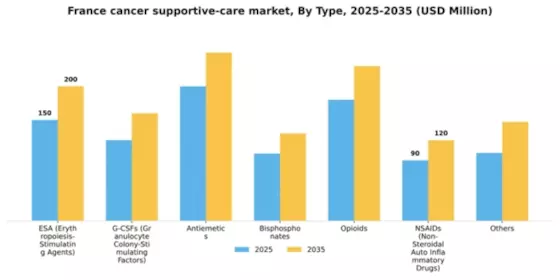
In the France cancer supportive-care market, the ESA segment holds a significant share, primarily due to its critical role in managing anemia related to cancer treatments. Following ESA, G-CSFs showcase a remarkable market presence, driven by their effectiveness in addressing neutropenia. Antiemetics and opioids also contribute notable shares, while bisphosphonates and NSAIDs are important. Other treatments collectively fill specialized niches, enhancing overall market dynamics. Growth trends in this segment indicate robust expansion, particularly for G-CSFs, which are rapidly becoming pivotal in supportive care protocols. Factors such as increasing cancer prevalence, advancements in drug formulation, and a growing emphasis on improving the quality of life for patients are driving this growth. As healthcare systems evolve, the demand for effective supportive care options will continue to rise, ensuring a progressive landscape for these therapies.
ESA (Dominant) vs. Opioids (Emerging)
ESA stands out as a dominant force in the France cancer supportive-care market due to its established efficacy in mitigating treatment-related anemia, significantly impacting patients' quality of life. In contrast, opioids, while traditionally used for pain management, are emerging as a crucial component of comprehensive supportive care. These therapies are increasingly recognized for their role in managing chronic pain associated with cancer. As regulations evolve and new formulations develop, opioids are gaining traction, appealing to both physicians and patients. The integration of ESAs and opioids underscores a trend towards a more holistic approach to cancer care, where addressing both anemia and pain is essential for patient well-being.
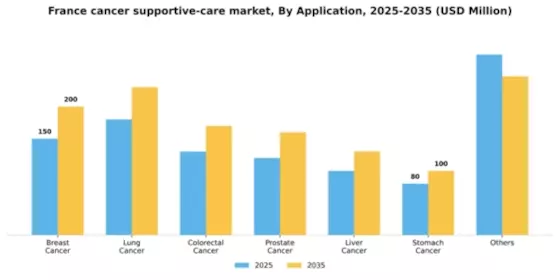
In the France cancer supportive-care market, the application segment reveals a diverse distribution of market shares, with breast cancer leading significantly. This dominance is attributed to heightened awareness, early detection, and effective treatment options that cater to the growing patient population. Other cancers like lung cancer, colorectal cancer, and prostate cancer also command notable shares, reflecting the varying incidence rates and patient needs across the population. Growth trends in this segment are primarily driven by technological advancements and a better understanding of cancer therapies. The increasing demand for personalized medicine is paving the way for lung cancer to emerge as the fastest-growing segment. Furthermore, ongoing research and development efforts are expanding the scope of supportive care, which is expected to enhance patient quality of life and encourage further market growth.
Breast Cancer: Dominant vs. Lung Cancer: Emerging
Breast cancer stands as the dominant application in the France cancer supportive-care market, driven by comprehensive screening programs and support systems that address both physical and emotional needs of patients. Its established infrastructure for treatment and recovery fosters high patient engagement. Conversely, lung cancer is rapidly emerging due to rising incidence rates and escalating awareness campaigns about smoking cessation and early diagnosis. The supportive care for lung cancer is evolving, with innovative therapies and holistic approaches gaining traction, thereby improving outcomes and shifting a growing patient demographic toward more focused care solutions.
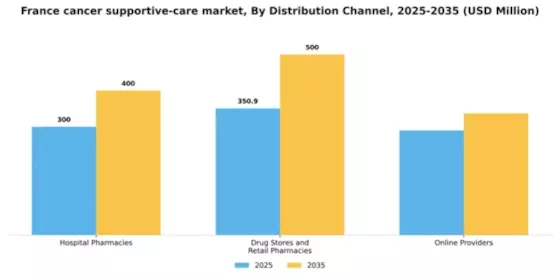
In the France cancer supportive-care market, Hospital Pharmacies capture the largest share, playing a critical role in the distribution of cancer care medications and supportive therapies. They are preferred for their accessibility and the direct supervision from healthcare professionals, ensuring that patients receive the appropriate treatments as prescribed. On the other hand, Drug Stores and Retail Pharmacies also hold a significant portion, catering to patients who seek over-the-counter options. Meanwhile, Online Providers, although currently a smaller segment, show promising growth as more patients turn to digital solutions for convenience and accessibility. The growth trends in this segment are influenced by several factors. The increasing acceptance of telemedicine and digital health solutions is propelling the rise of Online Providers, especially among younger demographics. Additionally, the ongoing demand for personalized care and the convenience of receiving medications at home further drive this trend. Hospital Pharmacies will continue to dominate, but the adaptability of Online Providers positions them as a crucial player in the evolving landscape of cancer supportive care distribution.
Hospital Pharmacies (Dominant) vs. Online Providers (Emerging)
Hospital Pharmacies are characterized by their strong ties to healthcare institutions, providing a reliable and professional environment for dispensing cancer care medications. They offer a wide array of pharmaceutical services, including patient counseling and personalized treatment plans, which contribute to their status as the dominant distribution channel. Furthermore, these pharmacies are directly integrated within healthcare systems, ensuring effective communication with healthcare providers. Conversely, Online Providers represent an emerging channel that is gaining traction, particularly among tech-savvy patients. They offer the convenience of purchasing medications from home, often accompanied by delivery services. While they may lack the direct oversight of Hospital Pharmacies, Online Providers are leveraging technology to enhance patient experience and streamline the purchasing process, signaling a significant shift in consumer preferences towards more digital solutions.
Get more detailed insights about France Cancer Supportive Care Market Request Free Sample
The cancer supportive-care market in France is characterized by a dynamic competitive landscape, driven by a confluence of innovation, strategic partnerships, and a growing emphasis on patient-centric solutions. Major players such as Roche (CH), Bristol-Myers Squibb (US), and Amgen (US) are at the forefront, each adopting distinct strategies to enhance their market positioning. Roche (CH) focuses on integrating advanced diagnostics with therapeutic solutions, thereby fostering a holistic approach to cancer care. Meanwhile, Bristol-Myers Squibb (US) emphasizes its commitment to immunotherapy, leveraging its robust pipeline to address unmet medical needs. Amgen (US) appears to be concentrating on expanding its biosimilars portfolio, which may provide cost-effective alternatives in the supportive-care segment, thus shaping the competitive environment through innovation and accessibility.The business tactics employed by these companies reflect a nuanced understanding of the market's structure, which is moderately fragmented yet increasingly influenced by a few dominant players. Localizing manufacturing and optimizing supply chains are pivotal strategies that enhance operational efficiency and responsiveness to market demands. This collective approach not only strengthens their competitive positions but also fosters a collaborative ecosystem that encourages innovation and shared resources among key players.
In October Roche (CH) announced a strategic partnership with a leading digital health company to develop an integrated platform for patient monitoring and support. This initiative is poised to enhance patient engagement and adherence to treatment protocols, thereby potentially improving outcomes in cancer supportive care. The strategic importance of this partnership lies in its ability to leverage technology to provide real-time data, which could facilitate personalized care plans and optimize resource allocation.
In September Bristol-Myers Squibb (US) launched a new patient assistance program aimed at improving access to its immunotherapy treatments for underserved populations. This initiative not only underscores the company's commitment to health equity but also positions it favorably in a market increasingly focused on social responsibility. By addressing barriers to access, Bristol-Myers Squibb (US) may enhance its brand loyalty and expand its market share in the supportive-care segment.
In August Amgen (US) received regulatory approval for its latest biosimilar product, which is expected to significantly reduce treatment costs for patients. This strategic move is likely to disrupt the market by providing a more affordable option for patients requiring supportive care, thereby enhancing Amgen's competitive edge. The introduction of this biosimilar aligns with the broader trend of increasing cost-effectiveness in cancer treatment, which is becoming a critical factor in patient decision-making.
As of November the competitive trends in the cancer supportive-care market are increasingly defined by digitalization, sustainability, and the integration of artificial intelligence (AI) into treatment protocols. Strategic alliances among companies are shaping the landscape, fostering innovation and enhancing patient outcomes. Looking ahead, competitive differentiation is expected to evolve, with a pronounced shift from price-based competition to a focus on innovation, technological advancements, and supply chain reliability. This transition may redefine how companies engage with healthcare providers and patients, ultimately leading to improved care delivery and patient satisfaction.



The France Cancer Supportive Care Market has seen various notable developments recently. In October 2023, Merck launched a new line of supportive care products aimed at improving the quality of life for cancer patients. Meanwhile, Bristol Myers Squibb reported a significant increase in market share following the successful launch of their novel supportive therapy aimed at managing chemotherapy-induced side effects. Current affairs indicate a growing emphasis on holistic patient care, with multiple companies, including Sanofi and Roche, investing in educational programs to train healthcare professionals in supportive care practices.
In the mergers and acquisitions scene, AstraZeneca announced the acquisition of a small biotech firm specializing in cancer supportive therapies in September 2023, enhancing its portfolio in this area. Companies like Eli Lilly and Teva Pharmaceuticals are collaborating with cancer treatment centers in France to integrate supportive care into their therapeutic regimens. The market has seen consistent growth, with a notable valuation increase attributed to the rising awareness and demand for comprehensive support systems during cancer treatments.
In the past two years, initiatives such as state-funded research projects focusing on supportive care protocols have reinforced France's commitment to improving cancer patient outcomes.
The Cancer Supportive Care Market in France is projected to grow at a 2.52% CAGR from 2025 to 2035, driven by increasing patient needs and advancements in treatment options.
New opportunities lie in:
By 2035, the market is expected to achieve robust growth, reflecting evolving patient care dynamics.
| MARKET SIZE 2024 | 940.95(USD Million) |
| MARKET SIZE 2025 | 964.66(USD Million) |
| MARKET SIZE 2035 | 1237.16(USD Million) |
| COMPOUND ANNUAL GROWTH RATE (CAGR) | 2.52% (2025 - 2035) |
| REPORT COVERAGE | Revenue Forecast, Competitive Landscape, Growth Factors, and Trends |
| BASE YEAR | 2024 |
| Market Forecast Period | 2025 - 2035 |
| Historical Data | 2019 - 2024 |
| Market Forecast Units | USD Million |
| Key Companies Profiled | Roche (CH), Bristol-Myers Squibb (US), Amgen (US), Merck & Co (US), Novartis (CH), Pfizer (US), Eli Lilly and Company (US), AstraZeneca (GB) |
| Segments Covered | Type, Application, Distribution Channel |
| Key Market Opportunities | Integration of telehealth solutions enhances access to cancer supportive-care services in France. |
| Key Market Dynamics | Rising demand for personalized therapies drives innovation in the cancer supportive-care market in France. |
| Countries Covered | France |
The overall market valuation was $940.95 Million in 2024.
The projected valuation for 2035 is $1237.16 Million.
The expected CAGR during the forecast period 2025 - 2035 is 2.52%.
Antiemetics had the highest valuation at $200.0 - $250.0 Million in 2024.
Key players include Roche, Bristol-Myers Squibb, Amgen, Merck & Co, Novartis, Pfizer, Eli Lilly and Company, and AstraZeneca.
Opioids were valued between $180.0 - $230.0 Million, indicating a strong position among other segments.
The valuation range for G-CSFs was $120.0 - $160.0 Million in 2024.
Drug Stores and Retail Pharmacies, valued at $350.95 - $500.0 Million, are expected to show significant growth by 2035.
The Breast Cancer segment was valued between $150.0 - $200.0 Million in 2024.
The Others segment in Application had a valuation of $280.95 - $247.16 Million, indicating a diverse range of applications.


Kindly complete the form below to receive a free sample of this Report

“This is really good guys. Excellent work on a tight deadline. I will continue to use you going forward and recommend you to others. Nice job”


“Thanks. It’s been a pleasure working with you, please use me as reference with any other Intel employees.”


“Thanks for sending the report it gives us a good global view of the Betaïne market.”


“Thank you, this will be very helpful for OQS.”


“We found the report very insightful! we found your research firm very helpful. I'm sending this email to secure our future business.”


“I am very pleased with how market segments have been defined in a relevant way for my purposes (such as "Portable Freezers & refrigerators" and "last-mile"). In general the report is well structured. Thanks very much for your efforts.”


“I have been reading the first document or the study, ,the Global HVAC and FP market report 2021 till 2026. Must say, good info! I have not gone in depth at all parts, but got a good indication of the data inside!”


“We got the report in time, we really thank you for your support in this process. I also thank to all of your team as they did a great job.”


“The Automotive 48V ECU Components Procurement Intelligence Study” was a complex project, but the Market Research Future (MRFR) team handled it with quality, agility, and customer-centricity. They delivered all requested data on time and within the agreed scope. The team, including Shubhendra Anand and Rahul Gotadki, was always readily available to clarify questions and swiftly implement necessary adjustments, driving the project to a successful conclusion within a very demanding timeframe.
I would also like to specifically commend Akshay Agarwal for his responsiveness and support at every stage—from our initial inquiry on May 6th through to final delivery on June 18th. His dedication made the entire process seamless.”



