×
Request Free Sample ×

Kindly complete the form below to receive a free sample of this Report

* Please use a valid business email

Leading companies partner with us for data-driven Insights

clients tt-cursor
Hero Background

Freight Trucking Market

ID: MRFR/PCM/8717-HCR
111 Pages
Snehal Singh
October 2025

Freight Trucking Market Research Report Information By Vehicle Type (Light Commercial Vehicles, Medium Commercial Vehicles, and Heavy Commercial Vehicles), by End Use (Industrial & Manufacturing, Oil & Gas, Construction & Mining, Chemicals & Agri-Products, Food & Beverages, and Others), And By Region (North America, Europe, Asia-Pacific, And Rest Of The World) – Market Forecast Till 2035

Share:
Download PDF ×

We do not share your information with anyone. However, we may send you emails based on your report interest from time to time. You may contact us at any time to opt-out.

Freight Trucking Market Infographic
Purchase Options

Freight Trucking Market Summary

As per MRFR analysis, the Freight Trucking Market Size was estimated at 3232.28 USD Billion in 2024. The Freight Trucking industry is projected to grow from 3372.95 USD Billion in 2025 to 5164.38 USD Billion by 2035, exhibiting a compound annual growth rate (CAGR) of 4.35 during the forecast period 2025 - 2035.

Key Market Trends & Highlights

The Freight Trucking Market is currently experiencing a transformative phase driven by technological advancements and evolving consumer demands.

  • Technological integration is reshaping operational efficiencies across the Freight Trucking Market, particularly in North America.
  • The sustainability focus is becoming increasingly prominent, influencing fleet management strategies in both North America and Asia-Pacific.
  • E-commerce delivery remains the largest segment, significantly impacting logistics operations and driving demand for faster services.
  • Infrastructure development and rising fuel costs are major drivers propelling growth in the Freight Trucking Market, especially within the heavy-duty truck segment.

Market Size & Forecast

2024 Market Size 3232.28 (USD Billion)
2035 Market Size 5164.38 (USD Billion)
CAGR (2025 - 2035) 4.35%

Major Players

J.B. Hunt Transport Services (US), Schneider National (US), Knight-Swift Transportation Holdings (US), XPO Logistics (US), Werner Enterprises (US), Old Dominion Freight Line (US), C.H. Robinson Worldwide (US), Ryder System (US)

Freight Trucking Market Trends

The Freight Trucking Market is currently experiencing a dynamic transformation, driven by various factors that influence logistics and transportation. The increasing demand for efficient supply chain solutions appears to be a primary catalyst for growth. Companies are increasingly focusing on optimizing their operations, which may lead to the adoption of advanced technologies and innovative practices. Furthermore, the rise of e-commerce has significantly altered consumer expectations, necessitating faster and more reliable delivery services. This shift in consumer behavior seems to be reshaping the landscape of freight trucking, compelling businesses to adapt to new market realities. In addition to technological advancements, sustainability initiatives are gaining traction within the Freight Trucking Market. Stakeholders are increasingly aware of the environmental impact of transportation, prompting a shift towards greener practices. This includes the exploration of alternative fuels and the implementation of energy-efficient vehicles. As regulatory frameworks evolve, companies may find themselves under pressure to comply with stricter environmental standards. Overall, the Freight Trucking Market appears poised for continued evolution, with a focus on efficiency, sustainability, and responsiveness to consumer demands.

Technological Integration

The Freight Trucking Market is witnessing a surge in the integration of technology, which enhances operational efficiency. Companies are increasingly utilizing advanced software solutions for route optimization, real-time tracking, and fleet management. This trend not only streamlines logistics but also improves customer satisfaction by providing transparency and reliability in delivery services.

Sustainability Focus

There is a growing emphasis on sustainability within the Freight Trucking Market, as stakeholders seek to minimize their environmental footprint. This trend encompasses the adoption of alternative fuels, electric vehicles, and energy-efficient practices. Companies are likely to invest in greener technologies to comply with regulations and meet consumer expectations for eco-friendly transportation.

E-commerce Influence

The rise of e-commerce is significantly impacting the Freight Trucking Market, as consumer demand for rapid delivery continues to escalate. Businesses are adapting their logistics strategies to accommodate this shift, leading to increased competition and innovation in service offerings. This trend suggests that companies must remain agile to meet the evolving needs of online shoppers.

Market Segment Insights

By Application: E-commerce Delivery (Largest) vs. Logistics Services (Fastest-Growing)

The application segment of the Freight Trucking Market comprises various segments including Freight Transportation, Logistics Services, Supply Chain Management, and E-commerce Delivery. Among these, E-commerce Delivery stands out as the largest segment, driven by the rising consumer demand for fast and efficient shipping. Meanwhile, Logistics Services are experiencing rapid growth due to the increasing complexity of supply chains and the demand for integrated solutions. Overall, these segments contribute significantly to the growth and effectiveness of freight trucking operations.

E-commerce Delivery (Dominant) vs. Logistics Services (Emerging)

E-commerce Delivery has established itself as the dominant application within the Freight Trucking Market, fueled by the increasing preference for online shopping and the need for speedy deliveries. Companies are investing heavily in last-mile delivery solutions to meet consumer expectations. Conversely, Logistics Services are emerging rapidly as businesses seek comprehensive solutions that can streamline operations and optimize resources in an increasingly competitive market. This growth is driven by advances in technology and data analytics, enabling logistics providers to offer more tailored and efficient services. As such, both segments are crucial to the evolving landscape of freight trucking.

By Vehicle Type: Heavy Duty Truck (Largest) vs. Refrigerated Truck (Fastest-Growing)

In the Freight Trucking Market, the distribution of market share among vehicle types reveals that Heavy Duty Trucks hold the largest share, primarily due to their extensive use for long-haul transportation of goods. Medium Duty Trucks follow, catering to a diverse range of local and regional freight needs, while Light Duty Trucks occupy a niche for smaller loads in urban settings. Refrigerated Trucks, which serve critical functions in transporting perishable goods, are witnessing a significant rise in demand, contributing to their market expansion.

Heavy Duty Truck (Dominant) vs. Refrigerated Truck (Emerging)

Heavy Duty Trucks dominate the Freight Trucking Market, characterized by their robust design and capacity to transport heavy loads over long distances. This vehicle type is essential for various industries, including construction and oil, where high payload capabilities are required. On the other hand, Refrigerated Trucks are emerging as a vital segment, driven by the growing demand for fresh produce and pharmaceuticals. Their ability to maintain temperature control during transit positions them increasingly favorably in a market where quality preservation is paramount, thus contributing to their fast growth and adoption.

By Fuel Type: Diesel (Largest) vs. Electric (Fastest-Growing)

In the Freight Trucking Market, diesel remains the predominant fuel type, capturing a substantial portion of the market share. This traditional fuel continues to dominate due to its efficiency, widespread availability, and the extensive infrastructure supporting diesel-powered trucks. Natural gas follows, showing moderate adoption rates but still significantly less than diesel. Electric and hybrid fuel types are emerging, targeting specific niches within the market that prioritize sustainability and regulatory compliance, but their overall share remains smaller compared to diesel.

Diesel (Dominant) vs. Electric (Emerging)

Diesel trucks are characterized by their strong performance, existing infrastructure, and lower per-mile fuel costs, making them the dominant choice for long-haul freight. They are favored for their reliability and the ability to handle heavy loads over long distances. Conversely, electric trucks are gaining traction as an emerging choice, particularly in urban areas where emissions regulations are stringent. While still in the early adoption phase, electric trucks promise significant advantages in operational costs and environmental benefits. As battery technology and charging infrastructure improve, the electric segment is expected to grow, appealing to companies looking to enhance their sustainability profiles.

By End Use: Retail (Largest) vs. Food and Beverage (Fastest-Growing)

In the Freight Trucking Market, the end-use segment is primarily dominated by Retail, which commands the largest share. This sector relies heavily on freight services to transport a wide variety of goods from warehouses to retail outlets, ensuring timely availability of products to consumers. Following Retail are sectors like Manufacturing and Construction, both of which also contribute significantly to freight demand, particularly in the movement of raw materials and finished goods.

Retail: Dominant vs. Food and Beverage: Emerging

The Retail sector is characterized by a vast network of distribution channels, necessitating reliable freight trucking services for efficient inventory management. This segment benefits from a stable demand driven by consumer spending patterns and e-commerce growth. On the other hand, the Food and Beverage segment is emerging rapidly due to rising consumption trends and the increasing demand for fresh produce. This segment requires specialized trucking solutions, such as temperature-controlled transport, to ensure product quality and safety, making it a key focus for growth in the freight industry.

By Service Type: Dedicated Contract Carriage (Largest) vs. For-Hire Carrier (Fastest-Growing)

In the Freight Trucking Market, the service type segment exhibits a diverse distribution, with Dedicated Contract Carriage holding the largest share. This service model allows carriers to manage transportation operations on behalf of customers, providing tailored solutions and ensuring capacity and service level commitments. Following closely is the For-Hire Carrier category, which has gained substantial attention due to its flexibility and responsiveness to market demands, showcasing a significant growth trajectory in recent years. The landscape of the Freight Trucking Market is evolving, driven by increasing demand for logistics efficiency and operational flexibility. The For-Hire Carrier segment is particularly benefitting from the rise in e-commerce, where companies seek adaptable shipping solutions. Meanwhile, Dedicated Contract Carriage is solidifying its position as businesses invest in long-term partnerships with carriers, enhancing reliability and customer satisfaction.

Dedicated Contract Carriage (Dominant) vs. Private Fleet (Emerging)

Dedicated Contract Carriage is recognized as the dominant service type in the Freight Trucking Market, offering specialized services tailored to meet the logistics needs of specific clients. This model enhances operational efficiency by allocating dedicated resources, leading to improved service quality and predictability. On the other hand, the Private Fleet segment represents an emerging trend where companies operate their own transportation services. This approach allows firms to control their logistics operations, reduce costs, and maintain service levels that align with their brand. Both segments are crucial in shaping the industry, with Dedicated Contract Carriage focusing on customer-specific needs and Private Fleets gaining traction as businesses seek greater autonomy in their logistics processes.

Get more detailed insights about Freight Trucking Market

Regional Insights

North America : Market Leader in Freight Trucking

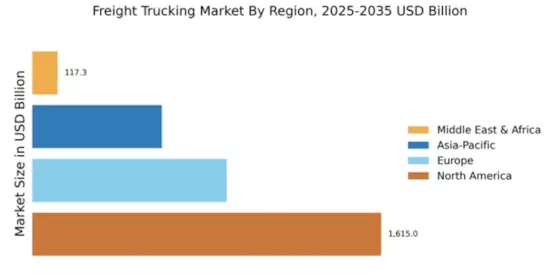
North America continues to lead the Freight Trucking Market, holding a significant market share of 1615.0 million. Key growth drivers include the rise in e-commerce, increased demand for efficient logistics, and favorable regulatory frameworks. The region's infrastructure investments and technological advancements further bolster market expansion, making it a hub for freight transportation. The competitive landscape is characterized by major players such as J.B. Hunt Transport Services, Schneider National, and XPO Logistics. These companies leverage advanced technologies and extensive networks to enhance service delivery. The U.S. remains the dominant country, with a robust trucking industry that supports both domestic and international trade, ensuring a steady growth trajectory for the market.

Europe : Emerging Freight Hub

Europe's Freight Trucking Market is valued at 900.0 million, driven by increasing cross-border trade and stringent environmental regulations promoting sustainable logistics. The region is witnessing a shift towards greener technologies, with governments incentivizing electric and hybrid trucks. This regulatory push is expected to enhance operational efficiencies and reduce carbon footprints, contributing to market growth. Leading countries in this sector include Germany, France, and the UK, where established players like C.H. Robinson and Ryder System are making significant inroads. The competitive landscape is evolving, with a focus on digitalization and supply chain optimization. As the market adapts to new regulations, companies are investing in innovative solutions to maintain their competitive edge.

Asia-Pacific : Rapidly Growing Market

The Asia-Pacific Freight Trucking Market, valued at 600.0 million, is experiencing rapid growth due to urbanization and increasing consumer demand. Countries like China and India are leading this expansion, driven by infrastructure development and rising logistics needs. Regulatory support for improving road networks and freight efficiency is also a significant catalyst for market growth in the region. China stands out as the largest market, with major players like Knight-Swift and Werner Enterprises expanding their operations. The competitive landscape is marked by a mix of local and international companies, all vying for market share. As e-commerce continues to flourish, the demand for efficient freight solutions is expected to rise, further propelling the market forward.

Middle East and Africa : Emerging Market Potential

The Middle East and Africa Freight Trucking Market, valued at 117.28 million, is on the cusp of significant growth. Key drivers include increasing trade activities and investments in infrastructure development. Governments are focusing on enhancing logistics capabilities to support economic diversification, which is crucial for the region's growth trajectory. Regulatory frameworks are evolving to facilitate smoother cross-border transport. Leading countries in this region include South Africa and the UAE, where local players are beginning to dominate the market. The competitive landscape is characterized by a mix of established firms and new entrants, all aiming to capitalize on the growing demand for freight services. As the region continues to develop, opportunities for innovation and investment in logistics are expected to expand.

Key Players and Competitive Insights

The Freight Trucking Market is characterized by a dynamic competitive landscape, driven by factors such as increasing demand for efficient logistics solutions, technological advancements, and a growing emphasis on sustainability. Major players like J.B. Hunt Transport Services (US), Schneider National (US), and XPO Logistics (US) are strategically positioning themselves to capitalize on these trends. J.B. Hunt Transport Services (US) focuses on integrating advanced technology into its operations, enhancing efficiency and customer service. Schneider National (US) emphasizes sustainability through its commitment to reducing carbon emissions, while XPO Logistics (US) leverages its extensive network to optimize supply chain solutions, thereby shaping a competitive environment that prioritizes innovation and operational excellence.

The business tactics employed by these companies include optimizing supply chains and localizing operations to better serve regional markets. The market structure appears moderately fragmented, with a mix of large and small players competing for market share. The collective influence of key players fosters a competitive atmosphere where innovation and service quality are paramount, as companies strive to differentiate themselves in a crowded marketplace.

In November 2025, J.B. Hunt Transport Services (US) announced the launch of a new digital platform aimed at enhancing real-time tracking and customer engagement. This strategic move is likely to bolster its competitive edge by providing clients with greater visibility and control over their shipments, thereby improving customer satisfaction and loyalty. Similarly, in October 2025, Schneider National (US) unveiled its initiative to transition to a fully electric fleet by 2030, a significant step towards achieving its sustainability goals. This commitment not only positions Schneider as a leader in eco-friendly logistics but also aligns with the growing demand for sustainable practices in the industry.

In September 2025, XPO Logistics (US) expanded its partnership with a leading technology firm to enhance its AI-driven logistics solutions. This collaboration is expected to streamline operations and improve decision-making processes, thereby increasing efficiency and reducing costs. The integration of AI into logistics operations signifies a broader trend within the industry, where technology plays a crucial role in driving competitive advantage.

As of December 2025, the Freight Trucking Market is witnessing trends such as digitalization, sustainability, and AI integration, which are redefining competitive dynamics. Strategic alliances among key players are increasingly shaping the landscape, fostering innovation and collaboration. Looking ahead, competitive differentiation is likely to evolve from traditional price-based competition to a focus on technological innovation, supply chain reliability, and sustainable practices. Companies that can effectively leverage these trends will likely emerge as leaders in the Freight Trucking Market.

Key Companies in the Freight Trucking Market market include

Industry Developments

In February 2022, A.P. Moller – Maersk acquired Pilot Freight Services (Pilot) to extend its integrated logistics offering deeper into the supply chain of its customers.

In July 2021, Geodis acquired Velocity Freight Transport Inc. to meet the increased customer demand for more transportation alternatives to ensure their supply chains remain agile and effective.In September 2023, The California Air Resources Board (CARB) adopted new regulations that will require all new heavy-duty trucks sold in the state to be zero-emission by 2045. The regulations also require truck manufacturers to begin selling a certain percentage of zero-emission trucks each year, starting in 2024.

In October 2023: The American Trucking Associations reported a record-high 80,000 driver shortage, exacerbating capacity constraints and driving up freight rates.

In November 2023: The Biden administration announced a new initiative aimed at attracting and retaining truck drivers, including funding for training programs and apprenticeship opportunities.

Future Outlook

Freight Trucking Market Future Outlook

The Freight Trucking Market is projected to grow at a 4.35% CAGR from 2024 to 2035, driven by e-commerce expansion, technological advancements, and increasing demand for efficient logistics solutions.

New opportunities lie in:

  • Integration of AI-driven route optimization software
  • Development of electric and hybrid truck fleets
  • Expansion of last-mile delivery services through partnerships

By 2035, the Freight Trucking Market is expected to be robust, driven by innovation and strategic partnerships.

Market Segmentation

Freight Trucking Market End Use Outlook

  • Retail
  • Manufacturing
  • Construction
  • Food and Beverage

Freight Trucking Market Fuel Type Outlook

  • Diesel
  • Natural Gas
  • Electric
  • Hybrid

Freight Trucking Market Application Outlook

  • Freight Transportation
  • Logistics Services
  • Supply Chain Management
  • E-commerce Delivery

Freight Trucking Market Service Type Outlook

  • Dedicated Contract Carriage
  • Private Fleet
  • For-Hire Carrier
  • Intermodal Transportation

Freight Trucking Market Vehicle Type Outlook

  • Heavy Duty Truck
  • Medium Duty Truck
  • Light Duty Truck
  • Refrigerated Truck

Report Scope

MARKET SIZE 20243232.28(USD Billion)
MARKET SIZE 20253372.95(USD Billion)
MARKET SIZE 20355164.38(USD Billion)
COMPOUND ANNUAL GROWTH RATE (CAGR)4.35% (2024 - 2035)
REPORT COVERAGERevenue Forecast, Competitive Landscape, Growth Factors, and Trends
BASE YEAR2024
Market Forecast Period2025 - 2035
Historical Data2019 - 2024
Market Forecast UnitsUSD Billion
Key Companies ProfiledJ.B. Hunt Transport Services (US), Schneider National (US), Knight-Swift Transportation Holdings (US), XPO Logistics (US), Werner Enterprises (US), Old Dominion Freight Line (US), C.H. Robinson Worldwide (US), Ryder System (US)
Segments CoveredApplication, Vehicle Type, Fuel Type, End Use, Service Type
Key Market OpportunitiesIntegration of autonomous vehicle technology enhances efficiency in the Freight Trucking Market.
Key Market DynamicsTechnological advancements in logistics are reshaping operational efficiencies and competitive dynamics within the Freight Trucking Market.
Countries CoveredNorth America, Europe, APAC, South America, MEA

Market Highlights

Author
Snehal Singh
Assistant Manager - Research

High acumen in analyzing complex macro & micro markets with more than 6 years of work experience in the field of market research. By implementing her analytical skills in forecasting and estimation into market research reports, she has expertise in Packaging, Construction, and Equipment domains. She handles a team size of 20-25 resources and ensures smooth running of the projects, associated marketing activities, and client servicing.

Leave a Comment

FAQs

How much is the Freight Trucking market?

The Freight Trucking market size was valued at USD 2700.1 Billion in 2021.

What is the growth rate of the Freight Trucking market?

Freight Trucking Market is projected to grow at a CAGR of 4.35% during the forecast period, 2025-2035

Which region held the largest market share in the Freight Trucking market?

Asia Pacific had the largest share of the Freight Trucking market.

Who are the key players in the Freight Trucking market?

The key players in the market are Yellow Corporation (U.S.), Estes Express Lines (U.S.), XPO Logistics (U.S.), CEVA Logistics (Switzerland), CMA CGM S.A (France), Kuehne + Nagel International AG (Germany), Nippon Express Co., Ltd. (Japan), Saia Inc. (U.S.), SNCF group (France), ArcBest (U.S.).

Which Vehicle type led the Freight Trucking market?

The Heavy Commercial Vehicles category dominated the market in 2021.

Which End -use had the largest market share in the market?

The Industrial & Manufacturing base had the largest share in the market for Freight Trucking.

Download Free Sample

Kindly complete the form below to receive a free sample of this Report

Compare Licence

×
Features License Type
Single User Multiuser License Enterprise User
Price $4,950 $5,950 $7,250
Maximum User Access Limit 1 User Upto 10 Users Unrestricted Access Throughout the Organization
Free Customization
Direct Access to Analyst
Deliverable Format
Platform Access
Discount on Next Purchase 10% 15% 15%
Printable Versions