Freighter Aircraft Market
Freighter Aircraft Market Summary
As per Market Research Future analysis, the Freighter Aircraft Market Size was estimated at 30.01 USD Billion in 2024. The Freighter Aircraft industry is projected to grow from 31.28 USD Billion in 2025 to 47.34 USD Billion by 2035, exhibiting a compound annual growth rate (CAGR) of 4.23% during the forecast period 2025 - 2035
Key Market Trends & Highlights
The Freighter Aircraft Market is poised for robust growth driven by e-commerce and technological advancements.
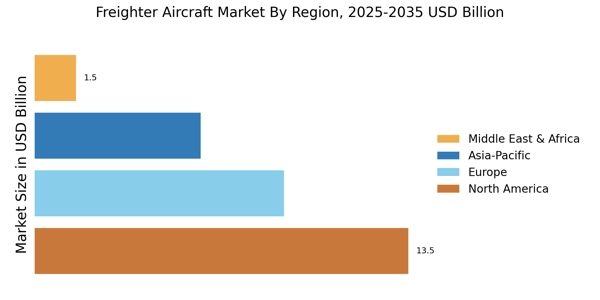
- North America remains the largest market for freighter aircraft, driven by a strong logistics infrastructure.
- The Asia-Pacific region is emerging as the fastest-growing market, fueled by increasing e-commerce activities.
- Narrow-body freighter aircraft dominate the market, while wide-body freighters are experiencing the fastest growth due to rising demand for long-haul logistics.
- E-commerce expansion and increased demand for cold chain logistics are key drivers propelling the market forward.
Market Size & Forecast
| 2024 Market Size | 30.01 (USD Billion) |
| 2035 Market Size | 47.34 (USD Billion) |
| CAGR (2025 - 2035) | 4.23% |
Major Players
Boeing (US), Airbus (FR), Lockheed Martin (US), Antonov (UA), Embraer (BR), Bombardier (CA), Mitsubishi Aircraft Corporation (JP), Saab (SE), Ilyushin (RU)
Freighter Aircraft Market Trends
The Freighter Aircraft Market is currently experiencing a dynamic evolution, driven by various factors that shape its landscape. The increasing demand for air cargo services, fueled by the growth of e-commerce and global trade, appears to be a primary catalyst. As businesses seek faster and more efficient logistics solutions, the need for dedicated freighter aircraft seems to intensify. Additionally, advancements in technology and fuel efficiency are likely to influence the design and operation of these aircraft, potentially leading to a more sustainable and cost-effective fleet. Furthermore, regulatory changes and environmental considerations may also play a role in shaping the future of this market, as stakeholders strive to balance operational efficiency with ecological responsibility. In the context of ongoing globalization, the Freighter Aircraft Market is poised for further transformation. The rise of new trade routes and the expansion of existing ones could create opportunities for growth. Moreover, the increasing focus on enhancing supply chain resilience may prompt airlines and logistics companies to invest in dedicated freighter solutions. As the market adapts to these evolving demands, it is essential to monitor emerging trends and innovations that could redefine the competitive landscape. Overall, the Freighter Aircraft Market appears to be on a trajectory of growth, driven by a confluence of technological advancements and shifting consumer preferences.
E-commerce Growth
The surge in e-commerce activities is significantly impacting the Freighter Aircraft Market. As online shopping becomes more prevalent, the demand for rapid delivery services increases, necessitating a robust air cargo infrastructure. This trend is likely to drive investments in freighter aircraft to meet the logistical challenges posed by consumer expectations.
Technological Advancements
Innovations in aircraft design and technology are reshaping the Freighter Aircraft Market. Enhanced fuel efficiency, improved payload capacities, and advanced navigation systems are becoming increasingly important. These developments may lead to a more competitive market, as operators seek to optimize their fleets for better performance.
Sustainability Initiatives
There is a growing emphasis on sustainability within the Freighter Aircraft Market. Stakeholders are increasingly aware of the environmental impact of air freight operations. As a result, there is a potential shift towards greener technologies and practices, which could influence aircraft design and operational strategies in the coming years.
Freighter Aircraft Market Drivers
Regulatory Changes
Regulatory changes are influencing the dynamics of the Freighter Aircraft Market. Governments worldwide are increasingly implementing stricter environmental regulations aimed at reducing carbon emissions from aviation. This has prompted manufacturers to innovate and develop more sustainable freighter aircraft. For example, the International civil aviation Organization has set ambitious targets for reducing greenhouse gas emissions, which may lead to a shift towards electric and hybrid aircraft in the coming years. As compliance with these regulations becomes imperative, the Freighter Aircraft Market is likely to witness a transformation, with a growing emphasis on sustainability and eco-friendly practices.
Rising Global Trade
The rise in The Freighter Aircraft Industry. As countries engage in international trade, the need for efficient air cargo services has intensified. In 2025, the value of global merchandise trade is expected to exceed 25 trillion USD, creating a substantial demand for air freight solutions. Freighter aircraft are essential for transporting high-value and time-sensitive goods, such as electronics and pharmaceuticals, across borders. This increasing trade volume is likely to bolster the Freighter Aircraft Market, as logistics providers seek to enhance their capabilities to meet the growing demands of international commerce.
E-commerce Expansion
The rapid expansion of e-commerce has emerged as a pivotal driver for the Freighter Aircraft Market. As online shopping continues to gain traction, the demand for efficient logistics solutions has surged. In 2025, e-commerce sales are projected to reach approximately 6 trillion USD, necessitating a robust air freight infrastructure to meet consumer expectations for fast delivery. This trend compels logistics companies to invest in freighter aircraft, which offer the speed and capacity required to transport goods across vast distances. Consequently, the Freighter Aircraft Market is likely to experience significant growth as companies adapt to the evolving landscape of consumer behavior and preferences.
Technological Innovations
Technological advancements play a crucial role in shaping the Freighter Aircraft Market. Innovations in aircraft design, materials, and propulsion systems have led to the development of more fuel-efficient and environmentally friendly freighter aircraft. For instance, the introduction of composite materials has reduced aircraft weight, enhancing payload capacity and operational efficiency. Furthermore, advancements in avionics and automation are streamlining operations, reducing turnaround times, and improving safety. As these technologies continue to evolve, they are expected to drive the Freighter Aircraft Market forward, enabling operators to optimize their fleets and respond effectively to market demands.
Increased Demand for Cold Chain Logistics
The increased demand for cold chain logistics is emerging as a vital driver for the Freighter Aircraft Market. With the rise of perishable goods and pharmaceuticals requiring temperature-controlled transport, the need for specialized freighter aircraft has become more pronounced. The global market for cold chain logistics is projected to reach over 500 billion USD by 2026, highlighting the importance of efficient air freight solutions. Freighter aircraft equipped with advanced refrigeration systems are essential for maintaining the integrity of temperature-sensitive products during transit. This trend is likely to propel the Freighter Aircraft Market, as operators invest in capabilities to cater to this growing segment.
Market Segment Insights
By Aircraft Type: Narrow-body (Largest) vs. Wide-body (Fastest-Growing)
In the Freighter Aircraft Market, the distribution of market share between narrow-body and wide-body aircraft reveals distinct competitive dynamics. Narrow-body aircraft currently hold the majority of the market, favored for their versatility and efficiency in short to medium-haul routes. This segment caters to smaller freight demands and is widely adopted by cargo carriers due to operational cost-effectiveness. In contrast, wide-body aircraft are gradually increasing their market presence as they provide the capacity for larger and heavier cargo loads over longer distances, thus appealing to more extensive logistics requirements.
Narrow-body (Dominant) vs. Wide-body (Emerging)
Narrow-body freighter aircraft are characterized by their cost efficiency, ease of operation, and suitability for regional cargo markets, standing as the dominant choice for many logistics providers. Their operational flexibility allows carriers to serve a broad range of routes without the overhead costs associated with larger aircraft. Meanwhile, wide-body freighters, while emerging, are gaining traction due to their ability to transport larger volumes of goods, thus enabling economies of scale for airlines and freight operators. They are increasingly seen as a necessary asset in a globalized market that demands quick delivery times and capacity for diverse cargo types, ultimately enhancing supply chain efficiencies.
By Operation Type: Scheduled (Largest) vs. Charter (Fastest-Growing)
The Freighter Aircraft Market is primarily divided into two operation types: Scheduled and Charter services. Scheduled operations hold the largest market share owing to their established business models and regularity in freight operations. Airlines utilizing scheduled freighter services benefit from predictable revenue streams and optimized cargo capacity management, as they serve established routes with high demand.
Operation Type: Scheduled (Dominant) vs. Charter (Emerging)
Scheduled operations are characterized by their consistent and regular service, catering to a multitude of customers requiring reliable freight transport. This segment typically involves operating fixed routes with established time tables, ensuring that shippers can depend on timely deliveries. Conversely, Charter operations have emerged as a flexible alternative, allowing clients to arrange flights based on specific needs, thus attracting businesses with fluctuating or urgent freight demands. This ability to customize services positions Charter operations as a growing segment, particularly appealing in a market where speed and adaptability are becoming increasingly vital.
By Cargo Type: General Cargo (Largest) vs. Special Cargo (Fastest-Growing)
In the Freighter Aircraft Market, 'General Cargo' dominates the segment, commanding a significant portion of market share due to its versatility and demand for transporting a wide array of goods. This includes everything from retail products to industrial materials, making it a staple for logistics companies worldwide. Conversely, 'Special Cargo' represents a rapidly growing niche, catering to specific needs such as pharmaceuticals, perishables, and oversized equipment, capturing attention for its specialized requirements.
General Cargo (Dominant) vs. Special Cargo (Emerging)
General Cargo serves as the backbone of the Freighter Aircraft Market, characterized by its flexibility in transporting various commodities. It appeals to companies looking for reliable solutions for regular shipments, thus ensuring steady demand. On the other hand, Special Cargo has emerged as a crucial segment, driven by increasing globalization and a rise in e-commerce. This segment involves higher operational complexity and requires specialized handling, indicating a trend towards customized logistics solutions. Both segments are vital, with General Cargo providing stability while Special Cargo shows promising growth potential.
By Propulsion System: Jet (Largest) vs. Turbo Prop (Fastest-Growing)
In the Freighter Aircraft Market, the propulsion system segment is primarily dominated by Jet engines, which account for the largest market share. Their widespread adoption is attributed to their efficiency and performance in various freight operations. Conversely, Turbo Prop engines have been gaining traction, especially in regional and short-haul freight routes, contributing to an increase in their market presence. The growth trends in this segment show a clear bifurcation between the traditional and rising propulsion technologies. Jet engines are being enhanced with new technologies to improve fuel efficiency and reduce emissions, while Turbo Prop systems are embraced for their operational cost-effectiveness and versatility in servicing less accessible markets. This dual focus indicates a dynamic shift in the propulsion preferences within the freighter aircraft sector.
Jet (Dominant) vs. Turbo Prop (Emerging)
Jet propulsion systems stand as the dominant choice in the Freighter Aircraft Market due to their robust performance capabilities, particularly in long-haul logistics. They offer higher speeds and are suited for transporting large volumes of goods over expansive distances. Meanwhile, Turbo Prop systems represent an emerging segment, optimized for shorter distances and lower operational costs. Turbo Props excel in versatility and efficiency in regional markets, making them ideal for connecting smaller airports. Their increasing adoption is spurred by technological advances that enhance fuel efficiency and reduce environmental impact, establishing their position as a compelling alternative in specific applications within the market.
By Range: Medium-Haul (Largest) vs. Long-Haul (Fastest-Growing)
In the Freighter Aircraft Market, the distribution of market share among the range segments reveals that Medium-Haul aircraft dominate, serving a significant portion of freight logistics due to their optimal balance between capability and operational costs. Short-Haul, while still relevant, occupies a smaller share as the demand for rapid, regional delivery continues to grow, but it does not eclipse the medium-haul operations.
Medium-Haul (Dominant) vs. Long-Haul (Emerging)
Medium-Haul freighters are well-positioned in the logistics network, offering flexibility and efficiency for businesses requiring regular freight transport over moderate distances, thereby supporting regional supply chains effectively. On the other hand, Long-Haul freighters are emerging as critical assets for international trade, driven by the increase in global e-commerce and demand for cross-border transportation. Despite their higher operational costs, advancements in fuel efficiency have enabled long-haul aircraft to capture a growing share of the market, reflecting a shift towards accommodating international freight needs.
Regional Insights
North America : Aerospace Innovation Leader
North America remains the largest market for freighter aircraft, holding approximately 45% of the global share. The region's growth is driven by increasing e-commerce demand, regulatory support for air cargo operations, and advancements in aircraft technology. The U.S. Federal Aviation Administration (FAA) has implemented regulations that facilitate the expansion of air freight services, further boosting market growth. The United States is the leading country in this sector, with major players like Boeing and Lockheed Martin dominating the landscape. Canada also contributes significantly, with Bombardier's presence in the market. The competitive environment is characterized by innovation and collaboration among manufacturers, ensuring that North America maintains its leadership in the freighter aircraft market.
Europe : Strategic Logistics Hub
Europe is the second-largest market for freighter aircraft, accounting for around 30% of the global market share. The region's growth is fueled by the increasing need for efficient logistics solutions and the rise of e-commerce. Regulatory frameworks, such as the European Union Aviation Safety Agency (EASA) regulations, are enhancing operational efficiencies and safety standards, which are critical for market expansion. Leading countries in Europe include Germany, France, and the UK, where companies like Airbus and Antonov are key players. The competitive landscape is marked by a focus on sustainability and innovation, with manufacturers investing in eco-friendly technologies. The presence of established logistics companies further strengthens the market, making Europe a vital player in the global freighter aircraft sector.
Asia-Pacific : Emerging Market Potential
Asia-Pacific is witnessing rapid growth in the freighter aircraft market, holding approximately 20% of the global share. The region's expansion is driven by increasing trade activities, urbanization, and a growing middle class that demands faster delivery services. Government initiatives to improve air transport infrastructure and regulations supporting air cargo operations are also significant growth catalysts. China and Japan are the leading countries in this region, with major manufacturers like Mitsubishi Aircraft Corporation and Ilyushin contributing to the market. The competitive landscape is evolving, with both established players and new entrants focusing on innovation and efficiency. The increasing demand for air freight services positions Asia-Pacific as a key player in the global market.
Middle East and Africa : Strategic Trade Corridor
The Middle East and Africa region is emerging as a significant player in the freighter aircraft market, accounting for about 5% of the global share. The growth is driven by the strategic location of the Middle East as a trade hub, coupled with increasing investments in air transport infrastructure. Regulatory support from local governments is enhancing the operational capabilities of air cargo services, facilitating market growth. Countries like the UAE and South Africa are at the forefront, with key players such as Emirates SkyCargo and other regional airlines expanding their fleets. The competitive landscape is characterized by a focus on enhancing logistics capabilities and improving service delivery. As the region continues to develop its air cargo infrastructure, it is poised for further growth in the freighter aircraft market.
Key Players and Competitive Insights
The Freighter Aircraft Market is currently characterized by a dynamic competitive landscape, driven by increasing demand for air cargo services and the need for efficient logistics solutions. Major players such as Boeing (US), Airbus (FR), and Lockheed Martin (US) are strategically positioned to leverage their technological advancements and extensive experience in aerospace manufacturing. Boeing (US) focuses on innovation in fuel efficiency and payload capacity, while Airbus (FR) emphasizes sustainability through the development of eco-friendly aircraft. Lockheed Martin (US) is exploring partnerships to enhance its military and commercial freighter capabilities, indicating a trend towards diversification in operational focus. Collectively, these strategies shape a competitive environment that is increasingly oriented towards technological advancement and sustainability.Key business tactics within the Freighter Aircraft Market include localizing manufacturing and optimizing supply chains to enhance operational efficiency. The market appears moderately fragmented, with several key players exerting influence over various segments. This fragmentation allows for niche players to emerge, while larger companies consolidate their market positions through strategic partnerships and technological investments. The collective influence of these key players fosters a competitive structure that encourages innovation and responsiveness to market demands.
In August Boeing (US) announced a significant partnership with a leading logistics company to develop a new generation of freighter aircraft designed for enhanced cargo capacity and reduced emissions. This strategic move is likely to position Boeing at the forefront of the market, as it aligns with the growing emphasis on sustainability and operational efficiency. The collaboration may also facilitate access to new markets, thereby expanding Boeing's operational footprint in the global freighter aircraft sector.
In September Airbus (FR) unveiled its latest freighter model, which incorporates advanced digital technologies for improved cargo management and tracking. This launch not only underscores Airbus's commitment to innovation but also reflects a broader trend towards digital transformation in the aviation industry. By integrating cutting-edge technology, Airbus aims to enhance customer experience and operational efficiency, potentially setting new standards in the freighter aircraft market.
In July Lockheed Martin (US) secured a contract with a government agency for the development of a specialized freighter aircraft tailored for military logistics. This contract highlights Lockheed Martin's strategic focus on diversifying its offerings and catering to both commercial and defense sectors. The implications of this contract may extend beyond immediate revenue, as it positions Lockheed Martin as a key player in the military logistics domain, potentially leading to further opportunities in the future.
As of October current competitive trends in the Freighter Aircraft Market are increasingly defined by digitalization, sustainability, and the integration of artificial intelligence. Strategic alliances are shaping the landscape, enabling companies to pool resources and expertise to address complex market challenges. Looking ahead, competitive differentiation is likely to evolve from traditional price-based competition towards a focus on innovation, technological advancements, and supply chain reliability. This shift suggests that companies that prioritize these elements will be better positioned to thrive in an increasingly competitive environment.
Key Companies in the Freighter Aircraft Market include
Industry Developments
- Q3 2025: Boeing raises outlook for widebody freighters as 777-8 production begins Boeing officially began production of the 777-8 freighter by drilling the first hole into a wing spar, marking a major milestone in the launch of its new large cargo jet program.
Future Outlook
Freighter Aircraft Market Future Outlook
The Freighter Aircraft Market is projected to grow at a 4.23% CAGR from 2025 to 2035, driven by e-commerce expansion, technological advancements, and increasing demand for air freight services.
New opportunities lie in:
- Development of hybrid-electric freighter aircraft for reduced emissions.
- Implementation of advanced cargo tracking systems to enhance logistics efficiency.
- Expansion of dedicated freighter services in emerging markets to capture new customer segments.
By 2035, the Freighter Aircraft Market is expected to be robust, reflecting sustained growth and innovation.
Market Segmentation
Freighter Aircraft Market Range Outlook
- Short-Haul
- Medium-Haul
- Long-Haul
Freighter Aircraft Market Cargo Type Outlook
- General Cargo
- Special Cargo
Freighter Aircraft Market Aircraft Type Outlook
- Narrow-body
- Wide-body
Freighter Aircraft Market Operation Type Outlook
- Scheduled
- Charter
Freighter Aircraft Market Propulsion System Outlook
- Jet
- Turbo Prop
Report Scope
| MARKET SIZE 2024 | 30.01(USD Billion) |
| MARKET SIZE 2025 | 31.28(USD Billion) |
| MARKET SIZE 2035 | 47.34(USD Billion) |
| COMPOUND ANNUAL GROWTH RATE (CAGR) | 4.23% (2025 - 2035) |
| REPORT COVERAGE | Revenue Forecast, Competitive Landscape, Growth Factors, and Trends |
| BASE YEAR | 2024 |
| Market Forecast Period | 2025 - 2035 |
| Historical Data | 2019 - 2024 |
| Market Forecast Units | USD Billion |
| Key Companies Profiled | Boeing (US), Airbus (FR), Lockheed Martin (US), Antonov (UA), Embraer (BR), Bombardier (CA), Mitsubishi Aircraft Corporation (JP), Saab (SE), Ilyushin (RU) |
| Segments Covered | Aircraft Type, Operation Type, Cargo Type, Propulsion System, Range, Regional |
| Key Market Opportunities | Integration of advanced automation technologies enhances operational efficiency in the Freighter Aircraft Market. |
| Key Market Dynamics | Rising demand for e-commerce drives innovation and competition in the freighter aircraft market. |
| Countries Covered | North America, Europe, APAC, South America, MEA |
FAQs
What is the current valuation of the Freighter Aircraft Market as of 2024?
The Freighter Aircraft Market was valued at 30.01 USD Billion in 2024.
What is the projected market valuation for the Freighter Aircraft Market in 2035?
The market is projected to reach a valuation of 47.34 USD Billion by 2035.
What is the expected CAGR for the Freighter Aircraft Market during the forecast period 2025 - 2035?
The expected CAGR for the Freighter Aircraft Market during 2025 - 2035 is 4.23%.
Which companies are considered key players in the Freighter Aircraft Market?
Key players in the market include Boeing, Airbus, Lockheed Martin, Antonov, Embraer, Bombardier, Mitsubishi Aircraft Corporation, Saab, and Ilyushin.
What are the main segments of the Freighter Aircraft Market?
The main segments include Aircraft Type, Operation Type, Cargo Type, Propulsion System, and Range.
How does the valuation of narrow-body freighter aircraft compare to wide-body freighter aircraft?
Narrow-body freighter aircraft are valued between 12.0 and 18.0 USD Billion, whereas wide-body freighter aircraft are valued between 18.01 and 29.34 USD Billion.
What is the valuation range for scheduled versus charter operations in the Freighter Aircraft Market?
Scheduled operations are valued between 15.0 and 23.0 USD Billion, while charter operations range from 15.01 to 24.34 USD Billion.
What is the market valuation for general cargo compared to special cargo in the Freighter Aircraft Market?
General cargo is valued between 20.01 and 31.34 USD Billion, while special cargo is valued between 10.0 and 16.0 USD Billion.
What are the projected valuations for jet and turbo prop propulsion systems in the market?
Jet propulsion systems are projected to be valued between 20.01 and 31.34 USD Billion, while turbo prop systems are valued between 10.0 and 16.0 USD Billion.
How does the range segment of the Freighter Aircraft Market break down in terms of valuation?
The range segment is valued as follows: short-haul at 8.0 to 12.0 USD Billion, medium-haul at 10.0 to 15.0 USD Billion, and long-haul at 12.01 to 20.34 USD Billion.
Research Approach
Secondary Research
The secondary research process involved comprehensive analysis of regulatory databases, aviation industry publications, peer-reviewed aerospace journals, and authoritative transportation organizations. Key sources included:
Regulatory & Government Aviation Authorities:
US Federal Aviation Administration (FAA) - Type certification data, airworthiness directives, and operational regulations
European Union Aviation Safety Agency (EASA) - Safety standards, environmental regulations, and aircraft certifications
International Civil Aviation Organization (ICAO) - Global aviation standards, carbon offsetting schemes (CORSIA), and air freight statistics
Civil Aviation Administration of China (CAAC) - Asia-Pacific regulatory approvals and fleet data
Transport Canada Civil Aviation (TCCA) - Canadian aviation regulations and freighter conversion standards
Industry & Trade Organizations:
International Air Transport Association (IATA) - Air cargo market analysis, freight tonne-kilometer (FTK) data, and industry outlook
The International Air Cargo Association (TIACA) - Global air freight trends and sustainability initiatives
Aerospace Industries Association (AIA) - US aerospace manufacturing data and export statistics
General Aviation Manufacturers Association (GAMA) - Aircraft shipment reports and market statistics
Society of Automotive Engineers (SAE) International - Aerospace standards and technical publications
Aviation Data & Intelligence Providers:
FlightGlobal/Ascend by Cirium - Fleet databases, aircraft valuations, and conversion intelligence
Aviation Week Network - Market intelligence, MRO data, and fleet forecasts
IBA Group - Aircraft market intelligence and freighter conversion analytics
Cargo Facts Consulting - Dedicated air cargo market research and freighter forecasts
Boeing Commercial Market Outlook - Air cargo demand projections and fleet analysis
Airbus Global Market Forecast - Freighter demand and replacement cycle data
Economic & Trade Databases:
International Trade Centre (ITC) - HS Code 8802 (Aircraft) trade flow statistics
UN Comtrade Database - Cross-border aircraft movement data
World Bank Open Data - Logistics performance indices and trade facilitation metrics
OECD Trade Statistics - Air freight transport value and volume trends
Eurostat Transport Database - European air cargo movement statistics
Academic & Technical Sources:
AIAA (American Institute of Aeronautics and Astronautics) Journal - Aerospace engineering research
Journal of Air Transport Management - Academic market analysis and operational studies
NCBI/PubMed - Occupational health studies for aviation workers
Transportation Research Board (TRB) - Aviation logistics and infrastructure studies
These sources were used to collect fleet statistics, conversion data, regulatory certification timelines, cargo traffic trends, fuel efficiency benchmarks, and competitive landscape analysis for narrow-body freighters, wide-body freighters, turboprop cargo aircraft, and passenger-to-freighter (P2F) conversion programs.
Primary Research
In order to gather both qualitative and quantitative insights, supply-side and demand-side stakeholders were interviewed during the primary research process. CEOs, vice presidents of fleet strategy, chief engineers, heads of freighter conversion programs, and sales directors from aircraft manufacturers, conversion houses, and MRO suppliers were examples of supply-side sources. Fleet managers, cargo operations directors, procurement heads from express logistics firms (DHL, FedEx, UPS), cargo airlines (Atlas Air, Cargolux), e-commerce logistics companies (Amazon Air, Alibaba Logistics), and leasing firms (ACG, GECAS, AerCap) were examples of demand-side sources.
Primary research verified freighter conversion pipeline timelines, validated market segmentation across aircraft types (narrow-body/wide-body), operation modes (scheduled/charter), and propulsion systems (jet/turboprop), and acquired information on fleet replacement cycles, yield management techniques, and cargo capacity pricing dynamics.
Primary Respondent Breakdown:
By Designation: C-level Primaries (28%), Director Level (32%), Others (40%)
By Region: North America (32%), Europe (30%), Asia-Pacific (28%), Middle East & Africa (6%), Latin America (4%)
Market Size Estimation
Global market valuation was derived through fleet mapping and cargo capacity analysis. The methodology included:
Identification of 35+ key manufacturers and conversion specialists across North America, Europe, Asia-Pacific, and the Middle East
Product mapping across narrow-body freighters (Boeing 737-800BCF, Airbus A321P2F), wide-body freighters (Boeing 777F, Airbus A350F), turboprop cargo aircraft (ATR 72-600F), and regional freighters
Analysis of reported and modeled annual revenues specific to freighter aircraft deliveries, conversion programs, and aftermarket services
Coverage of OEMs and conversion houses representing 75-80% of global freighter market share in 2024
Extrapolation using bottom-up (aircraft deliveries × ASP by type × conversion volume) and top-down (OEM revenue validation against IATA cargo data) approaches to derive segment-specific valuations across aircraft type, operation type, cargo type, propulsion system, and range categories
Kindly complete the form below to receive a free sample of this Report
Customer Stories
“This is really good guys. Excellent work on a tight deadline. I will continue to use you going forward and recommend you to others. Nice job”
“Thanks. It’s been a pleasure working with you, please use me as reference with any other Intel employees.”
“Thanks for sending the report it gives us a good global view of the Betaïne market.”
“Thank you, this will be very helpful for OQS.”
“We found the report very insightful! we found your research firm very helpful. I'm sending this email to secure our future business.”
“I am very pleased with how market segments have been defined in a relevant way for my purposes (such as "Portable Freezers & refrigerators" and "last-mile"). In general the report is well structured. Thanks very much for your efforts.”
“I have been reading the first document or the study, ,the Global HVAC and FP market report 2021 till 2026. Must say, good info! I have not gone in depth at all parts, but got a good indication of the data inside!”
“We got the report in time, we really thank you for your support in this process. I also thank to all of your team as they did a great job.”