×
Request Free Sample ×

Kindly complete the form below to receive a free sample of this Report

* Please use a valid business email

Leading companies partner with us for data-driven Insights

clients tt-cursor
Hero Background

Fuel Transfer Pump Market

ID: MRFR/CnM/9005-HCR
111 Pages
Snehal Singh
October 2025

Fuel Transfer Pump Market Research Report By Pump Type (Centrifugal Pump, Rotary Gear Pump, Diaphragm Pump, Peristaltic Pump, Screw Pump), By Application (Automotive, Industrial, Marine, Aerospace, Medical), By Flow Rate (Low Flow (less than 100 L/min), Medium Flow (100 to 500 L/min), High Flow (500 L/min or more)), By Material (Stainless Steel, Aluminum, Bronze, Cast Iron, Plastic) and By Regional (North America, Europe, South America, Asia Pacific, Middle East and Africa) - Forecast to 2035

Share:
Download PDF ×

We do not share your information with anyone. However, we may send you emails based on your report interest from time to time. You may contact us at any time to opt-out.

Fuel Transfer Pump Market Infographic
Purchase Options

Fuel Transfer Pump Market Summary

As per MRFR analysis, the Fuel Transfer Pump Market Size was estimated at 6.49 USD Billion in 2024. The Fuel Transfer Pump industry is projected to grow from 6.76 USD Billion in 2025 to 10.12 USD Billion by 2035, exhibiting a compound annual growth rate (CAGR) of 4.12 during the forecast period 2025 - 2035.

Key Market Trends & Highlights

The Fuel Transfer Pump Market is experiencing robust growth driven by technological advancements and increasing demand for efficient solutions.

  • Technological advancements are reshaping the Fuel Transfer Pump Market, enhancing efficiency and performance.
  • North America remains the largest market, while Asia-Pacific is emerging as the fastest-growing region in this sector.
  • The Fuel Dispensing segment holds the largest share, whereas the Fuel Transfer segment is witnessing rapid growth.
  • Rising demand for efficient fuel transfer solutions and the expansion of the transportation sector are key drivers propelling market growth.

Market Size & Forecast

2024 Market Size 6.49 (USD Billion)
2035 Market Size 10.12 (USD Billion)
CAGR (2025 - 2035) 4.12%

Major Players

GPI (US), Piusi S.p.A. (IT), Fill-Rite (US), Graco Inc. (US), Tuthill Corporation (US), Aro (US), Koshin Ltd. (JP), Bennett Pump Company (US), Seko S.p.A. (IT)

Fuel Transfer Pump Market Trends

The Fuel Transfer Pump Market is currently experiencing a dynamic evolution, driven by various factors that influence its growth trajectory. The increasing demand for efficient fuel transfer solutions across multiple sectors, including automotive, agriculture, and construction, appears to be a primary catalyst. Additionally, the rising emphasis on safety and environmental regulations is prompting manufacturers to innovate and enhance their product offerings. This market is characterized by a diverse range of applications, which further complicates the landscape, as different industries have unique requirements and standards. As a result, companies are likely focusing on developing specialized pumps that cater to specific needs, thereby fostering competition and technological advancements. Moreover, the Fuel Transfer Pump Market is witnessing a shift towards automation and smart technologies. The integration of IoT and advanced monitoring systems into fuel transfer solutions seems to be gaining traction, as businesses seek to optimize operations and reduce human error. This trend not only enhances efficiency but also aligns with the broader movement towards digital transformation in various industries. Consequently, the market landscape is expected to evolve, with an increasing number of players entering the field, each striving to offer innovative solutions that meet the changing demands of consumers.

Technological Advancements

The Fuel Transfer Pump Market is increasingly influenced by technological innovations. Manufacturers are integrating smart technologies and automation into their products, enhancing efficiency and safety. This trend indicates a shift towards more sophisticated solutions that cater to the evolving needs of various industries.

Environmental Regulations

Growing environmental concerns are shaping the Fuel Transfer Pump Market. Stricter regulations regarding emissions and safety are prompting companies to develop eco-friendly and compliant products. This trend suggests a potential for increased investment in sustainable technologies and practices.

Diverse Applications

The Fuel Transfer Pump Market is characterized by its wide range of applications across different sectors. From automotive to agriculture, each industry has distinct requirements, leading to a demand for specialized solutions. This diversity may drive innovation and competition among manufacturers.

Fuel Transfer Pump Market Drivers

Growth of Renewable Energy Sector

The Global Fuel Transfer Pump Market Industry is influenced by the expanding renewable energy sector, particularly in biofuels and alternative energy sources. As countries strive to transition towards greener energy solutions, the demand for fuel transfer pumps that can handle biofuels and other renewable resources is on the rise. This shift not only supports sustainability goals but also opens new avenues for pump manufacturers to diversify their product offerings. The increasing investments in renewable energy infrastructure are likely to bolster the market, aligning with global efforts to reduce carbon emissions and promote cleaner fuel alternatives.

Expansion of Fuel Distribution Networks

The expansion of fuel distribution networks is a key driver for the Global Fuel Transfer Pump Market Industry. As urbanization and industrialization continue to rise globally, the need for efficient fuel distribution systems becomes increasingly critical. This expansion necessitates the deployment of advanced fuel transfer pumps to ensure timely and safe fuel delivery. The market is expected to benefit from this trend, with projections indicating a growth to 10.1 USD Billion by 2035. Enhanced logistics and distribution capabilities are essential for meeting the growing fuel demands of various sectors, thereby driving the adoption of fuel transfer pumps.

Rising Demand for Fuel Transfer Solutions

The Global Fuel Transfer Pump Market Industry experiences an increasing demand for efficient fuel transfer solutions across various sectors, including automotive, agriculture, and construction. This trend is driven by the need for reliable and safe fuel handling practices, particularly in regions with stringent regulations. As industries expand, the market is projected to reach 6.49 USD Billion in 2024, reflecting a growing reliance on fuel transfer pumps to enhance operational efficiency. The emphasis on safety and compliance further propels this demand, as organizations seek to mitigate risks associated with fuel spills and contamination.

Technological Advancements in Pump Design

Technological innovations play a pivotal role in shaping the Global Fuel Transfer Pump Market Industry. The introduction of advanced materials and smart technologies enhances the performance and durability of fuel transfer pumps. For instance, the integration of IoT capabilities allows for real-time monitoring and predictive maintenance, which can significantly reduce downtime. As a result, manufacturers are increasingly investing in research and development to create more efficient and user-friendly products. This focus on innovation is expected to contribute to the market's growth, with projections indicating a compound annual growth rate of 4.12% from 2025 to 2035.

Regulatory Compliance and Safety Standards

Regulatory compliance and safety standards significantly impact the Global Fuel Transfer Pump Market Industry. Governments worldwide are implementing stringent regulations to ensure safe fuel handling and storage practices. Compliance with these regulations necessitates the use of high-quality fuel transfer pumps that meet safety standards. This requirement drives demand as businesses seek to avoid penalties and enhance their operational safety. The focus on environmental protection and worker safety further emphasizes the importance of reliable fuel transfer solutions, thereby contributing to the market's growth trajectory as organizations prioritize compliance in their operations.

Market Segment Insights

By Application: Fuel Dispensing (Largest) vs. Fuel Transfer (Fastest-Growing)

In the Fuel Transfer Pump Market, the application segments showcase distinct characteristics and market shares. Fuel Dispensing holds the largest share, reflecting ongoing investments in retail fueling infrastructure and the need for efficient and reliable fuel dispensing solutions. This segment's prominence is primarily due to the rising demand for fuel at service stations, influencing growth prospects across various regions. Fuel Transfer, while not the largest, is emerging as the fastest-growing segment. The surge in fuel transportation and logistics activities explains this growth, driven by increased reliance on mobile fuel transfer solutions in both industrial and consumer markets. Furthermore, the shift towards efficient and safe fuel handling practices supports this segment's rapid expansion in the market.

Fuel Dispensing (Dominant) vs. Fuel Transfer (Emerging)

Fuel Dispensing has established itself as a dominant application within the Fuel Transfer Pump Market, characterized by its essential role in retail outlets, gas stations, and fleet fueling services. Its widespread adoption is fueled by the urgency for efficient dispensing systems that not only save time but also enhance safety standards. In contrast, Fuel Transfer is experiencing emerging potential with the rise of versatile fuel-handling applications across various industries. This segment is influenced by advancements in technology and growing environmental regulations, which are driving the demand for innovative transfer solutions that ensure efficiency and minimize waste. As companies prioritize sustainability, the development of eco-friendly fuel transfer pumps further boosts this segment's growth.

By End Use: Automotive (Largest) vs. Aerospace (Fastest-Growing)

In the Fuel Transfer Pump Market, the 'End Use' segment shows a diverse distribution among critical sectors such as Automotive, Aerospace, Marine, and Industrial. Automotive emerges as the largest segment, driven by the growing demand for vehicles and the need for efficient fuel transfer systems. In contrast, the Aerospace sector, though smaller, is noted for its rapid growth due to increasing air travel and an uptick in military aviation activities, which demands advanced fuel handling solutions.

Automotive (Dominant) vs. Aerospace (Emerging)

The Automotive sector holds a dominant position in the Fuel Transfer Pump Market, largely due to a substantial increase in vehicle production and rising consumer preferences for fuel efficiency. Fuel transfer pumps in this sector are tailored to meet stringent regulatory standards, ensuring reliable performance and safety. On the other hand, the Aerospace sector, while currently classified as emerging, is gaining momentum with advancements in aircraft technology and increased investments in aviation infrastructure. These pumps must meet high standards of precision and reliability to handle specialized fuel types, setting them apart from those used in automotive applications.

By Pump Type: Electric Pump (Largest) vs. Manual Pump (Fastest-Growing)

In the Fuel Transfer Pump Market, the segment distribution reveals that Electric Pumps enjoy the largest market share, largely attributed to their efficiency and high performance in industrial applications. Conversely, Manual Pumps, while smaller in share, are identified as the fastest-growing segment, especially among DIY users and smaller operations that prioritize cost-effectiveness and ease of use for non-commercial settings.

Electric Pump (Dominant) vs. Manual Pump (Emerging)

Electric Pumps are recognized as the dominant force in the Fuel Transfer Pump Market due to their reliability and effectiveness in handling various types of fuels. Their ability to deliver high flow rates and facilitate automated operations makes them the preferred choice for industrial applications. On the other hand, Manual Pumps are emerging as a popular option for smaller enterprises and individual users. Their simplicity and lower upfront costs attract a growing consumer base looking for efficient yet affordable transfer solutions. This delineation highlights the diverse needs within the market, with Electric Pumps leading in industrial sectors while Manual Pumps cater to niche, growth-oriented segments.

By Power Source: Electricity (Largest) vs. Diesel (Fastest-Growing)

The Fuel Transfer Pump Market is diversifying with significant interest in various power sources. Electricity leads the segment, characterized by its widespread adoption and efficiency in various applications. Following closely, diesel remains popular due to its reliability and performance in heavy-duty operations. Gasoline and solar segment values remain smaller but vital in specific niches, contributing to overall market dynamics.

Electricity (Dominant) vs. Solar (Emerging)

Electricity-powered fuel transfer pumps are dominant in the market, offering high efficiency, reduced emissions, and minimal maintenance. Their widespread use in commercial and residential applications underscores their importance. In contrast, solar-powered pumps, though emerging, are gaining traction due to increasing emphasis on renewable energy and sustainability. These pumps leverage solar energy for operations, making them ideal for remote areas and applications where access to traditional power sources is limited. As technology advances, the solar segment is expected to capture a more significant share of the market as businesses and consumers alike turn to greener alternatives.

Get more detailed insights about Fuel Transfer Pump Market

Regional Insights

North America : Market Leader in Fuel Pumps

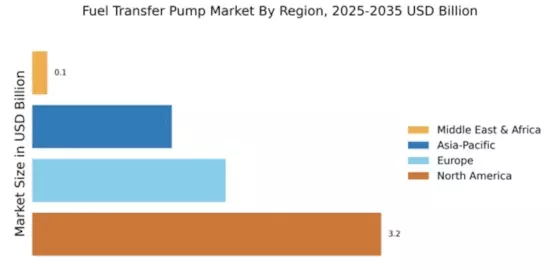
North America continues to lead the fuel transfer pump market, holding a significant share of 3.25 billion in 2024. The growth is driven by increasing demand for efficient fuel management systems, stringent regulations on fuel handling, and advancements in pump technology. The region's robust infrastructure and high levels of industrial activity further bolster market expansion. Regulatory catalysts, including safety standards and environmental regulations, are also pivotal in shaping market dynamics. The United States is the primary contributor to this market, with key players like GPI, Fill-Rite, and Graco Inc. dominating the landscape. The competitive environment is characterized by innovation and strategic partnerships among leading manufacturers. The presence of established companies ensures a steady supply of advanced fuel transfer solutions, catering to various sectors, including agriculture, construction, and transportation.

Europe : Emerging Market with Growth Potential

Europe's fuel transfer pump market is valued at 1.8 billion, reflecting a growing demand driven by the region's focus on sustainability and energy efficiency. Regulatory frameworks, such as the EU's Green Deal, are pushing industries to adopt cleaner technologies, thereby increasing the need for efficient fuel transfer solutions. The market is also influenced by the rising adoption of electric vehicles, which necessitate advanced fuel management systems. Leading countries in this region include Germany, France, and Italy, where companies like Piusi S.p.A. and Seko S.p.A. are making significant strides. The competitive landscape is marked by innovation and a shift towards eco-friendly products. As the market evolves, collaboration among manufacturers and regulatory bodies will be crucial in meeting the changing demands of consumers and industries alike.

Asia-Pacific : Rapid Growth in Emerging Markets

The Asia-Pacific region, with a market size of 1.3 billion, is witnessing rapid growth in the fuel transfer pump sector. This growth is fueled by increasing industrialization, urbanization, and rising energy demands across countries like China and India. Regulatory support for infrastructure development and energy efficiency initiatives is also driving market expansion. The region's diverse economic landscape presents both opportunities and challenges for market players. China and India are the leading countries in this market, with a growing presence of local and international manufacturers. Companies like Koshin Ltd. are expanding their operations to meet the rising demand. The competitive landscape is characterized by a mix of established players and new entrants, focusing on innovation and cost-effective solutions to capture market share. As the region continues to develop, the fuel transfer pump market is expected to thrive.

Middle East and Africa : Emerging Market with Unique Challenges

The Middle East and Africa (MEA) region, with a market size of 0.14 billion, presents unique challenges and opportunities in the fuel transfer pump market. The growth is primarily driven by increasing oil and gas exploration activities, coupled with a rising demand for efficient fuel management systems. Regulatory frameworks are gradually evolving to enhance safety and environmental standards, which is crucial for market growth in this region. Countries like Saudi Arabia and South Africa are at the forefront of this market, with key players focusing on establishing a strong presence. The competitive landscape is characterized by a mix of local and international companies, striving to meet the specific needs of the region. As the market matures, innovation and adherence to regulatory standards will be essential for success.

Key Players and Competitive Insights

The Fuel Transfer Pump Market is currently characterized by a dynamic competitive landscape, driven by increasing demand for efficient fuel management solutions across various sectors, including automotive, agriculture, and industrial applications. Key players such as GPI (US), Piusi S.p.A. (IT), and Fill-Rite (US) are strategically positioning themselves through innovation and regional expansion. GPI (US) focuses on enhancing its product offerings with advanced technology, while Piusi S.p.A. (IT) emphasizes sustainability in its operations. Fill-Rite (US) is leveraging partnerships to broaden its market reach, collectively shaping a competitive environment that is increasingly focused on technological advancement and customer-centric solutions.

In terms of business tactics, companies are localizing manufacturing to reduce costs and optimize supply chains, which appears to be a critical strategy in maintaining competitiveness. The market structure is moderately fragmented, with several players vying for market share. This fragmentation allows for diverse offerings but also intensifies competition among key players, as they strive to differentiate themselves through quality and innovation.

In November 2025, GPI (US) announced the launch of a new line of smart fuel transfer pumps equipped with IoT capabilities. This strategic move is likely to enhance operational efficiency for users by providing real-time monitoring and data analytics, thereby positioning GPI as a leader in technological innovation within the market. The introduction of smart technology aligns with the growing trend towards digitalization in fuel management, potentially attracting a broader customer base.

In October 2025, Piusi S.p.A. (IT) unveiled its commitment to sustainability by introducing a new range of eco-friendly fuel transfer pumps designed to minimize environmental impact. This initiative not only reflects the company's dedication to sustainable practices but also responds to increasing regulatory pressures and consumer demand for greener solutions. Such a focus on sustainability may enhance Piusi's brand reputation and market appeal, particularly among environmentally conscious consumers.

In September 2025, Fill-Rite (US) entered into a strategic partnership with a leading logistics firm to enhance its distribution capabilities. This collaboration is expected to streamline supply chain operations and improve delivery times, thereby increasing customer satisfaction. By optimizing its logistics, Fill-Rite may gain a competitive edge in a market where timely service is crucial for customer retention.

As of December 2025, the Fuel Transfer Pump Market is witnessing trends such as digitalization, sustainability, and AI integration, which are redefining competitive dynamics. Strategic alliances are becoming increasingly important, as they enable companies to leverage complementary strengths and enhance their market positions. Moving forward, competitive differentiation is likely to evolve from traditional price-based competition to a focus on innovation, technology, and supply chain reliability. This shift suggests that companies that prioritize these aspects may be better positioned to thrive in an increasingly competitive landscape.

Key Companies in the Fuel Transfer Pump Market market include

Industry Developments

This growth can be attributed to the increasing demand for fuel-efficient vehicles and the growing adoption of electric vehicles. Moreover, government regulations aimed at reducing carbon emissions are further driving the market expansion.

Key developments in the market include the introduction of advanced fuel transfer pumps with improved efficiency and durability, as well as the emergence of new technologies such as electric fuel pumps.

Future Outlook

Fuel Transfer Pump Market Future Outlook

The Fuel Transfer Pump Market is projected to grow at a 4.12% CAGR from 2024 to 2035, driven by increasing demand for efficient fuel management and technological advancements.

New opportunities lie in:

  • Expansion into renewable fuel transfer solutions
  • Development of smart fuel management systems
  • Partnerships with logistics companies for integrated fuel solutions

By 2035, the market is expected to achieve robust growth, reflecting evolving industry needs.

Market Segmentation

Fuel Transfer Pump Market End Use Outlook

  • Automotive
  • Aerospace
  • Marine
  • Industrial

Fuel Transfer Pump Market Pump Type Outlook

  • Electric Pump
  • Manual Pump
  • Air Operated Pump
  • Hydraulic Pump

Fuel Transfer Pump Market Application Outlook

  • Fuel Dispensing
  • Fuel Transfer
  • Fuel Storage
  • Fuel Distribution

Fuel Transfer Pump Market Power Source Outlook

  • Electricity
  • Diesel
  • Gasoline
  • Solar

Report Scope

MARKET SIZE 20246.49(USD Billion)
MARKET SIZE 20256.76(USD Billion)
MARKET SIZE 203510.12(USD Billion)
COMPOUND ANNUAL GROWTH RATE (CAGR)4.12% (2024 - 2035)
REPORT COVERAGERevenue Forecast, Competitive Landscape, Growth Factors, and Trends
BASE YEAR2024
Market Forecast Period2025 - 2035
Historical Data2019 - 2024
Market Forecast UnitsUSD Billion
Key Companies ProfiledGPI (US), Piusi S.p.A. (IT), Fill-Rite (US), Graco Inc. (US), Tuthill Corporation (US), Aro (US), Koshin Ltd. (JP), Bennett Pump Company (US), Seko S.p.A. (IT)
Segments CoveredApplication, End Use, Pump Type, Power Source
Key Market OpportunitiesIntegration of smart technology in Fuel Transfer Pump Market enhances efficiency and safety in fuel management.
Key Market DynamicsRising demand for efficient fuel transfer solutions drives innovation and competition among manufacturers in the market.
Countries CoveredNorth America, Europe, APAC, South America, MEA

Leave a Comment

FAQs

What was the expected market size of the Fuel Transfer Pump Market in 2024?

The Fuel Transfer Pump Market was expected to reach a valuation of USD 6.49 billion in 2024.

What is the projected CAGR of the Fuel Transfer Pump Market from 2025 to 2034?

Fuel Transfer Pump Market is projected to grow at a CAGR of 4.12% during the forecast period, 2025-2035

Which region is expected to hold the largest market share in the Fuel Transfer Pump Market in 2024?

North America is expected to hold the largest market share in the Fuel Transfer Pump Market in 2024.

What are the key applications of Fuel Transfer Pumps?

Key applications of Fuel Transfer Pumps include refueling vehicles, transferring fuel between storage tanks, and dispensing fuel at gas stations.

Who are the major competitors in the Fuel Transfer Pump Market?

Major competitors in the Fuel Transfer Pump Market include Dover Corporation, Flowserve Corporation, and ITT Inc.

Which region is expected to experience the highest growth rate in the Fuel Transfer Pump Market from 2025 to 2034?

The Asia-Pacific region is expected to experience the highest growth rate in the Fuel Transfer Pump Market from 2025 to 2034.

What factors are driving the growth of the Fuel Transfer Pump Market?

Factors driving the growth of the Fuel Transfer Pump Market include increasing demand for fuel-efficient vehicles, growing construction activities, and expanding e-commerce industry.

What are the challenges faced by the Fuel Transfer Pump Market?

Challenges faced by the Fuel Transfer Pump Market include fluctuating raw material prices, intense competition, and stringent environmental regulations.

What are the opportunities for growth in the Fuel Transfer Pump Market?

Opportunities for growth in the Fuel Transfer Pump Market include technological advancements, increasing demand from emerging economies, and expanding applications in various industries.

Download Free Sample

Kindly complete the form below to receive a free sample of this Report

Compare Licence

×
Features License Type
Single User Multiuser License Enterprise User
Price $4,950 $ $7,250
Maximum User Access Limit 1 User Upto 10 Users Unrestricted Access Throughout the Organization
Free Customization
Direct Access to Analyst
Deliverable Format
Platform Access
Discount on Next Purchase 10% 15% 15%
Printable Versions