×
Request Free Sample ×

Kindly complete the form below to receive a free sample of this Report

* Please use a valid business email

Leading companies partner with us for data-driven Insights

clients tt-cursor
Hero Background

Functional Cosmetic Market

ID: MRFR/CG/26602-HCR
111 Pages
Snehal Singh
October 2025

Functional Cosmetic Market Research Report: By Function (Anti-aging, Skin brightening, Moisturizing, Exfoliation, Sun protection), By Product Type (Creams and lotions, Serums, Masks, Cleansers, Toners), By Target Consumers (Women, Men, Teenagers, People with sensitive skin, People with specific skin concerns), By Ingredient Type (Natural ingredients, Synthetic ingredients, Organic ingredients, Vegan ingredients, Cruelty-free ingredients), By Price Range (Mass market, Premium, Luxury) and By Regional (North America, Europe, South America, Asi... read more

Share:
Download PDF ×

We do not share your information with anyone. However, we may send you emails based on your report interest from time to time. You may contact us at any time to opt-out.

Functional Cosmetic Market Infographic
Purchase Options

Functional Cosmetic Market Summary

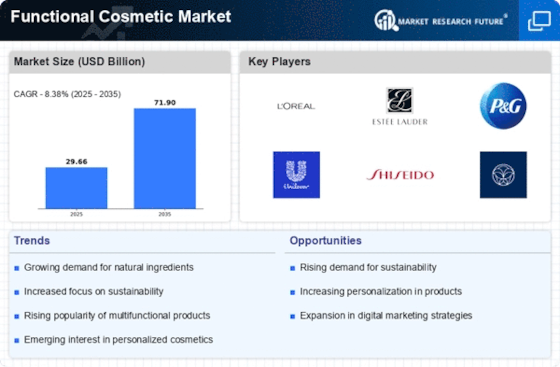
As per MRFR analysis, the Functional Cosmetic Market Size was estimated at 29.66 USD Billion in 2024. The Functional Cosmetic industry is projected to grow from 32.15 USD Billion in 2025 to 71.9 USD Billion by 2035, exhibiting a compound annual growth rate (CAGR) of 8.38 during the forecast period 2025 - 2035.

Key Market Trends & Highlights

The Functional Cosmetic Market is experiencing a transformative shift towards personalization and sustainability.

  • The rise of clean beauty is reshaping consumer preferences, particularly in North America.
  • Personalization in cosmetic products is becoming increasingly prevalent, catering to diverse consumer needs in the Asia-Pacific region.
  • Sustainability and eco-friendly practices are gaining traction, influencing product development across various segments.
  • The growing demand for natural and organic ingredients, driven by increasing consumer awareness and the influence of social media, is propelling the anti-aging and sun protection segments.

Market Size & Forecast

2024 Market Size 29.66 (USD Billion)
2035 Market Size 71.9 (USD Billion)
CAGR (2025 - 2035) 8.38%

Major Players

L'Oreal (FR), Estée Lauder (US), Procter & Gamble (US), Unilever (GB), Shiseido (JP), Coty (US), Revlon (US), Beiersdorf (DE), Amway (US)

Functional Cosmetic Market Trends

The Functional Cosmetic Market is currently experiencing a dynamic evolution, driven by a growing consumer awareness regarding personal care and wellness. This sector encompasses a diverse range of products that not only enhance beauty but also provide additional benefits, such as skin protection, hydration, and anti-aging properties. As consumers increasingly seek multifunctional solutions, brands are innovating to meet these demands, often incorporating natural ingredients and advanced technologies. The rise of e-commerce platforms further facilitates access to these products, allowing consumers to explore a wider array of options tailored to their specific needs. Moreover, the market appears to be influenced by shifting societal norms and values, with a notable emphasis on sustainability and ethical sourcing. Consumers are becoming more discerning, favoring brands that prioritize environmental responsibility and transparency in their formulations. This trend suggests a potential shift towards products that not only serve cosmetic purposes but also align with personal values. As the Functional Cosmetic Market continues to expand, it is likely to witness further innovations and adaptations to meet the evolving preferences of consumers, ultimately shaping the future landscape of beauty and personal care.

Rise of Clean Beauty

The Functional Cosmetic Market is witnessing a notable shift towards clean beauty products. Consumers increasingly prefer formulations that are free from harmful chemicals and synthetic additives. This trend indicates a growing demand for transparency in ingredient sourcing and product formulation, as individuals seek safer alternatives that align with their health and wellness goals.

Personalization in Cosmetic Products

Another emerging trend within the Functional Cosmetic Market is the rise of personalized beauty solutions. Brands are leveraging technology to offer customized products tailored to individual skin types and concerns. This approach not only enhances customer satisfaction but also fosters brand loyalty, as consumers feel more connected to products designed specifically for their unique needs.

Sustainability and Eco-Friendly Practices

Sustainability is becoming a central theme in the Functional Cosmetic Market. Companies are increasingly adopting eco-friendly practices, from sourcing ingredients to packaging. This trend reflects a broader societal shift towards environmental consciousness, as consumers actively seek brands that demonstrate a commitment to reducing their ecological footprint.

Functional Cosmetic Market Drivers

Increasing Consumer Awareness

The Functional Cosmetic Market experiences a notable surge in consumer awareness regarding the ingredients and benefits of cosmetic products. As consumers become more informed about the potential effects of various chemicals, they increasingly seek products that offer functional benefits, such as anti-aging, hydration, and skin protection. This trend is reflected in the rising demand for products that not only enhance appearance but also contribute to skin health. According to recent data, the market for functional cosmetics is projected to grow at a compound annual growth rate of approximately 8% over the next five years. This growth is driven by consumers' desire for transparency and efficacy in their cosmetic choices, leading brands to innovate and reformulate their offerings to meet these expectations.

Rise of E-commerce and Digital Marketing

The Functional Cosmetic Market is significantly influenced by the rise of e-commerce and digital marketing strategies. With the increasing penetration of the internet and mobile devices, consumers are more inclined to purchase cosmetics online. This shift has prompted brands to enhance their online presence and engage with consumers through targeted digital marketing campaigns. Data indicates that online sales of cosmetics have surged, with e-commerce platforms accounting for a substantial portion of total sales. This trend not only facilitates greater accessibility for consumers but also allows brands to reach a wider audience. Furthermore, social media platforms serve as powerful tools for brand promotion, enabling companies to showcase their functional cosmetic products and connect with potential customers effectively.

Technological Advancements in Formulation

Technological advancements play a pivotal role in shaping the Functional Cosmetic Market. Innovations in formulation techniques allow for the development of products that deliver enhanced performance and efficacy. For instance, the incorporation of nanotechnology and biotechnology in cosmetic formulations enables the creation of active ingredients that penetrate deeper into the skin, providing more effective results. This has led to a proliferation of products that claim to offer multifunctional benefits, such as moisturization, sun protection, and anti-aging properties. The market is witnessing a shift towards products that utilize these advanced technologies, as consumers increasingly favor cosmetics that provide visible results. As a result, brands that invest in research and development are likely to gain a competitive edge in this evolving landscape.

Influence of Social Media and Beauty Influencers

The Functional Cosmetic Market is profoundly impacted by the influence of social media and beauty influencers. Platforms such as Instagram and TikTok have become essential channels for beauty brands to promote their products and engage with consumers. Influencers play a crucial role in shaping consumer perceptions and driving purchasing decisions, often showcasing functional cosmetics that promise specific benefits. This trend has led to a surge in brand collaborations with influencers, resulting in increased visibility and credibility for products. Market analysis indicates that cosmetics endorsed by influencers tend to experience higher sales, as consumers are more likely to trust recommendations from individuals they follow. As social media continues to evolve, its impact on the functional cosmetics landscape is expected to grow, further driving market dynamics.

Growing Demand for Natural and Organic Ingredients

The Functional Cosmetic Market is witnessing a growing demand for products that feature natural and organic ingredients. As consumers become more health-conscious, they are increasingly seeking cosmetics that align with their values of sustainability and wellness. This trend is evident in the rising popularity of products that are free from synthetic chemicals and harmful additives. Market data suggests that the segment of natural and organic cosmetics is expected to expand significantly, driven by consumer preferences for clean beauty. Brands that prioritize the use of ethically sourced ingredients and transparent labeling are likely to resonate with this demographic. Consequently, the emphasis on natural formulations is reshaping product development strategies within the functional cosmetics sector.


Market Segment Insights

By Function: Anti-aging (Largest) vs. Sun protection (Fastest-Growing)

The Functional Cosmetic Market has witnessed a diverse distribution among key segment values, with anti-aging products holding the largest market share. The resistance against aging and the desire for youthful skin drive significant demand in this category. Conversely, sun protection is emerging as the fastest-growing segment, fueled by heightened awareness of the harmful effects of UV radiation and skin damage. Consumers are increasingly prioritizing protective measures, significantly impacting the market dynamics.

Anti-aging: (Dominant) vs. Sun Protection (Emerging)

Anti-aging products dominate the Functional Cosmetic Market, driven by an aging population and persistent demand for solutions that enhance youthful appearance. This segment includes a wide range of creams, serums, and treatments designed to reduce signs of aging. On the other hand, sun protection is rapidly gaining momentum as consumers recognize the importance of safeguarding skin from UV damage. Emerging technologies and formulations enhance the efficacy of sun protection products, making them more appealing. As awareness grows, innovation in this segment is anticipated to reshape market offerings, positioning it as a crucial area of growth.

By Product Type: Creams and Lotions (Largest) vs. Serums (Fastest-Growing)

In the Functional Cosmetic Market, the product type segment exhibits varied distribution, with creams and lotions holding the largest share. This category frequently attracts consumers due to its versatility, offering hydration, treatment, and protection in a single formulation. Following closely are serums, which have been gaining attention for their concentrated ingredients and targeted results, indicating a shift towards specialized beauty solutions.

Creams and Lotions (Dominant) vs. Serums (Emerging)

Creams and lotions represent the dominant force within the Functional Cosmetic Market, as they offer dual benefits of hydration and treatment while appealing to a broad audience. Their formulations are typically rich in emollients and active ingredients, making them versatile for various skin types. Conversely, serums have emerged as a fast-growing segment, characterized by their high concentration of active ingredients designed for specific skin concerns. This trend towards personalized skincare solutions is driven by consumer demand for efficacy and innovation, positioning serums as a key player for those seeking advanced skincare regimens.

By Target Consumer: Women (Largest) vs. Men (Fastest-Growing)

In the Functional Cosmetic Market, women hold the largest share, driven by the increasing preference for cosmetics with added benefits such as skincare properties. This segment significantly influences product innovation and branding, establishing a diverse range of options that appeal to various skin types and concerns. Meanwhile, the men's segment is experiencing rapid growth as societal perceptions shift, with more men embracing personal care and grooming products tailored for their specific needs.

Women (Dominant) vs. Men (Emerging)

The women’s segment in the Functional Cosmetic Market remains dominant due to their extensive engagement with beauty products, resulting in higher adoption rates of functional cosmetics. Women prioritize products that offer multifunctional benefits, including hydration and anti-aging properties. In contrast, the men’s segment is emerging rapidly as brands introduce male-specific products that address grooming and skincare needs. This shift indicates a narrowing gender gap in cosmetic consumption, with men increasingly seeking effective solutions to their skincare concerns. The growth of the men’s market is attributed to changing norms and increased marketing that targets men.

By Ingredient Type: Natural Ingredients (Largest) vs. Organic Ingredients (Fastest-Growing)

In the Functional Cosmetic Market, the distribution of market share among ingredient types reveals a strong inclination towards natural ingredients, which hold the largest segment share. This preference is increasingly driven by consumer demand for products that resonate with their values on health, wellness, and environmental sustainability. On the other hand, while organic ingredients trail behind in sheer volume, they are quickly gaining traction as a fast-growing segment due to their appeal in the market for clean beauty products, reflecting a shift in consumer habits prioritizing organic content.

Natural Ingredients: Dominant vs. Organic Ingredients: Emerging

Natural ingredients are currently recognized as the dominant force in the Functional Cosmetic Market, characterized by their appeal to health-conscious consumers seeking products free from synthetic additives. These ingredients often feature in formulations touted for their skin-benefitting properties and minimal environmental impact. Conversely, organic ingredients are emerging rapidly, appealing to a segment that values stringent standards for cultivation and processing. As consumers become more informed and discerning regarding ingredient transparency, the demand for organic products is expected to soar, driven by their potential for enhanced efficacy and ethical production practices.

By Price Range: Mass Market (Largest) vs. Luxury (Fastest-Growing)

In the Functional Cosmetic Market, the price range segment is characterized by a notable distribution among mass market, premium, and luxury categories. The mass market dominates significantly, appealing to a broad consumer base with affordability and accessibility, while premium brands cater to consumers seeking higher quality and specific functional benefits. Luxury products, although representing a smaller share, have been increasingly capturing attention due to their exclusive offerings and sophisticated formulations, attracting affluent consumers willing to invest in premium functional cosmetics.

Mass Market (Dominant) vs. Luxury (Emerging)

The mass market segment in the Functional Cosmetic Market represents the dominant player, characterized by widely available products at accessible price points. This segment emphasizes value for money, targeting a diverse demographic that seeks effective solutions without a hefty price tag. Conversely, the luxury segment serves emerging consumers driven by a desire for exclusivity and high-quality ingredients, often associated with prestige brands. Luxury functional cosmetics focus on superior formulations and innovative features aimed at delivering exceptional results. As consumer preferences evolve towards premium experiences, the luxury segment is poised for rapid growth, enticing customers who prioritize quality and brand reputation.

Get more detailed insights about Functional Cosmetic Market

Regional Insights

North America : Market Leader in Innovation

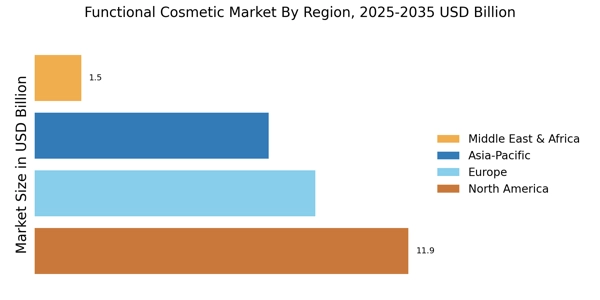
North America is the largest market for functional cosmetics, holding approximately 40% of the global share. The region's growth is driven by increasing consumer awareness regarding skincare benefits and a rising demand for multifunctional products. Regulatory support from agencies like the FDA ensures product safety, further boosting consumer confidence and market expansion. The United States and Canada are the leading countries in this market, with major players like Estée Lauder, Procter & Gamble, and Unilever dominating the landscape. The competitive environment is characterized by continuous innovation and marketing strategies that emphasize product efficacy and sustainability, appealing to a health-conscious consumer base.

Europe : Regulatory Framework and Growth

Europe is the second-largest market for functional cosmetics, accounting for around 30% of the global share. The region's growth is propelled by stringent regulations that ensure product safety and efficacy, fostering consumer trust. The European Commission's Cosmetic Regulation mandates comprehensive safety assessments, which enhance product credibility and drive demand for innovative solutions. Leading countries include Germany, France, and the UK, where brands like L'Oreal and Beiersdorf thrive. The competitive landscape is marked by a blend of established companies and emerging brands focusing on natural and organic ingredients. This trend aligns with consumer preferences for sustainable and ethical products, further enhancing market dynamics.

Asia-Pacific : Emerging Market Potential

Asia-Pacific is witnessing rapid growth in the functional cosmetics market, holding approximately 25% of the global share. The region's expansion is driven by increasing disposable incomes, urbanization, and a growing interest in beauty and personal care. Countries like China and India are leading this growth, supported by favorable government policies that encourage local manufacturing and innovation in cosmetic products. China is the largest market in the region, with a significant presence of both international and local brands. Companies like Shiseido and Coty are investing heavily in marketing and distribution channels to capture the growing consumer base. The competitive landscape is evolving, with a focus on digital marketing strategies to engage tech-savvy consumers seeking personalized beauty solutions.

Middle East and Africa : Untapped Market Opportunities

The Middle East and Africa region is emerging as a significant player in the functional cosmetics market, holding about 5% of the global share. The growth is primarily driven by a young and dynamic population that is increasingly interested in beauty and personal care products. Additionally, rising disposable incomes and urbanization are contributing to the demand for innovative cosmetic solutions tailored to local preferences. Countries like South Africa and the UAE are at the forefront of this market, with a mix of local and international brands competing for market share. The presence of key players such as Amway and Revlon highlights the competitive landscape, which is characterized by a focus on product quality and cultural relevance. As the market matures, there is a growing emphasis on sustainability and ethical sourcing, aligning with global trends.

Functional Cosmetic Market Regional Image

Key Players and Competitive Insights

The Functional Cosmetic Market is currently characterized by a dynamic competitive landscape, driven by innovation, sustainability, and digital transformation. Major players such as L'Oreal (France), Estée Lauder (United States), and Procter & Gamble (United States) are actively shaping the market through strategic initiatives that emphasize product efficacy and consumer engagement. L'Oreal (France) has positioned itself as a leader in the integration of technology and beauty, focusing on personalized skincare solutions that leverage AI and data analytics. Meanwhile, Estée Lauder (United States) continues to enhance its portfolio through targeted acquisitions and partnerships, aiming to expand its reach in emerging markets. Procter & Gamble (United States) emphasizes sustainability in its product development, aligning with consumer preferences for eco-friendly options, which collectively influences the competitive dynamics of the market.

The market structure appears moderately fragmented, with a mix of established brands and emerging players vying for market share. Key business tactics such as localizing manufacturing and optimizing supply chains are prevalent among these companies, allowing them to respond swiftly to regional demands and consumer preferences. This localized approach not only enhances operational efficiency but also fosters brand loyalty by catering to specific market needs. The collective influence of these key players is significant, as they set trends that smaller brands often follow, thereby shaping the overall market landscape.

In August 2025, L'Oreal (France) announced a partnership with a leading tech firm to develop an innovative skincare line that utilizes augmented reality for personalized beauty consultations. This strategic move underscores L'Oreal's commitment to enhancing consumer experience through technology, potentially setting a new standard in the industry for interactive product engagement. The integration of AR technology may not only attract tech-savvy consumers but also position L'Oreal as a pioneer in the functional cosmetics segment.

In September 2025, Estée Lauder (United States) launched a new line of sustainable beauty products, which are packaged in biodegradable materials. This initiative reflects the growing consumer demand for environmentally responsible products and aligns with the company's broader sustainability goals. By prioritizing eco-friendly practices, Estée Lauder is likely to strengthen its brand image and appeal to a conscientious consumer base, thereby enhancing its competitive edge in the market.

In July 2025, Procter & Gamble (United States) unveiled a new supply chain initiative aimed at reducing carbon emissions across its manufacturing processes. This strategic action not only addresses regulatory pressures but also resonates with consumers increasingly concerned about climate change. By investing in sustainable practices, Procter & Gamble is positioning itself as a responsible leader in the functional cosmetics market, which may enhance its reputation and customer loyalty.

As of October 2025, the competitive trends in the Functional Cosmetic Market are increasingly defined by digitalization, sustainability, and the integration of artificial intelligence. Strategic alliances among key players are shaping the landscape, fostering innovation and enhancing product offerings. The shift from price-based competition to a focus on technological advancement and supply chain reliability is evident, suggesting that future differentiation will hinge on the ability to innovate and respond to evolving consumer expectations.

Key Companies in the Functional Cosmetic Market market include

Industry Developments

  • Q2 2024: Shiseido Launches New 'Bio-Performance Skin Filler' with MolecuShift Technology Shiseido announced the launch of its new functional cosmetic product, 'Bio-Performance Skin Filler,' which utilizes proprietary MolecuShift technology to deliver hyaluronic acid deep into the skin, targeting anti-aging concerns.
  • Q2 2024: L'Oréal Announces Acquisition of Functional Skincare Brand Gjosa L'Oréal completed the acquisition of Gjosa, a Swiss company specializing in water-efficient and functional skincare technologies, to strengthen its portfolio in the functional cosmetics sector.

  • Q3 2024: Estée Lauder Companies Appoints New Chief Innovation Officer to Lead Functional Cosmetics Expansion Estée Lauder Companies named Dr. Maria Chen as Chief Innovation Officer, tasking her with accelerating the company's development of functional cosmetic products with advanced skin health benefits.
  • Q3 2024: Amorepacific Opens New R&D Center Focused on Functional Cosmetics in Seoul Amorepacific inaugurated a new research and development facility in Seoul dedicated to the innovation of functional cosmetic ingredients and formulations, aiming to boost its leadership in the Asian market.
  • Q4 2024: Procter & Gamble Launches Olay Regenerist Ultra-Rich with Peptide Complex Procter & Gamble introduced Olay Regenerist Ultra-Rich, a new functional cosmetic moisturizer featuring a proprietary peptide complex designed to improve skin elasticity and hydration.
  • Q4 2024: Unilever Partners with Alganelle to Develop Functional Cosmetic Market Ingredients from Microalgae Unilever announced a partnership with French biotech firm Alganelle to co-develop functional cosmetic ingredients derived from microalgae, focusing on sustainability and efficacy.
  • Q1 2025: Beiersdorf Acquires Functional Cosmetics Startup S-Biomedic Beiersdorf, the parent company of Nivea, acquired S-Biomedic, a Belgian startup specializing in microbiome-based functional cosmetic products, to enhance its innovation pipeline.
  • Q1 2025: Colgate-Palmolive Launches Functional Oral Care Cosmetic Line in Asia Colgate-Palmolive launched a new line of functional oral care cosmetics in Asia, featuring products with whitening, anti-sensitivity, and enamel-strengthening benefits.
  • Q2 2025: LVMH Invests in Functional Cosmetics Brand Typology LVMH made a strategic investment in Typology, a French brand known for its minimalist and functional cosmetic formulations, to expand its presence in the clean and functional beauty segment.
  • Q2 2025: Kao Corporation Receives Regulatory Approval for New Functional Sunscreen in Japan Kao Corporation received regulatory approval in Japan for its new functional sunscreen, which features advanced UV-blocking technology and skin barrier support.
  • Q2 2025: Mary Kay Opens New Manufacturing Facility for Functional Cosmetics in Texas Mary Kay opened a new manufacturing facility in Texas dedicated to the production of functional cosmetic products, supporting the company's growth in the North American market.
  • Q3 2025: Shiseido Announces Strategic Partnership with Givaudan for Functional Fragrance-Cosmetic Hybrids Shiseido entered a strategic partnership with Givaudan to co-develop hybrid products that combine functional cosmetic benefits with advanced fragrance technologies.

Future Outlook

Functional Cosmetic Market Future Outlook

The Functional Cosmetic Market is projected to grow at an 8.38% CAGR from 2024 to 2035, driven by increasing consumer awareness and demand for multifunctional products.

New opportunities lie in:

  • Development of personalized skincare solutions using AI technology.
  • Expansion into emerging markets with tailored product lines.
  • Partnerships with wellness brands for holistic beauty offerings.

By 2035, the market is expected to solidify its position as a leader in innovative beauty solutions.

Market Segmentation

Functional Cosmetic Market Function Outlook

  • Anti-aging
  • Skin Brightening
  • Moisturizing
  • Exfoliation
  • Sun protection

Functional Cosmetic Market Price Range Outlook

  • Mass market
  • Premium
  • Luxury

Functional Cosmetic Market Product Type Outlook

  • Creams and lotions
  • Serums
  • Masks
  • Cleansers
  • Toners

Functional Cosmetic Market Ingredient Type Outlook

  • Natural ingredients
  • Synthetic ingredients
  • Organic ingredients
  • Vegan ingredients
  • Cruelty-free ingredients

Functional Cosmetic Market Target Consumer Outlook

  • Women
  • Men
  • Teenagers
  • People with sensitive skin
  • People with specific skin concerns

Report Scope

MARKET SIZE 202429.66(USD Billion)
MARKET SIZE 202532.15(USD Billion)
MARKET SIZE 203571.9(USD Billion)
COMPOUND ANNUAL GROWTH RATE (CAGR)8.38% (2024 - 2035)
REPORT COVERAGERevenue Forecast, Competitive Landscape, Growth Factors, and Trends
BASE YEAR2024
Market Forecast Period2025 - 2035
Historical Data2019 - 2024
Market Forecast UnitsUSD Billion
Key Companies ProfiledMarket analysis in progress
Segments CoveredMarket segmentation analysis in progress
Key Market OpportunitiesGrowing consumer demand for multifunctional products enhances opportunities in the Functional Cosmetic Market.
Key Market DynamicsRising consumer demand for multifunctional products drives innovation and competition in the Functional Cosmetic Market.
Countries CoveredNorth America, Europe, APAC, South America, MEA

Leave a Comment

FAQs

What is the current valuation of the Functional Cosmetic Market as of 2024?

The Functional Cosmetic Market was valued at 29.66 USD Billion in 2024.

What is the projected market valuation for the Functional Cosmetic Market in 2035?

The market is projected to reach 71.9 USD Billion by 2035.

What is the expected CAGR for the Functional Cosmetic Market during the forecast period 2025 - 2035?

The expected CAGR for the Functional Cosmetic Market during 2025 - 2035 is 8.38%.

Which segment is projected to have the highest valuation in the Functional Cosmetic Market?

The Anti-aging segment is projected to grow from 8.5 USD Billion to 20.5 USD Billion.

What are the key product types in the Functional Cosmetic Market?

Key product types include Creams and lotions, Serums, Masks, Cleansers, and Toners.

How does the market for natural ingredients compare to synthetic ingredients in the Functional Cosmetic Market?

Natural ingredients are projected to grow from 5.0 USD Billion to 12.0 USD Billion, whereas synthetic ingredients are expected to increase from 10.0 USD Billion to 25.0 USD Billion.

What is the target consumer segmentation in the Functional Cosmetic Market?

Target consumers include Women, Men, Teenagers, People with sensitive skin, and those with specific skin concerns.

Which companies are considered key players in the Functional Cosmetic Market?

Key players include L'Oreal, Estée Lauder, Procter & Gamble, Unilever, Shiseido, Coty, Revlon, Beiersdorf, and Amway.

What is the projected growth for the moisturizing segment in the Functional Cosmetic Market?

The moisturizing segment is expected to grow from 7.0 USD Billion to 17.0 USD Billion.

Download Free Sample

Kindly complete the form below to receive a free sample of this Report

Compare Licence

×
Features License Type
Single User Multiuser License Enterprise User
Price $4,950 $ $7,250
Maximum User Access Limit 1 User Upto 10 Users Unrestricted Access Throughout the Organization
Free Customization
Direct Access to Analyst
Deliverable Format
Platform Access
Discount on Next Purchase 10% 15% 15%
Printable Versions