×
Request Free Sample ×

Kindly complete the form below to receive a free sample of this Report

* Please use a valid business email

Leading companies partner with us for data-driven Insights

clients tt-cursor
Hero Background

Gas Telecom Generator Market

ID: MRFR/EnP/28085-HCR
128 Pages
Priya Nagrale
October 2025

Gas Telecom Generator Market Research Report By Fuel Type (Diesel, Natural Gas, Gasoline, Hybrid), By Power Capacity (Up to 1 kW, 1 kW to 5 kW, 5 kW to 10 kW, 10 kW to 50 kW, Above 50 kW), By End User (Telecommunications Industry, Data Centers, Industrial Applications, Commercial Buildings, Residential Buildings) and By Regional (North America, Europe, South America, Asia-Pacific, Middle East and Africa) - Forecast to 2035

Share:
Download PDF ×

We do not share your information with anyone. However, we may send you emails based on your report interest from time to time. You may contact us at any time to opt-out.

Gas Telecom Generator Market Infographic
Purchase Options

Gas Telecom Generator Market Summary

As per MRFR analysis, the Gas Telecom Generator Market Size was estimated at 4.112 USD Billion in 2024. The Gas Telecom Generator industry is projected to grow from 4.31 USD Billion in 2025 to 6.901 USD Billion by 2035, exhibiting a compound annual growth rate (CAGR) of 4.82 during the forecast period 2025 - 2035.

Key Market Trends & Highlights

The Gas Telecom Generator Market is poised for growth driven by technological advancements and sustainability initiatives.

  • North America remains the largest market for gas telecom generators, driven by robust telecommunications infrastructure.
  • Asia-Pacific is emerging as the fastest-growing region, fueled by increasing energy demands and economic development.
  • The diesel segment continues to dominate the market, while the natural gas segment is experiencing rapid growth due to its environmental benefits.
  • Key market drivers include the rising demand for reliable power supply and regulatory support for clean energy solutions.

Market Size & Forecast

2024 Market Size 4.112 (USD Billion)
2035 Market Size 6.901 (USD Billion)
CAGR (2025 - 2035) 4.82%

Major Players

Caterpillar Inc. (US), Cummins Inc. (US), General Electric Company (US), Kohler Co. (US), MTU Onsite Energy (DE), Perkins Engines Company Limited (GB), Wärtsilä Corporation (FI), Atlas Copco AB (SE)

Gas Telecom Generator Market Trends

The Gas Telecom Generator Market is currently experiencing a notable transformation, driven by the increasing demand for reliable power solutions in the telecommunications sector. As the reliance on uninterrupted connectivity grows, the necessity for efficient and dependable power sources becomes paramount. This market appears to be evolving in response to technological advancements, with a focus on enhancing energy efficiency and reducing environmental impact. Furthermore, the integration of renewable energy sources into traditional generator systems is gaining traction, suggesting a shift towards more sustainable practices within the industry. In addition, the Gas Telecom Generator Market seems to be influenced by the expansion of telecommunications infrastructure in emerging economies. As these regions invest in enhancing their communication networks, the demand for robust power solutions is likely to rise. This trend indicates a potential for growth, as companies seek to provide innovative and adaptable generator systems that can meet the unique challenges of diverse environments. Overall, the Gas Telecom Generator Market is poised for continued development, reflecting the dynamic nature of the telecommunications landscape and the ongoing pursuit of energy-efficient solutions.

Technological Advancements

The Gas Telecom Generator Market is witnessing a surge in technological innovations aimed at improving generator efficiency and performance. Enhanced control systems and monitoring technologies are being integrated, allowing for real-time data analysis and optimization of power generation processes. This trend indicates a move towards smarter, more responsive systems that can adapt to varying energy demands.

Sustainability Initiatives

There is a growing emphasis on sustainability within the Gas Telecom Generator Market, as companies increasingly prioritize environmentally friendly practices. The incorporation of alternative fuels and hybrid systems is becoming more prevalent, reflecting a broader commitment to reducing carbon footprints and promoting cleaner energy solutions. This trend suggests a significant shift towards greener operational methodologies.

Emerging Market Growth

The expansion of telecommunications infrastructure in developing regions is driving demand within the Gas Telecom Generator Market. As these areas enhance their connectivity capabilities, the need for reliable power sources becomes critical. This trend highlights the potential for market growth as companies seek to address the unique challenges posed by diverse geographical and economic conditions.

Gas Telecom Generator Market Drivers

Increasing Demand for Reliable Power Supply

The Gas Telecom Generator Market is experiencing a surge in demand for reliable power supply solutions. As telecommunications infrastructure expands, the need for uninterrupted power becomes critical. This demand is driven by the increasing reliance on digital communication and the necessity for constant connectivity. In many regions, power outages can disrupt services, leading to significant financial losses. The market for gas telecom generators is projected to grow, with estimates suggesting a compound annual growth rate of around 5% over the next few years. This growth is indicative of the industry's response to the pressing need for dependable energy sources, particularly in remote and underserved areas.

Regulatory Support for Clean Energy Solutions

The Gas Telecom Generator Market is benefiting from regulatory frameworks that promote clean energy solutions. Governments are increasingly implementing policies aimed at reducing carbon emissions and encouraging the use of cleaner fuels. This regulatory support is likely to enhance the adoption of gas telecom generators, which are often viewed as a more environmentally friendly alternative to diesel generators. The market is expected to see a shift towards these cleaner technologies, with projections indicating that the share of gas generators in the telecom sector could rise significantly in the coming years. This trend aligns with broader sustainability goals and reflects a growing awareness of environmental impacts.

Expansion of Telecommunications Infrastructure

The Gas Telecom Generator Market is closely linked to the expansion of telecommunications infrastructure. As new technologies such as 5G are deployed, the demand for robust power solutions to support these networks is intensifying. This expansion is particularly evident in developing regions, where the need for reliable communication services is paramount. The market is projected to grow in response to this infrastructure development, with estimates indicating that investments in telecom infrastructure could reach several billion dollars in the next few years. This growth presents a significant opportunity for gas telecom generators, which are essential for maintaining operational continuity in these expanding networks.

Rising Energy Costs and Economic Considerations

The Gas Telecom Generator Market is influenced by rising energy costs, which compel telecommunications companies to seek more cost-effective power solutions. As traditional energy prices fluctuate, the appeal of gas generators, which often provide a more stable and predictable cost structure, becomes more pronounced. This economic consideration is driving a shift towards gas-powered solutions, as they can offer lower operational costs compared to diesel counterparts. Market analysts suggest that this trend may lead to an increased market share for gas telecom generators, particularly in regions where energy prices are volatile. The focus on cost efficiency is likely to shape purchasing decisions in the telecom sector.

Technological Innovations in Generator Efficiency

Technological advancements are playing a pivotal role in the Gas Telecom Generator Market. Innovations in generator design and fuel efficiency are leading to more effective and economical solutions for telecommunications providers. Enhanced efficiency not only reduces operational costs but also minimizes environmental impact, making these generators more appealing to companies focused on sustainability. Recent developments in hybrid systems, which combine gas generators with renewable energy sources, are particularly noteworthy. These innovations are expected to drive market growth, as they offer a dual benefit of reliability and reduced carbon footprint, potentially increasing market penetration in various regions.

Market Segment Insights

By Fuel Type: Diesel (Largest) vs. Natural Gas (Fastest-Growing)

In the Gas Telecom Generator Market, the fuel type segment reflects a varied landscape, with Diesel holding the largest share due to its established infrastructure and robust performance. Natural Gas follows closely, capturing significant attention due to its environmentally-friendly profile and support from policy incentives. Gasoline, while presenting reliability in certain markets, contributes a lesser share, often overshadowed by Diesel and Natural Gas. Meanwhile, Hybrid technology begins to carve out its niche, appealing to segments oriented towards sustainability and operational flexibility. Growth trends show a decisive movement towards Natural Gas as the fastest-growing segment, propelled by a global push for cleaner energy solutions and efficiency improvements in gas-based technologies. The demand for Hybrid generators is also on the rise, supported by advancements in hybrid technology that promise to balance performance and emissions. Diesel continues to be favored for its power, but innovation and regulatory frameworks favor a shift towards Natural Gas and Hybrid solutions for future developments in the Gas Telecom Generator Market.

Diesel (Dominant) vs. Hybrid (Emerging)

Diesel generators remain the dominant force in the Gas Telecom Generator Market, thanks to their reliability and energy density, making them ideal for uninterrupted power supply in critical infrastructure. They are extensively used in remote telecom applications where consistent power is crucial. Despite emerging challenges from regulatory pressures to reduce emissions, Diesel technology is continually evolving to meet modern standards. On the other hand, Hybrid generators are seen as an emerging solution that blends the strengths of Diesel and renewable energy sources, leveraging batteries and solar panels for improved efficiency and reduced operational costs. As infrastructure evolves and needs shift towards sustainability, Hybrid technology is positioned to gain traction due to its potential for lower emissions and operational flexibility, making it an attractive alternative in various market segments.

By Power Capacity: Up to 1 kW (Largest) vs. 10 kW to 50 kW (Fastest-Growing)

In the Gas Telecom Generator Market, the power capacity segments reveal diverse distribution patterns. The 'Up to 1 kW' segment dominates the market, favored for its compact size and suitability for small telecom operations needing limited power. Meanwhile, the '10 kW to 50 kW' segment emerges as the fastest-growing due to increasing demand for robust solutions that can support medium to large telecom infrastructure, offering reliability as the market expands.

Power Capacity: Up to 1 kW (Dominant) vs. 10 kW to 50 kW (Emerging)

The 'Up to 1 kW' segment leads the market, particularly appealing for small-scale applications where space and budget constraints matter. These generators are lightweight and easy to transport, making them ideal for temporary setups required in remote telecom installations. Conversely, the '10 kW to 50 kW' segment is gaining traction due to its ability to serve larger networks that demand higher power capacity. This range balances scalability with efficiency, making it suitable for both emergency backup and primary power for systems that rely on consistent, uninterrupted energy access.

By End User: Telecommunications Industry (Largest) vs. Data Centers (Fastest-Growing)

In the Gas Telecom Generator Market, the telecommunications industry holds the largest market share, reflecting its crucial reliance on uninterrupted power supply for operational integrity. This segment dominates due to the increasing demand for network reliability and the expansion of telecom infrastructure, supported by advancements in communication technologies. Data centers, recognized as the fastest-growing sector, have witnessed a surge in demand for gas-powered generators to ensure energy efficiency and reliability as they support the continuous operation of digital services and cloud computing.

Telecommunications Industry (Dominant) vs. Data Centers (Emerging)

The telecommunications industry is characterized by its established framework and extensive reliance on gas telecom generators for maintaining service continuity, scalability, and operational resilience. In contrast, the data centers segment, while emerging, exhibits rapid growth driven by the surge in data consumption and the migration of businesses towards cloud solutions. Data centers prioritize energy efficiency and seek reliable power sources to mitigate operational risks. Both segments are vital; telecommunications ensures connectivity while data centers reflect trends towards digital transformation, positioning them both as essential players in the gas telecom generator landscape.

Get more detailed insights about Gas Telecom Generator Market

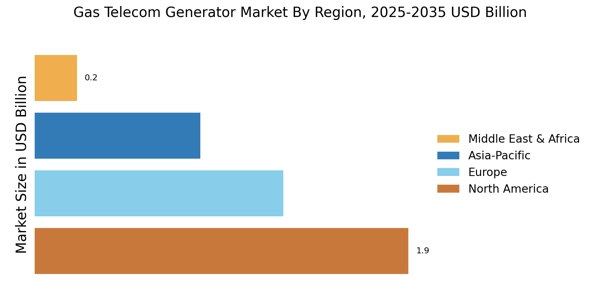
Regional Insights

North America : Market Leader in Innovation

North America is the largest market for gas telecom generators, holding approximately 45% of the global market share. The region's growth is driven by increasing demand for reliable power solutions in telecommunications, coupled with stringent regulatory standards promoting cleaner energy sources. The U.S. and Canada are the primary contributors, with investments in infrastructure and technology enhancing market dynamics. The competitive landscape is characterized by major players such as Caterpillar Inc., Cummins Inc., and General Electric Company, which dominate the market with innovative products and services. The presence of these key players fosters a robust ecosystem, encouraging advancements in generator technology. Additionally, government initiatives aimed at reducing carbon emissions further stimulate market growth, ensuring a sustainable future for gas telecom generators.

Europe : Emerging Market with Regulations

Europe is witnessing significant growth in the gas telecom generator market, accounting for approximately 30% of the global share. The region's demand is fueled by the increasing need for energy-efficient solutions and compliance with EU regulations aimed at reducing greenhouse gas emissions. Countries like Germany and the UK are leading this growth, supported by government incentives for cleaner energy technologies. The competitive landscape in Europe features key players such as MTU Onsite Energy and Wärtsilä Corporation, which are at the forefront of innovation. The market is also characterized by a strong emphasis on sustainability, with companies investing in research and development to meet regulatory standards. The European market is expected to continue expanding as governments push for greener energy solutions, creating opportunities for growth in the gas telecom generator sector.

Asia-Pacific : Rapid Growth and Demand

Asia-Pacific is emerging as a significant player in the gas telecom generator market, holding around 20% of the global market share. The region's growth is driven by rapid urbanization, increasing telecommunications infrastructure, and a rising demand for reliable power sources. Countries like China and India are leading this trend, with substantial investments in energy projects to support their growing economies. The competitive landscape is becoming increasingly dynamic, with local and international players vying for market share. Companies such as Perkins Engines Company Limited and Atlas Copco AB are expanding their presence in the region, focusing on innovative solutions tailored to local needs. The government's push for energy security and sustainability further enhances the market's potential, making Asia-Pacific a key area for future growth in gas telecom generators.

Middle East and Africa : Resource-Rich Opportunities

The Middle East and Africa region is gradually developing its gas telecom generator market, currently holding about 5% of the global share. The growth is primarily driven by the increasing demand for reliable power in telecommunications, particularly in countries like South Africa and the UAE. Government initiatives aimed at diversifying energy sources and enhancing infrastructure are key catalysts for market expansion. The competitive landscape is characterized by a mix of local and international players, with companies exploring opportunities in renewable energy integration. The presence of key players is growing, as they adapt to the unique challenges of the region. As governments focus on improving energy access and sustainability, the gas telecom generator market is poised for gradual growth, presenting opportunities for investment and development.

Gas Telecom Generator Market Regional Image

Key Players and Competitive Insights

The Gas Telecom Generator Market is currently characterized by a dynamic competitive landscape, driven by the increasing demand for reliable power solutions in telecommunications. Key players are focusing on innovation, sustainability, and strategic partnerships to enhance their market positions. Companies such as Caterpillar Inc. (US), Cummins Inc. (US), and Wärtsilä Corporation (FI) are at the forefront, leveraging their technological expertise and extensive product portfolios to meet the evolving needs of the telecom sector. Their strategies, which include regional expansion and digital transformation initiatives, collectively shape a competitive environment that is increasingly focused on efficiency and reliability.

In terms of business tactics, companies are localizing manufacturing and optimizing supply chains to enhance responsiveness to market demands. The market structure appears moderately fragmented, with several key players exerting influence over various segments. This fragmentation allows for a diverse range of offerings, yet the collective strength of major companies like General Electric Company (US) and Kohler Co. (US) ensures that competition remains robust, pushing innovation and service quality to the forefront.

In August 2025, Caterpillar Inc. (US) announced the launch of a new line of gas-powered generators specifically designed for telecom applications, emphasizing energy efficiency and reduced emissions. This strategic move not only aligns with global sustainability trends but also positions Caterpillar as a leader in providing eco-friendly solutions to the telecom industry. The introduction of these generators is likely to enhance their market share and appeal to environmentally conscious customers.

In September 2025, Cummins Inc. (US) expanded its partnership with a major telecommunications provider to integrate advanced digital monitoring systems into their gas generators. This collaboration aims to enhance operational efficiency and predictive maintenance capabilities. By leveraging IoT technology, Cummins is poised to offer superior service and reliability, which could significantly improve customer satisfaction and retention in a competitive market.

In July 2025, Wärtsilä Corporation (FI) secured a contract to supply gas generators for a large-scale telecom project in Southeast Asia. This contract underscores Wärtsilä's commitment to expanding its footprint in emerging markets, where demand for reliable power solutions is surging. The strategic importance of this move lies in its potential to establish long-term relationships with key telecom operators in the region, thereby enhancing Wärtsilä's competitive positioning.

As of October 2025, the Gas Telecom Generator Market is witnessing trends such as digitalization, sustainability, and the integration of artificial intelligence into operational processes. Strategic alliances are increasingly shaping the competitive landscape, allowing companies to pool resources and expertise. Looking ahead, competitive differentiation is likely to evolve from traditional price-based competition to a focus on innovation, technological advancements, and supply chain reliability, as companies strive to meet the complex demands of the telecom sector.

Key Companies in the Gas Telecom Generator Market market include

Industry Developments

The Gas Telecom Generator Market is expected to witness significant growth in the coming years, driven by the increasing demand for reliable and efficient power supply in remote and off-grid areas. The market is expected to reach a valuation of USD 6.58 billion by 2034, expanding at a CAGR of 4.8% from 2025 to 2034.

This growth is attributed to the rising adoption of gas-powered generators in the telecommunications sector, as they offer advantages such as low operating costs, high fuel efficiency, and reduced emissions compared to diesel generators.Recent developments in the market include the launch of new products with advanced features and the increasing adoption of smart technologies for remote monitoring and control of generators. Key players in the market are focusing on strategic partnerships and acquisitions to expand their product portfolio and geographical reach.

Governments in various countries are also implementing supportive policies and regulations to promote the adoption of renewable energy sources, including natural gas, which is expected to further drive the demand for gas telecom generators.

Future Outlook

Gas Telecom Generator Market Future Outlook

The Gas Telecom Generator Market is projected to grow at a 4.82% CAGR from 2024 to 2035, driven by increasing demand for reliable power solutions and technological advancements.

New opportunities lie in:

  • Development of hybrid generator systems integrating renewable energy sources.
  • Expansion into emerging markets with tailored financing solutions.
  • Implementation of IoT-enabled monitoring systems for predictive maintenance.

By 2035, the market is expected to solidify its position as a leader in energy solutions for telecommunications.

Market Segmentation

Gas Telecom Generator Market End User Outlook

  • Telecommunications Industry
  • Data Centers
  • Industrial Applications
  • Commercial Buildings
  • Residential Buildings

Gas Telecom Generator Market Fuel Type Outlook

  • Diesel
  • Natural Gas
  • Gasoline
  • Hybrid

Gas Telecom Generator Market Power Capacity Outlook

  • Up to 1 kW
  • 1 kW to 5 kW
  • 5 kW to 10 kW
  • 10 kW to 50 kW
  • Above 50 kW

Report Scope

MARKET SIZE 20244.112(USD Billion)
MARKET SIZE 20254.31(USD Billion)
MARKET SIZE 20356.901(USD Billion)
COMPOUND ANNUAL GROWTH RATE (CAGR)4.82% (2024 - 2035)
REPORT COVERAGERevenue Forecast, Competitive Landscape, Growth Factors, and Trends
BASE YEAR2024
Market Forecast Period2025 - 2035
Historical Data2019 - 2024
Market Forecast UnitsUSD Billion
Key Companies ProfiledMarket analysis in progress
Segments CoveredMarket segmentation analysis in progress
Key Market OpportunitiesIntegration of renewable energy sources into Gas Telecom Generator Market enhances sustainability and operational efficiency.
Key Market DynamicsRising demand for reliable power solutions drives innovation and competition in the Gas Telecom Generator Market.
Countries CoveredNorth America, Europe, APAC, South America, MEA

Leave a Comment

FAQs

What is the projected market valuation of the Gas Telecom Generator Market by 2035?

The projected market valuation for the Gas Telecom Generator Market is expected to reach 6.901 USD Billion by 2035.

What was the overall market valuation of the Gas Telecom Generator Market in 2024?

The overall market valuation of the Gas Telecom Generator Market was 4.112 USD Billion in 2024.

What is the expected CAGR for the Gas Telecom Generator Market during the forecast period 2025 - 2035?

The expected CAGR for the Gas Telecom Generator Market during the forecast period 2025 - 2035 is 4.82%.

Which fuel type segment is projected to have the highest valuation by 2035?

The Natural Gas segment is projected to have the highest valuation, expected to reach 2.045 USD Billion by 2035.

How does the power capacity segment '10 kW to 50 kW' perform in terms of valuation?

The '10 kW to 50 kW' power capacity segment is projected to grow to 2.9704 USD Billion by 2035.

What are the key players in the Gas Telecom Generator Market?

Key players in the Gas Telecom Generator Market include Caterpillar Inc., Cummins Inc., and General Electric Company, among others.

Which end-user segment is expected to show the most growth by 2035?

The Telecommunications Industry end-user segment is expected to show the most growth, projected to reach 2.5 USD Billion by 2035.

What is the valuation of the Hybrid fuel type segment by 2035?

The Hybrid fuel type segment is projected to reach a valuation of 2.44 USD Billion by 2035.

How does the valuation of the Data Centers segment compare to the Telecommunications Industry segment by 2035?

By 2035, the Data Centers segment is projected to reach 1.8 USD Billion, which is lower than the Telecommunications Industry segment at 2.5 USD Billion.

Download Free Sample

Kindly complete the form below to receive a free sample of this Report

Compare Licence

×
Features License Type
Single User Multiuser License Enterprise User
Price $4,950 $5,950 $7,250
Maximum User Access Limit 1 User Upto 10 Users Unrestricted Access Throughout the Organization
Free Customization
Direct Access to Analyst
Deliverable Format
Platform Access
Discount on Next Purchase 10% 15% 15%
Printable Versions