×
Request Free Sample ×

Kindly complete the form below to receive a free sample of this Report

* Please use a valid business email

Leading companies partner with us for data-driven Insights

clients tt-cursor
Hero Background

Diesel Fired Telecom Generator Market

ID: MRFR/EnP/31369-HCR
128 Pages
Priya Nagrale
October 2025

Diesel Fired Telecom Generator Market Research Report By Application (Network Communication, Base Transceiver Station, Data Centers, Remote Monitoring), By End Use (Telecom Operators, Service Providers, Corporate Sector, Government Institutions), By Generator Type (Portable Generators, Stationary Generators, Mobile Generators), By Power Rating (Below 50 kVA, 50-100 kVA, 100-250 kVA, Above 250 kVA) and By Regional (North America, Europe, South America, Asia Pacific, Middle East and Africa) - Forecast to 2035

Share:
Download PDF ×

We do not share your information with anyone. However, we may send you emails based on your report interest from time to time. You may contact us at any time to opt-out.

Diesel Fired Telecom Generator Market Infographic
Purchase Options

Diesel Fired Telecom Generator Market Summary

As per MRFR analysis, the Diesel Fired Telecom Generator Market Size was estimated at 3726.54 USD Million in 2024. The Diesel Fired Telecom Generator industry is projected to grow from 3908.47 USD Million in 2025 to 6295.31 USD Million by 2035, exhibiting a compound annual growth rate (CAGR) of 4.88 during the forecast period 2025 - 2035.

Key Market Trends & Highlights

The Diesel Fired Telecom Generator Market is poised for growth driven by technological advancements and increasing demand for reliable power solutions.

  • North America remains the largest market for diesel fired telecom generators, driven by robust telecommunications infrastructure.
  • The Asia-Pacific region is emerging as the fastest-growing market, fueled by rapid urbanization and increased connectivity needs.
  • Telecommunication towers represent the largest segment, while data centers are experiencing the fastest growth due to rising data consumption.
  • Key market drivers include the increasing demand for reliable power supply and rising telecommunications infrastructure investments.

Market Size & Forecast

2024 Market Size 3726.54 (USD Million)
2035 Market Size 6295.31 (USD Million)
CAGR (2025 - 2035) 4.88%

Major Players

Caterpillar (US), Cummins (US), Kohler (IT), MTU (DE), Perkins (GB), Wärtsilä (FI), Generac (US), Atlas Copco (SE), Honda (JP)

Diesel Fired Telecom Generator Market Trends

The Diesel Fired Telecom Generator Market is currently experiencing a notable evolution, driven by the increasing demand for reliable power sources in telecommunications. As the global telecommunications infrastructure expands, the need for uninterrupted power supply becomes paramount. Diesel generators are often favored for their efficiency and ability to provide backup power during outages. This market appears to be influenced by various factors, including technological advancements and the growing emphasis on sustainability. Companies are increasingly focusing on enhancing the performance and reducing emissions of diesel generators, which may lead to a more environmentally friendly product offering. Moreover, the Diesel Fired Telecom Generator Market seems to be shaped by the rising trend of hybrid power solutions. These solutions combine diesel generators with renewable energy sources, such as solar or wind, to create a more sustainable energy mix. This shift not only addresses environmental concerns but also enhances the reliability of power supply in remote areas. As the telecommunications sector continues to evolve, the integration of innovative technologies and sustainable practices is likely to play a crucial role in shaping the future of this market. The ongoing developments suggest a dynamic landscape where adaptability and efficiency are key drivers of growth.

Technological Advancements

The Diesel Fired Telecom Generator Market is witnessing a surge in technological innovations aimed at improving efficiency and performance. Manufacturers are increasingly investing in research and development to create generators that are not only more powerful but also more environmentally friendly. This trend indicates a shift towards smarter, more efficient systems that can better meet the demands of modern telecommunications.

Hybrid Power Solutions

There is a growing inclination towards hybrid power solutions within the Diesel Fired Telecom Generator Market. By integrating diesel generators with renewable energy sources, companies are able to enhance the reliability of power supply while addressing environmental concerns. This trend suggests a potential transformation in how power is generated and utilized in the telecommunications sector.

Sustainability Initiatives

Sustainability initiatives are becoming increasingly prominent in the Diesel Fired Telecom Generator Market. Companies are focusing on reducing emissions and improving the overall environmental impact of their products. This trend reflects a broader commitment to sustainable practices within the telecommunications industry, indicating that future developments may prioritize eco-friendly solutions.

Diesel Fired Telecom Generator Market Drivers

Growing Need for Backup Power Solutions

The growing need for backup power solutions is a critical factor influencing the Global Diesel Fired Telecom Generator Market Industry. As the reliance on digital communication increases, telecom operators are prioritizing the establishment of robust backup systems to mitigate the risks associated with power failures. Diesel generators are favored for their reliability and quick deployment capabilities, making them ideal for emergency power supply. This increasing focus on resilience in telecommunications infrastructure is likely to drive demand for diesel generators, contributing to the overall market growth.

Increasing Demand for Reliable Power Supply

The Global Diesel Fired Telecom Generator Market Industry is experiencing a surge in demand for reliable power supply solutions, particularly in remote and off-grid areas. As telecommunications infrastructure expands, the need for uninterrupted power becomes critical. Diesel generators offer a dependable source of energy, ensuring that telecom operations remain functional even during power outages. This trend is particularly evident in developing regions where grid connectivity is inconsistent. The market is projected to reach 3.73 USD Billion in 2024, reflecting the growing reliance on diesel generators to support telecom networks.

Rising Telecommunications Sector Investments

The rising investments in the telecommunications sector are fueling the Global Diesel Fired Telecom Generator Market Industry. With the expansion of mobile networks and the rollout of 5G technology, telecom operators are investing heavily in infrastructure to meet growing consumer demands. Diesel generators serve as a reliable power source for these new installations, ensuring that network operations remain uninterrupted. This trend is expected to sustain a compound annual growth rate of 4.87% from 2025 to 2035, indicating a robust market outlook driven by ongoing investments in telecommunications.

Technological Advancements in Generator Efficiency

Technological advancements in diesel generator efficiency are playing a pivotal role in the Global Diesel Fired Telecom Generator Market Industry. Innovations in engine design and fuel management systems have led to improved fuel consumption rates and reduced emissions. These enhancements not only lower operational costs but also align with global sustainability goals. As telecom companies seek to minimize their environmental impact, the adoption of advanced diesel generators becomes increasingly attractive. This shift is expected to contribute to the market's growth, with projections indicating a rise to 6.29 USD Billion by 2035.

Regulatory Support for Energy Infrastructure Development

Regulatory support for energy infrastructure development is a significant driver in the Global Diesel Fired Telecom Generator Market Industry. Governments worldwide are implementing policies that encourage investment in energy solutions, particularly in underserved regions. This regulatory environment fosters the growth of diesel generator installations, as they are often seen as a quick and effective means to enhance energy access. As nations prioritize telecommunications as a vital service, the demand for diesel generators is likely to increase, further propelling market growth in the coming years.
Market Segment Insights

By Application: Telecommunication Towers (Largest) vs. Data Centers (Fastest-Growing)

In the Diesel Fired Telecom Generator Market, the application segment reflects a diverse distribution among various categories. Telecommunication towers emerge as the largest share contributors, driven by the increasing demand for robust and uninterrupted communication networks. Meanwhile, data centers, prioritizing energy efficiency and resilience, have increased their usage of diesel generators as a reliable power source, showcasing significant growth potential in this sector. In recent years, the application landscape for diesel fired telecom generators has been shaped by the urgent need for reliable power in various contexts. The telecommunication sector's continuous expansion fuels the demand for diesel generators in towers, while the rapid growth of data centers as critical infrastructures propels their adoption. Additionally, remote communication demands and the necessity of emergency backup power further strengthen these trends, ultimately driving sustained growth within the market.

Telecommunication Towers (Dominant) vs. Remote Communication (Emerging)

Telecommunication Towers serve as the dominant segment for diesel fired telecom generators, characterized by their requirement for continuous operation to maintain network integrity. These towers demand high reliability and efficiency, as power interruptions can lead to significant service disruptions. On the other hand, Remote Communication, though emerging, is gaining traction due to the increasing need for connectivity in far-flung areas. With an evolving landscape, this segment places emphasis on innovative power solutions that are both portable and efficient, showcasing potential for accelerated adoption. The contrasting characteristics of these segments highlight the strength of established infrastructures versus the opportunities in under-served areas seeking reliable communication solutions.

By Fuel Type: Diesel (Largest) vs. Biodiesel (Fastest-Growing)

In the Diesel Fired Telecom Generator Market, the fuel type segment is dominated by diesel, which holds the largest market share due to its established infrastructure and reliability. Diesel generators are favored for their efficiency, availability, and high energy output, making them the primary choice for telecom operators seeking dependable power solutions. However, biodiesel is rapidly gaining traction as a sustainable alternative, capturing an increasing share of the market thanks to growing environmental concerns and favorable government policies promoting renewable energy sources. The growth trends within this segment are significantly influenced by the expanding demand for eco-friendly energy solutions and advancements in biodiesel production technologies. Telecom companies are increasingly investing in biodiesel generators due to their lower carbon emissions and long-term cost benefits. This shift is not only promoting the use of biodiesel but also encouraging innovations in synthetic diesel, catering to the need for cleaner operations in the telecom sector. As regulations tighten globally on emissions, the preference is shifting towards greener fuel options, thus positioning biodiesel as a cornerstone of future market strategies.

Diesel (Dominant) vs. Synthetic Diesel (Emerging)

In the Diesel Fired Telecom Generator Market, diesel remains the dominant fuel type, known for its superior performance and reliability in various operational conditions. Its long-standing presence has established a robust supply chain and maintenance ecosystem, reinforcing its market leadership. Conversely, synthetic diesel is emerging as a viable alternative, particularly due to advancements in production methods and growing awareness of environmental impacts. Synthetic diesel, derived from renewable resources, presents a low-emission solution that appeals to environmentally conscious telecom operators. As industries seek to balance efficiency with sustainability, the transition towards synthetic diesel is gaining momentum, offering a promising horizon for future market dynamics.

By Power Output: 100 kW to 200 kW (Largest) vs. Above 200 kW (Fastest-Growing)

In the Diesel Fired Telecom Generator Market, the power output segment is divided into four categories: Below 50 kW, 50 kW to 100 kW, 100 kW to 200 kW, and Above 200 kW. Among these, the 100 kW to 200 kW segment holds the largest market share, serving as the backbone for medium to large telecom applications due to its balanced power output and efficiency. Meanwhile, the Above 200 kW segment is marked by its rapid growth rate, specifically catering to high-demand telecommunications infrastructures that rely on robust power solutions.

Power Output: 100 kW to 200 kW (Dominant) vs. Above 200 kW (Emerging)

The 100 kW to 200 kW segment is characterized by its reliability and efficiency, making it ideal for telecom networks that require a steady power supply. It fulfills the energy needs of medium-sized operations efficiently, facilitating uninterrupted service to a growing customer base. In contrast, the Above 200 kW segment is emerging as a vital player, driven by the increasing demand for high-capacity backup power sources in expansive telecom networks and data centers. This segment typically incorporates advanced technologies to enhance performance and is positioned to capture significant market attention as the industry trends towards more extensive infrastructure.

By Cooling System: Air Cooled (Largest) vs. Liquid Cooled (Fastest-Growing)

In the Diesel Fired Telecom Generator Market, the Cooling System segment is primarily divided into three categories: Air Cooled, Liquid Cooled, and Hybrid Cooling. Among these, Air Cooled systems hold the largest market share due to their widespread adoption in various telecom applications, attributed to their cost-effectiveness and simplicity. Conversely, Liquid Cooled systems are rapidly gaining traction among users looking for enhanced efficiency and performance in high-demand environments, leading to a notable increase in their market share. The growth trends for the Cooling System segment are being significantly influenced by the rising demand for reliable and efficient power solutions in the telecom industry. As operators focus on minimizing downtime and maximizing operational efficiency, Liquid Cooled systems are emerging as the preferred choice due to their ability to manage higher loads more effectively. Additionally, the increasing integration of hybrid technologies is fostering innovation and further driving sales in the segment, promising a dynamic environment for future growth.

Air Cooled (Dominant) vs. Liquid Cooled (Emerging)

Air Cooled systems dominate the cooling segment of the Diesel Fired Telecom Generator Market, renowned for their simplicity and lower maintenance costs. These systems utilize ambient air to dissipate heat, making them optimal for many telecom sites where space and cost constraints are critical. They require less infrastructure and are easier to install compared to their counterparts. On the other hand, Liquid Cooled systems are emerging as a competitive option, offering superior cooling efficiency and performance, particularly in high-temperature and high-load scenarios. These systems circulate liquid for heat extraction, allowing for more compact designs and greater energy efficiency. The growing trend towards hybrid technologies also supports the liquid cooling market, as operators seek advanced solutions to meet ever-increasing demand.

By End User: Telecom Operators (Largest) vs. Private Enterprises (Fastest-Growing)

The Diesel Fired Telecom Generator Market is primarily driven by the prevalence of telecom operators who hold a substantial market share, owing to their extensive need for reliable power solutions to maintain uninterrupted communication services. Government agencies also play a key role, particularly in regions where infrastructure development is critical. Private enterprises, while representing a smaller share, are increasingly adopting diesel generators to ensure operational continuity and energy security.

Telecom Operators (Dominant) vs. Private Enterprises (Emerging)

Telecom operators are positioned as the dominant users of diesel-fired telecom generators due to their high demand for energy reliability. They require robust, scalable solutions to support expansive networks, especially in remote or off-grid locations. On the other hand, private enterprises are emerging as significant users, driven by their need for uninterrupted power to sustain daily operations. The rise in digital services has prompted these enterprises to invest in dedicated power solutions, thus contributing to the segment's rapid growth. As they face increasing challenges related to energy costs and supply, the adoption of diesel generators is likely to intensify, making this segment one to watch.

Get more detailed insights about Diesel Fired Telecom Generator Market

Regional Insights

North America : Established Market Leaders

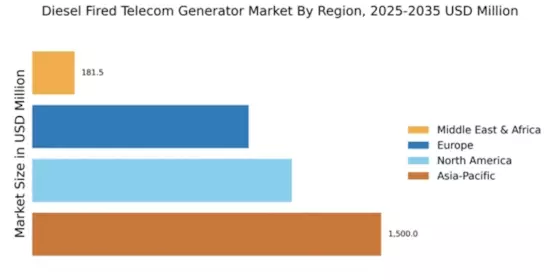
The North American diesel fired telecom generator market is projected to reach $1110.0 million by 2025, driven by increasing demand for reliable power solutions in telecommunications. Regulatory support for renewable energy integration and stringent emissions standards are key growth catalysts. The region's focus on enhancing infrastructure and expanding 5G networks further fuels market growth, as telecom operators seek dependable backup power sources to ensure uninterrupted service. Leading countries in this region include the US and Canada, where major players like Caterpillar, Cummins, and Generac dominate the market. The competitive landscape is characterized by innovation and technological advancements, with companies investing in R&D to enhance generator efficiency and reduce emissions. The presence of established manufacturers ensures a robust supply chain, catering to the growing needs of the telecom sector.

Europe : Regulatory-Driven Growth

Europe's diesel fired telecom generator market is expected to reach $930.0 million by 2025, driven by stringent regulations aimed at reducing carbon emissions and enhancing energy efficiency. The region's commitment to sustainability and the transition to renewable energy sources are significant growth drivers. Additionally, the increasing reliance on digital communication and the expansion of 5G networks are propelling demand for reliable backup power solutions in the telecom sector. Germany, the UK, and France are leading countries in this market, with key players like MTU, Kohler, and Perkins actively participating. The competitive landscape is marked by a focus on innovation, with companies developing advanced generator technologies to meet regulatory standards. The presence of established manufacturers and a growing emphasis on energy efficiency position Europe as a critical market for diesel fired telecom generators.

Asia-Pacific : Emerging Market Potential

The Asia-Pacific diesel fired telecom generator market is projected to dominate with a market size of $1500.0 million by 2025, reflecting its significant share in the global market. Rapid urbanization, increasing mobile penetration, and the expansion of telecom infrastructure are key growth drivers. Additionally, government initiatives to improve connectivity in rural areas and the rising demand for uninterrupted power supply are fueling market growth in this region. Countries like China, India, and Japan are at the forefront, with major players such as Honda and Wärtsilä leading the market. The competitive landscape is characterized by a mix of local and international manufacturers, focusing on cost-effective solutions and technological advancements. The presence of a diverse range of companies ensures a competitive environment, catering to the growing needs of the telecom sector in this dynamic region.

Middle East and Africa : Resource-Rich Opportunities

The Middle East and Africa diesel fired telecom generator market is expected to reach $186.54 million by 2025, driven by the increasing need for reliable power solutions in the telecommunications sector. The region's growing population and rapid urbanization are contributing to the demand for enhanced connectivity and uninterrupted power supply. Additionally, government initiatives aimed at improving infrastructure and energy access are significant growth catalysts in this market. Leading countries include South Africa and the UAE, where key players like Atlas Copco and Generac are actively involved. The competitive landscape is evolving, with a focus on providing tailored solutions to meet the unique challenges of the region. The presence of both local and international manufacturers ensures a diverse market, catering to the specific needs of the telecom industry.

Key Players and Competitive Insights

The Diesel Fired Telecom Generator Market is currently characterized by a competitive landscape that is both dynamic and multifaceted. Key growth drivers include the increasing demand for reliable power solutions in remote telecommunications, coupled with the ongoing expansion of mobile networks globally. Major players such as Caterpillar (US), Cummins (US), and Wärtsilä (FI) are strategically positioned to leverage their technological expertise and extensive product portfolios. Caterpillar (US) focuses on innovation in generator efficiency and emissions reduction, while Cummins (US) emphasizes its commitment to sustainability through cleaner fuel technologies. Wärtsilä (FI) is actively pursuing partnerships to enhance its service offerings, thereby shaping a competitive environment that is increasingly reliant on technological advancements and strategic collaborations.

In terms of business tactics, companies are localizing manufacturing to reduce costs and optimize supply chains, which is particularly relevant in the context of fluctuating global trade dynamics. The market structure appears moderately fragmented, with several key players exerting influence over regional markets. This fragmentation allows for a diverse range of products and services, catering to various customer needs while fostering competition among established and emerging players.

In November 2025, Cummins (US) announced a strategic partnership with a leading telecommunications provider to develop hybrid power solutions that integrate diesel generators with renewable energy sources. This move is significant as it aligns with the growing trend towards sustainability and positions Cummins as a frontrunner in the transition to greener energy solutions within the telecom sector. The partnership is expected to enhance operational efficiency and reduce carbon footprints for telecom operators.

In October 2025, Caterpillar (US) unveiled its latest line of diesel generators designed specifically for telecom applications, featuring advanced telemetry and remote monitoring capabilities. This launch underscores Caterpillar's commitment to innovation and reflects the increasing demand for smart technology in power generation. By integrating IoT capabilities, these generators can provide real-time data analytics, enabling telecom operators to optimize performance and maintenance schedules.

In September 2025, Wärtsilä (FI) expanded its service network in Asia by opening a new service center dedicated to supporting diesel generator operations in the telecom sector. This expansion is indicative of Wärtsilä's strategy to enhance customer support and service reliability, which is crucial in a market where downtime can lead to significant revenue losses for telecom operators. The new center is expected to improve response times and service quality, thereby strengthening Wärtsilä's competitive position in the region.

As of December 2025, current competitive trends in the Diesel Fired Telecom Generator Market are increasingly defined by digitalization, sustainability, and the integration of AI technologies. Strategic alliances are becoming more prevalent, as companies recognize the need to collaborate in order to innovate and meet evolving customer demands. Looking ahead, competitive differentiation is likely to shift from traditional price-based competition to a focus on technological innovation, reliability, and supply chain resilience. This evolution suggests that companies that prioritize R&D and strategic partnerships will be better positioned to thrive in an increasingly complex market.

Key Companies in the Diesel Fired Telecom Generator Market market include

Industry Developments

Recent developments in the Diesel Fired Telecom Generator Market highlight increased investments amid rising demand for reliable power solutions in the telecommunications sector. Companies like Cummins and Caterpillar continue to enhance their product offerings, introducing innovative features to improve fuel efficiency and reduce emissions. Mergers and acquisitions are shaping the competitive landscape; for instance, there are whispers of strategic partnerships involving Wärtsilä and Kohler that aim to expand market reach and technological capabilities.

Furthermore, the growth of the renewable energy sector is prompting Diesel Fired Telecom Generator Market manufacturers to explore hybrid solutions, integrating diesel generators with solar or wind power sources.

The surge in telecommunications infrastructure, particularly in emerging markets, is expected to drive significant market valuation increases. Perkins and Himoinsa are reportedly boosting their production abilities to meet this rising demand. Volatile fuel prices are also influencing manufacturers’ strategies, as companies focus on delivering cost-effective solutions. Consequently, the diesel fired telecom generator sector is poised for evolution, responding dynamically to challenges and opportunities in the broader energy market.

Future Outlook

Diesel Fired Telecom Generator Market Future Outlook

The Diesel Fired Telecom Generator Market is projected to grow at a 4.88% CAGR from 2024 to 2035, driven by increasing demand for reliable power solutions and technological advancements.

New opportunities lie in:

  • Expansion into renewable hybrid systems for telecom applications.
  • Development of advanced monitoring and control technologies for efficiency.
  • Strategic partnerships with telecom operators for integrated power solutions.

By 2035, the market is expected to solidify its position as a key player in the telecom power sector.

Market Segmentation

Diesel Fired Telecom Generator Market End User Outlook

  • Telecom Operators
  • Government Agencies
  • Private Enterprises

Diesel Fired Telecom Generator Market Fuel Type Outlook

  • Diesel
  • Biodiesel
  • Synthetic Diesel

Diesel Fired Telecom Generator Market Application Outlook

  • Telecommunication Towers
  • Data Centers
  • Remote Communication
  • Emergency Backup Power

Diesel Fired Telecom Generator Market Power Output Outlook

  • Below 50 kW
  • 50 kW to 100 kW
  • 100 kW to 200 kW
  • Above 200 kW

Diesel Fired Telecom Generator Market Cooling System Outlook

  • Air Cooled
  • Liquid Cooled
  • Hybrid Cooling

Report Scope

MARKET SIZE 20243726.54(USD Million)
MARKET SIZE 20253908.47(USD Million)
MARKET SIZE 20356295.31(USD Million)
COMPOUND ANNUAL GROWTH RATE (CAGR)4.88% (2024 - 2035)
REPORT COVERAGERevenue Forecast, Competitive Landscape, Growth Factors, and Trends
BASE YEAR2024
Market Forecast Period2025 - 2035
Historical Data2019 - 2024
Market Forecast UnitsUSD Million
Key Companies ProfiledCaterpillar (US), Cummins (US), Kohler (IT), MTU (DE), Perkins (GB), Wärtsilä (FI), Generac (US), Atlas Copco (SE), Honda (JP)
Segments CoveredApplication, Fuel Type, Power Output, Cooling System, End User
Key Market OpportunitiesIntegration of renewable energy sources with Diesel Fired Telecom Generators enhances sustainability and operational efficiency.
Key Market DynamicsRising demand for reliable power solutions drives innovation and competition in the Diesel Fired Telecom Generator market.
Countries CoveredNorth America, Europe, APAC, South America, MEA

Leave a Comment

FAQs

What is the expected market size of the Diesel Fired Telecom Generator Market in 2034?

The Diesel Fired Telecom Generator Market is expected to reach a value of 6.00 USD Billion by 2034.

What is the projected CAGR for the Diesel Fired Telecom Generator Market from 2025 to 2034?

The market is projected to grow at a CAGR of 4.88% from 2025 to 2034.

Which application dominates the Diesel Fired Telecom Generator Market in 2032?

The Base Transceiver Station application is expected to be valued at 1.8 USD Billion in 2032.

What is the market size of the North American segment of the Diesel Fired Telecom Generator Market in 2023?

The North American segment is valued at 1.2 USD Billion in 2023.

Who are the key players in the Diesel Fired Telecom Generator Market?

Major players include Wärtsilä, Kohler, Perkins, Cummins, and Caterpillar.

What is the expected market value for Network Communication in 2032?

The Network Communication application is expected to reach 1.7 USD Billion by 2032.

How much is the Data Centers application worth in the Diesel Fired Telecom Generator Market in 2023?

The Data Centers application is valued at 0.85 USD Billion in 2023.

What is the market size of the Europe region for the Diesel Fired Telecom Generator Market in 2032?

The European region is projected to reach 1.4 USD Billion by 2032.

What is the overall market value of the Diesel Fired Telecom Generator Market in 2024?

In 2024, the overall market is valued at 3.73 USD Billion.

What is the growth outlook for the Remote Monitoring application from 2024 to 2032?

The Remote Monitoring application is expected to grow from 0.24 USD Billion in 2023 to 0.4 USD Billion in 2032.

Download Free Sample

Kindly complete the form below to receive a free sample of this Report

Compare Licence

×
Features License Type
Single User Multiuser License Enterprise User
Price $4,950 $5,950 $7,250
Maximum User Access Limit 1 User Upto 10 Users Unrestricted Access Throughout the Organization
Free Customization
Direct Access to Analyst
Deliverable Format
Platform Access
Discount on Next Purchase 10% 15% 15%
Printable Versions