×
Request Free Sample ×

Kindly complete the form below to receive a free sample of this Report

* Please use a valid business email

Leading companies partner with us for data-driven Insights

clients tt-cursor
Hero Background

GCC Data Catalog Market

ID: MRFR/ICT/60333-HCR
200 Pages
Aarti Dhapte
October 2025

GCC Data Catalog Market Research Report By Component (Solution, Services), By Deployment (On-Premise, Cloud), By Application (Business Intelligence Tool, Enterprise Applications, Mobile and Web Applications), and By End-users (Healthcare, Retail, BFSI, IT & telecommunication, Government, Other)- Forecast to 2035

Share:
Download PDF ×

We do not share your information with anyone. However, we may send you emails based on your report interest from time to time. You may contact us at any time to opt-out.

GCC Data Catalog Market Infographic
Purchase Options

GCC Data Catalog Market Summary

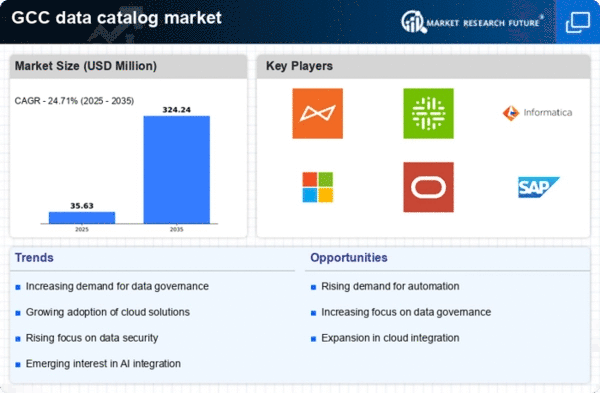
As per MRFR analysis, the GCC data catalog market Size was estimated at 28.57 USD Million in 2024. The GCC data catalog market is projected to grow from 35.63 USD Million in 2025 to 324.24 USD Million by 2035, exhibiting a compound annual growth rate (CAGR) of 24.71% during the forecast period 2025 - 2035.

Key Market Trends & Highlights

The GCC data catalog market is experiencing robust growth driven by technological advancements and increasing data governance needs.

  • The largest segment in the GCC data catalog market is the cloud-based solutions segment, which is witnessing heightened adoption.
  • The fastest-growing segment is the integration of advanced technologies, reflecting a shift towards more sophisticated data management.
  • The GCC market is characterized by a strong emphasis on data governance and compliance, which is becoming increasingly critical for organizations.
  • Key market drivers include the rising demand for data-driven decision making and the emphasis on data security and privacy.

Market Size & Forecast

2024 Market Size 28.57 (USD Million)
2035 Market Size 324.24 (USD Million)
CAGR (2025 - 2035) 24.71%

Major Players

Alation (US), Collibra (BE), Informatica (US), Microsoft (US), Oracle (US), SAP (DE), Tableau (US), IBM (US), Google (US)

GCC Data Catalog Market Trends

The data catalog market is currently experiencing a transformative phase, driven by the increasing need for organizations to manage and utilize their data effectively. In the GCC region, businesses are recognizing the importance of data governance and compliance, which has led to a surge in demand for robust data catalog solutions. These tools facilitate better data discovery, classification, and management, enabling organizations to harness their data assets more efficiently. As companies strive to become data-driven, the integration of advanced technologies such as artificial intelligence and machine learning into data catalog solutions is becoming more prevalent. This integration not only enhances data quality but also streamlines data management processes, making it easier for users to access and utilize data across various departments. Moreover, the emphasis on data privacy and security is shaping the landscape of the data catalog market. Organizations in the GCC are increasingly focused on ensuring that their data practices comply with local regulations and international standards. This focus on compliance is prompting investments in data catalog solutions that offer features such as data lineage tracking and automated metadata management. As a result, the market is likely to witness continued growth, with vendors innovating to meet the evolving needs of businesses. The future of the data catalog market appears promising, as organizations continue to prioritize data management as a critical component of their overall strategy.

Increased Adoption of Cloud-Based Solutions

Organizations are increasingly shifting towards cloud-based data catalog solutions, driven by the need for scalability and flexibility. This trend allows businesses to manage their data assets more efficiently while reducing infrastructure costs. Cloud solutions also facilitate easier collaboration among teams, enhancing data accessibility.

Focus on Data Governance and Compliance

The emphasis on data governance is becoming more pronounced, as organizations seek to ensure compliance with local regulations. This focus is leading to the development of data catalog solutions that incorporate features for tracking data lineage and managing metadata, thereby enhancing data integrity.

Integration of Advanced Technologies

The incorporation of artificial intelligence and machine learning into data catalog solutions is gaining traction. These technologies enhance data quality and automate various data management tasks, making it easier for organizations to derive insights from their data.

GCC Data Catalog Market Drivers

Emphasis on Data Security and Privacy

In the context of the data catalog market, the increasing emphasis on data security and privacy is a critical driver. With the rise of data breaches and stringent regulations in the GCC, organizations are prioritizing the protection of sensitive information. The data catalog market is responding by offering solutions that enhance data governance and compliance. Companies are investing in data catalogs that provide robust security features, ensuring that data is accessible only to authorized users. This focus on security is likely to propel market growth, as organizations seek to mitigate risks associated with data management and maintain customer trust.

Rising Demand for Data-Driven Decision Making

The data catalog market is experiencing a notable surge in demand as organizations increasingly recognize the value of data-driven decision making. In the GCC region, businesses are investing heavily in data analytics to enhance operational efficiency and drive strategic initiatives. This trend is reflected in a projected growth rate of approximately 25% in the data catalog market by 2026. Companies are leveraging data catalogs to streamline data discovery, improve data quality, and foster collaboration among teams. As organizations strive to become more data-centric, the data catalog market is poised to benefit significantly from this shift, enabling firms to harness their data assets effectively.

Expansion of Digital Transformation Initiatives

The ongoing digital transformation initiatives across various sectors in the GCC are significantly impacting the data catalog market. Organizations are increasingly digitizing their operations, leading to a surge in data generation and the need for effective data management solutions. The data catalog market is benefiting from this trend, as companies seek to implement data catalogs that facilitate data integration and accessibility. With a projected market growth of around 20% by 2026, the demand for data catalogs is expected to rise as businesses strive to optimize their digital strategies and enhance their data capabilities.

Increased Focus on Collaboration and Data Sharing

The data catalog market is being driven by an increased focus on collaboration and data sharing among organizations in the GCC. As businesses recognize the importance of data as a shared asset, they are investing in data catalogs that promote transparency and accessibility. This trend is particularly relevant in industries such as finance and healthcare, where data sharing can lead to improved outcomes. The data catalog market is likely to see growth as organizations adopt solutions that facilitate collaboration across departments and with external partners. This emphasis on data sharing is expected to enhance innovation and drive competitive advantage.

Growth of Artificial Intelligence and Machine Learning

The integration of artificial intelligence (AI) and machine learning (ML) technologies is transforming the data catalog market. In the GCC, organizations are increasingly adopting AI-driven solutions to automate data management processes and enhance data discovery. The data catalog market is witnessing innovations that leverage AI to improve metadata management and facilitate advanced analytics. This trend is expected to drive market growth, with estimates suggesting a potential increase in market size by 30% over the next few years. As businesses seek to harness the power of AI and ML, the demand for sophisticated data catalog solutions is likely to rise.

Market Segment Insights

By Component: Solutions (Largest) vs. Services (Fastest-Growing)

In the GCC data catalog market, the Solutions segment emerges as the largest component, holding a significant market share compared to Services. This dominance is attributed to the increasing adoption of data-driven strategies across various industries, leading organizations to prioritize comprehensive solutions that enhance operational efficiency and data management capabilities. As enterprises increasingly rely on effective data cataloging, Solutions play a crucial role in fulfilling these needs, contributing to their substantial market presence. On the other hand, the Services segment is recognized as the fastest-growing component within the market. This growth is driven by the rising demand for consulting, implementation, and support services that accompany data catalog technologies. Businesses are seeking expertise to navigate the complexities of data management and to leverage the full potential of their data assets. As such, Services are expanding rapidly, fueled by a trend towards outsourcing and partnerships that enhance the deployment of data solutions.

Solutions: Dominant vs. Services: Emerging

The Solutions segment in the GCC data catalog market is characterized by providing integrated tools and platforms that facilitate data organization, accessibility, and management. As the dominant force, Solutions encompass a wide array of offerings designed to streamline data processes and enable businesses to derive insights efficiently. In contrast, the Services segment represents an emerging powerhouse that focuses on consulting, implementation, and managed services. This segment is vital for organizations aiming to urbanize their data landscapes, offering expertise and support tailored to individual business needs. The combination of robust Solutions and adaptive Services positions the market for sustainable growth, addressing both immediate data challenges and long-term strategic goals.

By Deployment: Cloud (Largest) vs. On-Premise (Fastest-Growing)

In the GCC data catalog market, the cloud deployment option commands a significant share, appealing to organizations looking for scalability and cost efficiency. Businesses are increasingly gravitating towards cloud solutions due to their flexibility and ease of integration with other digital tools, leading to a noticeable market dominance in this segment. Conversely, the on-premise deployments are recognized as the fastest-growing segment as organizations seek to enhance security and control over their data. The proliferation of data privacy regulations is propelling this trend, as companies prefer on-premise systems to ensure compliance and safeguard sensitive information, creating a robust demand for these solutions.

Cloud (Dominant) vs. On-Premise (Emerging)

The cloud deployment segment in the GCC data catalog market is characterized by its extensive adoption, driven by the diverse needs of businesses aiming for operational efficiency and reduced infrastructure costs. Major players are continuously enhancing their cloud offerings, ensuring high availability and performance which reinforces their dominant market position. In contrast, on-premise deployments are emerging due to increasing concerns over security and compliance, especially in data-sensitive industries. Organizations that prioritize data governance and regulatory adherence are leaning towards on-premise solutions, looking for tailored configurations and direct control over their data environments. This trend illustrates a valuable shift in preferences, offering a competitive landscape between the two deployment models.

By Application: Business Intelligence Tools (Largest) vs. Enterprise Applications (Fastest-Growing)

In the GCC data catalog market, Business Intelligence Tools currently dominate the landscape, holding the largest share due to their critical role in data analysis and decision-making processes across various industries. Enterprise Applications follow closely behind, experiencing rapid adoption as organizations seek integrated solutions that streamline operations and enhance productivity. Mobile and Web Applications, although growing, are still in the early phases of market integration compared to the former segments. The growth trends in the GCC data catalog market are being driven by factors such as the increasing need for real-time analytics, rising investments in digital transformation, and the surge in data-driven decision-making. The proliferation of cloud-based solutions is also contributing to the swift expansion of Enterprise Applications, while the demand for user-friendly Mobile and Web Applications is fueled by the growing mobile workforce and the need for remote access to data resources.

Business Intelligence Tools (Dominant) vs. Mobile and Web Applications (Emerging)

Business Intelligence Tools are recognized as the dominant segment in the GCC data catalog market, providing robust capabilities for data visualization, reporting, and analytics which are essential for informed business decisions. Their strong presence is bolstered by widespread adoption across sectors such as finance, healthcare, and retail, where they enable organizations to harness the power of data effectively. In contrast, Mobile and Web Applications are seen as emerging players, capturing attention due to the rise of mobile usage and the demand for accessible data solutions. These applications are rapidly evolving to support various business needs, focusing on user experience and functionality, thereby setting the stage for significant growth as more companies prioritize mobile accessibility in their data strategies.

By End-users: Healthcare (Largest) vs. Retail (Fastest-Growing)

The GCC data catalog market demonstrates a diverse distribution of market share among various end-users. Healthcare holds the largest share due to the increasing demand for data-driven solutions to enhance patient care and streamline operations. Retail follows suit, though not far behind, as businesses look to improve inventory management and consumer insights through effective data utilization. Moving forward, the growth trends for these segments are driven by rapid digital transformation in healthcare and retail. Healthcare is leveraging data analytics to improve treatment outcomes and manage resources efficiently. Retail, on the other hand, is experiencing a surge in demand for personalized shopping experiences, which propels data catalog adoption as businesses aim to understand and predict consumer behavior more effectively.

Healthcare: Dominant vs. Retail: Emerging

Healthcare serves as a dominant segment in the GCC data catalog market, characterized by substantial investment in technology to enhance patient management and operational efficiency. The sector's focus on integrating advanced analytics into clinical processes is driving its growth. In contrast, the retail segment is emerging rapidly, propelled by the necessity for real-time data insights to optimize supply chains and enhance customer interactions. Retailers are increasingly adopting data catalogs to organize and analyze vast amounts of customer data, contributing to improved inventory control and marketing strategies. As both sectors continue to evolve, their reliance on data will further solidify their respective positions within the GCC data catalog market.

Get more detailed insights about GCC Data Catalog Market

Key Players and Competitive Insights

The data catalog market is currently characterized by a dynamic competitive landscape, driven by the increasing demand for data governance, compliance, and analytics capabilities. Key players are actively pursuing strategies that emphasize innovation, partnerships, and regional expansion to enhance their market positioning. Companies such as Alation (US), Collibra (BE), and Informatica (US) are at the forefront, leveraging their technological advancements to cater to the growing needs of organizations seeking to manage their data assets effectively. This collective focus on enhancing data accessibility and usability is reshaping the competitive environment, fostering a climate where agility and responsiveness to market demands are paramount.

In terms of business tactics, companies are increasingly localizing their operations and optimizing supply chains to better serve regional markets. The competitive structure of the data catalog market appears moderately fragmented, with several key players exerting influence while also facing competition from emerging startups. This fragmentation allows for diverse offerings and innovation, as established firms and new entrants alike strive to capture market share through differentiated solutions and services.

In October 2025, Alation (US) announced a strategic partnership with a leading cloud service provider to enhance its data catalog capabilities. This collaboration aims to integrate advanced AI functionalities into Alation's platform, thereby improving data discovery and governance for clients. The significance of this move lies in its potential to position Alation as a leader in AI-driven data management solutions, appealing to organizations looking to leverage artificial intelligence for better data insights.

In September 2025, Collibra (BE) launched a new version of its data intelligence platform, which includes enhanced features for data lineage and impact analysis. This upgrade is particularly relevant as organizations increasingly prioritize data quality and compliance. By focusing on these critical areas, Collibra strengthens its value proposition, making it an attractive option for enterprises navigating complex regulatory environments.

In August 2025, Informatica (US) expanded its global footprint by entering into a strategic alliance with a prominent regional player in the GCC. This partnership is expected to facilitate localized support and services, thereby enhancing customer engagement and satisfaction. The strategic importance of this move lies in Informatica's ability to tap into new markets while providing tailored solutions that meet the specific needs of regional clients.

As of November 2025, the competitive trends in the data catalog market are increasingly defined by digitalization, sustainability, and the integration of AI technologies. Strategic alliances are playing a crucial role in shaping the current landscape, enabling companies to pool resources and expertise to deliver innovative solutions. Looking ahead, it is likely that competitive differentiation will evolve, with a shift from price-based competition to a focus on innovation, technological advancements, and supply chain reliability. This transition underscores the importance of agility and responsiveness in a rapidly changing market.


Key Companies in the GCC Data Catalog Market market include

Industry Developments

In recent months, the GCC Data Catalog Market has seen significant developments, particularly with major players like Oracle, Microsoft, SAP, and Informatica enhancing their offerings amid increasing demand for data-driven insights in the region. As of October 2023, both Oracle and Microsoft have reported expansions in cloud services within the Gulf Cooperation Council, aiming to integrate data catalogs that enhance data discovery and governance. 

The market is experiencing growth, with valuations reflecting a heightened emphasis on data management solutions spurred by digital transformation in various sectors. In terms of mergers and acquisitions, there was a notable acquisition by SAP of Altyus in July 2023, strengthening their position in the data catalog segment within the GCC. Furthermore, Talend and Qlik are focusing on improved collaboration tools, allowing organizations in the GCC to leverage data more effectively. 

In the past couple of years, companies like Amazon Web Services and Snowflake have also made strides to improve their market share, ensuring a competitive landscape full of innovations tailored for GCC stakeholders. Overall, these developments showcase the increasing importance of data management solutions in driving success across the region's rapidly evolving digital landscape.

Future Outlook

GCC Data Catalog Market Future Outlook

The data catalog market is projected to grow at a 24.71% CAGR from 2024 to 2035, driven by increasing data complexity, regulatory compliance, and demand for data democratization.

New opportunities lie in:

  • Development of AI-driven data catalog solutions for enhanced data discovery.
  • Integration of data governance features to ensure compliance and security.
  • Expansion into niche markets such as healthcare and finance for tailored data solutions.

By 2035, the data catalog market is expected to be robust, driven by innovation and strategic partnerships.

Market Segmentation

GCC Data Catalog Market Component Outlook

  • Solutions
  • Services

GCC Data Catalog Market End-users Outlook

  • Healthcare
  • Retail
  • BFSI
  • IT & telecommunication
  • Government
  • Other

GCC Data Catalog Market Deployment Outlook

  • On-Premise
  • Cloud

GCC Data Catalog Market Application Outlook

  • Business Intelligence Tools
  • Enterprise Applications
  • Mobile and Web Applications

Report Scope

MARKET SIZE 202428.57(USD Million)
MARKET SIZE 202535.63(USD Million)
MARKET SIZE 2035324.24(USD Million)
COMPOUND ANNUAL GROWTH RATE (CAGR)24.71% (2024 - 2035)
REPORT COVERAGERevenue Forecast, Competitive Landscape, Growth Factors, and Trends
BASE YEAR2024
Market Forecast Period2025 - 2035
Historical Data2019 - 2024
Market Forecast UnitsUSD Million
Key Companies Profiled["Alation (US)", "Collibra (BE)", "Informatica (US)", "Microsoft (US)", "Oracle (US)", "SAP (DE)", "Tableau (US)", "IBM (US)", "Google (US)"]
Segments CoveredComponent, Deployment, Application, End-users
Key Market OpportunitiesIntegration of artificial intelligence enhances data discovery and governance in the data catalog market.
Key Market DynamicsRising demand for data governance drives innovation and competition in the data catalog market across the GCC region.
Countries CoveredGCC

Leave a Comment

FAQs

What is the expected market size of the GCC Data Catalog Market in 2024?

The GCC Data Catalog Market is expected to be valued at 37.7 USD Million in 2024.

What will the market size of the GCC Data Catalog Market be by 2035?

By 2035, the market is anticipated to grow to a value of 172.5 USD Million.

What is the expected CAGR for the GCC Data Catalog Market from 2025 to 2035?

The expected CAGR for the GCC Data Catalog Market from 2025 to 2035 is 14.826%.

Which component of the GCC Data Catalog Market has the highest value in 2024?

The Solution component of the GCC Data Catalog Market is valued at 22.6 USD Million in 2024.

What is the projected value of the Services component by 2035?

The Services component is projected to reach 69.7 USD Million by 2035.

Who are the key players in the GCC Data Catalog Market?

Major players in the market include Oracle, Microsoft, SAP, Altyus, and Informatica among others.

What is the growth outlook for the GCC Data Catalog Market?

The market shows strong growth potential, driven by increasing data management needs and technology adoption.

What are the main applications of the GCC Data Catalog Market?

The main applications include data governance, analytics, and improved data discovery.

What are the emerging trends in the GCC Data Catalog Market?

Emerging trends include cloud integration, AI-driven data catalog solutions, and enhanced user experience.

How is the current regional environment impacting the GCC Data Catalog Market?

The current regional environment is fostering growth due to increased investments in data infrastructure and analytics.

Download Free Sample

Kindly complete the form below to receive a free sample of this Report

Compare Licence

×
Features License Type
Single User Multiuser License Enterprise User
Price $4,950 $5,950 $7,250
Maximum User Access Limit 1 User Upto 10 Users Unrestricted Access Throughout the Organization
Free Customization
Direct Access to Analyst
Deliverable Format
Platform Access
Discount on Next Purchase 10% 15% 15%
Printable Versions