×
Request Free Sample ×

Kindly complete the form below to receive a free sample of this Report

* Please use a valid business email

Leading companies partner with us for data-driven Insights

clients tt-cursor
Hero Background

Germany Data Catalog Market

ID: MRFR/ICT/61620-HCR
200 Pages
Aarti Dhapte
October 2025

Germany Data Catalog Market Research Report By Component (Solution, Services), By Deployment (On-Premise, Cloud), By Application (Business Intelligence Tool, Enterprise Applications, Mobile and Web Applications) and By End-users (Healthcare, Retail, BFSI, IT & telecommunication, Government, Other)- Forecast to 2035

Share:
Download PDF ×

We do not share your information with anyone. However, we may send you emails based on your report interest from time to time. You may contact us at any time to opt-out.

Germany Data Catalog Market Infographic
Purchase Options

Germany Data Catalog Market Summary

As per analysis, the Germany data catalog market is projected to grow from USD 63.76 Million in 2024 to USD 79.28 Million by 2025, exhibiting a compound annual growth rate (CAGR) of 24.33% during the forecast period (2025 - 2035).

Key Market Trends & Highlights

The Germany data catalog market is experiencing a robust evolution driven by technological advancements and regulatory demands.

  • The data analytics segment remains the largest contributor to the market, reflecting a strong emphasis on deriving actionable insights from data.
  • The data quality segment is the fastest-growing area, highlighting an increasing recognition of the importance of data integrity.
  • Cloud-based solutions dominate the market, while hybrid models are emerging as the fastest-growing deployment method.
  • Regulatory compliance and the rising importance of data analytics are key drivers propelling market growth.

Market Size & Forecast

2024 Market Size 63.76 (USD Million)
2035 Market Size 699.7 (USD Million)
CAGR (2025 - 2035) 24.33%

Major Players

Informatica (DE), Collibra (DE), Alation (DE), IBM (DE), Microsoft (DE), SAP (DE), Oracle (DE), Talend (DE), DataRobot (DE)

Germany Data Catalog Market Trends

The Germany data catalog market is currently experiencing a notable evolution, driven by the increasing demand for efficient data management solutions. Organizations across various sectors are recognizing the necessity of data catalogs to enhance data discoverability and governance. This trend is largely influenced by the growing emphasis on data-driven decision-making, which necessitates a structured approach to data management. As businesses strive to harness the power of their data assets, the adoption of data catalogs is becoming a strategic priority. Furthermore, regulatory frameworks in Germany, particularly those related to data protection and privacy, are compelling organizations to implement robust data governance practices. This regulatory landscape fosters a conducive environment for the growth of data catalog solutions, as companies seek to ensure compliance while maximizing the value derived from their data. In addition, the integration of advanced technologies such as artificial intelligence and machine learning into data catalog solutions is reshaping the market dynamics. These technologies facilitate automated data classification and metadata management, thereby enhancing the overall efficiency of data catalogs. As organizations in Germany continue to invest in digital transformation initiatives, the demand for sophisticated data catalog tools is likely to rise. This trend suggests a shift towards more intelligent and user-friendly data management solutions, which could further propel the growth of the Germany data catalog market in the coming years.

Increased Focus on Data Governance

Organizations in Germany are placing a heightened emphasis on data governance as they navigate complex regulatory requirements. This focus is driving the adoption of data catalog solutions that enable better data management and compliance.

Integration of Advanced Technologies

The incorporation of artificial intelligence and machine learning into data catalog solutions is becoming more prevalent. These technologies enhance data classification and metadata management, improving the efficiency of data catalogs.

Rising Demand for Data-Driven Insights

As businesses in Germany increasingly rely on data for decision-making, the demand for data catalogs is growing. These tools facilitate data discoverability and usability, supporting organizations in their quest for actionable insights.

Market Segment Insights

By Application: Data Analytics (Largest) vs. Data Quality (Fastest-Growing)

In the Germany data catalog market, the application segment demonstrates a clear distribution of market share among its key components. Data Analytics holds the largest share, significantly benefiting from the increasing need for organizations to leverage data for informed decision-making. Following closely is Data Governance, which ensures that the data ecosystem is compliant and structured. Data Quality, however, is rapidly gaining traction as businesses recognize the critical importance of maintaining high data standards for successful analytics and operations.

Data Analytics (Dominant) vs. Data Quality (Emerging)

Data Analytics is positioned as the dominant force in the Germany data catalog market, emphasizing the necessity for businesses to harness and analyze vast datasets to drive strategic decisions. It incorporates advanced technologies that facilitate real-time insights and foster a data-driven culture among enterprises. On the other hand, Data Quality is emerging as a critical focus area as organizations increasingly prioritize trusted data sources. This trend is propelled by the demand for accuracy in analytics, ensuring that insights derived from data are reliable and actionable, thus significantly influencing overall business success.

By Deployment Type: Cloud-Based (Largest) vs. Hybrid (Fastest-Growing)

In the Germany data catalog market, the deployment type segment showcases a diverse and evolving landscape. Among the options, cloud-based deployment holds the largest market share, signifying a shift toward flexibility and on-demand resources. This trend reflects the increasing preference among organizations for scalable solutions that can accommodate varying data needs and optimize business operations. Conversely, hybrid deployment is recognized as the fastest-growing segment. This growth is driven by businesses seeking to leverage both on-premises and cloud solutions. The hybrid model enables organizations to maintain control over sensitive data while also harnessing the advantages of cloud technology, resulting in a comprehensive and adaptable data management strategy.

Cloud-Based (Dominant) vs. Hybrid (Emerging)

Cloud-Based deployment is the dominant force in the Germany data catalog market, offering immense advantages such as scalability, cost-efficiency, and ease of integration with existing tools. Companies favor this model for its accessibility and automatic updates, which streamline data operations. In contrast, Hybrid deployment is emerging rapidly, creating a unique position by combining cloud flexibility with on-premise security. This model appeals to organizations that require both robust data security and the agility of cloud access, allowing them to efficiently manage their data assets while adapting to shifting business needs.

By End User: Large Enterprises (Largest) vs. Small and Medium Enterprises (Fastest-Growing)

In the Germany data catalog market, Large Enterprises hold a significant portion of the market share due to their extensive data management needs and resources. These organizations require robust data catalog solutions to handle vast datasets and ensure compliance with regulations, which leads to a high demand for such products. On the other hand, Small and Medium Enterprises (SMEs) are rapidly gaining traction as they seek to leverage data-driven insights for competitive advantage, representing a dynamic shift in market demand.

Large Enterprises: Dominant vs. Small and Medium Enterprises: Emerging

Large Enterprises are characterized by their substantial resources and need for comprehensive data solutions, driving most of the market's current dynamics. They often invest in advanced technologies to optimize data usage, maintain data governance, and enhance operational efficiencies. Meanwhile, Small and Medium Enterprises are emerging as a vital segment in the Germany data catalog market. These organizations increasingly recognize the value of data and analytics in making informed decisions. As they adopt data catalog solutions at a faster pace, they contribute significantly to market innovation and the overall growth of the sector.

By Functionality: Metadata Management (Largest) vs. Data Discovery (Fastest-Growing)

In the Germany data catalog market, the functionality segment exhibits a diverse landscape with Metadata Management taking the lead. It is the largest segment, primarily due to its critical role in ensuring the integrity and accessibility of data across organizations. Following closely, Data Lineage and Collaboration Tools play essential roles, though they hold smaller market shares compared to Metadata Management. Data Discovery is making remarkable strides and is rapidly growing as businesses increasingly prioritize data accessibility and utilization. The growth trends within this segment are driven by the digital transformation across industries, requiring advanced functionalities such as automated metadata management and data lineage tracking. The demand for collaboration tools has surged as remote work forces companies to enhance teamwork in data-centric projects. Concurrently, the rapid evolution of data analytics and the increasing need for organizations to harness big data effectively are pushing Data Discovery into the spotlight, marking it as a prominent growth driver in the market.

Metadata Management (Dominant) vs. Data Lineage (Emerging)

Metadata Management stands as the dominant functionality in the Germany data catalog market, serving as a foundational tool for organizations. Its comprehensive capabilities not only streamline data management processes but also augment data quality and organization-wide accessibility. On the other hand, Data Lineage is emerging as a vital tool, providing crucial insights into the data journey, ensuring compliance, and enhancing data governance. As organizations prioritize transparency and security in their data practices, the interest in Data Lineage is increasing. This segment's growth is fueled by the necessity for organizations to understand data provenance and its transformations, thus positioning Data Lineage as a strategic priority alongside the robust demands for Metadata Management.

Get more detailed insights about Germany Data Catalog Market

Key Players and Competitive Insights

The data catalog market in Germany is characterized by a dynamic competitive landscape, driven by the increasing demand for data governance, compliance, and analytics. Key players such as Informatica (DE), Collibra (DE), and SAP (DE) are at the forefront, each adopting distinct strategies to enhance their market positioning. Informatica (DE) focuses on innovation through advanced AI capabilities, while Collibra (DE) emphasizes partnerships to expand its ecosystem. SAP (DE), with its robust enterprise solutions, aims to integrate data cataloging into broader business processes, thereby shaping a competitive environment that prioritizes comprehensive data management solutions.

The market structure appears moderately fragmented, with several players vying for dominance. Companies are increasingly localizing their operations and optimizing supply chains to enhance service delivery. This competitive structure allows for a diverse range of offerings, where the collective influence of key players fosters innovation and responsiveness to market needs. The emphasis on localized strategies may also reflect a growing trend towards regional customization of data solutions, catering to specific regulatory and operational requirements.

In November 2025, Informatica (DE) announced a strategic partnership with a leading cloud provider to enhance its data integration capabilities. This move is likely to bolster Informatica's position in the market by enabling seamless data flow across platforms, thereby addressing the growing need for interoperability in data management. Such partnerships may also facilitate access to new customer segments, enhancing Informatica's competitive edge.

In October 2025, Collibra (DE) launched a new version of its data governance platform, incorporating advanced machine learning features. This development signifies Collibra's commitment to innovation and its focus on providing users with enhanced data insights. By leveraging AI, Collibra aims to streamline data discovery and improve compliance, which could attract organizations seeking to optimize their data governance frameworks.

In September 2025, SAP (DE) unveiled a comprehensive update to its data catalog solution, integrating it with its existing enterprise resource planning (ERP) systems. This integration is strategically significant as it positions SAP to offer a more holistic approach to data management, aligning data cataloging with core business processes. Such a move may enhance user experience and drive adoption among existing SAP customers, further solidifying its market presence.

As of December 2025, the competitive trends in the data catalog market are increasingly defined by digitalization, sustainability, and AI integration. Strategic alliances are becoming pivotal, as companies recognize the need for collaborative approaches to address complex data challenges. The shift from price-based competition to a focus on innovation and technology is evident, with firms striving to differentiate themselves through advanced capabilities and reliable supply chains. Looking ahead, competitive differentiation is likely to evolve, emphasizing the importance of technological advancements and strategic partnerships in navigating the complexities of the data landscape.


Key Companies in the Germany Data Catalog Market market include

Industry Developments

In recent months, the Germany Data Catalog Market has seen notable developments, particularly with major players such as SAP, Oracle, and Microsoft. SAP emphasized the importance of data governance and cataloging as businesses increasingly seek to manage data assets effectively in a fragmented regulatory landscape. 

Additionally, Oracle and Microsoft are expanding their cloud-based data solutions, enhancing integration features tailored for German enterprises that face strict data compliance regulations. In terms of mergers and acquisitions, Oracle acquired a regional data management company in June 2023 to bolster its offerings, while Dataiku announced a partnership with SAP in August 2023 for streamlined data workflows, enhancing visibility in the market. 

Over the last couple of years, the market has experienced steady growth, driven by the surge in demand for data-driven decision-making and regulatory compliance, reflecting a significant shift in how German companies approach data management. Moreover, the overall valuation of companies like Informatica and Collibra has risen due to increased investment in their data catalog solutions, all underscored by the ongoing digital transformation across various sectors in Germany.

Future Outlook

Germany Data Catalog Market Future Outlook

The Germany data catalog market is poised for growth at 24.33% CAGR from 2024 to 2035, driven by increasing data complexity, regulatory compliance, and demand for data democratization.

New opportunities lie in:

  • Integration of AI-driven data discovery tools
  • Development of industry-specific data catalog solutions
  • Expansion of cloud-based data catalog services for SMEs

By 2035, the market is expected to be robust, reflecting substantial advancements and widespread adoption.

Market Segmentation

Germany Data Catalog Market End User Outlook

  • Large Enterprises
  • Small and Medium Enterprises
  • Government Organizations
  • Educational Institutions

Germany Data Catalog Market Application Outlook

  • Data Governance
  • Data Integration
  • Data Quality
  • Data Analytics

Germany Data Catalog Market Functionality Outlook

  • Metadata Management
  • Data Lineage
  • Data Discovery
  • Collaboration Tools

Germany Data Catalog Market Deployment Type Outlook

  • On-Premises
  • Cloud-Based
  • Hybrid

Report Scope

MARKET SIZE 202463.76(USD Million)
MARKET SIZE 202579.28(USD Million)
MARKET SIZE 2035699.7(USD Million)
COMPOUND ANNUAL GROWTH RATE (CAGR)24.33% (2024 - 2035)
REPORT COVERAGERevenue Forecast, Competitive Landscape, Growth Factors, and Trends
BASE YEAR2024
Market Forecast Period2025 - 2035
Historical Data2019 - 2024
Market Forecast UnitsUSD Million
Key Companies ProfiledInformatica (DE), Collibra (DE), Alation (DE), IBM (DE), Microsoft (DE), SAP (DE), Oracle (DE), Talend (DE), DataRobot (DE)
Segments CoveredApplication, Deployment Type, End User, Functionality
Key Market OpportunitiesGrowing demand for data governance solutions in the Germany data catalog market drives innovation and investment opportunities.
Key Market DynamicsGrowing emphasis on data governance drives demand for advanced data catalog solutions in Germany's competitive landscape.

Countries CoveredGermany

Leave a Comment

FAQs

What is the market size of the Germany Data Catalog Market in 2024?

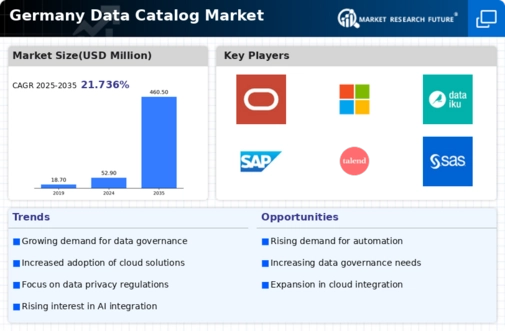
The Germany Data Catalog Market is expected to be valued at 52.92 million USD in 2024.

What is the projected market value of the Germany Data Catalog Market by 2035?

By 2035, the market is anticipated to reach a valuation of 460.48 million USD.

What is the expected CAGR for the Germany Data Catalog Market from 2025 to 2035?

The expected compound annual growth rate (CAGR) for the market from 2025 to 2035 is 21.736 percent.

What are the key players in the Germany Data Catalog Market?

Major players include Oracle, Microsoft, Dataiku, SAP, Talend, and SAS among others.

What are the market value estimates for the Solution component in 2024 and 2035?

The Solution segment is valued at 30.0 million USD in 2024 and is projected to reach 260.0 million USD by 2035.

What is the estimated market size for the Services component in 2024 and 2035?

The Services segment is expected to be valued at 22.92 million USD in 2024 and grow to 200.48 million USD by 2035.

What are the growth drivers for the Germany Data Catalog Market?

Key growth drivers include the increasing need for data management and compliance in organizations.

What are some emerging trends in the Germany Data Catalog Market?

Emerging trends involve the integration of advanced analytics and AI capabilities into data catalog solutions.

How does the current economic climate affect the Germany Data Catalog Market?

The market continues to grow as organizations prioritize data governance and management despite economic fluctuations.

What applications are driving the demand for data catalog solutions in Germany?

Applications such as data discovery, governance, and asset inventories are significantly driving demand for data catalog solutions.

Download Free Sample

Kindly complete the form below to receive a free sample of this Report

Compare Licence

×
Features License Type
Single User Multiuser License Enterprise User
Price $4,950 $5,950 $7,250
Maximum User Access Limit 1 User Upto 10 Users Unrestricted Access Throughout the Organization
Free Customization
Direct Access to Analyst
Deliverable Format
Platform Access
Discount on Next Purchase 10% 15% 15%
Printable Versions