Increased Focus on Drug Discovery
The growing emphasis on drug discovery is a key driver for the ips cell-derived-organoids market. Pharmaceutical companies are increasingly utilizing organoids derived from iPSCs to enhance their drug development pipelines. These organoids provide a more accurate representation of human tissues, which is essential for evaluating drug efficacy and safety. In the GCC, the market for drug discovery using organoids is expected to reach $200 million by 2027, reflecting a robust demand for innovative testing models. The ability to screen compounds on patient-derived organoids allows for a more personalized approach to medicine, potentially leading to higher success rates in clinical trials. Consequently, the ips cell-derived-organoids market is likely to expand as more companies adopt these technologies to streamline their drug discovery processes.
Advancements in Stem Cell Technology
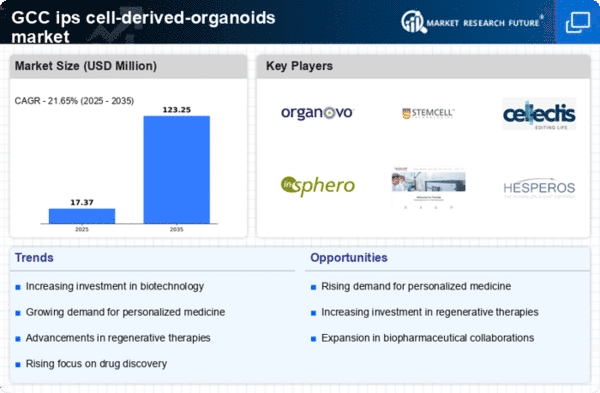
The advancements in stem cell technology are propelling the ips cell-derived-organoids market forward. Innovations in reprogramming techniques and differentiation protocols have enhanced the efficiency of generating induced pluripotent stem cells (iPSCs). This has led to a surge in the production of organoids that closely mimic human physiology, which is crucial for drug testing and disease modeling. In the GCC region, the market is projected to grow at a CAGR of approximately 15% over the next five years, driven by increased funding for stem cell research. The ability to create patient-specific organoids from iPSCs allows for more accurate preclinical testing, thereby reducing the time and cost associated with drug development. As a result, the ips cell-derived-organoids market is likely to witness significant growth as researchers and pharmaceutical companies seek to leverage these advancements.
Rising Demand for Regenerative Medicine
The increasing demand for regenerative medicine is a significant driver of the ips cell-derived-organoids market. As the healthcare landscape evolves, there is a growing interest in therapies that can repair or replace damaged tissues and organs. iPSC-derived organoids offer a promising avenue for developing regenerative therapies, particularly in the GCC, where healthcare systems are prioritizing innovative treatment options. The regenerative medicine market is expected to reach $50 billion by 2030, with organoids playing a crucial role in this growth. Their potential applications in transplantation and tissue engineering are likely to attract substantial investment, further propelling the ips cell-derived-organoids market. As researchers explore the therapeutic potential of these organoids, the market is poised for significant expansion.
Growing Applications in Disease Modeling
The applications of ips cell-derived organoids in disease modeling are expanding and significantly impacting the market. Researchers are increasingly using organoids to study various diseases, including cancer, neurodegenerative disorders, and genetic conditions. This trend is particularly pronounced in the GCC, where research institutions are investing heavily in developing organoid models for local diseases. The market for disease modeling using organoids is projected to grow by 20% annually, driven by the need for better understanding of disease mechanisms and the development of targeted therapies. By providing insights into disease progression and drug responses, organoids derived from iPSCs are becoming indispensable tools in biomedical research. Thus, the ips cell-derived-organoids market is likely to benefit from this growing focus on disease modeling.
Enhanced Collaboration Between Academia and Industry
The enhanced collaboration between academia and industry is fostering growth in the ips cell-derived-organoids market. Partnerships between research institutions and biotechnology companies are becoming increasingly common, facilitating the translation of scientific discoveries into commercial applications. In the GCC, several initiatives are underway to promote collaboration, which is expected to accelerate the development of organoid technologies. This synergy is likely to lead to innovative products and services, thereby expanding the market. The collaborative efforts are also aimed at addressing regulatory challenges and ensuring that new therapies derived from organoids can reach the market efficiently. As a result, the ips cell-derived-organoids market is likely to experience robust growth driven by these collaborative endeavors.



















Leave a Comment