×
Request Free Sample ×

Kindly complete the form below to receive a free sample of this Report

* Please use a valid business email

Leading companies partner with us for data-driven Insights

clients tt-cursor
Hero Background

GCC Linux Operating System Market

ID: MRFR/ICT/63335-HCR
200 Pages
Aarti Dhapte
October 2025

GCC Linux Operating System Market Research Report By Distribution Channel (Direct Sales, Online Sales, Retail Sales), By Deployment Type (On-Premises, Cloud-Based), By End User (Individual Users, Small and Medium Enterprises, Large Enterprises, Government) and By Application (Server Operating System, Desktop Operating System, Embedded Operating System)- Forecast to 2035

Share:
Download PDF ×

We do not share your information with anyone. However, we may send you emails based on your report interest from time to time. You may contact us at any time to opt-out.

GCC Linux Operating System Market Infographic
Purchase Options

GCC Linux Operating System Market Summary

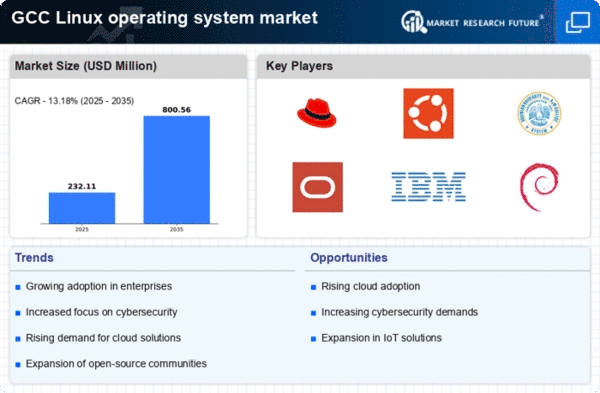
As per MRFR analysis, the GCC Linux operating system market size was estimated at 205.08 $ Million in 2024. The GCC Linux operating system market is projected to grow from 232.11 $ Million in 2025 to 800.56 $ Million by 2035, exhibiting a compound annual growth rate (CAGR) of 13.18% during the forecast period 2025 - 2035.

Key Market Trends & Highlights

The GCC Linux operating-system market is experiencing robust growth driven by enterprise adoption and technological advancements.

  • The largest segment in the GCC Linux market is enterprise solutions, reflecting a rising adoption in various industries.
  • The fastest-growing segment is tech startups, which are increasingly leveraging Linux for its flexibility and cost-effectiveness.
  • A notable trend is the heightened focus on cybersecurity, as organizations prioritize secure operating systems to protect sensitive data.
  • Key market drivers include the increasing demand for open source solutions and government initiatives supporting Linux adoption.

Market Size & Forecast

2024 Market Size 205.08 (USD Million)
2035 Market Size 800.56 (USD Million)
CAGR (2025 - 2035) 13.18%

Major Players

Red Hat (US), Canonical (GB), SUSE (DE), Oracle (US), IBM (US), Debian (FR), Alpine Linux (US), Arch Linux (US)

GCC Linux Operating System Market Trends

The Linux operating system market is experiencing notable growth in the GCC region, driven by an increasing demand for open-source solutions among businesses and government entities. This trend is largely attributed to the rising need for cost-effective and customizable software options that can enhance operational efficiency. As organizations seek to reduce reliance on proprietary systems, the adoption of linux operating systems is becoming more prevalent. Furthermore, the emphasis on cybersecurity and data privacy is prompting many entities to explore linux-based solutions, which are often perceived as more secure and transparent compared to their proprietary counterparts. In addition, the GCC region is witnessing a surge in tech startups and innovation hubs, which are increasingly favoring linux operating systems for their flexibility and scalability. This shift is likely to foster a vibrant ecosystem for developers and users alike, encouraging collaboration and knowledge sharing. As educational institutions also begin to incorporate linux into their curricula, the future workforce is expected to be more adept at utilizing these systems. Overall, the linux operating-system market appears poised for continued expansion in the GCC, reflecting broader trends in technology and business practices.

Rising Adoption in Enterprises

Organizations in the GCC are increasingly adopting linux operating systems to enhance operational efficiency and reduce costs. This trend is driven by the need for customizable solutions that align with specific business requirements.

Focus on Cybersecurity

The emphasis on data security is leading many entities to explore linux-based solutions. These systems are often viewed as more secure, making them attractive options for businesses concerned about data breaches.

Growth of Tech Startups

The emergence of tech startups in the GCC is fostering a preference for linux operating systems. These startups value the flexibility and scalability offered by linux, which supports their innovative approaches.

GCC Linux Operating System Market Drivers

Rising Focus on Cloud Computing

The Linux operating system market is significantly influenced by the rising focus on cloud computing within the GCC region. As businesses migrate to cloud-based infrastructures, the demand for linux-based operating systems is expected to increase. Linux systems are favored for their stability, security, and scalability, making them ideal for cloud environments. Recent statistics suggest that over 60% of cloud servers run on linux, highlighting its dominance in this space. This trend is likely to continue, with cloud service providers increasingly offering linux-based solutions, thereby driving growth in the linux operating-system market as organizations seek to optimize their IT resources.

Growing Interest in IoT and Edge Computing

The Linux operating system market is poised for growth due to the increasing interest in Internet of Things (IoT) and edge computing technologies in the GCC. As industries adopt IoT solutions for enhanced operational efficiency, the need for robust and flexible operating systems becomes paramount. Linux is often the preferred choice for IoT devices due to its lightweight nature and adaptability. Furthermore, edge computing, which processes data closer to the source, is gaining traction, and linux-based systems are well-suited for these applications. This trend could potentially lead to a 20% increase in the adoption of linux operating systems in IoT applications over the next few years.

Enhanced Security Features Driving Adoption

The Linux operating system market is benefiting from enhanced security features that are increasingly appealing to organizations in the GCC. With rising concerns over data breaches and cyber threats, businesses are prioritizing security in their IT infrastructure. Linux operating systems are renowned for their robust security protocols, which include advanced user permissions and regular updates. This focus on security is likely to drive more enterprises to adopt linux solutions, as they seek to mitigate risks associated with cyber threats. Current estimates suggest that the market for linux operating systems could expand by 15% as organizations prioritize secure computing environments.

Increasing Demand for Open Source Solutions

The Linux operating system market is experiencing a notable surge in demand for open source solutions across various sectors. Organizations in the GCC region are increasingly recognizing the benefits of open source software, including cost-effectiveness and flexibility. This trend is particularly evident in the public sector, where governments are adopting linux-based systems to enhance transparency and reduce dependency on proprietary software. According to recent data, the adoption of open source solutions in the GCC has grown by approximately 30% over the past two years. This shift not only fosters innovation but also encourages collaboration among developers, thereby strengthening the linux operating-system market.

Government Initiatives Supporting Linux Adoption

Government initiatives in the GCC are playing a pivotal role in promoting the Linux operating system market. Various national strategies aim to enhance digital transformation and encourage the use of open source technologies. For instance, several GCC countries have launched programs to train IT professionals in linux systems, thereby creating a skilled workforce capable of supporting this market. Additionally, government contracts increasingly favor linux-based solutions, which are perceived as more secure and cost-efficient. This trend is likely to bolster the market, with projections indicating a potential growth rate of 25% in the next five years as more public sector projects adopt linux operating systems.


Market Segment Insights

By Distribution Channel: Online Sales (Largest) vs. Retail Sales (Fastest-Growing)

The GCC Linux operating system market shows an interesting distribution among its primary distribution channels. Online Sales lead the segment with a significant market share due to the convenience and accessibility it offers users. This channel has become the preferred choice for many consumers seeking to acquire linux operating systems, allowing for easy comparison and selection processes. In contrast, Retail Sales, although smaller in share, have seen considerable traction as physical stores cater to customers who prefer a hands-on purchasing experience. Growth trends in the GCC linux operating-system market are influenced by several factors. The rapid digitization and increasing internet penetration have fueled Online Sales growth. Furthermore, the rise of e-commerce platforms has enabled consumers to access a wider variety of products. Meanwhile, Retail Sales are emerging as a vital segment, driven by consumers’ desire for immediate access and personal customer service. This shift showcases the evolving preferences of consumers in the region, presenting opportunities for both channels.

Online Sales: Leading (Dominant) vs. Retail Sales (Emerging)

Online Sales dominate the distribution channel segment in the GCC linux operating-system market, attributed to the shift in consumer behavior toward digital purchasing methods. This channel offers comprehensive product variety and competitive pricing, making it an attractive option for users. The convenience of purchasing from home, coupled with easy access to customer reviews and product comparisons, solidifies Online Sales' position. On the other hand, Retail Sales are emerging as a notable segment; they cater to a specific audience who value immediate gratification and personalized service. As retail outlets begin to expand their linux operating-system offerings and enhance in-store experiences, they attract a growing number of customers who prefer direct interaction and instant product access.

By Deployment Type: Cloud-Based (Largest) vs. On-Premises (Fastest-Growing)

The GCC Linux operating system market exhibits a clear preference for cloud-based deployment, which currently holds the largest share. Businesses are increasingly adopting cloud solutions due to their scalability, flexibility, and cost-effectiveness. Conversely, while on-premises solutions remain significant, they are seeing rapid growth as organizations seek enhanced security and control over their IT environments. This shifting landscape underscores the evolving needs of enterprises in the region. Growth trends in the deployment type segment reveal a robust trajectory for both cloud and on-premises deployments. Cloud-based implementations are driven by the ongoing digital transformation journey of businesses that prioritize remote access and online collaboration. Conversely, the resurgence of on-premises deployments is fueled by enterprises' need for customized solutions and regulatory compliance, particularly in sectors such as finance and healthcare. This dual trend indicates a market balancing between established cloud practices and fresh on-premises innovations.

Cloud-Based (Dominant) vs. On-Premises (Emerging)

Cloud-based deployment is currently the dominant force in the GCC linux operating-system market, favored for its ability to provide flexible resources and easy scalability. This deployment model enables organizations to minimize infrastructure costs while maximizing operational efficiency. As more businesses migrate to the cloud, this segment showcases innovative solutions that address diverse business needs, including agility and rapid deployment. In contrast, on-premises solutions are emerging as a robust alternative, particularly for companies demanding strict data sovereignty and tailored environments. These systems allow firms to maintain direct oversight of their IT operations, thus ensuring stringent security measures. As such, while cloud solutions lead, on-premises deployments are carving their niche as a strong and necessary option.

By End User: Small and Medium Enterprises (Largest) vs. Individual Users (Fastest-Growing)

In the GCC Linux operating system market, Small and Medium Enterprises (SMEs) represent the largest share, driven by their increasing reliance on cost-effective, scalable, and secure operating systems to support their operations. The growth of SMEs in the region has been supported by favorable government policies and initiatives that encourage digital transformation, leading to a significant adoption of linux operating systems. In contrast, Individual Users, while currently smaller in market share, are emerging as the fastest-growing segment. This is attributed to the rising popularity of open-source solutions among tech-savvy individuals who prioritize customization and community support. The growth trends in the GCC linux operating-system market are influenced by several key factors. SMEs are leveraging linux capabilities to enhance productivity and efficiency, while the rise of remote work and digital innovation is prompting individuals to gravitate towards linux for personal and professional usage. Furthermore, educational institutions in the region are increasingly incorporating linux into their curricula, fostering a new generation of users who are proficient in this technology. This trend is expected to fuel further growth in the Individual Users segment over the forecast period, positioning it as a key player in the GCC linux operating-system market.

SMEs (Dominant) vs. Individual Users (Emerging)

Small and Medium Enterprises dominate the GCC linux operating-system market due to their need for reliable, flexible, and cost-effective solutions that can scale with their growth. This segment values features like security, customization, and community support, which linux distributions offer extensively. Large Enterprises are also significant players but tend to opt for more robust, support-oriented solutions which can lead to higher costs. Meanwhile, Individual Users are emerging rapidly, driven by a quest for personalization and control over their computing environment. They typically favor user-friendly distributions and community-driven support, making them an important factor in shaping trends within the GCC linux operating-system market.

By Application: Server Operating System (Largest) vs. Embedded Operating System (Fastest-Growing)

In the GCC Linux operating system market, the Server Operating System segment holds the largest share, driven by increasing digital transformation initiatives among businesses and public sector organizations. Alongside, the Desktop Operating System segment continues to maintain a significant presence, catering mainly to educational and administrative functions, while the Embedded Operating System shows promising growth potential as industries embrace IoT solutions and smart technologies. Emerging trends indicate a rapid shift towards cloud-based solutions within the Server Operating System segment, enhancing its growth trajectory further. The increased adoption of embedded systems across sectors like automotive, healthcare, and manufacturing positions the Embedded Operating System as the fastest-growing segment. This is propelled by the demand for connectivity and automation, showcasing the evolving landscape of the GCC linux operating-system market.

Server Operating System (Dominant) vs. Embedded Operating System (Emerging)

The Server Operating System segment is characterized by its robust infrastructure capabilities, which are essential for managing enterprise-level applications and data centers. It is widely adopted by large organizations that require high reliability, scalability, and security. Its dominance in the market is bolstered by the increasing migration of businesses to cloud-based services and the growing need for virtualization. On the other hand, the Embedded Operating System segment, while emerging, is rapidly gaining traction due to the proliferation of smart devices and IoT applications. This segment focuses on providing tailored solutions for specific functions, resulting in a growing demand across multiple industries such as automotive, healthcare, and consumer electronics, making it a promising area of growth for the future.

Get more detailed insights about GCC Linux Operating System Market

Key Players and Competitive Insights

The linux operating-system market is currently characterized by a dynamic competitive landscape, driven by rapid technological advancements and increasing demand for open-source solutions. Key players such as Red Hat (US), Canonical (GB), and SUSE (DE) are strategically positioned to leverage their extensive experience and innovative capabilities. Red Hat (US) focuses on enhancing its hybrid cloud offerings, while Canonical (GB) emphasizes its commitment to IoT and edge computing solutions. SUSE (DE), on the other hand, is concentrating on expanding its enterprise solutions, particularly in the realm of cloud-native applications. Collectively, these strategies not only enhance their market presence but also foster a competitive environment that encourages continuous innovation and adaptation.

In terms of business tactics, companies are increasingly localizing their operations to better serve regional markets, optimizing supply chains to enhance efficiency, and investing in partnerships to expand their reach. The market appears moderately fragmented, with a mix of established players and emerging startups. This structure allows for a diverse range of offerings, although the influence of major companies remains substantial, shaping overall market trends and consumer preferences.

In October 2025, Red Hat (US) announced a strategic partnership with a leading cloud provider to enhance its hybrid cloud capabilities. This collaboration is expected to streamline deployment processes and improve service delivery, thereby solidifying Red Hat's position as a leader in the hybrid cloud segment. The strategic importance of this partnership lies in its potential to attract new customers seeking integrated solutions that combine the flexibility of open-source software with the scalability of cloud infrastructure.

In September 2025, Canonical (GB) launched a new version of its Ubuntu operating system, specifically designed for IoT applications. This release is significant as it positions Canonical to capitalize on the growing IoT market, which is projected to expand rapidly in the coming years. By focusing on IoT, Canonical not only diversifies its product offerings but also aligns itself with current technological trends, potentially increasing its market share in this burgeoning sector.

In August 2025, SUSE (DE) expanded its portfolio by acquiring a startup specializing in cloud-native application development. This acquisition is likely to enhance SUSE's capabilities in providing comprehensive solutions for enterprises transitioning to cloud environments. The strategic move underscores SUSE's commitment to innovation and its desire to remain competitive in a rapidly evolving market.

As of November 2025, current trends in the linux operating-system market are heavily influenced by digitalization, sustainability initiatives, and the integration of AI technologies. Strategic alliances are becoming increasingly vital, as companies seek to combine strengths and resources to address complex market demands. Looking ahead, competitive differentiation is expected to evolve, with a shift from traditional price-based competition towards a focus on innovation, technological advancements, and supply chain reliability. This transition may redefine how companies position themselves in the market, emphasizing the importance of agility and responsiveness to changing consumer needs.

Key Companies in the GCC Linux Operating System Market market include

Industry Developments

The GCC Linux Operating System Market has seen notable developments in recent months. In September 2023, AlmaLinux announced a collaboration with regional universities to enhance Linux education, a step towards increasing the talent pool in open-source technologies within the Gulf Cooperation Council. 

Additionally, Red Hat has been actively participating in GCC tech conferences, highlighting its commitment to expand its user base and services in the region. In August 2023, IBM launched a training initiative focused on Linux systems, aiming to solidify its presence and align with the GCC's digital transformation goals. Merger and acquisition activity remains low among the key players like Oracle and Canonical, with no substantial reports indicating recent deals. However, significant growth has been observed in the market valuation of these companies due to the rising demand for cloud-based and enterprise solutions. 

The GCC's strategic focus on enhancing digital infrastructure, coupled with government support for open-source technologies, contributes to the overall positive trajectory of the Linux Operating System Market in this region. The GCC's market is actively evolving, influenced by government initiatives and technological advancements in the Linux ecosystem over the last few years.


Future Outlook

GCC Linux Operating System Market Future Outlook

The linux operating-system market is projected to grow at a 13.18% CAGR from 2024 to 2035, driven by increased cloud adoption, IoT integration, and demand for open-source solutions.

New opportunities lie in:

  • Development of tailored enterprise solutions for cloud environments.
  • Expansion of Linux-based IoT platforms for smart city applications.
  • Creation of subscription-based support services for Linux distributions.

By 2035, the linux operating-system market is expected to achieve substantial growth and innovation.

Market Segmentation

GCC Linux Operating System Market End User Outlook

  • Individual Users
  • Small and Medium Enterprises
  • Large Enterprises
  • Government

GCC Linux Operating System Market Application Outlook

  • Server Operating System
  • Desktop Operating System
  • Embedded Operating System

GCC Linux Operating System Market Deployment Type Outlook

  • On-Premises
  • Cloud-Based

GCC Linux Operating System Market Distribution Channel Outlook

  • Direct Sales
  • Online Sales
  • Retail Sales

Report Scope

MARKET SIZE 2024 205.08(USD Million)
MARKET SIZE 2025 232.11(USD Million)
MARKET SIZE 2035 800.56(USD Million)
COMPOUND ANNUAL GROWTH RATE (CAGR) 13.18% (2024 - 2035)
REPORT COVERAGE Revenue Forecast, Competitive Landscape, Growth Factors, and Trends
BASE YEAR 2024
Market Forecast Period 2025 - 2035
Historical Data 2019 - 2024
Market Forecast Units USD Million
Key Companies Profiled ["Red Hat (US)", "Canonical (GB)", "SUSE (DE)", "Oracle (US)", "IBM (US)", "Debian (FR)", "Alpine Linux (US)", "Arch Linux (US)"]
Segments Covered Distribution Channel, Deployment Type, End User, Application
Key Market Opportunities Growing demand for cloud computing solutions enhances opportunities in the linux operating-system market.
Key Market Dynamics Rising demand for open-source solutions drives innovation and competition in the Linux operating-system market.
Countries Covered GCC

Leave a Comment

FAQs

What is the projected market size of the GCC Linux Operating System Market in 2024?

The GCC Linux Operating System Market is projected to be valued at 323.82 million USD in 2024.

What will the total market value be by 2035?

By 2035, the GCC Linux Operating System Market is expected to reach a total value of 1074.66 million USD.

What is the anticipated compound annual growth rate (CAGR) for the GCC Linux Operating System Market from 2025 to 2035?

The market is expected to experience a CAGR of 11.522% from 2025 to 2035.

Which distribution channel will have the highest value in 2035?

In 2035, the Online Sales distribution channel is anticipated to hold the highest value at 500.0 million USD.

What is the expected market value for Direct Sales in 2024 and 2035?

The expected market value for Direct Sales is 100.0 million USD in 2024 and projected to rise to 350.0 million USD by 2035.

Who are the key players in the GCC Linux Operating System Market?

Major players include Oracle, Tizen, Parrot Security OS, AlmaLinux, Red Hat, Arch Linux, Fedora, CentOS, IBM, Debian, Canonical, and SUSE.

What will be the value of the Retail Sales channel in 2035?

The Retail Sales channel is expected to be valued at 224.66 million USD in 2035.

What challenges could impact the GCC Linux Operating System Market in the coming years?

The market may face challenges such as increasing competition, evolving technology needs, and security concerns.

What are the growth drivers for the GCC Linux Operating System Market?

Growth drivers include rising demand for open-source solutions, increased cloud adoption, and the growing use of Linux in enterprise environments.

How does the GCC Linux Operating System Market compare with global trends?

The GCC Market aligns with global trends towards open-source software and increased adoption of Linux operating systems across various sectors.

Download Free Sample

Kindly complete the form below to receive a free sample of this Report

Compare Licence

×
Features License Type
Single User Multiuser License Enterprise User
Price $4,950 $5,950 $7,250
Maximum User Access Limit 1 User Upto 10 Users Unrestricted Access Throughout the Organization
Free Customization
Direct Access to Analyst
Deliverable Format
Platform Access
Discount on Next Purchase 10% 15% 15%
Printable Versions