Download Free Sample
Kindly complete the form below to receive a free sample of this Report
GCC Ophthalmic Drugs Market Research Report By Dosage Form (Eye Drops, Eye Ointments, Eye Solutions, Gels, Capsules Tablets, Others), By Product Type (Prescription Drug, OTC Drug), By Drug Class (Antibiotics, Anti-Inflammatory, Anti-Glaucoma, Others), By Indication (Glaucoma, Retinal Disorder, Dry Eye, Eye Allergy, Others) and By Distribution Channels (Hospital pharmacies, Drug stores, Online pharmacies, Others) - Growth & Industry Forecast 2025 To 2035
As per Market Research Future analysis, the GCC ophthalmic drugs market was estimated at 1122.12 $ Million in 2024. The GCC ophthalmic drugs market is projected to grow from 1193.04 $ Million in 2025 to 2201.84 $ Million by 2035, exhibiting a compound annual growth rate (CAGR) of 6.3% during the forecast period 2025 - 2035
The GCC ophthalmic drugs market is poised for growth driven by technological advancements and increasing awareness of eye health.
| 2024 Market Size | 1122.12 (USD Million) |
| 2035 Market Size | 2201.84 (USD Million) |
| CAGR (2025 - 2035) | 6.32% |
Novartis (CH), Allergan (IE), Bausch Health (CA), Regeneron Pharmaceuticals (US), Santen Pharmaceutical (JP), Hoya Corporation (JP), Pfizer (US), Merck & Co. (US), Aerie Pharmaceuticals (US)
Our Impact
Enabled $4.3B Revenue Impact for Fortune 500 and Leading Multinationals
Partnering with 2000+ Global Organizations Each Year
30K+ Citations by Top-Tier Firms in the Industry
In the GCC region, the market is currently experiencing notable growth, driven by an increasing prevalence of eye disorders and a rising awareness of eye health among the population. The region's healthcare infrastructure is evolving, with investments in advanced medical technologies and facilities that enhance the delivery of ophthalmic care. Furthermore, the demographic shift towards an aging population is likely to contribute to a higher demand for effective treatments for age-related eye conditions. This trend is compounded by the growing incidence of lifestyle-related eye issues, such as digital eye strain, which has become more prevalent due to increased screen time. In addition, the regulatory environment in the GCC is becoming more conducive to the development and approval of new ophthalmic drugs. Governments are actively promoting research and development initiatives, which may lead to the introduction of innovative therapies in the market. The collaboration between public and private sectors is also fostering a more dynamic landscape for ophthalmic drug manufacturers. As a result, the ophthalmic drugs market appears poised for sustained growth, with opportunities for both established players and new entrants to capitalize on emerging trends and consumer needs.
The increasing prevalence of eye disorders in the GCC region is a significant driver for the ophthalmic drugs market. Conditions such as cataracts, glaucoma, and diabetic retinopathy are becoming more common, necessitating effective treatment options. This trend is likely to spur demand for innovative therapies and medications.
Technological advancements in drug formulation and delivery systems are transforming the ophthalmic drugs market. Innovations such as sustained-release formulations and targeted therapies are enhancing treatment efficacy and patient compliance, which may lead to better health outcomes.
The regulatory landscape in the GCC is evolving to support the development of new ophthalmic drugs. Governments are implementing policies that encourage research and development, which could facilitate the introduction of novel therapies and improve access to essential medications.
The ophthalmic drugs market is experiencing growth due to the increasing aging population in the GCC region. As individuals age, they become more susceptible to various eye disorders, such as cataracts and age-related macular degeneration. This demographic shift is projected to lead to a higher demand for ophthalmic medications. According to recent estimates, the population aged 65 and above in the GCC is expected to reach approximately 10% by 2030. This trend indicates a growing market for ophthalmic drugs, as older adults typically require more frequent eye care and treatment. Consequently, pharmaceutical companies are likely to focus on developing innovative therapies tailored to this demographic, thereby driving the overall growth of the ophthalmic drugs market.
Healthcare expenditure in the GCC is on the rise, which positively impacts the ophthalmic drugs market. Governments in the region are investing significantly in healthcare infrastructure and services, leading to improved access to eye care. For instance, healthcare spending in the GCC is projected to reach $104 billion by 2025, reflecting a compound annual growth rate (CAGR) of around 7%. This increase in funding allows for better diagnostic tools and treatment options, enhancing the quality of care for patients with eye conditions. As a result, the demand for ophthalmic drugs is likely to grow, as healthcare providers are better equipped to diagnose and treat various ocular diseases, thus expanding the market.
There is a notable increase in awareness regarding eye health among the population in the GCC, which is contributing to the growth of the ophthalmic drugs market. Public health campaigns and educational initiatives are encouraging individuals to seek regular eye examinations and treatment for eye disorders. This heightened awareness is likely to lead to earlier diagnosis and treatment of conditions such as glaucoma and diabetic retinopathy. As more people recognize the importance of eye health, the demand for ophthalmic medications is expected to rise. Furthermore, the increasing prevalence of lifestyle-related eye issues, such as digital eye strain, is also driving the need for effective ophthalmic solutions, thereby positively influencing the market.
Regulatory bodies in the GCC are increasingly supportive of new drug approvals, which is beneficial for the ophthalmic drugs market. Streamlined approval processes and incentives for innovation are encouraging pharmaceutical companies to invest in research and development of new ophthalmic therapies. This regulatory environment is likely to facilitate the introduction of novel drugs that address unmet medical needs in the field of ophthalmology. As a result, the market may witness a surge in the availability of advanced treatment options for patients suffering from various eye disorders. The proactive stance of regulatory agencies is expected to enhance competition among manufacturers, ultimately benefiting consumers through improved access to effective ophthalmic drugs.
Technological advancements in drug delivery systems are playing a crucial role in shaping the ophthalmic drugs market. Innovations such as sustained-release formulations and nanotechnology are enhancing the efficacy and safety of ophthalmic medications. These advancements allow for targeted delivery of drugs to the ocular tissues, improving therapeutic outcomes and patient compliance. For instance, the development of eye drops with enhanced penetration capabilities is likely to reduce the frequency of administration, making treatment more convenient for patients. As these technologies continue to evolve, they are expected to attract investment and research in the ophthalmic drugs market, fostering growth and expanding treatment options for various eye conditions.
The GCC ophthalmic drugs market showcases a diverse distribution of market share among its drug classes, with Anti-Inflammatory Drugs taking the lead as the largest segment. This dominance can be attributed to the increasing prevalence of eye surgeries and inflammatory conditions necessitating effective management. Following closely, Glaucoma Drugs are rapidly gaining traction as their share grows, driven by rising awareness and diagnosis of glaucoma, making them essential for patient care. Furthermore, growth trends indicate robust expansion in segments such as Artificial Tears and Anti-Infective Drugs, largely due to lifestyle changes and an increase in eye-related disorders. The demand for Ophthalmic Anesthetics also reflects market growth, as surgical interventions become more common. Overall, the GCC ophthalmic drugs market is witnessing an evolving landscape where ongoing research and development are pivotal in addressing patient needs and enhancing therapeutic outcomes.
Anti-Inflammatory Drugs (Dominant) vs. Glaucoma Drugs (Emerging)
Anti-Inflammatory Drugs play a dominant role in the GCC ophthalmic drugs market, driven by their effectiveness in treating various inflammatory conditions affecting the eyes. They are widely prescribed, particularly post-surgery, to manage inflammation and pain. The segment benefits from a robust pipeline of innovative formulations and a growing understanding of ocular inflammatory diseases. In contrast, Glaucoma Drugs are an emerging force within the market, propelled by the increasing incidence of glaucoma in the region. This segment is characterized by advancements in drug formulation and delivery systems, enhancing therapy adherence and patient outcomes. The ongoing research into novel therapeutic targets for glaucoma positions these drugs as vital for future growth, responding to the pressing need for effective management solutions.
In the GCC ophthalmic drugs market, Eye Drops represent the largest share of the formulation type segment, driven by their widespread usage and convenience in administration. Liquid formulations also hold a significant portion of the market, but products like Ointments and Gels are gradually gaining traction due to their targeted application and effectiveness. The market is characterized by a diverse range of formulations that cater to various therapeutic needs, providing multiple options for consumers and healthcare professionals alike. Growth trends in this segment are largely influenced by the increasing prevalence of ophthalmic diseases and the aging population in the region. Additionally, technological advancements in drug formulation and delivery are propelling the sustained release segment, which is expected to witness the fastest growth. These innovations not only enhance therapeutic efficacy but also improve patient compliance, making sustained release formulations an attractive option for both manufacturers and patients.
Liquid (Dominant) vs. Ointment (Emerging)
Liquid formulations, particularly eye drops, dominate the formulation type segment due to their ease of use and quick action in delivering therapeutic agents directly to the eye. These products are preferred by both patients and healthcare providers for their convenience and effectiveness in treating various eye conditions. On the other hand, Ointments, while currently a smaller segment, are emerging as a valuable therapeutic option, primarily for their longer-lasting effects and ability to protect the eye surface. As more consumers and professionals recognize the benefits of ointments, their market presence is expected to grow, catering to niche applications where prolonged retention of medication is crucial.
In the GCC ophthalmic drugs market, Glaucoma is currently the largest segment, capturing a significant share due to the rising prevalence of this ocular condition among the aging population. Following Glaucoma, Dry Eye Syndrome is making notable gains, driven by increasing screen time and environmental factors that exacerbate the condition. Other segments like Allergic Conjunctivitis, Cataracts, and Intraocular Infections also hold their ground, reflecting diverse therapeutic needs in the region. Growth trends in the therapeutic application segment indicate a shift towards more advanced and targeted therapies. The increase in awareness of eye health and government initiatives promoting eye care have contributed to the segment's expansion. Technology advancements in drug delivery systems and the introduction of innovative formulations are set to fuel the market further, particularly for Dry Eye Syndrome, which is emerging rapidly due to lifestyle changes and increased prevalence.
Glaucoma (Dominant) vs. Dry Eye Syndrome (Emerging)
Glaucoma is a dominant therapeutic application in the GCC ophthalmic drugs market, characterized by its chronic nature and the need for lifelong management. This condition primarily affects the elderly, leading to a substantial demand for effective treatments that can lower intraocular pressure. In contrast, Dry Eye Syndrome is emerging as a significant focus for pharmaceutical companies, influenced by modern lifestyles and environmental changes. This segment is seeing increased investment in research and development to create over-the-counter options and prescription treatments, catering to the growing number of individuals experiencing symptoms. Both segments emphasize the critical role of education and awareness in improving patient outcomes.
In the GCC ophthalmic drugs market, the distribution of market share among the various routes of administration highlights the significant role of Topical formulations, which hold a substantial portion of the overall market. This segment is preferred due to its ease of application and patient compliance, contributing to its dominance. Conversely, Intraocular administration is gaining traction, driven by advancements in technique and technology that enhance delivery efficacy and patient outcomes. Growth trends in the GCC ophthalmic drugs market are heavily influenced by the increasing prevalence of eye diseases and a rise in awareness about ocular health. The Topical segment continues to thrive due to its established position and effectiveness, whereas Intraocular approaches are experiencing rapid expansion as practitioners and patients become more aware of the benefits, making it the fastest-growing avenue in the market. Systemic administration remains relevant but is not experiencing the growth seen in other segments.
Topical (Dominant) vs. Intraocular (Emerging)
The Topical route of administration in the GCC ophthalmic drugs market is characterized by its widespread use and patient-friendly nature, enabling easy self-administration of medications directly to the eyes. This method is preferred for treating several conditions, including dry eye syndrome and glaucoma, resulting in its dominant market share. In contrast, Intraocular administration is emerging as a significant alternative, particularly for more severe ocular conditions requiring precise delivery at the site of action. This method allows for higher drug concentration and effectiveness, which is increasingly recognized by healthcare professionals, suggesting a growing trend towards its adoption in specialized treatments.
The distribution channels for the GCC Ophthalmic Drugs Market include Hospital pharmacies, Drug stores, Online pharmacies, and Others, each playing a crucial role in market accessibility and growth. Hospital pharmacies are essential as they ensure patients receive immediate access to required ophthalmic medications, particularly for urgent surgical procedures and treatments.
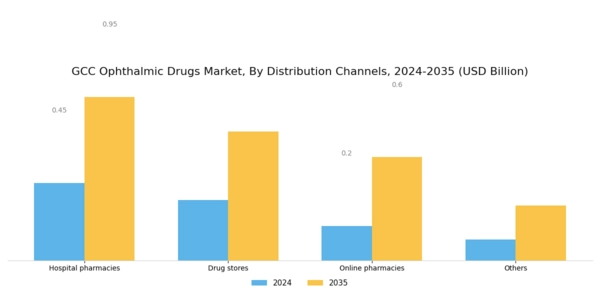
Drug stores serve as a traditional yet significant point of sale, offering convenience and a wide range of products that cater to local demands. Online pharmacies have gained popularity in the GCC, driven by increasing consumer preference for digital shopping, particularly during the pandemic, facilitating easy access to prescriptions and over-the-counter ophthalmic products.
Other distribution avenues, such as specialty pharmacies and clinics, also contribute to the diverse market landscape, providing tailored services and products that meet specific patient needs. As trends continue to evolve towards online solutions coupled with robust regulatory frameworks in the GCC, the landscape for distribution channels in the ophthalmic drugs market is expected to expand and adapt, resulting in higher market growth and improved patient reach in the region.
Get more detailed insights about GCC Ophthalmic Drugs Market Request Free Sample
It exhibits a dynamic competitive landscape characterized by rapid innovation and strategic collaborations among key players. Major companies such as Novartis (CH), Allergan (IE), and Regeneron Pharmaceuticals (US) are at the forefront, leveraging their extensive research capabilities and established market presence to drive growth. Novartis (CH) focuses on expanding its portfolio through innovative therapies, particularly in the treatment of retinal diseases, while Allergan (IE) emphasizes its stronghold in aesthetic and therapeutic ophthalmic solutions. Regeneron Pharmaceuticals (US) is noted for its commitment to developing cutting-edge biologics, particularly in the area of age-related macular degeneration, which positions it favorably in a competitive environment that increasingly values advanced treatment options.The business tactics employed by these companies reflect a concerted effort to optimize operations and enhance market penetration. Localizing manufacturing and optimizing supply chains are prevalent strategies aimed at reducing costs and improving responsiveness to market demands. The market structure appears moderately fragmented, with a mix of established players and emerging companies vying for market share. This fragmentation is indicative of a competitive environment where innovation and strategic partnerships play crucial roles in shaping market dynamics.
In October Novartis (CH) announced a strategic partnership with a leading technology firm to integrate AI-driven analytics into its drug development processes. This move is likely to enhance the efficiency of clinical trials and accelerate the time-to-market for new ophthalmic therapies, thereby reinforcing Novartis's competitive edge. Similarly, in September 2025, Allergan (IE) launched a new digital platform aimed at improving patient engagement and adherence to treatment regimens. This initiative not only strengthens its customer relationships but also aligns with the growing trend of digital health solutions in the ophthalmic sector.
In August Regeneron Pharmaceuticals (US) received FDA approval for a novel treatment targeting diabetic retinopathy, marking a significant milestone in its product pipeline. This approval is expected to bolster Regeneron's market position and reflects its ongoing commitment to addressing unmet medical needs in ophthalmology. Furthermore, in July 2025, Bausch Health (CA) expanded its product offerings by acquiring a smaller biotech firm specializing in ocular therapeutics, a strategic move that enhances its portfolio and market reach.
As of November current competitive trends in the ophthalmic drugs market are increasingly defined by digitalization, sustainability, and the integration of AI technologies. Strategic alliances are becoming more prevalent, as companies recognize the value of collaboration in driving innovation and improving operational efficiencies. Looking ahead, the competitive landscape is likely to evolve, with a pronounced shift from price-based competition to a focus on technological advancements and supply chain reliability. This transition underscores the importance of innovation as a key differentiator in a market that is rapidly adapting to the changing needs of patients and healthcare providers.
The GCC Ophthalmic Drugs Market has recently witnessed significant developments, with notable advancements in drug approvals and market growth. In September 2023, Alcon launched a new innovative treatment for glaucoma in the Gulf region aimed at improving patient outcomes. Additionally, Novartis' recent introduction of pioneering gene therapies has garnered attention, enhancing the potential for treating inherited retinal diseases in the GCC.
Companies such as Roche and Johnson Johnson continue to expand their portfolios through collaboration with local health authorities, aiming to improve ophthalmic care accessibility across GCC nations. In terms of mergers and acquisitions, no significant transactions involving the listed companies have been reported in recent months. From a growth perspective, the market valuation for ophthalmic drugs is projected to increase substantially, driven by an aging population and rising prevalence of eye diseases in the region, emphasizing the crucial role of firms like Merck Co. and Pfizer.
Over the last two years, the ongoing research and development in the ophthalmic sector reflect heightened investment and commitment towards innovative healthcare solutions that cater to the needs of the GCC population.
The Ophthalmic Drugs Market is projected to grow at a 6.32% CAGR from 2025 to 2035, driven by increasing prevalence of eye disorders and advancements in drug formulations.
New opportunities lie in:
By 2035, the ophthalmic drugs market is expected to achieve substantial growth and innovation.
| MARKET SIZE 2024 | 1122.12(USD Million) |
| MARKET SIZE 2025 | 1193.04(USD Million) |
| MARKET SIZE 2035 | 2201.84(USD Million) |
| COMPOUND ANNUAL GROWTH RATE (CAGR) | 6.32% (2025 - 2035) |
| REPORT COVERAGE | Revenue Forecast, Competitive Landscape, Growth Factors, and Trends |
| BASE YEAR | 2024 |
| Market Forecast Period | 2025 - 2035 |
| Historical Data | 2019 - 2024 |
| Market Forecast Units | USD Million |
| Key Companies Profiled | Novartis (CH), Allergan (IE), Bausch Health (CA), Regeneron Pharmaceuticals (US), Santen Pharmaceutical (JP), Hoya Corporation (JP), Pfizer (US), Merck & Co. (US), Aerie Pharmaceuticals (US) |
| Segments Covered | Drug Class, Formulation Type, Therapeutic Application, Route of Administration |
| Key Market Opportunities | Advancements in personalized medicine and digital health technologies enhance treatment options in the ophthalmic drugs market. |
| Key Market Dynamics | Rising demand for innovative ophthalmic therapies drives competition and regulatory adaptations in the GCC market. |
| Countries Covered | GCC |
The overall market valuation was $1122.12 Million in 2024.
The projected valuation for 2035 is $2201.84 Million.
The expected CAGR during the forecast period 2025 - 2035 is 6.32%.
In 2024, Glaucoma Drugs had the highest valuation at $300.0 Million.
Key players include Novartis (CH), Allergan (IE), Bausch Health (CA), and Regeneron Pharmaceuticals (US), among others.
Eye Drops are projected to dominate with a valuation range of $600.0 Million to $1200.0 Million.
Dry Eye Syndrome is expected to show significant growth, with a valuation range of $448.84 Million to $880.72 Million.
Topical administration is anticipated to have the highest market share, valued between $672.84 Million and $1344.0 Million.
Anti-Infective Drugs had a valuation of $200.0 Million in 2024, with potential growth to $400.0 Million.
The valuation range for Artificial Tears is $322.12 Million to $601.84 Million.


Kindly complete the form below to receive a free sample of this Report

“This is really good guys. Excellent work on a tight deadline. I will continue to use you going forward and recommend you to others. Nice job”


“Thanks. It’s been a pleasure working with you, please use me as reference with any other Intel employees.”


“Thanks for sending the report it gives us a good global view of the Betaïne market.”


“Thank you, this will be very helpful for OQS.”


“We found the report very insightful! we found your research firm very helpful. I'm sending this email to secure our future business.”


“I am very pleased with how market segments have been defined in a relevant way for my purposes (such as "Portable Freezers & refrigerators" and "last-mile"). In general the report is well structured. Thanks very much for your efforts.”


“I have been reading the first document or the study, ,the Global HVAC and FP market report 2021 till 2026. Must say, good info! I have not gone in depth at all parts, but got a good indication of the data inside!”


“We got the report in time, we really thank you for your support in this process. I also thank to all of your team as they did a great job.”


“The Automotive 48V ECU Components Procurement Intelligence Study” was a complex project, but the Market Research Future (MRFR) team handled it with quality, agility, and customer-centricity. They delivered all requested data on time and within the agreed scope. The team, including Shubhendra Anand and Rahul Gotadki, was always readily available to clarify questions and swiftly implement necessary adjustments, driving the project to a successful conclusion within a very demanding timeframe.
I would also like to specifically commend Akshay Agarwal for his responsiveness and support at every stage—from our initial inquiry on May 6th through to final delivery on June 18th. His dedication made the entire process seamless.”



