Generative AI in Fulfillment Logistics Market
Generative AI in Fulfillment Logistics Market Summary
As per Market Research Future analysis, the Generative AI in Fulfillment & Logistics Market was estimated at 346653.55 USD Million in 2024. The Generative AI in Fulfillment & Logistics industry is projected to grow from 497864.64 USD Million in 2025 to 18589492.01 USD Million by 2035, exhibiting a compound annual growth rate (CAGR) of 43.62% during the forecast period 2025 - 2035
Key Market Trends & Highlights
The Generative AI in Fulfillment and Logistics Market is poised for substantial growth driven by technological advancements and evolving consumer expectations.
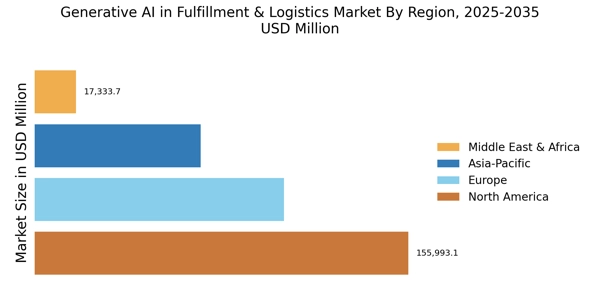
- North America remains the largest market for Generative AI in Fulfillment and Logistics, showcasing robust demand for innovative solutions.
- The Asia-Pacific region is emerging as the fastest-growing market, fueled by rapid digital transformation and increasing logistics needs.
- The Solution segment dominates the market, while the Services segment is experiencing the fastest growth due to rising demand for tailored offerings.
- Enhanced operational efficiency and improved decision-making are key drivers propelling market expansion, as companies seek to optimize their logistics processes.
Market Size & Forecast
| 2024 Market Size | 346653.55 (USD Million) |
| 2035 Market Size | 18589492.01 (USD Million) |
| CAGR (2025 - 2035) | 43.62% |
Major Players
Amazon (US), Google (US), IBM (US), Microsoft (US), Siemens (DE), SAP (DE), Oracle (US), C3.ai (US), NVIDIA (US)
Generative AI in Fulfillment Logistics Market Trends
The Generative AI in Fulfillment & LogisticsMarket is currently experiencing a transformative phase, driven by advancements in artificial intelligence technologies. Companies are increasingly adopting generative AI solutions to enhance operational efficiency, streamline supply chain processes, and improve customer experiences. This shift appears to be motivated by the need for greater agility and responsiveness in logistics operations, as businesses seek to adapt to evolving market demands. Furthermore, the integration of generative AI into fulfillment strategies seems to facilitate better decision-making, enabling organizations to optimize inventory management and reduce lead times. As a result, the market is witnessing a surge in innovative applications, ranging from automated warehousing to predictive analytics, which could redefine traditional logistics paradigms. In addition, the Generative AI in Fulfillment & Logistics Market is likely to benefit from increased investment in research and development. Organizations are exploring novel ways to leverage AI capabilities, potentially leading to the emergence of new business models and service offerings. Collaboration between technology providers and logistics firms appears to be a key driver of this trend, fostering an environment conducive to innovation. As the market evolves, it may also face challenges related to data privacy and security, necessitating a careful approach to implementation. Overall, the future landscape of this market seems promising, with generative AI poised to play a pivotal role in shaping the logisticssector.
Enhanced Predictive Analytics
The integration of generative AI into logistics operations is likely to enhance predictive analyticscapabilities. This advancement enables companies to forecast demand more accurately, thereby optimizing inventory levels and reducing waste. By analyzing historical data and identifying patterns, generative AI can provide insights that inform strategic decision-making.
Automation of Warehousing Processes
Generative AI is expected to drive automation within warehousing environments. This trend may lead to the development of intelligent systems that manage inventory, streamline order fulfillment, and improve overall efficiency. Automation could reduce human error and enhance productivity, allowing businesses to respond swiftly to customer needs.
Personalized Customer Experiences
The Generative AI in Fulfillment & Logistics Market appears to be shifting towards creating personalized customer experiences. By utilizing AI-driven insights, companies can tailor their services to meet individual preferences, thereby enhancing customer satisfaction. This focus on personalization may differentiate businesses in a competitive landscape.
Generative AI in Fulfillment Logistics Market Drivers
Improved Decision-Making
The utilization of Generative AI in Fulfillment & Logistics Market is likely to facilitate improved decision-making processes. By harnessing vast amounts of data, AI systems can provide actionable insights that inform strategic choices. For example, AI-driven analytics can identify trends and anomalies in logistics operations, enabling managers to make informed decisions regarding resource allocation and route optimization. This capability is particularly relevant as the logistics sector faces increasing complexity due to globalization and evolving consumer demands. Studies suggest that companies employing AI for decision-making have seen a 20% increase in operational effectiveness, underscoring the importance of data-driven strategies in the industry.
Sustainability Initiatives
The growing emphasis on sustainability is a notable driver for the integration of Generative AI in Fulfillment & Logistics Market. As environmental concerns become more pressing, companies are seeking innovative solutions to reduce their carbon footprint. AI can optimize logistics operations by minimizing waste and enhancing energy efficiency. For instance, AI algorithms can analyze transportation routes to reduce fuel consumption and emissions. Additionally, AI can assist in inventory management by predicting demand more accurately, thereby reducing overproduction and waste. Industry reports suggest that companies adopting AI for sustainability initiatives have improved their environmental performance by up to 30%. This alignment with sustainability goals is increasingly influencing the logistics market.
Cost Reduction Opportunities
The potential for cost reduction is a compelling driver for the adoption of Generative AI in Fulfillment & Logistics Market. By automating labor-intensive processes and optimizing resource utilization, businesses can achieve significant savings. For instance, AI can streamline warehouse operations by predicting the most efficient picking routes, thereby reducing labor costs and time. Additionally, AI can enhance transportation logistics by optimizing delivery routes, which can lead to lower fuel consumption and reduced emissions. Reports indicate that companies implementing AI solutions have realized cost savings of up to 25% in logistics operations. This financial incentive is a critical factor influencing the market's growth.
Enhanced Customer Satisfaction
The role of Generative AI in Fulfillment & Logistics Market in enhancing customer satisfaction cannot be overstated. By personalizing customer interactions and improving service delivery, AI technologies can significantly elevate the customer experience. For example, AI can analyze customer preferences and behaviors to tailor logistics solutions that meet specific needs. Furthermore, real-time tracking and predictive delivery notifications powered by AI can keep customers informed, thereby increasing transparency and trust. Research indicates that companies that prioritize customer experience through AI-driven solutions have seen a 15% increase in customer retention rates. This focus on customer satisfaction is a vital driver for the adoption of AI in the logistics sector.
Enhanced Operational Efficiency
The integration of Generative AI in Fulfillment & Logistics Market appears to enhance operational efficiency significantly. By automating routine tasks and optimizing supply chain processes, companies can reduce lead times and improve inventory management. For instance, predictive algorithms can analyze historical data to forecast demand accurately, allowing businesses to adjust their inventory levels accordingly. This capability is particularly crucial in a market where efficiency can lead to substantial cost savings. Reports indicate that organizations leveraging AI technologies have experienced up to a 30% reduction in operational costs. As such, the drive towards enhanced operational efficiency is a key factor propelling the adoption of Generative AI in the Fulfillment & Logistics Market.
Market Segment Insights
By Offering: Solution (Largest) vs. Services (Fastest-Growing)
In the Generative AI in Fulfillment & Logistics Market, the 'Solution' segment holds a significant market share, driven by the increasing demand for automated processes and enhanced operational efficiency. As businesses recognize the potential of generative AI to streamline logistics, provide intelligent forecasting, and optimize inventory management, this segment benefits from higher adoption rates across various industries. Conversely, the 'Services' segment, while smaller in market share, is rapidly gaining traction as businesses seek specialized expertise and tailored AI implementation solutions to optimize their logistics processes.
Solutions: Software(Dominant) vs. Consulting Services (Emerging)
The 'Solutions' segment, particularly dominated by software offerings, emphasizes advanced algorithms and AI-driven tools that enhance supply chain management, logistics planning, and real-time analytics. These softwaresolutions enable organizations to make data-driven decisions, reduce costs, and improve customer satisfaction. On the other hand, 'Consulting Services' are emerging as vital contributors to the market, providing organizations with the necessary guidance to navigate AI integration challenges. As firms increasingly recognize the strategic importance of tailored AI solutions, the demand for these consulting services is projected to grow, reflecting a shift towards a more personalized approach in deploying generative AI technologies.
By Type: Generative Adversarial Networks (Largest) vs. Variational Autoencoder (Fastest-Growing)
In the Generative AI in Fulfillment & Logistics Market, Generative Adversarial Networks (GANs) currently hold the largest market share among the segmentation of technologies used for AI applications. With its innovative approach to training models through adversarial processes, GANs have been widely adopted in various logistics and fulfillment applications, enabling improved efficiency and operational capabilities. In contrast, Variational Autoencoders (VAEs) are emerging rapidly, attracting attention for their unique ability to generate high-quality data representations, thus paving the way for their increasing uptake in market deployments.
GANs (Dominant) vs. VAEs (Emerging)
Generative Adversarial Networks (GANs) have established themselves as the dominant force in the Generative AI landscape, specifically in the Fulfillment and Logistics Market. Their capability to create realistic data samples has transformed various operational facets such as demand forecasting, inventory optimization, and route planning. The deep learning framework of GANs enables them to handle vast amounts of data and generate solutions that simulate real-world scenarios, thereby enhancing decision-making processes. Conversely, Variational Autoencoders (VAEs) are emerging as a significant alternative due to their efficiency in compressing and reconstructing data. Their ability to generate new information based on learned data distributions has attracted attention in predictive analytics, indicating a growing adoption in logistics applications.
By Application: Warehouse Operations (Largest) vs. Data Analytics & Reporting (Fastest-Growing)
In the Generative AI in Fulfillment & Logistics Market, 'Warehouse Operations' leads significantly in market share, capitalizing on its essential role in optimizing storage and retrieval processes. This segment demonstrates a robust demand as companies increasingly adopt AI technologies to enhance efficiency and reduce operational costs. On the other hand, the 'Data Analytics & Reporting' segment has emerged as a fast-growing area, leveraging AI to drive insights and inform decision-making across logistics operations. Companies are recognizing the importance of data-driven strategies, contributing to its rapid expansion.
Warehouse Operations: Dominant vs. Data Analytics & Reporting: Emerging
The 'Warehouse Operations' segment operates at the forefront of the Generative AI in Fulfillment & Logistics Market, focusing on automating and optimizing processes within storage facilities. It is characterized by advanced robotic systems, AI-driven inventory management, and real-time data integration, enabling businesses to streamline operations and improve accuracy. In contrast, the 'Data Analytics & Reporting' segment is gaining momentum as organizations seek to harness big datafor predictive analytics and strategic planning. This emerging area emphasizes the need for advanced algorithms to transform raw data into actionable insights, positioning it as a critical component for enhancing overall logistics performance.
By Industry Vertical: Retail & E-Commerce (Largest) vs. Pharmaceuticals & Healthcare (Fastest-Growing)
In the Generative AI in Fulfillment & Logistics Market, the distribution of market share among industry verticals reveals that Retail & E-Commerce holds the dominant position, significantly leveraging AI solutions to optimize inventory management and enhance customer experiences. Meanwhile, the Pharmaceuticals & Healthcare sector is rapidly gaining traction, adopting Generative AI for supply chain optimization and ensuring compliance with stringent regulations. The growth trends in these segments are influenced by varying drivers. Retail & E-Commerce benefits from the rise in online shopping and digital transformation, while the Pharmaceuticals & Healthcare vertical is propelled by the need for improved logistics efficiency and real-time tracking. As a result, these two sectors are expected to shape the future landscape of the market with their distinct approaches to AI utilization.
Retail & E-Commerce: Dominant vs. Pharmaceuticals & Healthcare: Emerging
The Retail & E-Commerce sector is the cornerstone of the Generative AI in Fulfillment & Logistics Market. Its dominance stems from the accelerated shift towards online platforms, requiring sophisticated AI-driven solutions to enhance supply chain visibility and customer engagement. Companies in this vertical are rapidly implementing AI technologies to predict demand, manage inventory, and streamline fulfillment processes, creating a competitive advantage. In contrast, the Pharmaceuticals & Healthcare sector, while still emerging, showcases robust growth in applying Generative AI for logistics. It focuses on predictive analytics to manage inventory levels accurately, ensuring that medical supplies and pharmaceuticals are delivered timely. This sector's unique regulatory landscape drives the adoption of AI, making it an increasingly vital player within the broader market.

Regional Insights
North America : Innovation and Leadership Hub
North America is the largest market for Generative AI in Fulfillment & Logistics, holding approximately 45% of the global market share. The region's growth is driven by rapid technological advancements, significant investments in AI research, and a strong regulatory framework that encourages innovation. The demand for automation and efficiency in logistics operations is further fueled by the increasing e-commerce activities and the need for real-time data analytics. The United States leads the market, with major players like Amazon, Google, and Microsoft driving innovation. The competitive landscape is characterized by a mix of established tech giants and emerging startups, all vying for a share of the lucrative logistics sector. The presence of advanced infrastructure and a skilled workforce enhances the region's attractiveness for AI investments, solidifying its position as a global leader in this domain.
Europe : Emerging AI Powerhouse
Europe is rapidly emerging as a significant player in the Generative AI in Fulfillment & Logistics market, holding around 30% of the global market share. The region benefits from strong regulatory support aimed at fostering innovation while ensuring ethical AI use. Initiatives like the European AI Act are pivotal in shaping a conducive environment for AI development, driving demand for AI solutions in logistics and fulfillment sectors across member states. Germany and the United Kingdom are the leading countries in this market, with key players such as Siemens and SAP making substantial contributions. The competitive landscape is marked by a blend of established firms and innovative startups, all focused on enhancing operational efficiencies through AI. The region's commitment to sustainability and digital transformation further propels the adoption of AI technologies in logistics, making it a vibrant market for growth.
Asia-Pacific : Rapid Growth and Adoption
Asia-Pacific is witnessing rapid growth in the Generative AI in Fulfillment & Logistics market, accounting for approximately 20% of the global market share. The region's growth is driven by increasing urbanization, a booming e-commerce sector, and significant investments in digital infrastructure. Countries like China and India are at the forefront, with government initiatives promoting AI adoption in logistics to enhance efficiency and reduce costs. China is the largest market in the region, with major companies like Alibaba and Tencent investing heavily in AI technologies. The competitive landscape is evolving, with numerous startups emerging to address specific logistics challenges. The region's diverse market dynamics and varying regulatory environments present both opportunities and challenges for AI implementation, making it a key area for future growth in the logistics sector.
Middle East and Africa : Untapped Potential in AI
The Middle East and Africa region is gradually recognizing the potential of Generative AIin Fulfillment & Logistics, holding about 5% of the global market share. The growth is primarily driven by increasing investments in technology and a growing awareness of AI's benefits in enhancing operational efficiencies. Governments in several countries are initiating programs to support digital transformation, which is crucial for the logistics sector's evolution in this region. Countries like South Africa and the UAE are leading the charge, with local companies beginning to adopt AI solutions to streamline logistics operations. The competitive landscape is still developing, with a mix of local and international players entering the market. As infrastructure improves and regulatory frameworks become more supportive, the region is poised for significant growth in AI applications within logistics, making it an area of interest for investors and tech companies alike.
Key Players and Competitive Insights
Key Companies in the Generative AI in Fulfillment Logistics Market include
Industry Developments
In May 2023, SAP launched AI solutions to future-proof supply chains, addressing the need for increased productivity and reduced waste in the FreightTech industry. While AI can enhance current logistics systems, it's also critical to consider disruptive global shipping changes that would be impossible without AI support, according to FreightTech providers.
In November 2023, SAP SE introduced a range of generative AI solutions to simplify logistics applications, enabling developers to create AI-driven apps and enhance business operations. These advancements aimed to empower developers of varying skill levels to capitalize on the potential of AI and drive success in their respective industries.
Future Outlook
Generative AI in Fulfillment Logistics Market Future Outlook
The Generative AI in Fulfillment & Logistics Market is projected to grow at a 43.62% CAGR from 2025 to 2035, driven by automation, data analytics, and enhanced customer experiences.
New opportunities lie in:
- Automated inventory management systems leveraging AI for real-time tracking. AI-driven predictive analytics for demand forecasting and supply chain optimization. Personalized logistics solutions utilizing generative AI for tailored customer experiences.
By 2035, the market is expected to be a cornerstone of logistics innovation and efficiency.
Market Segmentation
Generative AI in Fulfillment Logistics Market Type Outlook
- Variational Autoencoder (VAE)
- Generative Adversarial Networks (GANs)
- Recurrent Neural Networks (RNNs)
- Long Short-Term Memory (LSTM) Networks
Generative AI in Fulfillment Logistics Market Offering Outlook
- Solution
- Services
Generative AI in Fulfillment Logistics Market Application Outlook
- Warehouse Operations
- Optimization and Management
- Supply Chain Operations
- Predictive Maintenance
- Logistics Network Design
- Inventory Management
- Fraud Detection
- Customer Service Operations
- Autonomous Robotics
- Data Analytics & Reporting
- Others
Generative AI in Fulfillment Logistics Market Industry Vertical Outlook
- Automotive
- Pharmaceutical & Healthcare
- Semiconductors & Electronics
- Retail & E-Commerce
- Food & Beverages
- Others
Report Scope
| MARKET SIZE 2024 | 346653.55(USD Million) |
| MARKET SIZE 2025 | 497864.64(USD Million) |
| MARKET SIZE 2035 | 18589492.01(USD Million) |
| COMPOUND ANNUAL GROWTH RATE (CAGR) | 43.62% (2025 - 2035) |
| REPORT COVERAGE | Revenue Forecast, Competitive Landscape, Growth Factors, and Trends |
| BASE YEAR | 2024 |
| Market Forecast Period | 2025 - 2035 |
| Historical Data | 2019 - 2024 |
| Market Forecast Units | USD Million |
| Key Companies Profiled | Amazon (US), Google (US), IBM (US), Microsoft (US), Siemens (DE), SAP (DE), Oracle (US), C3.ai (US), NVIDIA (US) |
| Segments Covered | offerings, Regions Forecast Till 2035 |
| Key Market Opportunities | Integration of Generative AI enhances operational efficiency and personalization in the Generative AI in Fulfillment and Logistics Market. |

| Key Market Dynamics | Rising adoption of Generative Artificial Intelligence enhances operational efficiency and optimizes supply chain management in logistics. |
| Countries Covered | North America, Europe, APAC, South America, MEA |
Market Highlights
FAQs
What is the projected market valuation for Generative AI in Fulfillment & Logistics by 2035?
The projected market valuation for Generative AI in Fulfillment & Logistics is 18589492.01 USD Million by 2035.
What was the overall market valuation for Generative AI in Fulfillment & Logistics in 2024?
The overall market valuation for Generative AI in Fulfillment & Logistics was 346653.55 USD Million in 2024.
What is the expected CAGR for the Generative AI in Fulfillment & Logistics Market during 2025 - 2035?
The expected CAGR for the Generative AI in Fulfillment & Logistics Market during 2025 - 2035 is 43.62%.
Which companies are considered key players in the Generative AI in Fulfillment & Logistics Market?
Key players in the market include Amazon, Google, IBM, Microsoft, Siemens, SAP, Oracle, C3.ai, and NVIDIA.
What are the main segments of the Generative AI in Fulfillment & Logistics Market?
The main segments include Offering, Type, Application, and Industry Vertical.
What was the valuation of the 'Services' segment in the Generative AI market in 2024?
Which application areas are driving growth in the Generative AI in Fulfillment & Logistics Market?
What is the valuation of Generative Adversarial Networks (GANs) in the market?
How does the Automotive industry contribute to the Generative AI market?
What is the projected growth for the Retail & E-Commerce sector in the Generative AI market by 2035?
Kindly complete the form below to receive a free sample of this Report
Customer Stories
“This is really good guys. Excellent work on a tight deadline. I will continue to use you going forward and recommend you to others. Nice job”
“Thanks. It’s been a pleasure working with you, please use me as reference with any other Intel employees.”
“Thanks for sending the report it gives us a good global view of the Betaïne market.”
“Thank you, this will be very helpful for OQS.”
“We found the report very insightful! we found your research firm very helpful. I'm sending this email to secure our future business.”
“I am very pleased with how market segments have been defined in a relevant way for my purposes (such as "Portable Freezers & refrigerators" and "last-mile"). In general the report is well structured. Thanks very much for your efforts.”
“I have been reading the first document or the study, ,the Global HVAC and FP market report 2021 till 2026. Must say, good info! I have not gone in depth at all parts, but got a good indication of the data inside!”
“We got the report in time, we really thank you for your support in this process. I also thank to all of your team as they did a great job.”