×
Request Free Sample ×

Kindly complete the form below to receive a free sample of this Report

* Please use a valid business email

Leading companies partner with us for data-driven Insights

clients tt-cursor
Hero Background

Germany Filling Machines Market

ID: MRFR/PCM/47249-HCR
111 Pages
Snehal Singh
October 2025

Germany Filling Machines Market Research Report By Product (Aseptic, Rotary, Net Weight, Volumetric, Others), By Mode of Operation (Automatic, Semi-automatic), and By Application (Beverages, Food, Chemicals, Personal Care, Pharmaceuticals, Others)- Forecast to 2035.

Share:
Download PDF ×

We do not share your information with anyone. However, we may send you emails based on your report interest from time to time. You may contact us at any time to opt-out.

Germany Filling Machines Market Infographic
Purchase Options

Germany Filling Machines Market Summary

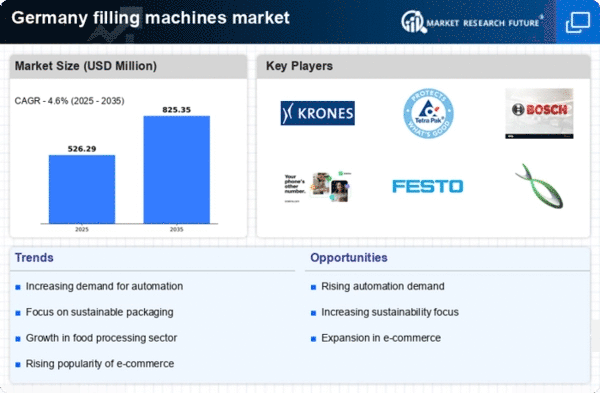
As per MRFR analysis, the filling machines market size was estimated at 503.15 USD Million in 2024. The filling machines market is projected to grow from 526.29 USD Million in 2025 to 825.35 USD Million by 2035, exhibiting a compound annual growth rate (CAGR) of 4.6% during the forecast period 2025 - 2035.

Key Market Trends & Highlights

The Germany filling machines market is experiencing a transformative shift driven by technological advancements and sustainability initiatives.

  • Technological advancements are enhancing the efficiency and precision of filling machines across various sectors.
  • Sustainability initiatives are increasingly influencing manufacturers to adopt eco-friendly practices and materials in their operations.
  • Customization and versatility are becoming essential as businesses seek tailored solutions to meet diverse consumer demands.
  • Rising demand for automation and growth in e-commerce are key drivers propelling the market forward.

Market Size & Forecast

2024 Market Size 503.15 (USD Million)
2035 Market Size 825.35 (USD Million)
CAGR (2025 - 2035) 4.6%

Major Players

Krones AG (DE), Tetra Pak (SE), Bosch Packaging Technology (DE), Sidel (FR), Festo AG & Co. KG (DE), Marel (IS), Schneider Electric (FR), Ishida Co., Ltd. (JP), Filling Systems (IT)

Germany Filling Machines Market Trends

The The filling machines market in Germany is currently experiencing a notable transformation. This shift is driven by advancements in technology and an increasing demand for automation. Manufacturers are increasingly adopting innovative solutions to enhance efficiency and precision in production processes. This shift is largely influenced by the need for higher output and reduced operational costs. Furthermore, the growing emphasis on sustainability is prompting companies to invest in eco-friendly filling technologies, which not only minimize waste but also align with regulatory standards. As a result, the market is witnessing a surge in the development of machines that utilize less energy and generate lower emissions. In addition to technological advancements, the filling machines market is also shaped by changing consumer preferences. There is a rising demand for customized packaging solutions that cater to diverse product types and sizes. This trend is compelling manufacturers to offer versatile machines capable of handling various materials and formats. Moreover, the increasing focus on food safety and quality assurance is driving the adoption of advanced filling technologies that ensure compliance with stringent regulations. Overall, the landscape of the filling machines market in Germany appears to be evolving rapidly, with a strong emphasis on innovation, sustainability, and adaptability to market needs.

Technological Advancements

The filling machines market is witnessing a significant shift towards automation and smart technologies. Manufacturers are increasingly integrating IoT and AI into their systems, enhancing operational efficiency and precision. This trend is likely to streamline production processes and reduce human error, thereby improving overall productivity.

Sustainability Initiatives

There is a growing emphasis on eco-friendly practices within the filling machines market. Companies are investing in sustainable technologies that minimize waste and energy consumption. This shift not only meets regulatory requirements but also aligns with consumer preferences for environmentally responsible products.

Customization and Versatility

The demand for customized packaging solutions is reshaping the filling machines market. Manufacturers are responding by developing versatile machines that can accommodate various product types and sizes. This adaptability is crucial for meeting the diverse needs of consumers and ensuring compliance with safety standards.

Germany Filling Machines Market Drivers

Rising Demand for Automation

The filling machines market in Germany experiences a notable surge in demand for automation technologies. Industries are increasingly adopting automated filling solutions to enhance efficiency and reduce labor costs. This trend is driven by the need for higher production rates and improved accuracy in filling processes. According to recent data, the automation segment within the filling machines market is projected to grow at a CAGR of approximately 8% over the next five years. As manufacturers seek to optimize their operations, the integration of advanced robotics and control systems becomes essential. This shift not only streamlines production but also minimizes human error, thereby ensuring product quality. Consequently, the filling machines market is likely to witness significant investments in automation technologies, positioning it for robust growth in the coming years.

Emergence of Smart Packaging Solutions

The filling machines market in Germany is witnessing a transformative shift. This change is driven by the emergence of smart packaging solutions. These innovations integrate technology into packaging processes, allowing for enhanced tracking, monitoring, and consumer engagement. Smart packaging, which includes features such as QR codes and RFID tags, is gaining traction as companies seek to provide added value to consumers. This trend is particularly relevant in sectors like food and beverage, where transparency and traceability are increasingly demanded. The integration of smart technologies into filling machines enables manufacturers to optimize their operations and improve supply chain efficiency. As consumer preferences evolve, the filling machines market is likely to adapt by incorporating smart packaging capabilities, thereby enhancing the overall value proposition of products.

Growth in E-commerce and Online Retail

The filling machines market in Germany is significantly influenced by the rapid expansion of e-commerce. The online retail sectors are also contributing to this growth. As consumer preferences shift towards online shopping, manufacturers are compelled to adapt their packaging and filling processes to meet the demands of this evolving landscape. The e-commerce sector has seen a remarkable increase, with online sales accounting for over 15% of total retail sales in Germany. This growth necessitates efficient filling solutions that can handle diverse product types and packaging formats. Companies are increasingly investing in flexible filling machines that can accommodate various container sizes and materials. This adaptability is crucial for meeting the fast-paced requirements of e-commerce fulfillment centers. As a result, the filling machines market is poised for growth, driven by the need for innovative solutions that cater to the dynamic nature of online retail.

Regulatory Compliance and Quality Standards

The filling machines market in Germany is heavily influenced by stringent regulatory compliance. Quality standards imposed by governmental bodies also play a significant role. Industries such as food and beverage, pharmaceuticals, and cosmetics are required to adhere to rigorous safety and quality regulations. This necessitates the adoption of advanced filling technologies that ensure compliance with these standards. For instance, the implementation of Good Manufacturing Practices (GMP) is critical in the pharmaceutical sector, where precision and hygiene are paramount. As a result, manufacturers are increasingly investing in filling machines that incorporate features such as automated cleaning systems and real-time monitoring capabilities. This focus on compliance not only enhances product safety but also boosts consumer confidence. Consequently, the filling machines market is likely to see sustained growth as companies prioritize adherence to regulatory requirements.

Focus on Cost Efficiency and Resource Optimization

The filling machines market in Germany is increasingly characterized by a focus on cost efficiency. Resource optimization is also a key factor. Manufacturers are under constant pressure to reduce operational costs while maintaining high-quality standards. This has led to the adoption of filling machines that are designed for energy efficiency and minimal waste generation. Recent studies indicate that companies that implement resource optimization strategies can achieve cost savings of up to 20%. As a result, there is a growing demand for filling machines that utilize advanced technologies, such as energy-efficient motors and recyclable materials. This trend not only contributes to lower production costs but also aligns with broader sustainability goals. Consequently, the filling machines market is likely to experience growth as companies prioritize cost-effective solutions that enhance their competitive edge.


Market Segment Insights

Filling Machines Market Product Insights

The Germany Filling Machines Market is a dynamic landscape characterized by a diverse array of products designed to cater to various industries, including food and beverage, pharmaceuticals, and cosmetics. The segmentation of this market into categories such as Aseptic, Rotary, Net Weight, Volumetric, and Others illustrates the complexity and versatility of filling technology in Germany.

Aseptic filling systems are pivotal in ensuring the preservation of sensitive products by maintaining sterility and extending shelf life, meeting the stringent safety and quality standards set forth by regulators in the region.

Rotary filling machines hold a significant share of the market due to their efficiency and ability to enhance production speed, making them an ideal choice for high-volume manufacturing environments.

The Net Weight filling method is increasingly adopted for its accuracy and reliability, especially within the food industry, as it allows for precise control over the product quantity, reducing waste and ensuring consistency. Volumetric filling, on the other hand, offers flexibility and is widely used across various sectors for its ability to handle varied product consistencies, from liquids to granulates.

Other technologies also play a crucial role in the market by catering to specialized needs, accommodating different industries, and enhancing production capabilities. In Germany, the emphasis on automation and efficiency drives innovation, with companies investing heavily in advanced solutions to remain competitive.

Filling Machines Market Mode of Operation Insights

The Germany Filling Machines Market is characterized by a notable segmentation based on the Mode of Operation, primarily distinguishing between Automatic and Semi-automatic systems.

Automatic filling machines tend to dominate the market due to their efficiency, precision, and reduced labor costs, aligning with the increasing demand for high-speed operations in various industries, including food and beverage, pharmaceuticals, and cosmetics.

Technological advancements in automation are significantly driving this trend as manufacturers strive to optimize production lines and enhance operational reliability.

On the other hand, Semi-automatic filling machines hold a substantial share, owing to their versatility and lower initial investment costs, making them favorable for small to medium-sized enterprises. These machines still require operator intervention, which may limit speed but provide a level of control that is essential for certain applications.

As Germany continues to strengthen its manufacturing base, particularly in high-value sectors, the differentiation in Mode of Operation becomes essential for understanding the trends and growth dynamics within the Germany Filling Machines Market.

Filling Machines Market Application Insights

The Germany Filling Machines Market is notably segmented by Application, which includes Beverages, Food, Chemicals, Personal Care, Pharmaceuticals, and Others. Each of these applications plays a vital role in driving the market forward.

The Beverages segment leads the market due to the increasing demand for ready-to-drink products and the growing trend of beverage personalization among consumers.

Meanwhile, the Food sector benefits from technological advancements that enhance packaging efficiency and preserve product freshness. Chemicals dominate with the rising production of various industrial goods, creating a need for efficient filling solutions.

Personal Care products rely on precise filling processes to maintain quality and consistency, while Pharmaceuticals require highly regulated filling operations to ensure safety and efficacy. The Others category encompasses various niche applications that expand market possibilities.

Overall, the diversity within the Application segment is crucial for understanding market dynamics and consumer preferences, making it an essential focus for stakeholders in the Germany Filling Machines Market.

Get more detailed insights about Germany Filling Machines Market

Key Players and Competitive Insights

The filling machines market in Germany exhibits a dynamic competitive landscape characterized by innovation and strategic partnerships. Key players such as Krones AG (Germany), Tetra Pak (Sweden), and Bosch Packaging Technology (Germany) are at the forefront, leveraging their technological expertise to enhance operational efficiency and product offerings. Krones AG (Germany) focuses on digital transformation, integrating Industry 4.0 solutions into its machinery, which appears to enhance production capabilities and reduce downtime. Meanwhile, Tetra Pak (Sweden) emphasizes sustainability, developing eco-friendly packaging solutions that align with global environmental standards, thereby appealing to a growing segment of environmentally conscious consumers. Bosch Packaging Technology (Germany) is also investing in automation and smart technologies, which likely positions it favorably in a market increasingly driven by efficiency and cost-effectiveness.

The business tactics employed by these companies reflect a trend towards localizing manufacturing and optimizing supply chains to enhance responsiveness to market demands. The competitive structure of the market appears moderately fragmented, with several players vying for market share, yet the influence of major companies remains substantial. This collective presence shapes a landscape where innovation and operational excellence are paramount, driving smaller players to adapt or collaborate to remain competitive.

In October 2025, Krones AG (Germany) announced a strategic partnership with a leading software firm to develop advanced predictive maintenance solutions for its filling machines. This initiative is likely to enhance machine reliability and reduce operational costs for clients, thereby reinforcing Krones' market position as a technology leader. Similarly, in September 2025, Tetra Pak (Sweden) launched a new line of filling machines designed specifically for plant-based beverages, responding to the increasing consumer demand for alternative products. This move not only diversifies Tetra Pak's portfolio but also positions the company to capture a growing market segment.

In August 2025, Bosch Packaging Technology (Germany) unveiled a new automated filling system that integrates AI-driven analytics to optimize production processes. This innovation is expected to significantly improve efficiency and reduce waste, aligning with the industry's shift towards smart manufacturing. Furthermore, in July 2025, Sidel (France) expanded its operations in Germany by establishing a new manufacturing facility aimed at enhancing local production capabilities. This expansion is indicative of Sidel's commitment to meeting regional demand and strengthening its competitive edge.

As of November 2025, the competitive trends in the filling machines market are increasingly defined by digitalization, sustainability, and the integration of AI technologies. Strategic alliances among key players are shaping the landscape, fostering innovation and enhancing product offerings. The shift from price-based competition to a focus on technological advancement and supply chain reliability is evident, suggesting that future competitive differentiation will hinge on the ability to innovate and adapt to evolving market needs.

Key Companies in the Germany Filling Machines Market market include

Industry Developments

In recent months, the Germany Filling Machines Market has seen significant developments, particularly among key players like OPTIMA, Bosch Packaging Technology, and Krones. In September 2023, Bosch Packaging Technology announced a collaboration with Schneider Electric aimed at automating filling processes which is expected to enhance production efficiency.

Additionally, in June 2023, Krones launched an innovative filling technology with improved energy efficiency, catering to the growing demand for sustainable solutions. The market is projected to experience continuous growth, attributed to increased investments in food and beverage sectors emphasizing automation and sustainability.

Over the past two to three years, major trends include the rapid adoption of smart manufacturing technologies and a heightened focus on hygiene and safety standards, propelled by the COVID-19 pandemic. Notably, in August 2022, GEA Group expanded its portfolio by acquiring a smaller filling solutions company, enhancing its market position.

This strategic acquisition is among several, illustrating the competitive landscape as companies like Sidel and Marel pursue innovation in filling technologies. The growing consumer preference for packaged goods fuels demand, positioning Germany as a crucial hub in the European filling machinery market.

Future Outlook

Germany Filling Machines Market Future Outlook

The filling machines market in Germany is projected to grow at a 4.6% CAGR from 2024 to 2035, driven by automation, demand for efficiency, and sustainability initiatives.

New opportunities lie in:

  • Integration of IoT for real-time monitoring and predictive maintenance.
  • Development of eco-friendly filling solutions to meet regulatory standards.
  • Expansion into emerging sectors like e-commerce and pharmaceuticals for diverse applications.

By 2035, the filling machines market is expected to achieve robust growth, reflecting evolving industry demands.

Market Segmentation

Germany Filling Machines Market Product Outlook

  • Aseptic
  • Rotary
  • Net Weight
  • Volumetric
  • Others

Germany Filling Machines Market Application Outlook

  • Beverages
  • Food
  • Chemicals
  • Personal Care
  • Pharmaceuticals
  • Others

Germany Filling Machines Market Mode of Operation Outlook

  • Automatic
  • Semi-automatic

Report Scope

MARKET SIZE 2024 503.15(USD Million)
MARKET SIZE 2025 526.29(USD Million)
MARKET SIZE 2035 825.35(USD Million)
COMPOUND ANNUAL GROWTH RATE (CAGR) 4.6% (2024 - 2035)
REPORT COVERAGE Revenue Forecast, Competitive Landscape, Growth Factors, and Trends
BASE YEAR 2024
Market Forecast Period 2025 - 2035
Historical Data 2019 - 2024
Market Forecast Units USD Million
Key Companies Profiled Krones AG (DE), Tetra Pak (SE), Bosch Packaging Technology (DE), Sidel (FR), Festo AG & Co. KG (DE), Marel (IS), Schneider Electric (FR), Ishida Co., Ltd. (JP), Filling Systems (IT)
Segments Covered Product, Mode of Operation, Application
Key Market Opportunities Integration of automation and smart technology enhances efficiency in the filling machines market.
Key Market Dynamics Technological advancements drive efficiency and sustainability in the filling machines market, reshaping competitive dynamics.
Countries Covered Germany

Leave a Comment

FAQs

What is the expected market size of the Germany Filling Machines Market in 2024?

The Germany Filling Machines Market is expected to be valued at approximately 603.6 million USD in 2024.

What is the projected market valuation of the Germany Filling Machines Market by 2035?

By 2035, the Germany Filling Machines Market is projected to reach a valuation of around 1000.0 million USD.

What is the expected CAGR for the Germany Filling Machines Market from 2025 to 2035?

The expected CAGR for the Germany Filling Machines Market from 2025 to 2035 is approximately 4.696 percent.

Which segments are expected to dominate the Germany Filling Machines Market?

In 2024, the Aseptic, Rotary, Volumetric, and Net Weight segments are expected to have significant market shares.

What is the market size for the Aseptic filling machines segment in 2024?

The Aseptic filling machines segment is projected to be valued at 120.0 million USD in 2024.

What are the expected market values for the Rotary filling machines segment by 2035?

The Rotary filling machines segment is expected to be valued at 250.0 million USD by 2035.

Who are the key players in the Germany Filling Machines Market?

Major players in this market include OPTIMA, Festo, Serac, Delkor Systems, Coesia, and Bosch Packaging Technology.

What is the expected market size for the Net Weight filling machines in 2035?

The Net Weight filling machines segment is expected to reach about 160.0 million USD by 2035.

What are the growth opportunities in the Germany Filling Machines Market?

Emerging trends and increasing demand for automated filling solutions present key growth opportunities in this market.

What challenges are faced by the Germany Filling Machines Market?

Challenges include the need for technological advancements and the complexity of regulatory compliance in the industry.

Download Free Sample

Kindly complete the form below to receive a free sample of this Report

Compare Licence

×
Features License Type
Single User Multiuser License Enterprise User
Price $4,950 $5,950 $7,250
Maximum User Access Limit 1 User Upto 10 Users Unrestricted Access Throughout the Organization
Free Customization
Direct Access to Analyst
Deliverable Format
Platform Access
Discount on Next Purchase 10% 15% 15%
Printable Versions