Gesture Recognition Market Summary
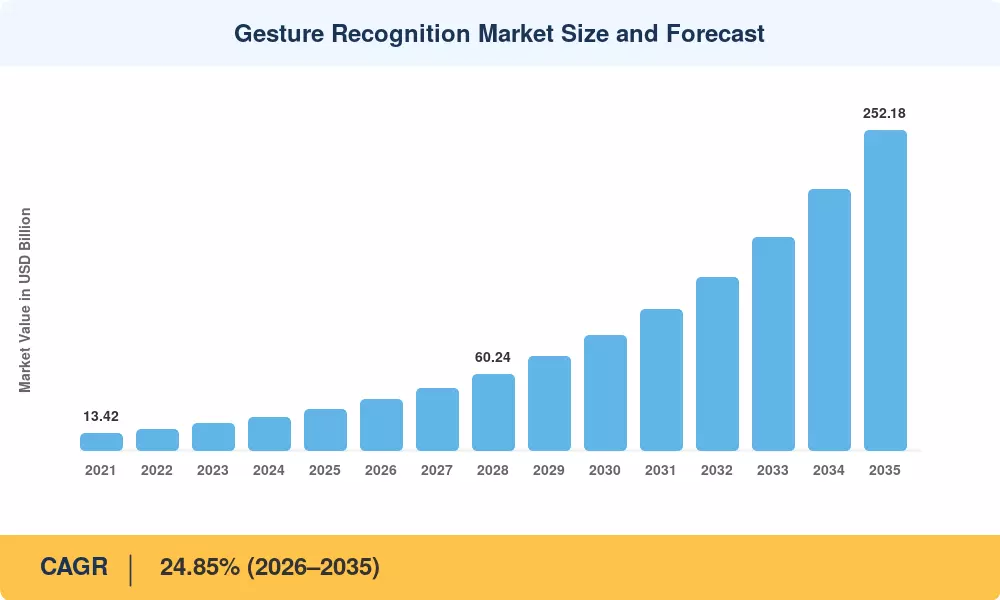
The Gesture Recognition Market reached an estimated USD 32.61 billion in 2025 and is projected to grow from USD 40.24 billion in 2026 to USD 252.18 billion by 2035, registering a CAGR of 24.85% during the forecast period. This trajectory reflects a step-change in how humans interact with machines — driven by the U.S. CHIPS Act's USD 52.7 billion semiconductor investment mandate and parallel European Chips Act funding that together are reshaping the sensor supply chain underpinning contactless UI technology [2]. Infection-control protocols adopted post-pandemic across hospitals and public kiosks continue to pull forward adoption curves for touchless interaction technology in high-traffic environments [3].
Legacy touch-dependent interfaces — resistive touchscreens, mechanical buttons, capacitive panels — are giving way to multizone Time-of-Flight sensor arrays and millimeter-wave radar modules that interpret hand motion detection at sub-10 ms latency. Edge-AI inference chips from vendors like Qualcomm and STMicroelectronics now process computer vision gestures locally, eliminating cloud round-trips and enabling gesture-based control systems even in bandwidth-constrained industrial settings [4]. A 2024 STMicroelectronics white paper confirmed that its FlightSense multizone ToF sensors shipped in over 150 million smartphones during the prior fiscal year, underscoring the volume economics that accelerate cost declines across the Gesture Recognition Market [1].
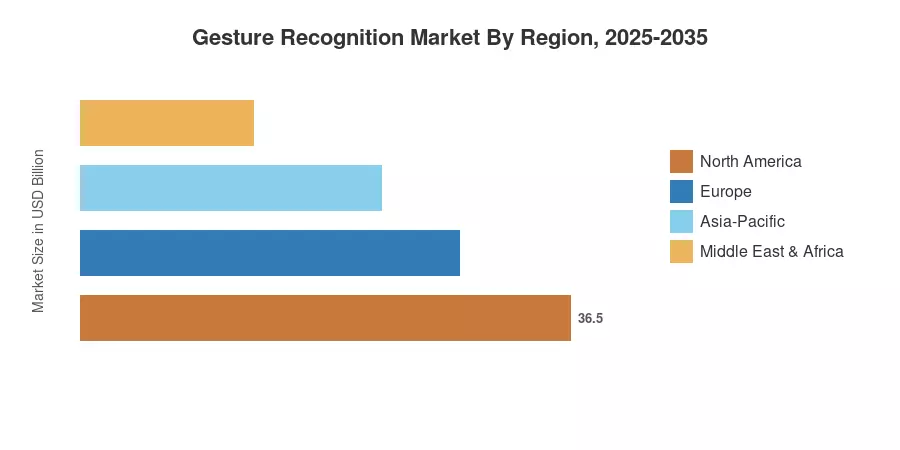
Asia-Pacific commands the largest share of the Gesture Recognition Market at approximately 38.5% of 2025 revenue, propelled by China's consumer electronics manufacturing base and India's Digital India infrastructure program. North America follows at roughly 28% share, anchored by automotive OEM integration mandates and defense R&D. Europe, the third-largest region, is growing fast behind EU safety regulation EN 16005 updates that promote touchless interaction technology in public-access buildings [5]. Over the next decade, the convergence of spatial computing platforms with gesture recognition stacks will likely redefine human–machine interaction paradigms worldwide.
Key Report Takeaways
• By Technology
- Touchless gesture recognition systems held 61.40% revenue share of the Gesture Recognition Market in 2025, driven by healthcare hygiene mandates and automotive cabin sensing requirements
- 3-D depth and ToF-based solutions are projected to expand at a 25.65% CAGR through 2035 as edge-AI algorithms improve false-positive rejection rates for hand motion detection
• By Component
- Hardware components — sensors, cameras, and radar modules — accounted for USD 24.35 billion within the Gesture Recognition Market in 2025
• By End-User
- Hardware components — sensors, cameras, and radar modules — accounted for USD 24.35 billion within the Gesture Recognition Market in 2025
- Consumer electronics commanded a 44.75% share of gesture recognition demand in 2025; Healthcare represents the fastest-growing end-user vertical for contactless UI technology at a 26.15% CAGR
• By Region
- Asia-Pacific leads the Gesture Recognition Market with 38.5% revenue share, while North America accounts for approximately USD 9.13 billion in 2025
- South America and the Middle East & Africa together represent an emerging USD 2.61 billion opportunity in gesture-based control systems
Market Size and Forecast (2021–2035)
The market sizing model integrates bottom-up component shipment data, top-down end-user spending estimates, and triangulation against published OEM sensor attach-rate disclosures. Historical values (2021–2024) reflect audited revenue, while the base year 2025 incorporates preliminary shipment data. Forecast values (2026–2035) apply the calibrated CAGR with adjustments for regulatory catalysts, technology adoption S-curves, and macroeconomic scenarios validated against IMF GDP projections.