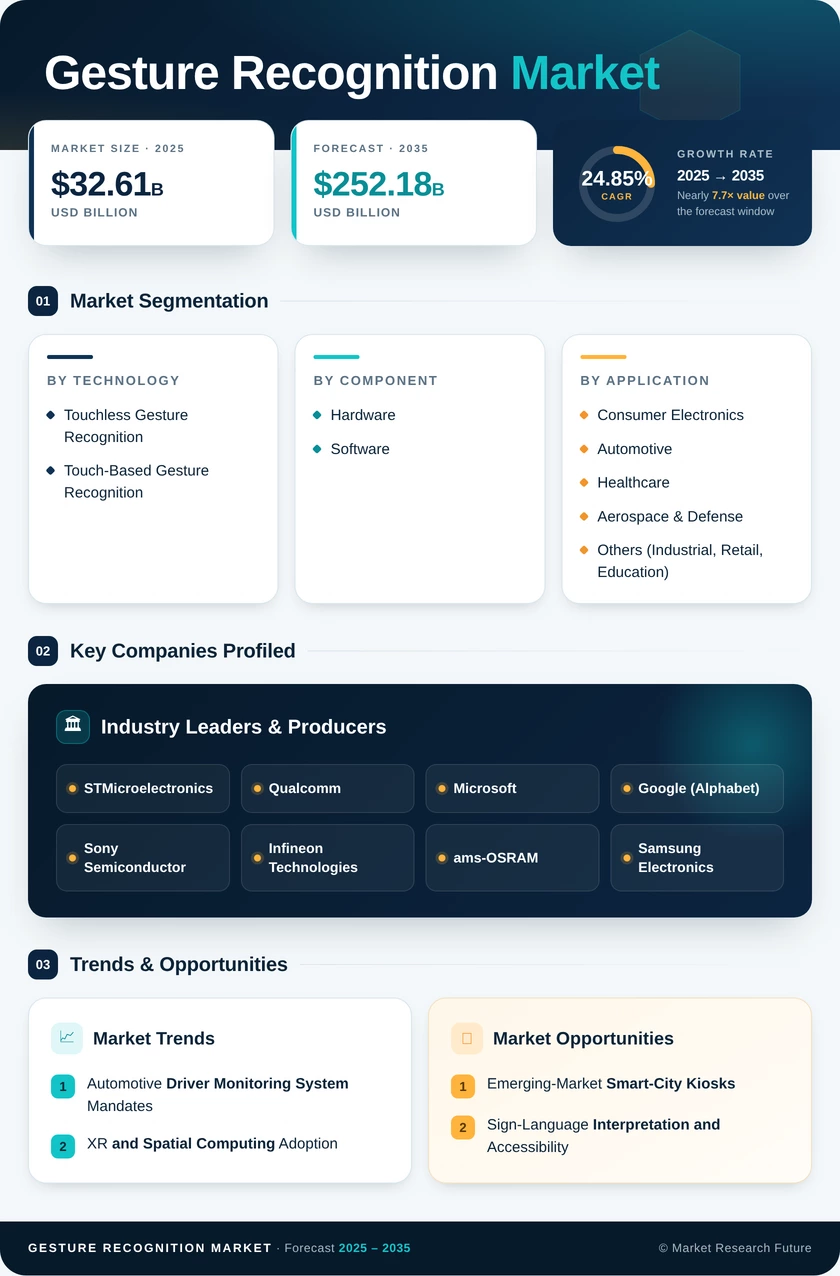
Segmentation Quick Reference
| Dimension | Sub-Segments | Dominant Segment (2025) | Fastest Growing Segment (2026–2035) |
| Technology | Touch-Based Gesture Recognition; Touchless Gesture Recognition | Touchless Gesture Recognition | Touchless Gesture Recognition |
| Component | Hardware; Software | Hardware | Software |
| Gesture Type | Dynamic Gestures (Online); Static Gestures (Offline) | Dynamic Gestures (Online) | Static Gestures (Offline) |
| Authentication | Biometric; Non-Biometric | Non-Biometric | Biometric |
| End-User Industry | Consumer Electronics; Automotive; Healthcare; Gesture Recognition Market; Others | Consumer Electronics | Healthcare |
Market Segmentation Overview
By Technology
| Sub-Segment | Key Trend |
| Touch-Based Gesture Recognition | Stable growth driven by smartphone and tablet OS-level gesture UIs; foldable-display form factors introducing new gesture vocabularies |
| Touchless Gesture Recognition | Rapid expansion via ToF sensor cost declines, healthcare hygiene mandates, and automotive DMS integration requirements |
Touchless gesture recognition is the primary growth vector, with 3-D depth sensing and mmWave radar enabling responsive, low-latency interfaces in automotive, healthcare, and XR applications. Touch-based recognition maintains a large installed base but grows at a slower rate as contactless alternatives gain preference.
By Component
| Sub-Segment | Key Trend |
| Hardware | ToF sensors, IR cameras, and mmWave radar modules dominate BOM; cost deflation accelerating mid-tier device adoption |
| Software | AI gesture SDKs, cloud APIs, and analytics platforms capturing increasing value share through recurring-revenue models |
Hardware remains the revenue-dominant component, but the value shift toward software — gesture SDKs, cloud-hosted recognition APIs, and AI personalization layers — is the defining trend as the ecosystem matures.
By Gesture Type
| Sub-Segment | Key Trend |
| Dynamic Gestures (Online) | Real-time swipe, wave, and pinch interactions dominate consumer electronics and automotive cabin use cases |
| Static Gestures (Offline) | Pose-based recognition gaining traction in sign-language interpretation and biometric authentication |
Dynamic gestures account for the majority of interactions across consumer and automotive platforms. Static gesture recognition is emerging as a high-value niche for accessibility and security applications.
By Authentication
| Sub-Segment | Key Trend |
| Biometric | Vein-pattern and behavioral gesture profiling growing within enterprise zero-trust security frameworks |
| Non-Biometric | General-purpose motion and pose control remains the default interaction modality across all verticals |
Non-biometric gesture control dominates by volume, while biometric gesture authentication is the fastest-growing sub-segment as organizations adopt multi-factor security architectures.
By End-User Industry
| Sub-Segment | Key Trend |
| Consumer Electronics | Smartphone and XR headset integration; per-device gesture content value rising with spatial computing |
| Automotive | DMS mandates and in-cabin experience platforms driving sensor and software content per vehicle |
| Healthcare | Touchless surgical-suite digitization and infection-prevention protocols creating compliance-driven procurement |
| Gesture Recognition Market | Cockpit gesture HMI modernization and field-wearable applications |
| Others (Industrial, Retail, Education) | Cobot gesture interfaces, retail kiosks, and smart-classroom deployments expanding the addressable footprint |
Consumer electronics lead by revenue share, while healthcare is the fastest-growing end-user vertical. Automotive represents the highest per-unit gesture content value, driven by safety regulation and premium in-cabin experience platforms.