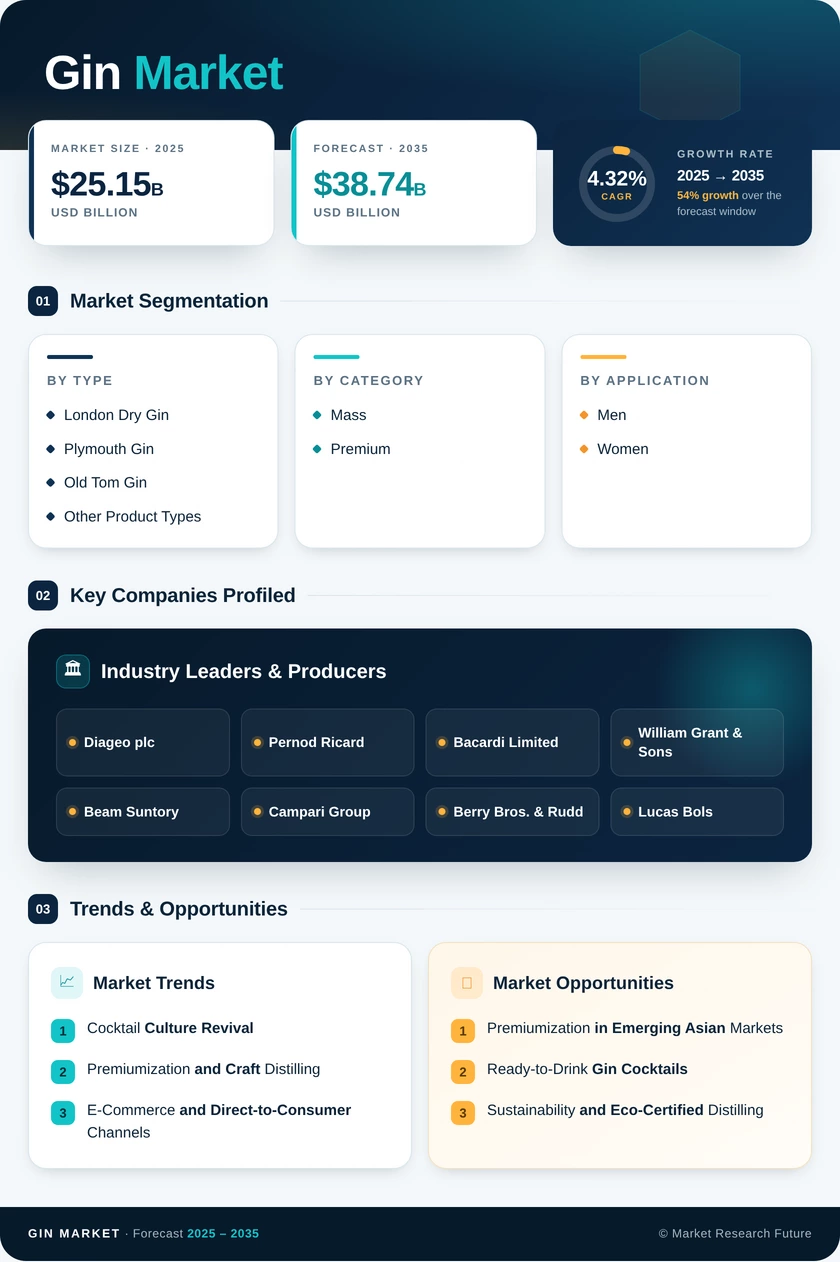
Gin Market

ID: MRFR/FnB/6478-HCR
128 Pages
Snehal Singh
Last Updated: June 16, 2026
Gin Market Size, Share, Industry Trend & Analysis Research Report Information By Product Type (London Dry Gin, Plymouth Gin, Old Tom Gin, Other Product Types), By Category (Mass, Premium), By End User (Men, Women), By Distribution Channel (Off-Trade, On-Trade), By Geography (North America, Europe, Asia-Pacific, South America, Middle East & Africa) – Forecast Till 2035
Download PDF ×

We do not share your information with anyone. However, we may send you emails based on your report interest from time to time. You may contact us at any time to opt-out.

  1. 1 Market Overview |
    1. 1.1 Study Assumptions & Market Definition |
    2. 1.2 Scope of the Study |
    3. 1.3 Research Methodology
  2. 2 Market Summary & Key Takeaways
  3. 3 Market Dynamics |
    1. 3.1 Market Drivers Analysis | |
      1. 3.1.1 Cocktail Culture Revival | |
      2. 3.1.2 Premiumization and Craft Distilling | |
      3. 3.1.3 Botanical Innovation and Flavor Diversification | |
      4. 3.1.4 Expanding Middle-Class Consumption in Asia-Pacific | |
      5. 3.1.5 E-Commerce and DTC Spirits Channels | |
      6. 3.1.6 Gin Tourism and Experiential Distillery Visits | |
      7. 3.1.7 RTD Gin Cocktail Segment Growth |
    2. 3.2 Market Restraints Analysis | |
      1. 3.2.1 Health-Consciousness and Moderation Trends | |
      2. 3.2.2 Regulatory Warning Labels and Advertising Restrictions | |
      3. 3.2.3 High Excise Taxation on Spirits | |
      4. 3.2.4 Competition from Other Spirit Categories | |
      5. 3.2.5 Supply Chain Volatility for Botanical Ingredients |
    3. 3.3 Market Opportunity Analysis | |
      1. 3.3.1 Premiumization in Emerging Asian Markets | |
      2. 3.3.2 Ready-to-Drink Gin Cocktails | |
      3. 3.3.3 Sustainability and Eco-Certified Distilling | |
      4. 3.3.4 Gin Tourism and Experiential Retail | |
      5. 3.3.5 Data-Driven Personalization and Subscription Models |
    4. 3.4 Industry Value Chain Analysis |
    5. 3.5 Porter's Five Forces Analysis
  4. 4 Global Gin Market Size & Forecast (2021–2035) |
    1. 4.1 Historical Market Size (2021–2025) |
    2. 4.2 Current & Forecast Market Size (2026–2035) |
    3. 4.3 Market Size by Revenue (USD Billion) |
    4. 4.4 Year-over-Year Growth Analysis
  5. 5 Segmentation Analysis |
    1. 5.1 By Product Type | |
      1. 5.1.1 London Dry Gin | |
      2. 5.1.2 Plymouth Gin | |
      3. 5.1.3 Old Tom Gin | |
      4. 5.1.4 Other Product Types (Genever, Sloe Gin, Navy Strength) |
    2. 5.2 By Category | |
      1. 5.2.1 Mass | |
      2. 5.2.2 Premium |
    3. 5.3 By End User | |
      1. 5.3.1 Men | |
      2. 5.3.2 Women |
    4. 5.4 By Distribution Channel | |
      1. 5.4.1 Off-Trade | |
      2. 5.4.2 On-Trade
  6. 6 Regional Analysis |
    1. 6.1 North America | |
      1. 6.1.1 United States | |
      2. 6.1.2 Canada | |
      3. 6.1.3 Mexico |
    2. 6.2 Europe | |
      1. 6.2.1 Germany | |
      2. 6.2.2 United Kingdom | |
      3. 6.2.3 France | |
      4. 6.2.4 Italy | |
      5. 6.2.5 Spain | |
      6. 6.2.6 Nordic Countries | |
      7. 6.2.7 Russia | |
      8. 6.2.8 Rest of Europe |
    3. 6.3 Asia-Pacific | |
      1. 6.3.1 China | |
      2. 6.3.2 India | |
      3. 6.3.3 Japan | |
      4. 6.3.4 South Korea | |
      5. 6.3.5 ASEAN | |
      6. 6.3.6 Rest of Asia-Pacific |
    4. 6.4 South America | |
      1. 6.4.1 Brazil | |
      2. 6.4.2 Argentina | |
      3. 6.4.3 Rest of South America |
    5. 6.5 Middle East & Africa | |
      1. 6.5.1 Saudi Arabia | |
      2. 6.5.2 UAE | |
      3. 6.5.3 South Africa | |
      4. 6.5.4 Egypt | |
      5. 6.5.5 Rest of MEA
  7. 7 Competitive Landscape |
    1. 7.1 Market Share Analysis (2025) |
    2. 7.2 Competitive Benchmarking Matrix |
    3. 7.3 Company Profiles | |
      1. 7.3.1 Diageo plc | |
      2. 7.3.2 Pernod Ricard | |
      3. 7.3.3 Bacardi Limited | |
      4. 7.3.4 William Grant & Sons | |
      5. 7.3.5 Beam Suntory | |
      6. 7.3.6 Campari Group | |
      7. 7.3.7 Berry Bros. & Rudd | |
      8. 7.3.8 Lucas Bols | |
      9. 7.3.9 Radico Khaitan | |
      10. 7.3.10 Kyoto Distillery
  8. 8 Future Outlook & Strategic Recommendations (2026–2035) |
    1. 8.1 AI-Driven Flavor Discovery and Process Optimization |
    2. 8.2 Sustainability as a Competitive Moat |
    3. 8.3 Premiumization Supercycle and Ultra-Premium Positioning |
    4. 8.4 Non-Alcoholic and Low-ABV Gin Integration
  9. 9 Recent Developments & News
  10. 10 Frequently Asked Questions (FAQs)
  11. 11 Report Scope & Methodology |
    1. 11.1 Study Period & Base Year |
    2. 11.2 Data Sources & Citations |
    3. 11.3 Abbreviations
  12. 12 LIST OF TABLES |
  13. TABLE 1 Global Gin Market Size & Forecast, by Revenue (USD Billion), 2021–2035 |
  14. TABLE 2 Global Gin Market — Year-over-Year Growth Analysis, 2021–2035 |
  15. TABLE 3 Global Gin Market — Driver Impact Analysis |
  16. TABLE 4 Global Gin Market — Restraint Impact Analysis |
  17. TABLE 5 Global Gin Market Size, by Product Type, 2021–2035 (USD Billion) |
  18. TABLE 6 Global Gin Market Size, by Category, 2021–2035 (USD Billion) |
  19. TABLE 7 Global Gin Market Size, by End User, 2021–2035 (USD Billion) |
  20. TABLE 8 Global Gin Market Size, by Distribution Channel, 2021–2035 (USD Billion) |
  21. TABLE 9 Global Gin Market Size, by Region, 2021–2035 (USD Billion) |
  22. TABLE 10 North America Gin Market Size, by Country, 2021–2035 (USD Billion) |
  23. TABLE 11 Europe Gin Market Size, by Country, 2021–2035 (USD Billion) |
  24. TABLE 12 Asia-Pacific Gin Market Size, by Country, 2021–2035 (USD Billion) |
  25. TABLE 13 South America Gin Market Size, by Country, 2021–2035 (USD Billion) |
  26. TABLE 14 Middle East & Africa Gin Market Size, by Country, 2021–2035 (USD Billion) |
  27. TABLE 15 Competitive Benchmarking Matrix — Global Gin Market, 2025 |
  28. TABLE 16 Company Profiles — Key Players, Global Gin Market |
  29. TABLE 17 Recent Developments & Strategic Announcements, 2023–2025 |
  30. TABLE 18 Report Scope & Methodology Summary |
  31. TABLE 19 Detailed Sources and Citations
  32. 13 LIST OF FIGURES |
  33. FIGURE 1 Global Gin Market Dynamics — Drivers, Restraints, and Opportunities |
  34. FIGURE 2 Gin Market Industry Value Chain Analysis |
  35. FIGURE 3 Porter's Five Forces Analysis — Global Gin Market |
  36. FIGURE 4 Global Gin Market Size Trend (USD Billion), 2021–2035 |
  37. FIGURE 5 Global Gin Market Share, by Product Type (%), 2025 |
  38. FIGURE 6 Global Gin Market Share, by Category (%), 2025 |
  39. FIGURE 7 Global Gin Market Share, by End User (%), 2025 |
  40. FIGURE 8 Global Gin Market Share, by Distribution Channel (%), 2025 |
  41. FIGURE 9 Global Gin Market Share, by Region (%), 2025 |
  42. FIGURE 10 Competitive Landscape — Market Share Analysis, 2025

SEGMENTATION QUICK REFERENCE

DimensionSub-SegmentsDominant SegmentFastest Growing Segment
Product TypeLondon Dry Gin, Plymouth Gin, Old Tom Gin, Other Product TypesLondon Dry Gin (~55% share)Old Tom Gin (4.68% CAGR)
CategoryMass, PremiumMass (~58% share)Premium (5.28% CAGR)
End UserMen, WomenMen (~74% share)Women (5.05% CAGR)
Distribution ChannelOff-Trade, On-TradeOff-Trade (~63% share)On-Trade (4.59% CAGR)
GeographyNorth America, Europe, Asia-Pacific, South America, Middle East & AfricaEurope (USD 11.82B, 2025)Asia-Pacific (5.45% CAGR)


MARKET SEGMENTATION OVERVIEW

By Product Type

Sub-SegmentKey Trend
London Dry GinEnduring dominance driven by mixability and GI-protected quality standards
Plymouth GinNiche heritage positioning with protected designation of origin
Old Tom GinRevival through vintage cocktail culture and sweetened botanical profiles
Other Product TypesGenever, sloe gin, and navy strength diversifying the category


London Dry Gin anchors the global Gin Market with its regulated distillation standards and universal bartender acceptance. Old Tom Gin's growth trajectory signals consumer appetite for sweeter, more approachable expressions within the juniper-based distilled spirit category.

By Category

Sub-SegmentKey Trend
MassVolume leadership sustained by supermarket distribution and price accessibility
PremiumOutpacing mass growth through craft positioning and botanical infused gin innovation


The premium segment's accelerating CAGR reflects a secular shift toward quality-over-quantity spirits consumption, particularly in Europe and North America, where consumers trade up to small-batch and single-estate botanical releases.

By End User

Sub-SegmentKey Trend
MenTraditional base with strong on-trade consumption patterns
WomenFastest-growing demographic, attracted by flavored and contemporary gin expressions


Gender rebalancing represents a structural Gin Market growth driver, with female-targeted branding and flavor innovation expanding the consumer base beyond traditional male-dominated spirits demographics.

By Distribution Channel

Sub-SegmentKey Trend
Off-TradeDominant revenue channel leveraging supermarket, e-commerce, and duty-free sales
On-TradeHigher growth rate as cocktail bars and experiential venues recover post-pandemic


The interplay between off-trade volume and on-trade premiumization defines the Gin Market's channel dynamics, with e-commerce emerging as a bridge that blends the reach of off-trade with the curation typically associated with on-trade experiences.