×
Request Free Sample ×

Kindly complete the form below to receive a free sample of this Report

* Please use a valid business email

Leading companies partner with us for data-driven Insights

clients tt-cursor
Hero Background

Glass Market

ID: MRFR/CnM/9995-HCR
128 Pages
Pradeep Nandi
February 2026

Glass Market Research Report Information By Product (Container Glass, Flat Glass, Fiber Glass, and Others), By Application (Packaging, Construction, Transportation, Electrical & Electronics, Telecommunication, and Others), And By Region (North America, Europe, Asia-Pacific, And Rest Of The World) –Market Forecast Till 2035

Share:
Download PDF ×

We do not share your information with anyone. However, we may send you emails based on your report interest from time to time. You may contact us at any time to opt-out.

Glass Market Infographic
Purchase Options

Glass Market Summary

As per Market Research Future analysis, the Glass Market Size was estimated at 296.15 USD Billion in 2024. The Glass industry is projected to grow from 311.26 USD Billion in 2025 to 511.95 USD Billion by 2035, exhibiting a compound annual growth rate (CAGR) of 5% during the forecast period 2025 - 2035

Key Market Trends & Highlights

The glass market is currently experiencing a dynamic shift towards sustainability and technological innovation.

  • North America remains the largest market for glasses, driven by robust construction and infrastructure development.
  • Asia-Pacific is recognized as the fastest-growing region, fueled by increasing urbanization and industrialization.
  • The container segment continues to dominate the market, while the flat glass segment is witnessing rapid growth due to advancements in smart glass technology.
  • Key market drivers include the rising demand for eco-friendly products and technological advancements in glass manufacturing, particularly in the automotive and construction sectors.

Market Size & Forecast

2024 Market Size 296.15 (USD Billion)
2035 Market Size 511.95 (USD Billion)
CAGR (2025 - 2035) 5.1%

Major Players

Saint-Gobain (FR), AGC Inc. (JP), Nippon Sheet Glass (JP), Guardian Industries (US), Corning Inc. (US), Schott AG (DE), PPG Industries (US), Owens-Illinois (US)

Our Impact
Enabled $4.3B Revenue Impact for Fortune 500 and Leading Multinationals
Partnering with 2000+ Global Organizations Each Year
30K+ Citations by Top-Tier Firms in the Industry

Glass Market Trends

The Glass Market is currently experiencing a dynamic evolution, driven by various factors that influence demand and supply. Innovations in manufacturing processes and materials are reshaping the landscape, allowing for enhanced product performance and sustainability. The increasing focus on energy efficiency and environmental concerns is prompting manufacturers to adopt eco-friendly practices, which may lead to a shift in consumer preferences towards greener alternatives. Furthermore, the rise of smart technologies is likely to create new opportunities for glass applications, particularly in the construction and automotive sectors. As a result, the market appears poised for growth, with potential expansions in both residential and commercial segments. In addition to technological advancements, the Glass Market is also influenced by changing consumer behaviors and preferences. The trend towards customization and personalization is becoming more pronounced, as consumers seek unique designs and functionalities in glass products. This shift may encourage manufacturers to diversify their offerings and explore niche markets. Moreover, the globalization of trade is facilitating the exchange of ideas and innovations across borders, which could further enhance competition and drive market development. Overall, the Glass Market seems to be on a trajectory of transformation, characterized by innovation, sustainability, and evolving consumer demands.

Sustainability Initiatives

The Glass Market is increasingly prioritizing sustainability, with manufacturers adopting eco-friendly practices. This trend reflects a growing awareness of environmental issues, leading to the development of recyclable and energy-efficient products. Companies are likely to invest in technologies that minimize waste and reduce carbon footprints, aligning with global sustainability goals.

Smart Glass Market Technology

The integration of smart technologies into glass products is gaining traction. Smart glass market, which can change its properties in response to environmental stimuli, is becoming popular in various applications, including architecture and automotive. This trend suggests a shift towards multifunctional materials that enhance user experience and energy efficiency.

Customization and Personalization

Consumer demand for unique and personalized glass products is on the rise. This trend encourages manufacturers to offer customizable options, catering to individual preferences and styles. As a result, the Glass Market may see an increase in niche offerings, allowing for greater differentiation and customer engagement.

Glass Market Drivers

Expansion of Automotive Glass Applications

The Glass Market is experiencing a notable expansion in automotive glass applications, driven by advancements in vehicle design and technology. The increasing integration of glass in vehicle structures, such as panoramic roofs and large windows, enhances both aesthetics and functionality. Additionally, the rise of electric vehicles is prompting manufacturers to explore lightweight glass options that contribute to overall vehicle efficiency. Recent data suggests that the automotive glass segment is poised for growth, as consumers seek vehicles that offer improved visibility and modern design. This expansion in automotive applications is likely to provide new opportunities for the Glass Market, as manufacturers adapt to the evolving needs of the automotive sector.

Increasing Demand for Eco-Friendly Products

The Glass Market is experiencing a notable shift towards eco-friendly products, driven by heightened consumer awareness regarding sustainability. As environmental concerns gain traction, manufacturers are increasingly focusing on producing glass products that are recyclable and made from sustainable materials. This trend is reflected in the rising demand for glass packaging, which is perceived as a more environmentally responsible alternative to plastic. According to recent data, the market for recycled glass is projected to grow significantly, indicating a robust shift in consumer preferences. This increasing demand for eco-friendly glass products is likely to propel the Glass Market forward, as companies adapt their production processes to meet these evolving consumer expectations.

Rising Demand for Energy-Efficient Solutions

The Glass Market is witnessing a surge in demand for energy-efficient solutions, particularly in the context of building materials. Energy-efficient glass products, such as low-emissivity (Low-E) glass, are becoming increasingly popular due to their ability to reduce energy consumption in heating and cooling systems. This trend is driven by regulatory measures aimed at improving energy efficiency in buildings, as well as consumer preferences for sustainable living. The market for energy-efficient glass is expected to grow, as more consumers and businesses recognize the long-term cost savings associated with reduced energy usage. Consequently, this rising demand is likely to propel the Glass Market towards innovative solutions that align with energy efficiency goals.

Technological Advancements in Glass Manufacturing

Technological innovations are playing a pivotal role in shaping the Glass Market. The introduction of advanced manufacturing techniques, such as automated production lines and precision glass cutting, has enhanced efficiency and reduced production costs. Moreover, the development of smart glass technology, which allows for dynamic control of light and heat, is gaining traction in various applications, including architecture and automotive sectors. This technological evolution not only improves product quality but also expands the range of applications for glass products. As a result, the Glass Market is likely to witness increased investment in research and development, fostering further advancements and potentially leading to new market opportunities.

Growth in Construction and Infrastructure Development

The Glass Market is significantly influenced by the ongoing growth in construction and infrastructure development. As urbanization accelerates, there is a rising demand for glass in residential, commercial, and industrial buildings. Glass Market is increasingly favored for its aesthetic appeal, energy efficiency, and ability to enhance natural light in spaces. Recent statistics indicate that the construction sector is projected to expand, with glass usage in facades and windows expected to rise correspondingly. This trend suggests that the Glass Market will benefit from the construction boom, as architects and builders increasingly incorporate glass into their designs to meet modern architectural standards.
Market Segment Insights

By Type: Container (Largest) vs. Flat (Fastest-Growing)

The glass market is predominantly segmented into Container Glass Market, Flat Glass Market, Fiber Glass Market, and Others. Among these, Container Glass Market holds the largest market share due to its extensive application in food and beverage packaging. Flat Glass Market follows as a significant segment, widely used in construction and automotive industries. Fiber Glass Market and Others contribute to a smaller percentage of the overall market, indicating a distinct preference towards the first two segments.

Container Glass Market (Dominant) vs. Flat Glass Market (Emerging)

Container Glass Market is characterized by its versatility and robustness, making it the preferred choice for packaging beverages, foods, and pharmaceuticals, significantly driving its position in the market. On the other hand, Flat Glass Market has emerged as a vital segment, especially in modern architecture and energy-efficient buildings. Its use in insulated panels and solar applications is growing, reflecting a shift towards sustainability. The innovation in glass coating technologies is poised to enhance Flat Glass Market's appeal, positioning it as an emerging player.

By Application: Packaging (Largest) vs. Construction (Fastest-Growing)

The glass market exhibits diverse applications, with packaging leading the segment distribution. Packaging holds a dominant position due to the increasing demand for sustainable and attractive packaging solutions across various industries. Construction follows, leveraging glass's aesthetic appeal and energy efficiency in modern architecture. Transportation and electrical & electronics represent notable shares, while telecommunication and others contribute to the overall landscape, albeit to a lesser extent. These dynamics illustrate the significant role of glass across sectors, particularly in packaging and construction.

Packaging (Dominant) vs. Construction (Emerging)

The packaging segment of the glass market is characterized by its expansive use in food, beverage, and cosmetic sectors. Glass Market packaging appeals to consumers due to its recyclability and ability to preserve product integrity. This segment remains dominant as manufacturers emphasize sustainable practices and consumers prioritize eco-friendly packaging. Conversely, the construction segment, which is emerging rapidly, leverages innovations in glass technology, such as energy-efficient windows and solar control glazing. This segment's growth is driven by trends favoring modern architecture and a global push for energy efficiency in buildings, making glass an attractive choice for builders and architects alike.

Get more detailed insights about Glass Market

Regional Insights

North America : Market Leader in Glass Market Production

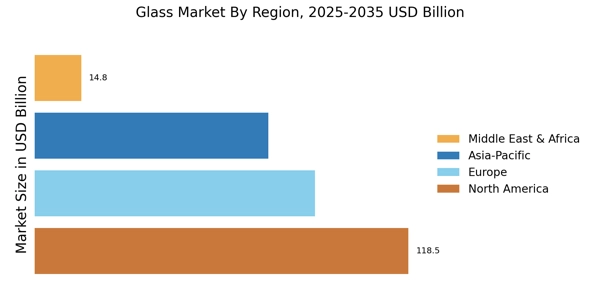
North America is the largest market for glass, holding approximately 40% of the global share, driven by robust demand in construction and automotive sectors. Regulatory support for energy-efficient building materials and sustainability initiatives further catalyze growth. The U.S. leads this region, followed closely by Canada, as both countries invest heavily in infrastructure and green technologies. The competitive landscape is characterized by major players such as Guardian Industries, Corning Inc., and Owens-Illinois, which dominate the market with innovative products. The presence of these key players fosters a dynamic environment, encouraging advancements in glass technology. The region's focus on high-performance glass solutions is expected to sustain its market leadership in the coming years.

Europe : Innovation and Sustainability Focus

Europe is the second-largest market for glass, accounting for approximately 30% of the global share. The region's growth is propelled by stringent regulations promoting energy efficiency and sustainability in construction. Countries like Germany and France are at the forefront, implementing policies that encourage the use of eco-friendly materials, thus driving demand for advanced glass products. Leading countries in this region include Germany, France, and the UK, where companies like Saint-Gobain and Schott AG are key players. The competitive landscape is marked by innovation, with a strong emphasis on research and development. European manufacturers are increasingly focusing on smart glass technologies, enhancing their market position and meeting evolving consumer demands.

Asia-Pacific : Emerging Market with High Potential

Asia-Pacific is witnessing rapid growth in the glass market, holding approximately 25% of the global share. The region's expansion is driven by urbanization, increasing disposable incomes, and a booming construction sector, particularly in countries like China and India. Government initiatives aimed at infrastructure development and modernization are significant catalysts for this growth. China is the largest market in this region, followed by Japan and India, with key players like AGC Inc. and Nippon Sheet Glass Market leading the charge. The competitive landscape is evolving, with local manufacturers increasingly investing in advanced technologies to enhance product quality and sustainability. This focus on innovation positions the Asia-Pacific region as a critical player in The Glass Market.

Middle East and Africa : Resource-Rich and Growing Demand

The Middle East and Africa region is emerging as a significant player in the glass market, holding approximately 5% of the global share. The growth is primarily driven by increasing construction activities and a rising demand for glass in the automotive sector. Countries like the UAE and South Africa are leading this growth, supported by government investments in infrastructure and urban development projects. The competitive landscape features both local and international players, with companies like PPG Industries making notable contributions. The region's focus on diversifying its economy and enhancing manufacturing capabilities is expected to further boost the glass market. As demand continues to rise, the region is poised for substantial growth in the coming years.

Glass Market Regional Image

Key Players and Competitive Insights

Increasing product demand has resulted in intense competition. Regarding manufacturing procedures and product development, market participants emphasize competitive differentiation. Major players in the glass manufacturing market are intent on bolstering their market position with technologically advanced solutions. Moreover, market development strategies, including new product launches, mergers and acquisitions, and collaboration with other organizations, are key strategies adopted by players. The Glass industry must offer cost-effective items to expand and survive in a more competitive and rising market climate.
Technology innovation is an important trend gaining popularity in the global Glass industry. These companies integrate next-generation glass manufacturing technologies, such as VRT and plasma technologies, laser, radiation-induced glass coloring, solarization, IT, and artificial intelligence, into their manufacturing processes. Major Glass Market players include AGC Inc., Fuyao Glass Industry Group Co. Ltd., Guardian Industries, Saint-Gobain, O-I Glass Market Inc., AGI glaspac, Nihon Yamaura Glass Market Co., Ltd., Vitro, and 3B- the fiberglass company.
Asahi Glass Market Co Ltd, AGC Inc (AGC) provides Glass Market, electronic components, chemicals, and ceramics. The company offers flat float Glass Market, Automotive Glass Market, Decorative Glass Market, heat-insulating and shielding Glass Market, Architectural Glass Market, disaster-resistant and security Glass Market, and polished wired Glass Market. It also provides LCD glass substrates, cover glass for vehicle-mounted displays, specialty glass for display applications, Glass Market for solar power systems, Glass Market for industrial use, and optoelectronic and lighting glass products. AGC offers polyvinyl chloride, caustic soda, vinyl chloride monomer, fluorinated polymers, and water- and oil-repellents.
Attoch, Coolverre, Wonderlite, Lacobel, XCV, Amorea, Aflas, Glascene, Preminol, inferred, and Thermotect is the brand names under which the company markets its products. The company operates in Asia, the Middle East, the Americas, Africa, and Europe. The headquarters of AGC is in Chiyoda-Ku, Tokyo, Japan.
Guardian Industries produces float Glass Market, glass fabrications, and plastic coatings for the automotive and commercial vehicle industries. Guardian Glass Market Company was founded in 1932 in Detroit, Michigan as a modest windshield fabricator. Forbes identifies Guardian Industries as one of the world's largest public companies, with over 14,000 employees.

Key Companies in the Glass Market include

Industry Developments

  • Q1 2024: Miter Brands acquiring PGT Innovations, Quanex acquiring Tyman and more In early 2024, Miter Brands acquired PGT Innovations and Quanex acquired Tyman, marking significant consolidation moves in the window and door sector as part of a wave of marquee deals in the glass market.
  • Q1 2024: PGT Innovations (Miter Brands) and Masonite (Owens Corning)—buyer appetite remains strong with mergers and acquisitions activity expected to continue to accelerate in 2025 PGT Innovations was acquired by Miter Brands and Masonite was acquired by Owens Corning, reflecting strong buyer appetite and ongoing M&A activity in the glass and building products sector.
  • Q3 2024: Window Nation, one of the largest window replacement companies in the U.S., announced in September 2024 it had acquired Florida-based Armorvue Window and Door Window Nation expanded its footprint by acquiring Armorvue Window and Door in September 2024, further consolidating its position in the U.S. window replacement market.
  • Q3 2024: Pella Corp. completed the successful divestment of its two luxury businesses—Duratherm Window Company and Michael Reilly Design—in July 2024 Pella Corp. divested its luxury subsidiaries, Duratherm Window Company and Michael Reilly Design, in July 2024, as part of a strategic realignment of its business portfolio.
  • Q4 2024: Full Glass Market Wine's latest acquisitions include Wine Access and Cameron Hughes Wine. It plans to close its next funding round in early 2025. Full Glass Market Wine Co. acquired Wine Access and Cameron Hughes Wine in December 2024, strengthening its direct-to-consumer wine market presence and announcing plans for a new funding round in early 2025.
  • Q1 2024: Trulite Glass Market & Aluminum Solutions acquired three fabricator companies within the last year, all of them long-time Top Glass Market Fabricators Trulite Glass Market & Aluminum Solutions acquired American Insulated Glass Market, Insulite, and Dependable Glass Market Works, expanding its geographic reach and product offerings through an active M&A strategy.
  • Q1 2024: Glaz-Tech also acquired Tomakk Glass Market Partners, a fabricator based in Shreveport, Louisiana Glaz-Tech acquired Tomakk Glass Market Partners, enabling the company to expand its market reach in the Southeast and broaden its product mix, including energy-efficient glass products.

Future Outlook

Glass Market Future Outlook

The Glass Market is projected to grow at a 5.1% CAGR from 2025 to 2035, driven by increasing demand in construction, automotive, and renewable energy sectors.

New opportunities lie in:

  • Expansion into smart glass technologies for energy efficiency
  • Development of eco-friendly glass recycling solutions
  • Investment in automated glass manufacturing processes to reduce costs

By 2035, the Glass Market is expected to achieve robust growth, driven by innovation and sustainability.

Market Segmentation

Glass Market Type Outlook

  • Container Glass
  • Flat Glass
  • Fiber Glass
  • Others

Glass Market Application Outlook

  • Packaging
  • Construction
  • Transportation
  • Electrical & Electronics
  • Telecommunication
  • Others

Report Scope

MARKET SIZE 2024 296.15(USD Billion)
MARKET SIZE 2025 311.26(USD Billion)
MARKET SIZE 2035 511.95(USD Billion)
COMPOUND ANNUAL GROWTH RATE (CAGR) 5.1% (2025 - 2035)
REPORT COVERAGE Revenue Forecast, Competitive Landscape, Growth Factors, and Trends
BASE YEAR 2024
Market Forecast Period 2025 - 2035
Historical Data 2019 - 2024
Market Forecast Units USD Billion
Key Companies Profiled Saint-Gobain (FR), AGC Inc. (JP), Nippon Sheet Glass (JP), Guardian Industries (US), Corning Inc. (US), Schott AG (DE), PPG Industries (US), Owens-Illinois (US)
Segments Covered Product, Application, Region
Key Market Opportunities Adoption of sustainable glass solutions driven by environmental regulations and consumer demand for eco-friendly products.
Key Market Dynamics Technological advancements and sustainability trends drive innovation and competition in the glass manufacturing sector.
Countries Covered North America, Europe, APAC, South America, MEA

Market Highlights

Author
Pradeep Nandi
Senior Research Analyst

I have a bachelor's degree in mechanical engineering and an MBA. I have more than two years of expertise in the retail, food, and beverage, chemical, and material industries, and hence have developed a sound cross-domain expertise. A firm believer in lifelong learning and sharing of knowledge. Having a proclivity for hatching ideas and trying to absorb as much information as possible in a short amount of time. Introducing corporates to the data and insight, which enables them to move from probability to possibility, has been my key areas of interest. 

Leave a Comment

FAQs

What is the current valuation of the Glass Market as of 2024?

The Glass Market was valued at 296.15 USD Billion in 2024.

What is the projected market valuation for the Glass Market in 2035?

The Glass Market is projected to reach a valuation of 511.95 USD Billion by 2035.

What is the expected CAGR for the Glass Market during the forecast period 2025 - 2035?

The expected CAGR for the Glass Market during the forecast period 2025 - 2035 is 5.1%.

Which segments are included in the Glass Market, and what are their valuations?

The Glass Market includes segments such as Container Glass, Flat Glass, Fiber Glass, and Others, with valuations ranging from 70.0 to 141.95 USD Billion.

What are the key applications of glass in various industries?

Key applications of glass include Packaging, Construction, Transportation, Electrical & Electronics, and Telecommunication, with valuations from 20.0 to 200.0 USD Billion.

Who are the leading players in the Glass Market?

Key players in the Glass Market include Saint-Gobain, AGC Inc., Nippon Sheet Glass, Guardian Industries, Corning Inc., Schott AG, PPG Industries, and Owens-Illinois.

Research Approach

Research Methodology on Advanced Glass Market

1.0 Introduction

The purpose of this research is to gain insights into the global advanced glass market. Glass, while often being relegated to the background of most industries, has a tremendous impact and application in multiple industries. For example, from automotive to home décor, Advanced Glass is utilized for its various benefits as it is a combination of materials that can be adapted, customized and formed into various shapes to create products and components that are of high-quality and varying function.

Advanced glass has a variety of usages making it attractive to multiple sectors. It can be used for enhanced impact protection, thermal insulation, and sound vibration reduction, as well as for creating advanced components such as LED lighting, fibre optics, display parts and much more. it offers several advantages such as sustainability, lightweight, and superior strength. Thus, the advanced glass market is expected to grow significantly over the forecast period 2023 to 2030.

Thus, this research study helps determine the current market growth, challenges and opportunities in the advanced glass market. The study will also draw on its research results to provide in-depth knowledge about the current drivers and constraining factors impacting the growth of the global market.

2.0 Research Objectives

The primary purpose of this research is to gain insights into the current and future trends of the global advanced glass market. To achieve this objective, the research will be conducted through both secondary and primary research.

The secondary research is conducted using sources such as industry associations, government reports, and literature reviews. Through primary research, an informed understanding is gained in the form of interviews and surveys with the industry's leading stakeholders such as manufacturers, suppliers, distributors, and other buyers.

The methodology adopted for this research includes the following objectives:

  • To identify and analyze the current market size and growth opportunities of the global advanced glass market.
  • To provide an in-depth assessment of the current competitive landscape of the global market.
  • To identify the drivers, restraints, opportunities, and market trends of the global market in detail.
  • To provide a comprehensive forecast of the market based on factors such as size, demand and supply side factors, supply chain dynamics, restrictions and trends influencing the market.

3.0 Research Methodology

3.1 Selection of Theoretical Framework

The research methodology is based mainly on the theoretical framework of Max Weber. According to Max Weber, all research is motivated by an idealistic understanding of the events, occurrences, behaviours, social phenomena, and attitudes that the researcher is interested in. In this case, the research will be conducted to gain a general understanding of the advanced glass market, its current trends, drivers and restraints, and future forecasts.

3.2 Secondary research

Secondary research is a process of collecting information from existing studies and research. In this stage, we save time and cost by referring to existing research papers, newspaper articles, books, websites, and reports on the advanced glass market. This method helps us understand the market dynamics, competitive landscape, and depth of the market trends.

We analyzed the secondary sources in this research which include industry journals, academic publications, white papers, published market reports, proprietary databases, company websites, and profiles. The details gathered from these sources were then validated through interactions with industry experts, key opinion leaders in the industry, and industry opinion leaders.

3.3 Primary research

Primary research involves a process of data collection from interviews and surveys conducted to gain detailed information about the advanced glass market at a specific point in time. Our target respondents include industry manufacturers, wholesalers, distributors, suppliers, non-governmental organizations (NGOs), industry associations, and government bodies.

3.3.1 Data Collection

The primary data was collected through interviews and surveys using structured questionnaires and face-to-face interactions. The questions were focused on the market trends, drivers, restraints, competitive landscape, and trends of the advanced glass market.

3.3.2 Sampling Technique

The sampling technique used in the research was convenience sampling, in which participants were selected based on their availability and willingness to participate. Through the convenience sampling process, we interviewed a total of 25 industry professionals from across the world.

3.3.3 Research Instruments

The research instruments used to collect the data in this study include open-ended questions, structured questions, questionnaires, scales, and exploratory analysis. The structured questionnaire was designed to gain insights into the overall market scenario of the advanced glass market.

3.4 Data Analysis Method

The data collected from the primary and secondary research were analyzed through various data analysis methods such as descriptive analysis, exploratory analysis, factor analysis, time-series analysis, bottom-up approach, top-down approach, and triangulation.

3.4.1 Exploratory Research

Exploratory research was used to identify the market dynamics of the advanced glass market. This method helps us understand the key drivers and restraints of the market.

3.4.2 Descriptive Research

Descriptive research was used to gain insights into the current market size and growth opportunities of the advanced glass market. Through this method, we conducted insights-driven research to understand the detailed industry trends and market challenges.

3.4.3 Reliability and Validity Tests

Reliability and validity tests were conducted to understand the accuracy of the data collected from the primary research. These tests helped us to determine the reliability of the research and the validity of the collected data.

4.0 Conclusion

This research presents a comprehensive overview of the current market size, drivers and restraints of the global advanced glass market. The research has been conducted through both primary and secondary research. Secondary research helped us gain an understanding of the market dynamics and competitive landscape, while primary research enables us to gain insights from industry experts. The data analysis method used for this research includes exploratory research, descriptive research, predictive analysis, reliability and validity tests, and triangulation.

Download Free Sample

Kindly complete the form below to receive a free sample of this Report

Compare Licence

×
Features License Type
Single User Multiuser License Enterprise User
Price $4,950 $5,950 $7,250
Maximum User Access Limit 1 User Upto 10 Users Unrestricted Access Throughout the Organization
Free Customization
Direct Access to Analyst
Deliverable Format
Platform Access
Discount on Next Purchase 10% 15% 15%
Printable Versions