Automotive Glass Market (2026 - 2035)

Automotive Glass Market Research Report By Glass Type (Regular Glass, Smart Glass), By Application (Windshield, Sidelite, Backlite, Sunroof), By Vehicle Type (Passenger Cars, Light Commercial Vehicles, Heavy Commercial Vehicles), By Propulsion (Internal Combustion Engine, Battery Electric Vehicle (BEV), Plug-in Hybrid / Other), By Sales Channel (OEM, Aftermarket) and By Regional (North America, Europe, South America, Asia Pacific, Middle East and Africa) - Forecast to 2035
ID: MRFR/AT/1513-CR
102 Pages
Chitranshi Jaiswal, Priya Nagrale
Last Updated: August 24, 2026
Automotive Glass Market
Market Size
Forecast Period2026-2035
CAGR (2026-2035)5.5%
2025 Market SizeUSD 23.91 Billion
2035 Market SizeUSD 40.69 Billion
Key Players
AGC Inc.
Fuyao Glass Industry Group
Saint-Gobain
NSG Group
Xinyi Glass Holdings
Central Glass Co.
Opportunities
  • Smart Glazing for Electric and Autonomous Vehicles
  • Aftermarket Windshield Replacement in Emerging Markets
  • Lightweight Thin-Glass Technologies

Automotive Glass Market Summary

The Automotive Glass Market reached an estimated USD 23.91 billion in 2025 and is projected to grow from USD 25.13 billion in 2026 to USD 40.69 billion by 2035, registering a CAGR of 5.5% across the forecast window. Escalating vehicle production volumes — global light-vehicle output topped 90 million units in 2024 [1] — and tightening safety glazing mandates under UNECE Regulation 43 are the twin anchors of this trajectory. OEM procurement cycles increasingly prioritize lighter, multi-functional glass that can trim vehicle weight and support ADAS sensor integration, giving the Automotive Glass Market a durable structural tailwind.

A technology shift is redefining what vehicle glazing can do. Conventional float-process windshields are ceding ground to advanced laminated assemblies that embed antenna layers, head-up-display reflectors, and infrared-filtering coatings. The European Commission's revised General Safety Regulation, effective mid-2024, mandates enhanced pedestrian-impact performance for frontal glazing [2], compelling suppliers to invest in thinner, tougher laminate stacks. Fuyao Glass alone committed roughly USD 800 million to new capacity in 2023–2025 [3], signaling the capital intensity of this transition.

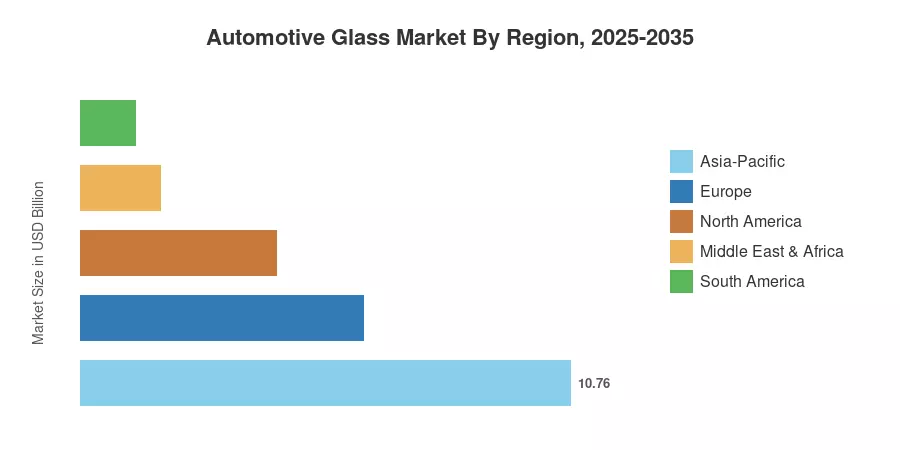
Asia-Pacific commands approximately 45% of Automotive Glass Market revenue, driven by China and India's combined output of over 35 million passenger vehicles annually [4]. The Middle East & Africa region, while smaller in absolute terms, is forecast to record the highest CAGR at roughly 7.3% through 2035, propelled by assembly-plant investments in Saudi Arabia and Morocco. Europe holds the second-largest share at around 26%, underpinned by premium-vehicle demand and strict CO₂ standards that favor lightweight glazing solutions. The decade ahead will reward suppliers that can scale advanced coatings and integrate digital functionality into every pane.


Key Report Takeaways

• By Glass Type

  • Regular glass accounted for roughly 87% of the Automotive Glass Market in 2025, reflecting continued dominance of conventional float and tempered products across mass-market vehicles.
  • Smart glass is anticipated to expand at approximately 13.1% CAGR through 2035, fueled by electrochromic and suspended-particle-device adoption in premium cabins.

• By Application

  • Windshields captured the largest application share within the Automotive Glass Market, representing close to 47% of 2025 revenue.


• By Vehicle Type

  • Windshields captured the largest application share within the Automotive Glass Market, representing close to 47% of 2025 revenue.
  • Light commercial vehicles are forecast to post the fastest segment CAGR at around 7.1%, driven by last-mile delivery fleet expansion.

• By Region

  • Asia-Pacific remained the dominant regional contributor to the Automotive Glass Market, while the Middle East & Africa is set to record the highest growth rate through 2035.
  • North America contributed approximately 18% of global revenue in 2025, supported by strong replacement-glass demand and SUV-heavy production mixes.


Market Size and Forecast (2021–2035)

Market Research Future's sizing framework triangulates top-down OEM production data from OICA with bottom-up glass-shipment volumes reported by leading producers, cross-validated against trade-flow databases and proprietary channel surveys.
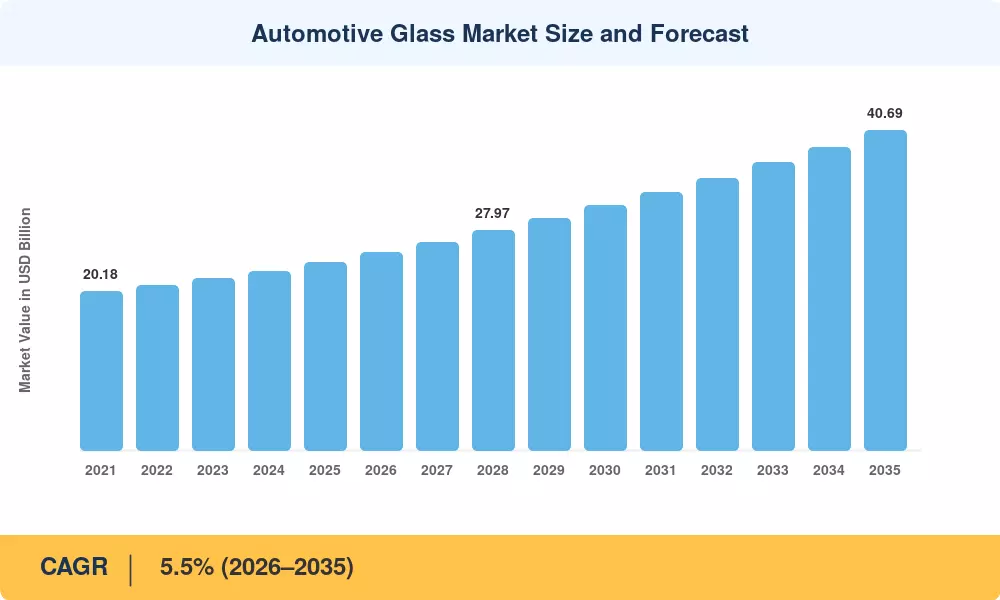
Automotive Glass Market Size and Forecast
Our Impact
Enabled $4.3B Revenue Impact for Fortune 500 and Leading Multinationals
Partnering with 2000+ Global Organizations Each Year
30K+ Citations by Top-Tier Firms in the Industry

Driver Impact Analysis

Driver ~% Impact on CAGR Geographic Relevance Impact Timeline
Rising global vehicle production +1.4 Global Long-term
EV and panoramic-roof penetration +1.2 China, Europe, North America Medium-term
Stricter safety glazing regulations +0.9 Europe, India Short-term
ADAS windshield integration +0.8 North America, Europe, Japan Medium-term
Lightweight glass for CO₂ reduction +0.6 Europe, Japan Long-term
Aftermarket replacement demand +0.4 Global Long-term
Smart-glass adoption in premium segment +0.3 North America, Europe Medium-term


Rising Global Vehicle Production

Every vehicle requires four to seven pieces of shaped glass, making output volumes the single largest determinant of Automotive Glass Market demand. India's production-linked incentive scheme for auto components, worth INR 26,058 crore (~USD 3.1 billion), is actively pulling new glass-manufacturing capacity into the subcontinent [7].

EV and Panoramic-Roof Penetration

Battery-electric vehicles consumed roughly 28% more per unit than comparable ICE models — because of expansive roof glazing and flush-mounted side windows [3]. Tesla's single-piece panoramic roof design, now emulated by at least 15 Chinese OEMs, has shifted supplier product mixes toward larger, thinner laminated panels.

Stricter Safety Glazing Regulations

Evolving international vehicle safety frameworks—such as UNECE Regulation 43 for safety glazing performance and Bharat NCAP crashworthiness protocols—require high-penetration-resistance laminated windshields and toughened side glazing across passenger car models, supporting regulatory compliance spending.

ADAS Windshield Integration

Over 60% of new vehicles produced in Europe and North America are now equipped with forward-facing cameras for lane-keeping and autonomous-emergency-braking systems installed behind the windshield [9]. Each ADAS-ready windshield costs 25-40% more than a normal unit, which adds significant value uplift to each piece supplied.


Restraints Impact Analysis

Restraint ~% Impact on CAGR Geographic Relevance Impact Timeline
Raw-material and energy cost volatility –0.6 Global Short-term
Semiconductor-led vehicle production disruptions –0.4 Global Short-term
Recycling and end-of-life complexity for laminated glass –0.3 Europe Medium-term
Price competition from low-cost Asian producers –0.3 North America, Europe Long-term
Supply-chain concentration risk (soda-ash sourcing) –0.2 Global Medium-term


Raw-Material and Energy Cost Volatility

Soda ash, silica sand, and natural gas account for roughly 55% of flat-glass production costs [12]. European natural-gas prices spiked over 300% between 2021 and 2022, compressing margins for continental float-glass plants. While prices have moderated, the Automotive Glass Market remains exposed to energy-market swings

Recycling Complexity for Laminated Products

The polyvinyl butyral interlayer that gives laminated windshields their safety properties also makes them difficult to recycle. The EU's revised End-of-Life Vehicles Regulation (proposed 2023) sets an 85% material-recovery target by 2030 [13]. Compliance will require new delamination technologies.


Automotive Glass Market Opportunities

Smart Glazing for Electric and Autonomous Vehicles

Electrochromic and SPD smart glass technologies dynamically modulate solar heat gain and visible light transmission, lowering cabin thermal buildup and reducing HVAC energy demand in electric vehicles. As BEV adoption expands globally, solar-control smart glazing and variable-tint panoramic roofs allow Tier-1 glass manufacturers to capture significantly higher content and revenue per vehicle.

Aftermarket Windshield Replacement in Emerging Markets

Aging vehicle fleets in South-East Asia, South America and Africa – where the average vehicle age is over 12 years [10] – represent a rising aftermarket potential. Replacement windshields require recalibration as well, increasing per-unit service revenue with more ADAS adoption. This dynamic helps fuel the Automotive Glass Market in regions where new-car sales alone could not support strong growth.


Lightweight Thin-Glass Technologies

For traditional cars, tempered glass panes are replaced by Corning’s Gorilla Glass for Automotive and AGC’s Leoflex, which are 30–50 % lighter [15]. The regulatory squeeze is coming post-2030, and OEMs chasing CO2 fleet-average targets are looking at thin-glass for side and rear windows, which is a volume opportunity.


Head-Up-Display Wedge Windshields

Vehicles equipped with Head-Up Displays (HUD) and Augmented Reality (AR-HUD) systems require precision-engineered windshields incorporating angled wedge PVB interlayers to eliminate ghosting and dual-imaging distortion. As HUD technology filters from luxury vehicles into mass-market automotive platforms, high-optical-clarity wedge windshields represent a rapidly expanding, premium-value segment within the automotive safety glazing market.

Data-Enabled Glass and Embedded-Antenna Monetization

5G-transparent, antenna-integrated windshields provide connected-vehicle capability – from V2X communication to over-the-air updates – without the need for separate antenna pods. Embedded-glass antennas are becoming a platform enabler for OEMs exploring software-defined vehicle architectures, bringing up recurring-revenue opportunities as telecom-tier partners co-develop with glass suppliers.


Automotive Glass Market Future Outlook

Electrification Supercycle and Glazing-Area Expansion

Electric platforms eliminate engine-bay constraints; designers are enlarging cabin glass surfaces — roof panels on several Chinese EVs already exceed 1.8 m² — translating into a structurally higher glass-content-per-vehicle ratio that will sustain the Automotive Glass Market above historical growth trends.

Autonomous-Vehicle Sensor Integration

SAE Level 3 and Level 4 vehicles require optically precise windshield zones for LiDAR and camera pass-through. Glass manufacturers investing in wavefront-controlled laminates and anti-reflective coatings are positioning themselves to capture premium content on these platforms.

Sustainability and Circular-Economy Pressures

Suppliers developing closed-loop cullet-recovery systems will secure regulatory compliance and cost advantages. AGC and Saint-Gobain have each announced pilot delamination plants in Belgium and France, signalling that the Automotive Glass Market's sustainability transition is already under way.

Digital-Glass Platforms and Software-Defined Vehicles

As automakers move to software-defined architectures, glazing becomes a functional surface: housing 5G antennas, photovoltaic interlayers, and dynamic-tint controls that are updated over the air. This platform potential turns a commodity component into a recurring revenue enabler and will significantly reshape the value chain of the Automotive Glass Market over the next decade [20].


Automotive Glass Market Segmentation

By Glass Type

Segment Key Metric Primary Demand Driver
Regular Glass ~87% share (2025) Volume demand across mass-market ICE and EV models
Smart Glass ~13.1% CAGR (2026–2035) Premium-cabin electrochromic and SPD adoption


Regular glass — encompassing float, tempered, and laminated variants — continues to serve the vast majority of the Automotive Glass Market. Its dominance reflects the cost sensitivity of mass-market OEMs, where a standard windshield costs USD 80–150 versus USD 400–900 for a smart-glass equivalent. That said, smart glass is gaining ground as production scales, lowering unit costs. Electrochromic sunroofs, already standard on several Maybach and BMW models, are migrating to mid-tier vehicles as Chinese suppliers like Fuyao and Benxi Glass enter the segment with competitively priced offerings.

By Application

Segment Key Metric Primary Demand Driver
Windshield ~47% share (2025) Safety regulation, ADAS integration
Sidelite USD 5.50 Billion (2025) Flush-glass design trend in EVs
Backlite 4.8% CAGR Antenna-embedded rear windows
Sunroof ~8.9% CAGR (2026–2035) Panoramic-roof popularity in SUVs and EVs


Windshields anchor the Automotive Glass Market by application because every vehicle requires at least one, and ADAS-camera integration is lifting per-unit value. Sunroofs are the fastest-growing application, riding the panoramic-roof trend that has become a near-standard feature in Chinese NEVs and European premium SUVs.

By Vehicle Type

Segment Key Metric Primary Demand Driver
Passenger Cars ~67% share (2025) Largest production volume globally
Light Commercial Vehicles ~7.1% CAGR (2026–2035) Last-mile delivery fleet expansion
Heavy Commercial Vehicles USD 2.87 Billion (2025) Truck replacement cycles, safety upgrades


Passenger cars dominate the Automotive Glass Market by vehicle type, consistent with global production ratios. Light commercial vehicles represent the fastest-growing segment as e-commerce-driven delivery fleet purchases accelerate, particularly in China, India, and Western Europe.

By Propulsion

Segment Key Metric Primary Demand Driver
Internal Combustion Engine ~82% share (2025) Installed production-base inertia
Battery Electric Vehicle ~17.8% CAGR (2026–2035) Government mandates, OEM platform launches
Plug-in Hybrid / Other USD 1.43 Billion (2025) Transitional powertrain adoption


ICE vehicles still constitute the bulk of the Automotive Glass Market by propulsion, yet BEVs are reshaping supplier strategies. Each BEV typically uses 15–28% more glass area than an equivalent ICE model, and the price premium per square metre of BEV glazing — driven by acoustic and thermal specifications — is lifting revenue faster than unit growth alone would suggest.

By Sales Channel

Segment Key Metric Primary Demand Driver
OEM ~83% share (2025) New-vehicle production volumes
Aftermarket ~4.9% CAGR (2026–2035) Fleet aging, ADAS windshield recalibration


OEM sales dominate the Automotive Glass Market because glass is specified during vehicle design and procured through long-term supply contracts. The aftermarket channel, while smaller, is growing steadily as more vehicles on the road feature ADAS windshields that must be replaced with OEM-equivalent parts and professionally recalibrated.


Regional Market Share Analysis

Region Key Metric Primary Investment Themes
Asia-Pacific ~45% share (2025) Mass EV production, float-glass capacity expansion
Europe ~26% share (2025) Premium OEM specs, CO₂-driven lightweighting
North America ~18% share (2025) SUV/truck glazing, ADAS recalibration services
South America ~5% share (2025) CKD assembly growth, aftermarket replacement
Middle East & Africa ~7.3% CAGR (2026–2035) New assembly plants, import substitution
Total USD 23.91 Billion (2025)

The Automotive Glass Market spans five core regions, each shaped by distinct production ecosystems and regulatory frameworks.


North America

Country Key Metric Key Driver
United States ~72% of regional revenue Light-truck & SUV production dominance
Canada 5.6% CAGR EV assembly investments in Ontario
Mexico USD 1.12 Billion (2025) Near-shoring of OEM assembly capacity


The North American Automotive Glass Market benefits from a production mix tilted heavily toward full-size SUVs and pick-up trucks, which use 20–30% more glazing area than sedans. The U.S. Inflation Reduction Act's EV-assembly incentives have triggered three new battery-electric truck programmes in Michigan and Tennessee [16], each requiring ADAS-calibrated windshield supply chains.

Europe

Country Key Metric Key Driver
Germany ~24% of regional share Premium OEM headquarters; high-value glazing specs
United Kingdom 4.9% CAGR EV transition strategy and Gigafactory pipeline
France USD 1.08 Billion (2025) Renault-Stellantis EV platforms
Italy ~11% of regional share Luxury and sports-vehicle glazing demand
Spain 5.2% CAGR Export-oriented assembly plants
Nordic Countries USD 0.41 Billion (2025) Volvo EV model roll-out
Russia ~6% of regional share Import-substitution policies
Rest of Europe 4.7% CAGR Eastern European assembly expansion


Europe's Automotive Glass Market is shaped by the EU's CO₂ fleet-average regime, which drops to 50 g/km by 2030 for new passenger cars [8]. This forces OEMs toward thinner, coated glazing that cuts vehicle mass while maintaining acoustic and thermal performance. Saint-Gobain Sekurit and AGC Europe operate the region's largest float-glass furnaces, giving them proximity advantages for just-in-sequence OEM delivery.

Asia-Pacific

Country Key Metric Key Driver
China ~52% of regional share World's largest auto market; Fuyao dominance
India 8.2% CAGR Bharat NCAP adoption, production-linked incentives
Japan USD 1.74 Billion (2025) Technology leadership in thin-glass R&D
South Korea ~9% of regional share Hyundai-Kia global platform demand
ASEAN 7.0% CAGR New assembly hubs in Indonesia, Thailand
Rest of Asia-Pacific USD 0.68 Billion (2025) Emerging markets ramp-up


Asia-Pacific dominates the Automotive Glass Market thanks to China's annual passenger-vehicle output exceeding 26 million units and India's rapid motorisation trajectory [4]. Fuyao Glass supplies roughly one in three windshields produced globally and continues to expand capacity in Fuqing and Changchun. India's production-linked incentive scheme has attracted at least three new float-glass lines scheduled for commissioning before 2027 [7].

South America

Country Key Metric Key Driver
Brazil ~63% of regional share Largest regional vehicle market; flex-fuel production
Argentina 5.1% CAGR Mercosur trade dynamics
Rest of South America USD 0.22 Billion (2025) CKD import and aftermarket channels


Brazil anchors the South American Automotive Glass Market through an installed production base of roughly 2.3 million vehicles per year, with Stellantis, Volkswagen, and Toyota all operating major assembly complexes in São Paulo state. Aftermarket replacement glass constitutes a higher share of revenue here than in any other region, reflecting an average fleet age exceeding 10 years [10].

Middle East & Africa

Country Key Metric Key Driver
Saudi Arabia ~28% of regional share Vision 2030 automotive cluster investments
UAE 6.9% CAGR Trade-hub role, luxury-vehicle import volume
South Africa USD 0.31 Billion (2025) Established OEM assembly (BMW, Toyota)
Egypt 7.5% CAGR Domestic assembly incentives
Rest of MEA ~22% of regional share Aftermarket-led demand


The Middle East & Africa is the fastest-growing region for the Automotive Glass Market, propelled by Saudi Arabia's Lucid Motors plant in King Abdullah Economic City and Morocco's emergence as a European-supply export base with over 700,000 vehicles assembled annually [17]. Import-substitution policies in Egypt and Nigeria are also creating greenfield glass-processing opportunities.


Automotive Glass Market By Region, 2025-2035

Competitive Benchmarking

The Automotive Glass Market exhibits medium concentration, with an estimated top-five share of 55–62%. The Herfindahl-Hirschman Index falls in the 900–1,200 range, indicating a moderately competitive structure where a handful of global float-glass producers compete alongside regional specialists and new entrants from the smart-glass domain.

Company Est. Revenue Share Range Key Offerings Strategic Positioning
AGC Inc. ~12–16% Laminated windshields, coated glass, thin-glass (Leoflex) Global OEM Tier-1; strong in Europe and Japan
Fuyao Glass Industry Group ~14–18% Full-range automotive glazing, HUD windshields Cost leader; largest single-company global capacity
Saint-Gobain (Sekurit) ~10–14% Acoustic windshields, solar-control glazing Premium OEM partner; integrated float-glass supply
NSG Group (Pilkington) ~7–10% Laminated and tempered products, self-cleaning coatings Strong aftermarket presence; Japan/Europe focus
Xinyi Glass Holdings ~5–8% Float glass, tempered sidelites Vertically integrated; fast-growing China base
Central Glass Co. ~3–5% Specialty automotive glass, chemical interlayers Niche technology focus; Japan-centric
Vitro S.A.B. ~3–5% OEM and aftermarket windshields Leading supplier in North America / South America
Webasto Group ~2–4% Panoramic sunroofs, convertible roof systems System integrator for roof glazing
Gentex Corporation ~2–4% Auto-dimming mirrors, dimmable glass panels Technology leader in electrochromic mirrors
Corning Incorporated ~1–3% Gorilla Glass for Automotive, thin lightweight panes Materials-science innovator entering automotive
Guardian Industries ~2–4% Float glass, coated products Broad glass portfolio; Koch Industries backing


Recent News & Developments


  • AGC Inc. (May 2024): AGC Inc. expanded its production of advanced automotive glazing technologies, increasing capacity for head-up display (HUD) wedge windshields, electromagnetic-wave transparent coatings, and electrochromic smart glass to support software-defined and electric vehicle architectures.
  • Saint-Gobain Sekurit (February 2024): Saint-Gobain Sekurit advanced its North American supply chain footprint, expanding output of high-precision acoustic laminated glass and ADAS sensor-ready windshield assemblies to meet rising OEM demand across electric and hybrid vehicle assembly lines.
  • Corning Incorporated (June 2024): Expanded Gorilla Glass Automotive qualification to five new EV platforms in China and Europe, covering sidelite and rear-window applications [15].


  • NSG Group (October 2024): NSG Group showcased its next-generation Pilkington Optilam ADAS windshield platforms and advanced camera calibration solutions at Auto Glass Week, strengthening its supply of sensor-compatible and HUD-integrated safety glass to global automakers.


Automotive Glass Market Report Scope

Parameter Detail
Market Scope Global Automotive Glass Market — value-based sizing
Study Period 2021–2035
CAGR (Forecast) 5.5% (2026–2035)
Market Size — Base Year (2025) USD 23.91 Billion
Market Size — Forecast End (2035) USD 40.69 Billion
Fastest Growing Segment Smart Glass (by glass type); BEV (by propulsion)
Companies Profiled 11 (see Section 10)
Valuation Currency USD Billion

FAQs

What total cost of ownership factors should fleet buyers consider when specifying ADAS windshields?
ADAS windshields require professional recalibration after every replacement, adding USD 150–350 per event [9]. Fleet managers should budget for both higher glass unit costs and mandatory sensor realignment to avoid unexpected maintenance spend.
How does float-glass furnace lifespan affect supplier switching for OEM procurement teams?
Float furnaces operate continuously for 12–18 years before rebuild, locking capacity commitments [12]. Procurement teams should evaluate a supplier's furnace-age profile to gauge mid-contract supply continuity risk.
Which coating technologies offer the best trade-off between solar heat rejection and 5G signal transparency?
Metallic-sputtered coatings provide high solar heat rejection but degrade 5G and RF signal transmission; non-metallic nano-ceramic coatings offer effective infrared heat blockage while maintaining full electromagnetic permeability for connected vehicles.
How are insurance regulations influencing the Automotive Glass Market's aftermarket channel?
Rising ADAS penetration requires post-replacement sensor recalibration across aftermarket glass repairs, encouraging insurers and fleet operators to specify high-precision, calibration-ready replacement windshields.
What role does polyvinyl butyral interlayer sourcing play in supply-chain risk?
Three producers — Eastman, Kuraray, and Sekisui — control over 75% of global PVB interlayer capacity [12]. A disruption at any single plant can cascade into windshield production delays within weeks across multiple continents.
How can Tier-2 glass processors compete against vertically integrated global suppliers?
Regional processors can differentiate through rapid turnaround on low-volume specialty shapes and by offering recalibration services alongside replacement glass [10]. Proximity to aftermarket distribution networks provides a logistics edge that global players struggle to match.
What testing certifications do glass suppliers need for entry into the Japanese OEM supply chain?
Japanese OEMs typically require JIS R 3211 compliance, IATF 16949 quality-system certification, and a minimum two-year qualification cycle including climate-durability and optical-distortion testing [1]. Meeting these thresholds demands significant upfront investment.    
Author
Author
Author Profile
Chitranshi Jaiswal LinkedIn
Team Lead - Research
Chitranshi is a Team Leader in the Chemicals & Materials (CnM) and Energy & Power (EnP) domains, with 6+ years of experience in market research. She leads and mentors teams to deliver cross-domain projects that equip clients with actionable insights and growth strategies. She is skilled in market estimation, forecasting, competitive benchmarking, and both primary & secondary research, enabling her to turn complex data into decision-ready insights. An engineer and MBA professional, she combines technical expertise with strategic acumen to solve dynamic market challenges. Chitranshi has successfully managed projects that support market entry, investment planning, and competitive positioning, while building strong client relationships. Certified in Advanced Excel & Power BI she leverages data-driven approaches to ensure accuracy, clarity, and impactful outcomes.
Co-Author
Co-Author Profile
Priya Nagrale LinkedIn
Senior Research Analyst
With an experience of over five years in market research industry (Chemicals & Materials domain), I gather and analyze market data from diverse sources to produce results, which are then presented back to a client. Also, provide recommendations based on the findings. As a Senior Research Analyst, I perform quality checks (QC) for market estimations, QC for reports, and handle queries and work extensively on client customizations. Also, handle the responsibilities of client proposals, report planning, report finalization, and execution

Research Approach


Secondary Research

The secondary research process involved comprehensive analysis of regulatory databases, automotive safety standards, industry production statistics, and technical publications. Key sources included the National Highway Traffic Safety Administration (NHTSA), US Environmental Protection Agency (EPA) Federal Register, US Department of Transportation (DOT) Federal Motor Vehicle Safety Standards (FMVSS), European Automotive Manufacturers Association (ACEA), European Commission DG MOVE (Mobility & Transport), Euro NCAP (European New Car Assessment Programme), International Organization of Motor Vehicle Manufacturers (OICA) Production Statistics, Japan Automobile Manufacturers Association (JAMA), China Association of Automobile Manufacturers (CAAM), Society of Indian Automobile Manufacturers (SIAM), Glass Association of North America (GANA), Auto Glass Safety Council (AGSC), British Glass Association, Glass for Europe, SAE International Technical Papers, ASTM International Standards, Insurance Institute for Highway Safety (IIHS), International Code Council (ICC), Organisation for Economic Co-operation and Development (OECD) Transport Division, and national transportation ministry reports from key automotive markets. These sources were used to collect vehicle production data, safety regulation compliance requirements, glass performance standards, lightweight material adoption trends, and market landscape analysis for tempered glass, laminated glass, smart glass technologies, and application-specific demand across windscreens, sidelites, backlites, and sunroofs.


Primary Research

To gather both qualitative and quantitative information, the primary research process involved interviewing players from both the supply and demand sides. Members of the supply side included top executives from automotive glass manufacturers (such as Saint-Gobain, AGC Inc., NSG Group, Fuyao Glass, and Xinyi Glass) and Tier 1 suppliers, as well as heads of product innovation, research and development, and regulatory compliance. Procurement managers at OEMs, vehicle designers, quality assurance directors at automakers (both commercial and passenger), fleet managers, and aftermarket distributors made up the demand side.

Primary Respondent Breakdown:

By Designation: C-level Primaries (28%), Director Level (33%), Others (39%)

By Region: North America (32%), Europe (30%), Asia-Pacific (28%), Rest of World (10%)


Market Size Estimation

Global market valuation was derived through revenue mapping and vehicle production volume analysis. The methodology included:

Identification of 40+ key manufacturers across North America, Europe, Asia-Pacific, Latin America, and Middle East & Africa

Product mapping across tempered glass, laminated glass, smart glass/acoustic glass categories

Application-based segmentation across windscreens, sidelites, backlites, and sunroofs by vehicle type (passenger cars, light commercial vehicles, heavy commercial vehicles)

Analysis of reported and modeled annual revenues specific to automotive glass portfolios

Coverage of manufacturers representing 65-70% of global market share in 2024

Extrapolation using bottom-up (vehicle production volumes × glass content per vehicle × ASP by region/application) and top-down (manufacturer revenue validation) approaches to derive segment-specific valuations for OEM and aftermarket channels

Download Free Sample

Kindly complete the form below to receive a free sample of this Report

* Please use a valid business email

Download PDF ×

We do not share your information with anyone. However, we may send you emails based on your report interest from time to time. You may contact us at any time to opt-out.